I used to spend Monday mornings checking numbers across four different ad platforms before deciding where to put our advertising budget. Now, an agent checks those numbers every hour and moves the budget automatically, reducing spend on underperforming campaigns and increasing it on better-performing ones.
That shift, from manual dashboard monitoring to software taking action based on what it finds, is what separates an AI agent from other AI tools in my stack.
An AI marketing agent takes a goal, determines the steps needed, and acts on them, whether that is adjusting a bid, drafting a follow-up, or flagging a churn risk. Unlike a chatbot that answers questions or an automation that follows a sequence, an agent doesn’t need approval at every step.
Below are ten jobs marketers are already handing to agents, sorted by the job rather than the vendor, each with a tool that does it today.
By the end, you’ll know which tasks are realistic to hand to AI agents for marketing, with a human in the loop, and how to get started without overcommitting to unproven technology.
What Are AI Agents for Marketing?
An AI agent for marketing is a system given a specific goal that can assess results, decide its next step, and take action without waiting for manual approval at each step. An agent runs on much the same underlying model as an assistant or a workflow tool. The difference is that it can act on its own.
“AI for marketing” covers three distinct categories of tools, and they don’t work the same way.
Most marketing teams already use the first two. The third is newer, and it carries more risk along with more upside. An agent that picks the wrong winning campaign spends real money on that mistake before anyone reviews it.
If the underlying technology is new to you, start with generative AI tools and come back.
How AI Marketing Agents Work
Regardless of the marketing task, every agent follows the same basic loop: it observes new information, decides what to do based on that context, takes action through a connected tool, and checks whether the result moves it closer to its goal.
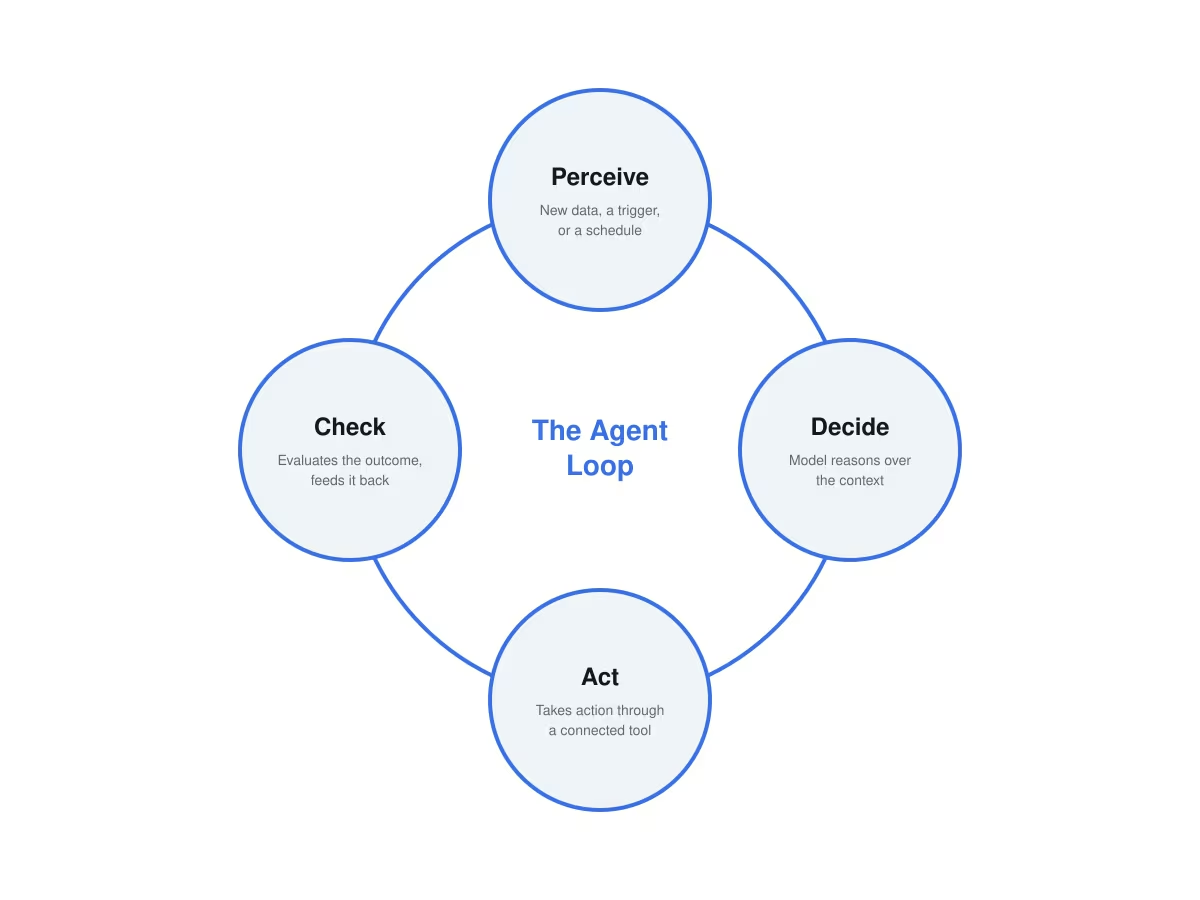
The “perceive” step: the agent needs access to current data, which means a live connection to your CRM, ad platform, email tool, or analytics dashboard.
The “decide” step: the underlying model interprets the data and chooses an action. This is also where guardrails matter most, since a model reasoning badly with system access can act on a bad conclusion just as quickly as a good one.
The “act” step: the agent takes the action itself, whether that means submitting a form, changing a budget, or sending an instruction straight to another tool it’s connected to. This is what distinguishes an agent from a chatbot or basic AI assistant.
The “check” step: the agent evaluates the outcome and uses what it learns to inform its next decision. A basic agent checks once and stops, while a more capable one keeps adjusting over many cycles without a person restarting it each time.
10 AI Agent Use Cases in Marketing
These are the marketing tasks teams are already handing to AI agents, organized by function. Each one includes a real example to show how the use case works in practice.
1. Content Creation and Repurposing
What it handles: turning one piece of content into the formats a campaign needs: a blog post into a LinkedIn thread, a webinar into three short clips, or a case study into an email sequence. A person doesn't have to adapt each version by hand.
A content agent watching a publishing calendar can pull a newly published article, draft versions for LinkedIn, X, and an email newsletter, and queue them for review, cutting the time between publishing once and distributing everywhere from days to hours.
HubSpot’s Breeze Content Agent generates these on-brand drafts from content you’ve already published, so nobody starts at a blank prompt.
2. SEO Research and Technical Optimization
What it handles: continuously auditing a site’s technical SEO health, tracking ranking movement, and surfacing content gaps against competitors; work that used to mean a weekly manual crawl.
Point an SEO agent at your site, and it crawls daily, flags a ranking drop, names the likely cause, and drafts the fix before anyone notices.
Surfer SEO content agents and Gumloop SEO audit workflows run this monitoring daily, so a problem surfaces the week it starts.
3. Paid Ad Campaign Optimization
What it handles: reallocating budget across campaigns, ad sets, and channels based on real-time performance, the exact task that opened this article.
This is the one I run myself. My ad agent moves spend between Google Ads and Meta every hour, pauses variants that stop converting, and writes new copy to test, all inside a daily cap I set once.
Smartly.io and AdCreative.ai’s agents do this kind of budget reallocation today, both with daily spend limits you set before the agent starts moving money.
4. Customer Segmentation and Personalization
What it handles: grouping customers by real behavior rather than static demographic fields, and adjusting what each segment sees without a marketer rebuilding the segment manually every quarter.
Say a visitor browses the same product category twice and buys nothing. A personalization agent spots that they behave differently from a first-timer and moves them into a different email flow, or shows them a more relevant offer.
Klaviyo’s K:AI Marketing Agent builds and adjusts these flows from customer and website data directly, inside the ecommerce stack most of its users already run.
5. Lead Scoring and Qualification
What it handles: reading behavioral and firmographic signals to rank which leads deserve a rep’s time this morning, and re-ranking them as new signals arrive.
A lead visits a pricing page three times in a week, and a lead-scoring agent watching CRM activity bumps their score and triggers an alert to the assigned rep.
Salesforce Agentforce does this same signal-based scoring natively, and Relevance AI lets teams build the same kind of signal-based scoring for CRMs where a native option doesn’t exist.
6. Email and Lifecycle Marketing
What it handles: building and adjusting the sequence of emails a customer receives, such as welcome series, abandoned cart, and post-purchase emails, based on each customer's specific behavior.
A lifecycle agent notices a customer who opened three emails and clicked none of them, then changes the subject line or the send time for that person alone.
Klaviyo and Braze both run agent-assisted lifecycle flows now, a step beyond the rule-based drip campaigns most email tools shipped just two years ago.
7. Social Media Management
What it handles: drafting, scheduling, and adjusting social content based on what’s performing, plus monitoring mentions and trends the moment they surface.
A social agent can track which post format is getting engagement this week, adjust the draft queue to lean into that format, and flag a spike in brand mentions that might need a human response before it becomes a bigger conversation.
HubSpot’s Breeze Social Agent and Gumloop-built workflows handle the monitoring and the drafting together, which is the combination scheduling tools miss.
8. Prospecting and Conversational Agents
What it handles: qualifying inbound leads or researching outbound prospects through a conversation, and handing off to a human only once the conversation reaches a point that needs one.
A prospecting agent can research a company that filled out a demo request, pull relevant firmographic and intent data, and draft a personalized outreach note before a rep even opens the lead. That work used to take a sales development rep real time to piece together by hand.
Salesforce Agentforce’s engagement agent runs this workflow, drawing on CRM data to personalize the first outreach.
9. Competitive and Market Research
What it handles: continuously tracking competitor pricing, messaging, and content moves as they happen.
Set a research agent loose on a competitor’s website and ad library, and it flags what changed, whether that’s a new pricing page or a different homepage headline, and delivers the summary before the team’s next planning meeting.
Unlike ad optimization or email marketing, competitive and market research is a more fragmented category, with tools differing in sources, workflow, and types of intelligence. Klue’s Compete Agent and Crayon’s Sparks are two examples of agents that can perform this use case.
10. Reporting and Analytics Synthesis
What it handles: pulling performance data from every platform into one summary and naming the two or three numbers that actually moved.
Ask a reporting agent for last week’s numbers, and it pulls them from Google Analytics and writes a plain-language summary of what changed and why.
This is one of the use cases general-purpose tools handle well: Claude or a similar model, connected to your data sources, can synthesize this kind of cross-platform summary without a dedicated reporting agent.
AI Marketing Agents Compared
Twelve of the tools, side by side. Custom-priced tools list what a typical entry deployment runs, since four of the tools don’t publish a public rate.
What AI Marketing Agents Cost
Prices in the table above range from $19 a month to a six-figure annual contract, and the gap tells you something: cost tracks how much of your stack the agent has to touch.
- Bolt-on agents inside a tool you already pay for: Klaviyo Composer and Relevance AI's Pro tier sit in the $19 to $49 a month range because they work inside data you've already connected. HubSpot Breeze costs more. Its Content Agent is bundled into the Professional plan at $890/mo ($800/mo billed annually), not a standalone low-cost add-on.
- Usage-priced agents: Salesforce Agentforce charges $2 per conversation, and Emergent's $20-a-month plan includes 100 build credits, so the bill scales with how much you actually run.
- Enterprise platforms with agents attached: Smartly.io, Braze, Klue, and Crayon don't publish self-serve pricing at all. Entry deployments start around $15,000 to $60,000 a year, and the agent features come bundled into that single contract.
The practical takeaway: start with whichever category matches your current stack. If you already run HubSpot, Klaviyo, or Salesforce, the agent is usually a cheap add-on before it's anything else. If you don't, the platform itself is the real cost, and the agent becomes one more reason to pick that platform over another.
Levels of AI Agent Autonomy in Marketing
Agents differ most in how much human approval they need before they can act, and that matters more than who built them.
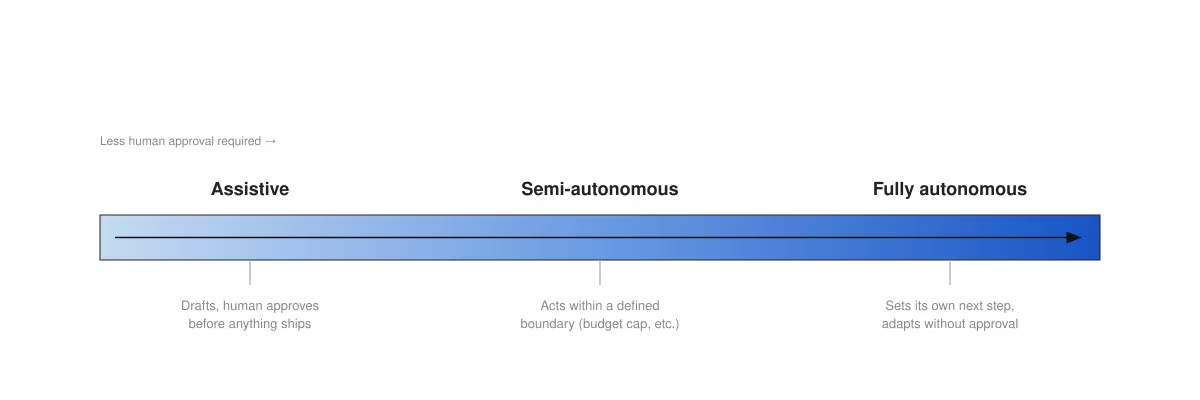
Most marketing teams should start with assistive or semi-autonomous agents rather than fully autonomous ones.
Public trust is still thin: in a YouGov survey of 1,187 Americans, fewer than one in five (18%) said they would trust an AI system to make a decision or take an action, even somewhat. That matters most for any agent whose output a customer sees directly, like a personalized email or a chat reply, so keep a person reviewing those before they ship.
Why Marketing Teams Are Adopting AI Agents Now
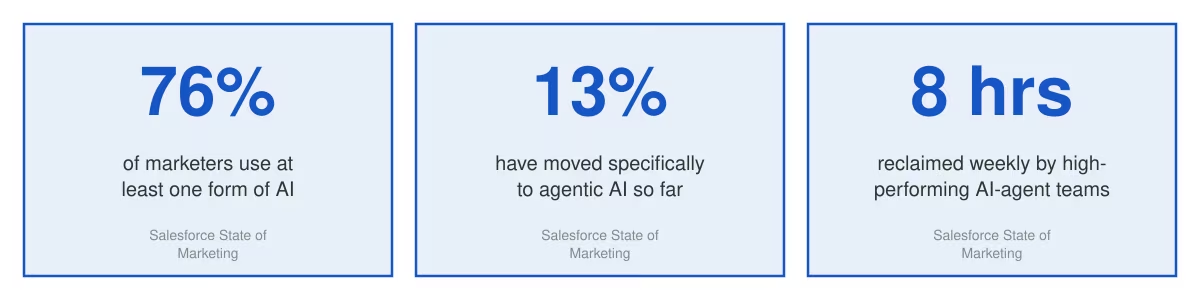
Marketing teams are adopting AI for practical reasons. In Salesforce’s 10th Edition State of Marketing Report, a survey of 4,450 marketers, 75% said they use at least one form of AI, but only 13% have adopted agentic AI.
That gap points to a significant opportunity. The same survey found that using AI agents frees up 6 to 7 hours a week of manual execution work, time that can be redirected toward strategic and creative work. It also found the highest-performing marketing teams are nearly twice as likely to be using AI agents as underperformers.
- Execution speed: an agent checking campaign performance hourly catches a losing ad set faster than a weekly review ever could.
- Personalization at a scale humans can’t match: adjusting a lifecycle flow based on each customer’s specific behavior is impractical across thousands of customers, but it’s exactly what an agent is built for.
- Recovered time on repetitive work: reclaimed hours shift toward the strategic and creative work an agent can’t do.
Managing several client accounts? The best AI tools for marketing agencies cover the tools built specifically for agency workflows.
The Risks and Limits of AI Agents in Marketing
The rapid adoption of AI agents doesn’t mean they’re ready to run marketing operations without oversight.
McKinsey’s 2026 State of AI survey found that the share of organizations scaling AI agents in one or more functions jumped from 27% to 40% in a year, though adoption at smaller organizations stayed flat at 22%. Scaling is accelerating at the top end and stalling everywhere else, which is the gap most teams are still sitting in.
Budget can move faster than judgment. A fully autonomous ad-spend agent without a cap will reallocate budget toward whatever signal looks best in the moment, even if that signal is noise. I capped mine on day one, and I’d do it again before letting any agent touch a budget.
Brand voice can drift without review. Even an agent trained on your brand guidelines can produce off-brand content, especially in unfamiliar formats. For the first few weeks, review its output before publishing rather than letting it go live immediately.
Personalization can cross into unsettling. When an agent references a customer’s exact browsing history in an email, it can be seen as either helpful or invasive, depending on the customer. Test messaging with a small audience before rolling out a new personalization approach more broadly.
General-purpose models can confidently generate wrong numbers. Ask a model without a live data connection for a specific campaign statistic, and it can produce something plausible-sounding but incorrect. Any agent-generated number that influences a decision needs a verifiable source.
How to Start Using AI Agents on Your Marketing Team
Most failed agent rollouts share the same root cause: the team automated a process that wasn’t clearly defined in the first place. An agent amplifies whatever process you hand it, including a bad one.
- Audit before you automate: write down the exact steps of the task you’re considering handing to an agent. If you can’t describe it precisely, an agent won’t reliably execute it either.
- Pick one narrow use case first: a single lifecycle email flow or the ad optimization for one campaign, rather than “marketing automation” broadly. A clearly defined, narrow scope makes it possible to judge whether it worked.
- Set the approval boundary explicitly: decide upfront what the agent can do without asking and what needs a human sign-off, matching autonomy levels to how much trust the task has earned.
- Measure against your manual baseline: track whichever metric mattered before the agent, such as conversion rate, response time, or cost per lead. Give it a few weeks before you call it a win.
Agents aren’t the only AI worth your time, and these AI productivity tools sit alongside one comfortably.
Building a Custom AI Marketing Agent
The use cases above assume there is already a tool for your specific workflow. But sometimes there isn’t. Your reporting format is unusual, your lead-scoring logic is specific to your business, or you want one agent doing a job that’s currently split across three disconnected tools.
Emergent lets you build a custom AI agent from a plain-language description rather than a no-code canvas. Describe the workflow, for example an agent that pulls weekly performance from your specific ad accounts and emails a formatted summary to your team, and it builds a working app around it.
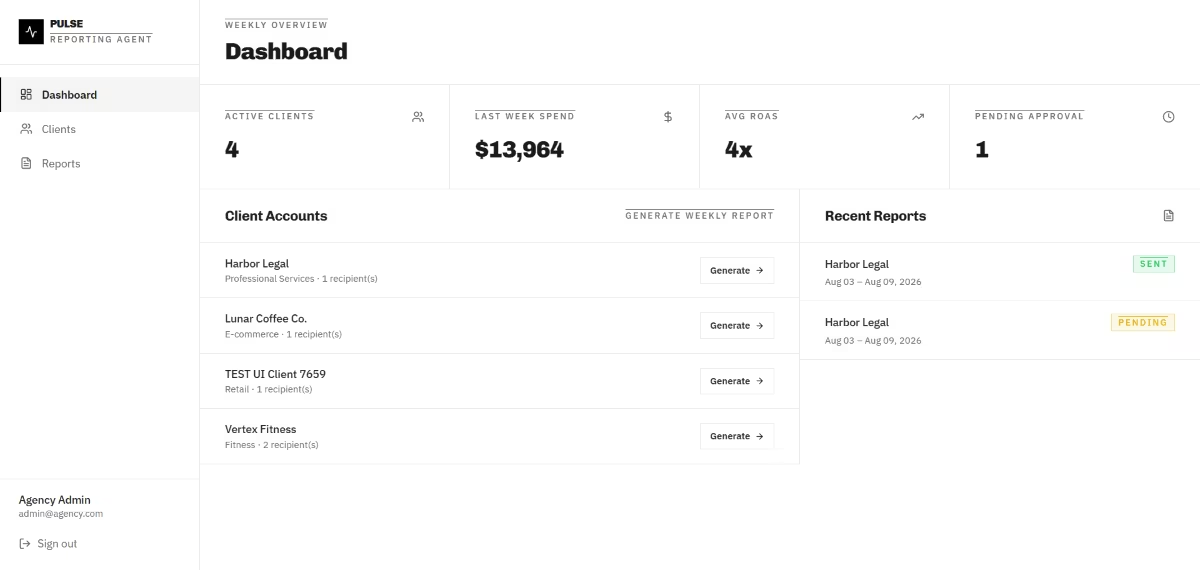
That’s a different approach from most of the tools above, which add agent features to an existing platform.
If you want to compare dedicated agent-building platforms, our guide to the best AI agent builders covers the main options.
Ready to build a custom agent for your marketing workflow? Start with Emergent.

Most AI app builders stop at prototypes. Emergent creates production-ready apps you can actually launch.
- Production-ready apps
- Web & mobile apps
- Deploy in minutes