
TL;DR
- Core difference: A chatbot replies to what you ask. An AI agent decides its own steps and takes action to complete a goal.
- What the field data shows: Across 680,000+ Taobao support chats, the chats Alibaba's agent handled finished 16.8% faster, outcomes didn't improve, and satisfaction fell 0.41 points on a 5-point scale.
- Where chatbots still win: Speed to launch, predictable answers, and cost on high-volume FAQ work. Agents aren't a straight upgrade.
- Action-taking: Chatbots respond in the chat window; agents update records, process refunds, and change real systems.
- Best at: Chatbots handle high-volume, predictable questions; agents handle multi-step tasks that touch real systems.
- Setup cost: A rule-based chatbot can launch in an afternoon; an agent needs tool access, guardrails, and testing before it should touch production data.
- When to choose: Use a chatbot for fast, predictable answers, and an agent when the request needs to be resolved, with a real action completed.
- Can they work together: Yes. A chatbot can handle the conversation and hand off to an agent for anything that needs real action.
Chatbots and AI agents can look remarkably similar from the outside: both can sit in a chat window, answer questions, and sound like they're having a conversation.
It's like confusing a receptionist with a personal assistant because they both answer the phone.
The difference shows up in what happens after you ask for something. A chatbot responds to your request. An AI agent can figure out the steps needed to reach a goal, carry them out through connected tools, check what happened, and decide what to do next without waiting for you to direct every move.
I built both to find where the line actually falls: a support chatbot for an online clothing store, and an agent that looks up an order and refunds it end to end. Each took about five minutes, and both are further down with the exact prompts I used.
Here's the AI agent vs chatbot breakdown, where each one works best, and how to decide which one you need.
What Is a Chatbot?
A chatbot is software designed to hold a conversation, usually through text, and respond to what a person types. Its core job is answering, not acting, and chatbots split into two categories that get lumped together far too often.
Rule-based chatbots match keywords or menu selections to a fixed set of scripted answers. They're cheap to build and completely predictable, but they break the moment a question falls outside the script.
AI or LLM-based chatbots use a language model to understand free-form questions and pull answers from a knowledge base, which is why they handle phrasing variation a rule-based bot can't.
They still don't take action on their own. They answer, and a human or a separate system does the rest.
The split matters for everything below: when this article compares a chatbot to an agent, it means the LLM kind, since a rule-based bot loses on flexibility before the comparison even starts.
For a deeper look at where chatbots fit across different jobs, our breakdown of chatbot use cases covers the specific scenarios each type handles well.
What Is an AI Agent?
An AI agent is software that pursues a goal, decides its own steps toward that goal, and takes action through connected tools and systems. It checks its results and adjusts without a person approving each individual step.
An agent runs a loop: it sizes up the situation, picks a step, does it in a real system, then checks whether it worked, something a chatbot simply doesn't do.
While a chatbot generates a reply and stops, an agent generates a plan, executes it against real systems, and keeps going until the goal is met or it hits a wall it needs help with.
This same pattern shows up in agentic coding, where an agent reads a codebase, writes and tests changes, and submits a working result rather than suggesting code.
AI Agent vs Chatbot: Key Differences
The differences below are where that split actually shows up in how each one behaves.
Autonomy and Action-Taking
A chatbot's output is a message, while an agent's output is a finished action: an updated record, a processed refund, a sent email. Any message it sends is a byproduct. Everything below follows from that one difference.
Memory and Context
Most chatbots reset with each new conversation or hold only what's relevant to answer the current question. Ask about a delayed order on Monday, come back Wednesday, and you start from scratch: order number again, problem again.
Agents are more often built to carry context across an entire task, and sometimes across multiple sessions, so a multi-step job doesn't lose its place halfway through.
Tool Use and System Integrations
A chatbot connects to a knowledge base to find an answer. An AI agent connects to systems it can actually operate: a CRM it can update, a payment processor it can refund through, a calendar it can book on.
Multi-Step Planning
Give an agent a goal that needs four steps across two systems, and it works out the order, runs them, and adjusts when one result changes what the next needs, where a chatbot just answers the follow-up and waits.
Accuracy
For a chatbot, a hallucination is usually contained: one wrong sentence in one reply that a person can catch and correct.
For an agent, a wrong step can feed into everything that follows. An agent that misreads a return policy at step two carries that error forward: it processes a refund based on the mistake at step four, and the error may not surface until someone audits the outcome.
Cost and Complexity
Nothing on this list ships faster or cheaper than a rule-based chatbot. An AI agent that takes real action needs a lot more: access to your tools, clear limits on what it's allowed to touch, testing against the weird cases, and a plan for when it gets something wrong.
That complexity is the reason you shouldn't reach for an agent by default.
Where Chatbots Still Make Sense
Most articles on this topic frame agents as the strict upgrade. That's not the honest version.
Predictability: A rule-based chatbot answers the same question the same way every time. In a regulated industry, or anywhere a wrong autonomous action costs real money, that predictability beats initiative.
Speed to launch: Still favors chatbots. A scripted FAQ bot can be live in an afternoon. An agent with real system access needs limits on what it can touch, testing, and a way to undo a bad action.
Cost: Stays lower for simple, high-volume jobs. If 80% of your incoming questions are answerable from a static FAQ, a chatbot resolves them for a fraction of what an agent's tool access and monitoring would cost to build and maintain.
How to Grade Success: AI Agent vs Chatbot
A chatbot and an agent don't get graded the same way because they can fail in different ways. A chatbot can give you a bad answer, but an agent can give you a good answer and still take the wrong action.
For a chatbot, the conversation is the primary measure of success. You're grading it on whether it:
- Answered the question
- Gave the customer what they needed to move on
- Left the customer satisfied
For an agent, the conversation isn't enough. You have to check what happened afterward:
- Did the refund go through?
- Is the account in the right state?
- Did the booking actually change?
An agent can have a smooth, polite conversation and still fail, because the outcome was always the actual goal, not the conversation.
That's why agents are harder to evaluate, and harder to trust, than chatbots. You have to measure what the AI did, since what it said in the conversation isn't the full picture.
A 2026 field experiment on Alibaba's Taobao platform, run by researchers at Zhejiang, Fudan, Dartmouth, and Alibaba itself, shows what this looks like in practice. It's still a preprint, so treat the numbers as early evidence rather than a settled result.
Alibaba randomly split 647 support workers into two groups: one supervised the agent on the chats it was cleared to handle, while the other kept resolving every chat themselves.
On speed, the chats the agent was cleared to handle finished 16.8% faster. Across every chat in the experiment, including the ones the agent never touched, the average was 3.2% faster.
But on whether the problem stayed solved, measured by how often customers came back about the same issue within seven days, the agent showed no statistically significant improvement.
Graded on the conversation itself, customer satisfaction dropped by 0.41 points on a 5-point scale for the chats the agent handled. Ratings for the chats it never touched went up 0.09 points over the same period: the human workers got better while the AI-handled chats got worse.
That's why you can't grade an agent on a single metric. Look at speed, outcomes, and satisfaction together to know whether the rollout made things better.
The same study adds a catch worth planning around. When a human stepped in because the agent hit a technical limit, ratings held steady. When they stepped in after the customer was already frustrated, chats ran 40.8% longer, more customers came back, and ratings fell almost a full point. Catching a bad chat early matters more than catching it at all.
Same Request, Two Approaches
Here's how each one handles “cancel my subscription and refund my last payment.”
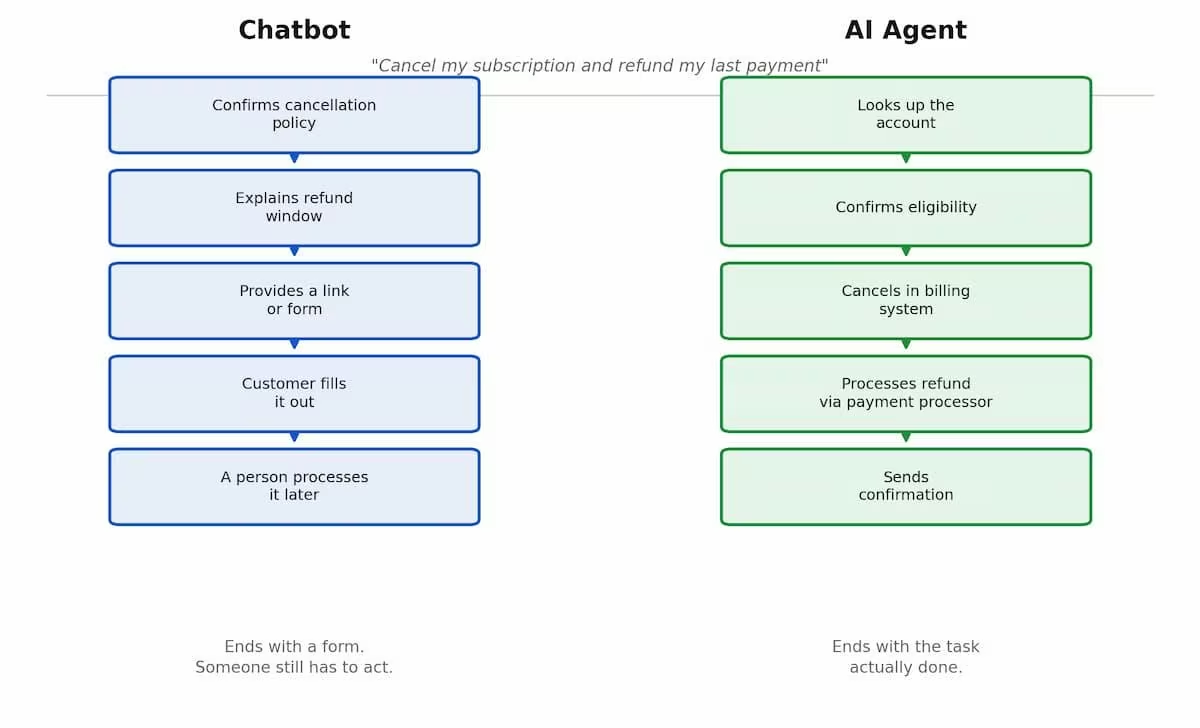
- Chatbot: Confirms the cancellation policy, explains the refund window, and provides a link or a form to submit the request. The customer still has to fill something out, and a person on the other end still has to process it.
- AI agent: Looks up the account, confirms the subscription is active and eligible, cancels it in the billing system, processes the refund through the payment processor, and sends a confirmation, all from the same request, with no separate form and no person in the loop unless something looks wrong.
That's the version that works. The same autonomy is why a wrong eligibility check here cancels a subscription that shouldn't have been touched.
Same input, different amount of work completed by the end of the conversation.
When to Use a Chatbot vs an AI Agent
Use a chatbot when you:
- Need to answer high-volume, predictable questions (hours, pricing, policies)
- Want something live in days, with minimal engineering overhead
- Don't need the system to touch or change real data
Use an AI agent when you:
- Need the request resolved, with a real action completed
- Have a process that spans multiple systems or steps
Use both when you:
- Get a high volume of answerable questions plus a smaller stream that needs action taken
- Want the chatbot to handle the conversation and hand off only what touches a real system
- Would rather scope an agent to one narrow job than let it near everything
This is the most common real setup, and usually the cheaper one: the chatbot absorbs the volume, so the agent only needs permissions for the handful of things it does.
For a deeper look at where agents specifically pay off across a business, our roundup of best AI agents for business breaks down real deployments by function.
Can a Chatbot Become an AI Agent?
No. An existing chatbot doesn't get upgraded into an agent. The agent is a separate build. What companies do is gradually roll out an agent's scope.
In practice, these are built as separate systems, so you don't get from one to the other by adding a feature. You build the agent alongside the chatbot and give it more to do over time.
That is what gradual adoption looks like: introducing an agent with a limited scope, supervising it closely, and expanding what it's trusted to handle as the system proves itself.
Alibaba's Taobao platform is a clear example of this. Before its agentic system existed, customer inquiries were handled by a rule-based chatbot, with anything it couldn't resolve escalated to a human.
In 2024, Alibaba introduced a separate agentic AI system for a narrow set of standardized, “AI-eligible” issues. It handled less than 10% of total volume, with a human worker supervising the chats it handled and able to step in.
Building Your Own Chatbot or AI Agent
Once you know which side of this you need, the build question is next.
Emergent builds either one from a plain-language description, with specialized agents splitting the work: some shape the screens, others handle the data and the outside connections, and testing agents check the build before anything ships. (Those are build-time agents, not the support agent you end up shipping.)
Describe a support chatbot grounded in your knowledge base, or describe an agent that looks up an order and issues a refund, and it builds the working version.
The agent below runs on sample orders rather than a live payment processor, since the point was testing the decision logic, but the same prompt takes a real payment connection instead.
Here's the chatbot I built in about five minutes.
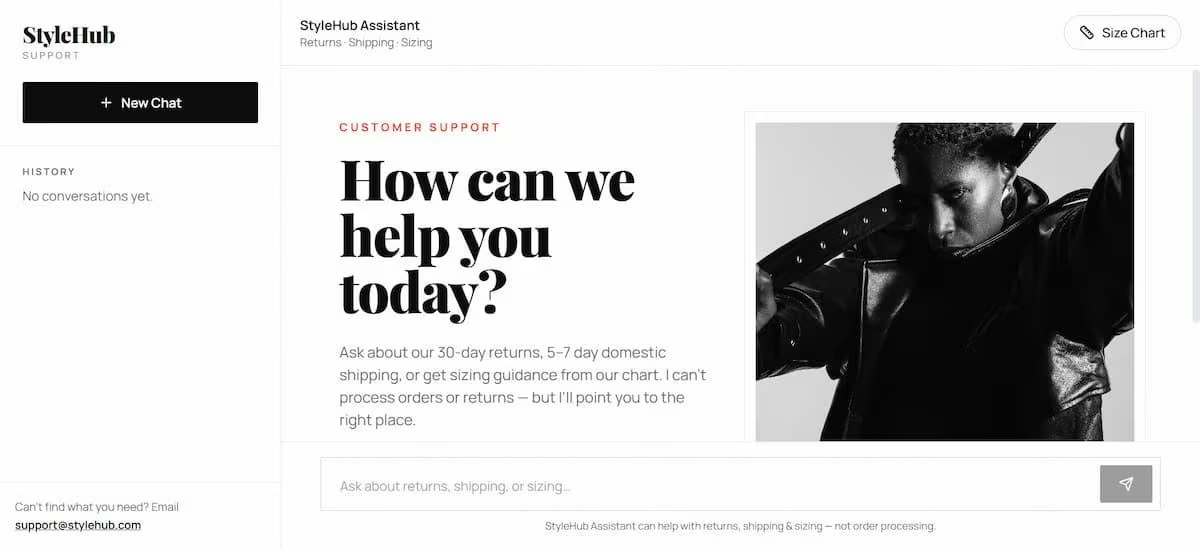
Try it here: the support chatbot I built
Prompt used: Build a customer support chatbot for an online clothing store. It should answer questions about our return policy (30 days, unworn items, original tags), shipping times (5-7 business days domestic), and sizing guidance based on a standard size chart. It should not process any actual returns or orders, just answer questions and, if it can't help, direct the customer to email support@[store].com.
It handled the return-policy question cleanly on the first try, correctly citing the 30-day window and original-tags requirement. It initially fumbled the sizing question, defaulting to a generic “check our size chart” answer instead of walking through it, so the prompt got a follow-up instruction to actually reference the size chart values when answering.
I built the agent side next. Here's the whole run in one pass: order lookup, eligibility check against the 30-day window, return processed, refund issued back to the original card.

Try it here: the return agent I built
Prompt used: Build a support agent for an online clothing store that can look up a customer's order by order number, check whether it's eligible for a return (eligible if within 30 days of delivery and not marked as a final-sale item), and if eligible, process the return and issue a refund to the original payment method. If the order isn't eligible, explain why to the customer and offer store credit instead. Connect it to a mock orders database with a handful of sample orders (some within the return window, some outside it, some marked final-sale) so I can test the full flow end to end.
The in-window orders processed cleanly. The final-sale order was the interesting case: it correctly refused the refund and offered store credit as instructed, but the first version explained the refusal in one flat line that read cold, so the prompt got adjusted to have it explain why the item was final sale before offering the alternative.
If you’d like to test out the tools first, you can try out our agent builder or chatbot builder to see what works for you.
Emergent gets you a working version fast. The builds that go wrong are the ones that skipped the testing.
The honest answer to AI agent vs chatbot is that most teams need the chatbot first and the agent second, scoped narrowly. Start with the questions you can answer, and give an agent real system access only where a completed action is the actual point.
Ready to build either one? Start with Emergent.
Most AI app builders stop at prototypes. Emergent creates production-ready apps you can actually launch.
- Production-ready apps
- Web & mobile apps
- Deploy in minutes