TL;DR
- Shopify Sidekick: Best for handling store administration, product work, merchandising, reporting, and marketing tasks inside Shopify.
- Klaviyo: Best for using customer behavior and purchase data to automate retention marketing across email, SMS, WhatsApp, and other channels.
- Gorgias: Best for centralizing ecommerce customer support and automating routine pre-sale and post-purchase conversations.
AI tools for ecommerce should remove work from your store, not give you six more dashboards to check. The strongest options handle a specific bottleneck, such as store administration, customer retention, or support.
I compared current features, official pricing, ecommerce integrations, and merchant feedback across nine platforms. Shopify Sidekick is my top choice for running a Shopify store, Klaviyo is the best for retention marketing, and Gorgias is the strongest customer-support option.
The other six tools still have clear strengths, but they solve narrower problems or suit a smaller group of ecommerce businesses. This guide shows whether your real bottleneck sits in Shopify administration, customer retention, or support, then points you to the strongest tool for that job.
How I Researched These AI Ecommerce Tools
I did not run these tools against a live ecommerce store, so I have not added testing scenarios or first-hand performance claims.
I assessed each product using four factors:
- Ecommerce relevance: The tool had to solve an important commerce problem rather than provide general-purpose AI writing.
- Ability to take action: I prioritized tools that can create campaigns, change store settings, trigger workflows, or resolve customer requests.
- Store and customer context: Product, order, inventory, browsing, and customer data make an AI tool more useful than a disconnected chatbot.
- Real cost: I looked beyond the advertised price to consider contacts, messages, tickets, automated interactions, credits, and other usage limits.
I selected only three main recommendations because each one clearly owns an essential ecommerce job. The honorable mentions either overlap with a stronger option, require more scale, or solve a narrower problem.
3 Best AI Tools for Ecommerce: Quick Comparison
The pricing below comes from each company’s official pricing page. Monthly pricing appears first, followed by the annual equivalent where the vendor publishes one.
| Tool | Best For | Free Plan | Starter Paid Price | Main Limitation |
|---|---|---|---|---|
| Shopify Sidekick | Store operations | No separate plan | Included with Shopify from $39/month ($29/month billed annually) | Shopify only |
| Klaviyo | Retention marketing | Yes | Paid configuration starts at $45/month; no standard annual price | Cost rises with usage |
| Gorgias | Ecommerce support | No | AI-enabled setup from $40/month; Helpdesk only from $10/month | Ticket and AI charges |
1. Shopify Sidekick: Best for Running a Shopify Store
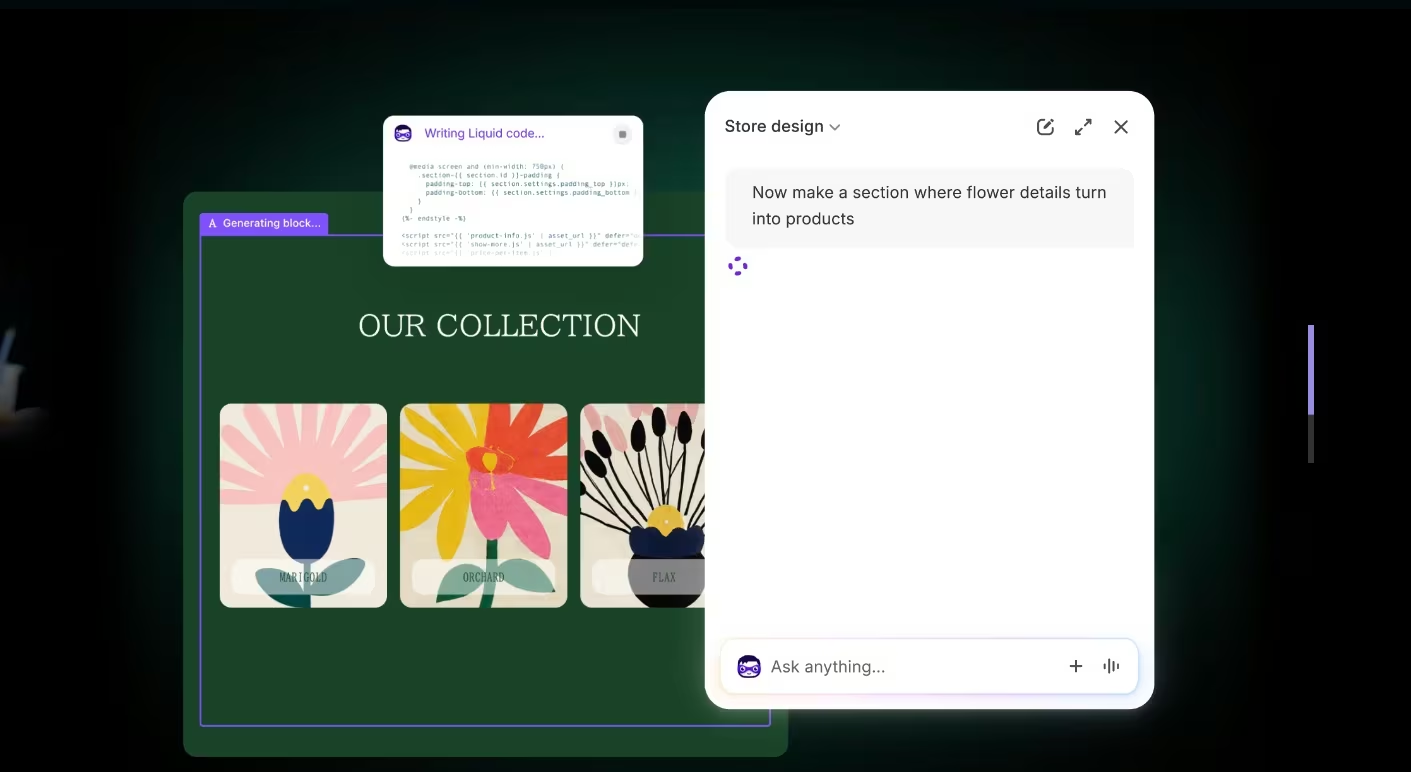
What it does: Shopify Sidekick is an AI commerce assistant built directly into the Shopify admin.
Best for: Shopify merchants who want help managing products, store settings, reporting, promotions, inventory, content, and routine administrative work.
Sidekick takes the top position because it works inside the system that already holds your products, customers, orders, inventory, payments, and store settings. You don’t need to connect another dashboard or repeatedly explain how your business works.
You can ask Sidekick to draft search-friendly product descriptions, review pricing, prepare social posts, summarize weekly performance, create discounts, organize collections, flag low-stock products, assess advertising channels, and audit shipping settings.
It can also create customer and company records and work with payment, fulfillment, payout, and web-performance data through ShopifyQL.
ShopifyQL is Shopify’s query language for analyzing commerce information. You don’t need to learn the language yourself because Sidekick can translate a plain-English request into the required query.
Sidekick can set up the discount inside Shopify and build the product collection from the same request. The work stays inside the admin instead of moving from a chat response into a manual setup.
Sidekick also respects Shopify staff permissions. A team member can interact only with the data and store features they already have permission to access.
Its main weakness is platform dependence. Sidekick is an excellent Shopify assistant, but it does little for a business running on WooCommerce, BigCommerce, a custom storefront, or several unrelated commerce systems.
It also does not replace specialist tools. Klaviyo gives you more control over retention marketing, while Gorgias provides a deeper customer-support operation. Start with Sidekick when the work happens mainly inside Shopify, then add another platform only when you can name the gap it needs to fill.
Key Features
- Store-aware assistance: Sidekick works with your Shopify products, orders, customers, settings, and performance data.
- Administrative actions: It can help create discounts, records, collections, and other store elements.
- Commerce analysis: You can request performance summaries, pricing reviews, inventory checks, and shipping audits.
- Content generation: It supports product descriptions, store design, product imagery, email ideas, and social content.
- Permission controls: Sidekick follows the existing permissions for each Shopify staff account.
Pros and Cons
Pros
- Works directly inside Shopify.
- Uses information already connected to your store.
- Handles analysis and practical store tasks.
- Does not require a separate Sidekick subscription.
- Covers more day-to-day ecommerce work than a general AI writer.
Cons
- Has little value if your store doesn’t run on Shopify.
- Cannot replace a dedicated lifecycle-marketing or support platform.
- Store-changing actions still need review, especially discounts, pricing, shipping, and inventory decisions.
What Merchants Say
Sidekick is a built-in Shopify product rather than a separate Shopify App Store app, so it does not have its own standalone marketplace rating. I therefore weighted its native store access, task coverage, permission controls, and included cost more heavily than review volume.
Pricing
Sidekick is included at no extra cost with Shopify plans. Basic costs $39/month ($29/month billed annually), Grow costs $105/month ($79/month billed annually), and Advanced costs $399/month ($299/month billed annually).
Plus starts at $2,300/month, with no standard annual equivalent displayed publicly. Sidekick features and usage limits vary by Shopify plan.
Bottom Line
Sidekick earns the top spot because it acts on the store data Shopify already holds, instead of handing you suggestions to re-enter elsewhere.
2. Klaviyo: Best for Ecommerce Retention Marketing
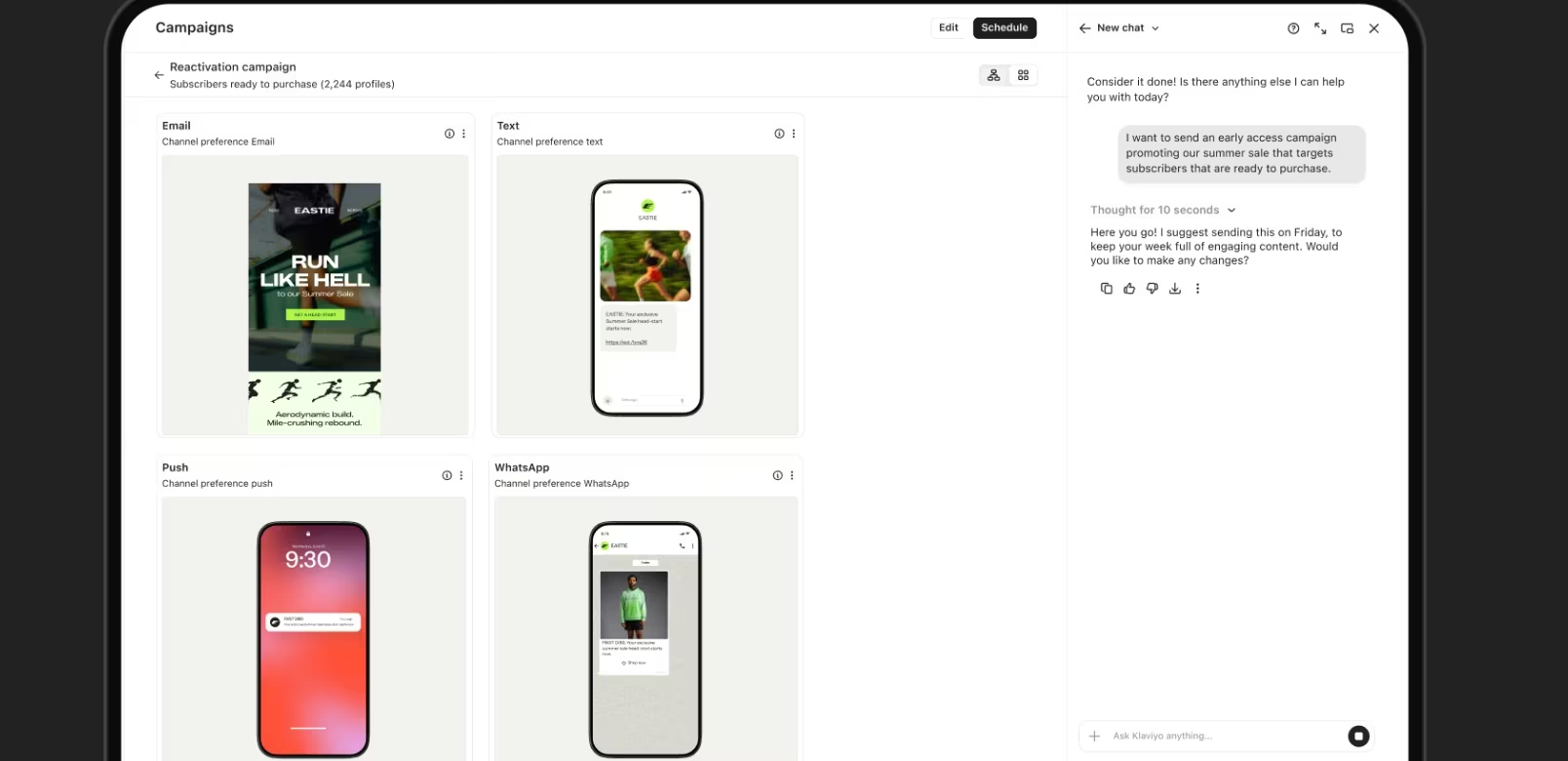
What it does: Klaviyo connects customer and commerce data with marketing, personalization, analytics, and customer-service workflows.
Best for: Ecommerce businesses that need better abandoned-cart, post-purchase, cross-sell, replenishment, and win-back campaigns.
Klaviyo is a business-to-consumer customer relationship management platform, or B2C CRM. A B2C CRM connects individual customer behavior with the messages, offers, and support experiences a brand provides.
That data layer is why Klaviyo ranks second. It can use purchases, product views, message engagement, profile details, and predicted behavior to decide who should receive a campaign, what product belongs in the message, and when the message should arrive.
Klaviyo supports email, SMS, WhatsApp, mobile notifications, forms, audience segmentation, automated flows, customer profiles, analytics, and service tools.
Its AI products include Composer for finding and building campaign opportunities, Customer Agent for product and support questions, and personalization tools that optimize content, audiences, channels, and timing.
Here’s a concrete segment: customers who bought a product, normally reorder within 60 days, have gone 75 days without buying again, and recently viewed a related product page.
Klaviyo can place them into a win-back or replenishment flow instead of sending the same discount to your whole list.
The message is tied to a real audience, business rule, event, product, and delivery schedule. That targeting is what puts Klaviyo second.
Klaviyo also connects with more than 350 apps, which helps ecommerce businesses combine storefront, advertising, subscription, shipping, loyalty, and support information. Its AI can then work with a broader customer profile rather than treating every channel as a separate conversation.
The downside is cost and setup. Klaviyo’s pricing changes with the number of active profiles, messaging volume, and products you add. The platform also gives you enough segmentation and automation options to create a complicated account quickly.
A small store with a short list should start with a lighter tool such as Omnisend. Klaviyo becomes the right investment when customer retention can produce enough additional revenue to justify the setup and growing bill.
Key Features
- Behavior-based segmentation: Create audiences from purchases, browsing, engagement, customer attributes, and predicted behavior.
- Automated customer flows: Run welcome, abandoned-cart, post-purchase, cross-sell, replenishment, and win-back sequences.
- Cross-channel communication: Coordinate email, SMS, WhatsApp, mobile, forms, and customer-service experiences.
- AI campaign creation: Composer can identify opportunities, build audiences, draft campaign content, and prepare sends.
- Predictive personalization: Klaviyo can analyze customer lifetime value, churn risk, purchase patterns, preferred channels, and likely order timing.
Pros and Cons
Pros
- Connects marketing to real customer and purchase activity.
- Provides more segmentation depth than most entry-level email tools.
- Supports campaigns, automated flows, service, and analytics in one customer profile.
- Works across several owned marketing channels.
- Gives established stores room to build detailed retention programs.
Cons
- Costs increase as your profile count and product use grow.
- Advanced segmentation and attribution take time to configure.
- Small stores can pay for capabilities they are not ready to use.
- AI-generated campaigns still need checks for product accuracy, brand voice, offer terms, and compliance.
What Merchants Say
As of July 2026, Klaviyo has a 4.7 out of 5 rating from +2,900 Shopify App Store reviews. Eighty-eight percent are five-star ratings, while 7% are one-star ratings.
Recent five-star reviews praise its Shopify integration, automation flows, segmentation controls, ease of use, and ability to generate revenue from existing customers. Critical reviews focus on editor friction, billing, support access, and profile-based costs, so calculate how your contact list will affect the bill before migrating a large database.
Pricing
The Free plan costs $0/month and supports up to 250 active profiles, 500 monthly emails, $5 of mobile messaging, and 10,000 Composer credits.
Klaviyo now uses modular, usage-based pricing rather than one simple subscription ladder. The current entry configuration displayed in its official pricing calculator totals $45/month, while Professional Services and Enterprise use custom pricing; Klaviyo does not publish one standard annual equivalent across the platform.
Bottom Line
Klaviyo turns customer behavior into targeted retention campaigns. Its advantage is targeting: it decides which customer receives each message and ties the campaign to what that person has actually done.
Also read our best AI tools for marketing agencies guide for what else is worth trying when retention campaigns are only part of the marketing job.
3. Gorgias: Best for Ecommerce Customer Support
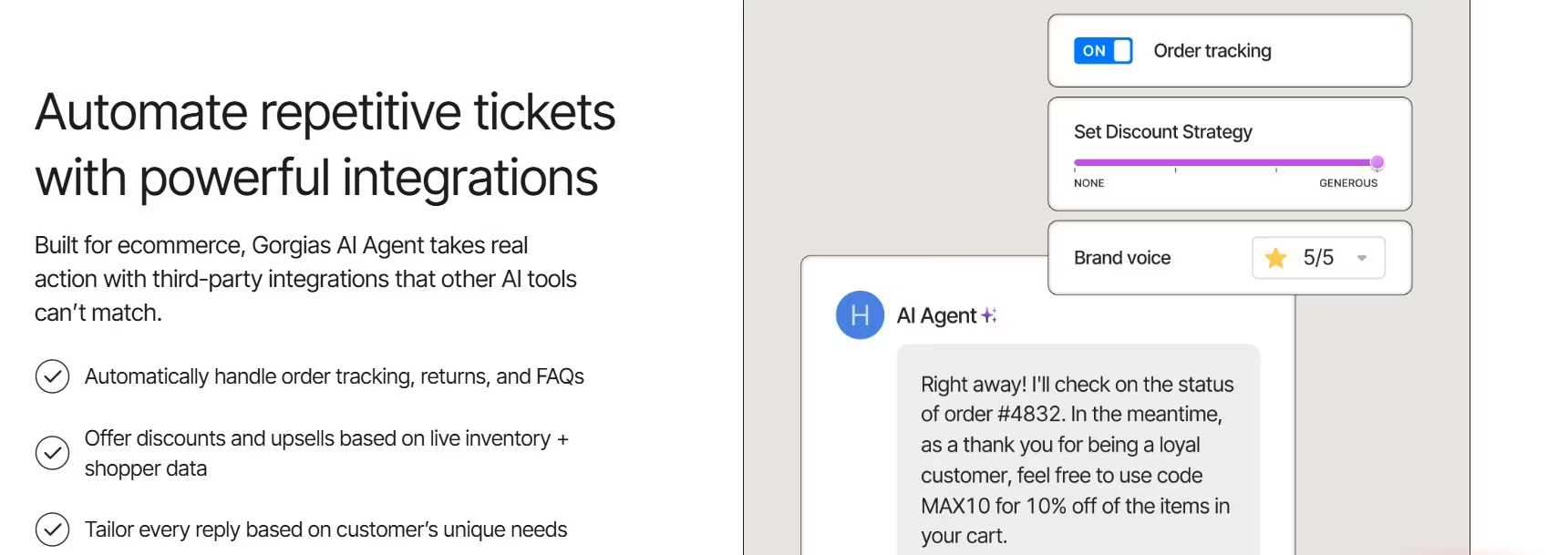
What it does: Gorgias combines an ecommerce helpdesk, shared inbox, live chat, support automation, and an AI customer agent.
Best for: Stores receiving enough customer questions to need structured automation, central reporting, and human escalation.
Gorgias makes the top three because ecommerce support contains a large amount of repeatable work. Customers regularly ask where an order is, when an item will ship, whether a product suits them, how to start a return, or whether a discount applies.
The Gorgias helpdesk brings conversations and commerce information into one workspace. It supports email, live chat, contact forms, Facebook, Instagram, TikTok Shop, WhatsApp, voice, and SMS, depending on the plan and add-ons.
Its AI Agent can answer support questions, recommend products, track orders, and complete approved actions. The platform connects with Shopify, BigCommerce, Magento, WooCommerce, and hundreds of ecommerce apps covering subscriptions, loyalty, returns, fulfillment, and marketing.
A general chatbot can explain a return policy, but Gorgias can identify the customer, locate the order, check its status, start the approved action, and preserve the conversation for a human agent.
Gorgias also supports pre-sale questions. A shopper who asks whether a product comes in a certain size or will arrive before an event is already close to buying. The AI Shopping Assistant can recommend products and guide shoppers while sending unusual or valuable conversations to a person.
The pricing model is the main concern. Each plan includes a ticket allowance and a number of automated interactions. Once you pass either limit, Gorgias charges overage fees.
Before signing up, calculate your normal monthly ticket volume, peak-season volume, expected automation rate, and the number of conversations that require a human. The $40 entry price can become misleading when a store regularly exceeds the included 50 tickets and 30 automated interactions.
Tidio is a less expensive starting point for stores with low volume. Gorgias is the stronger choice when support is already an operating function rather than an occasional inbox.
Key Features
- Unified inbox: Bring customer messages from several channels into one support workspace.
- AI Agent: Resolve repeat questions and complete approved ecommerce actions.
- Shopping Assistant: Recommend products and guide shoppers during pre-sale conversations.
- Commerce integrations: Connect storefronts, returns, subscriptions, loyalty, shipping, and marketing systems.
- Human escalation: Route complex, sensitive, or high-value cases to the right support agent.
- Support analytics: Track workload, automation, response patterns, and customer-conversation trends.
Pros and Cons
Pros
- Built specifically around ecommerce support.
- Gives agents access to customer and order context.
- Supports both customer service and pre-sale product guidance.
- Does not price its main helpdesk by individual agent seat.
- Connects with major commerce platforms and specialist ecommerce apps.
Cons
- Ticket and AI-interaction overages make costs harder to predict.
- The entry plan includes only 50 tickets and 30 automated interactions.
- Refunds, order changes, discounts, and account actions need strict permissions.
- Low-volume stores may not need a full ecommerce help desk.
What Merchants Say
As of July 2026, Gorgias has a 4.2 out of 5 rating from 613 Shopify App Store reviews. Eighty-three percent are five-star ratings, while 9% are one-star ratings.
Recent five-star reviews praise the AI Agent, Shopify integrations, centralized conversations, and its ability to reduce repetitive support work. One merchant reported that the AI Agent handled more than 40% of requests during peak periods, while others highlighted its Shopify and ShipBob connections.
Critical reviews raise concerns about onboarding, support response times, pricing, configuration work, and AI replies going live incorrectly. Test Gorgias on a limited group of predictable tickets before moving your full support operation.
Pricing
Starter costs $40/month, with monthly billing only. Basic costs $90/month ($77/month billed annually), Pro costs $550/month ($471/month billed annually), and Advanced costs $1,430/month ($1,227/month billed annually).
Enterprise uses custom pricing. Ticket overages cost $0.40 each on Starter and Basic or $0.36 on Pro and Advanced, while additional automated interactions cost $1.50 each.
Bottom Line
Gorgias is strongest once you're handling enough tickets to need real routing, automation, and reporting. Start with predictable requests, then expand automation after its answers, actions, and escalation rules hold up.
A Custom AI Ecommerce Tool to Consider: Emergent
What it does: Emergent lets you describe the software you need in plain English and build it as a custom web or mobile app.
Best for: Ecommerce businesses that need an internal tool, portal, dashboard, or workflow that packaged software doesn’t cover well.
Shopify Sidekick, Klaviyo, and Gorgias each solve an established ecommerce job. Emergent takes a different route: you use it when the software you need is specific to how your business operates.
You could build a wholesale ordering portal for repeat buyers, an internal inventory dashboard, a supplier-management tool, or a returns approval workflow designed around your own process.
That makes Emergent useful when your team is relying on spreadsheets, manual approvals, or several tools stitched together. Instead of changing your process to fit another off-the-shelf platform, you can build software around the workflow you already use.
Emergent supports conversational app building, integrations, managed hosting, and custom app workflows. Any app that handles payments, refunds, customer information, permissions, or production records should still be reviewed and tested before launch.
Pricing
The Free plan costs $0/month. Standard costs $20/month ($17/month billed annually), and Pro costs $200/month ($167/month billed annually). Enterprise uses custom pricing.
Bottom Line
Emergent makes sense when your ecommerce problem needs custom software rather than another packaged app. That is why I would treat it separately from the three ranked tools instead of forcing it into a fourth-place position.
Also read our guide on business app development to see when custom software fits better than another packaged ecommerce tool.
Other AI Ecommerce Tools Worth Checking Out
- Omnisend: Simpler option for email, SMS, push notifications, automated flows, and product recommendations. Paid plans start at $16/month, but Klaviyo offers more depth for advanced segmentation and retention workflows.
- Tidio: Combines live chat, ticketing, automation Flows, and the Lyro AI Agent. Paid plans start at $29/month, making it a lower-cost support option, while Gorgias is better suited to more complex ecommerce support operations.
- Triple Whale: Brings attribution, advertising data, dashboards, and Moby AI into one place for brands managing more complex performance marketing. Foundation starts at $219/month, so it makes more sense once your ad spend and data needs justify the extra cost.
- Jasper: Helps marketing teams create on-brand product, campaign, and ecommerce content at scale. Pro costs $69/month, but content creation is a narrower ecommerce need than the store operations, retention, and support workflows covered by the top three.
- Constructor: Built for enterprise retailers that need AI-powered search, recommendations, shopping agents, and merchandising across large catalogs. Pricing is custom through its sales process, so it is better suited to large retailers than most small and midsize ecommerce businesses.
Which AI Ecommerce Tool Should You Choose?
Choose Shopify Sidekick When You
- Run your store on Shopify.
- Spend too much time on products, collections, discounts, reports, inventory, or store settings.
- Want AI assistance without paying for another standalone tool.
- Need the AI to work with your actual store rather than generic prompts.
Choose Klaviyo When You
- Already have enough customers and traffic to create useful audience segments.
- Need better abandoned-cart, post-purchase, cross-sell, replenishment, and win-back campaigns.
- Want to coordinate email, SMS, WhatsApp, mobile, and customer profiles.
- Can justify higher costs through stronger customer retention.
Choose Gorgias When You
- Receive enough support messages to need a proper helpdesk.
- Want AI to handle common order, shipping, return, and product questions.
- Need customer conversations and commerce data in the same workspace.
- Have clear rules for human escalation and sensitive account actions.
Skip These Tools for Now When You
- Have not identified a specific workflow to improve.
- Do not have enough customer or store data to support useful automation.
- Cannot assign someone to review AI output and manage exceptions.
- Are buying AI software mainly because competitors are talking about it.
Start with one measurable bottleneck. Track the time saved, revenue recovered, tickets resolved, or repeat purchases generated before adding another subscription.
Final Verdict
The shortlist comes down to where the work lives: Shopify administration, lifecycle marketing, or customer support. Sidekick is the broadest starting point for Shopify stores, while Klaviyo and Gorgias earn their place when retention or support has become the measurable bottleneck.
The honorable mentions solve narrower jobs. Add one only after you can tie its cost to a clear outcome, such as recovered revenue, faster ticket resolution, or fewer hours spent on manual reporting.

Most AI app builders stop at prototypes. Emergent creates production-ready apps you can actually launch.
- Production-ready apps
- Web & mobile apps
- Deploy in minutes