



Choosing between Claude Opus 5.5 and Claude Fable 5.1 isn't simply about picking the more powerful AI model. It's about understanding whether Fable's positioning for particularly demanding reasoning tasks translates into meaningful improvements in performance, reliability, and task completion, and whether those improvements justify its higher cost.
Both models support High reasoning effort, allowing them to devote more computational resources to complex tasks such as software development, multistep research, and autonomous workflows. However, selecting the same effort level doesn't necessarily mean they use the same number of thinking tokens or deliver identical performance.
The distinction matters most when you're running AI agents, working with large codebases, or handling tasks that require sustained reasoning across multiple steps.
In this Claude Opus 5.5 (High) vs. Claude Fable 5.1 (High) comparison, we'll examine reasoning capabilities, coding and agentic performance, speed, token consumption, pricing, and practical limitations to help you decide which configuration best suits your needs.
Opus 5.5 High and Fable 5.1 High at a Glance
Claude Opus 5.5 and Claude Fable 5.1 are designed for demanding tasks, including complex reasoning, software development, and autonomous workflows. Both support adaptive thinking and High reasoning effort, but they differ in their default configurations, pricing, and expected response speed.
Here's how the two models compare when configured for High effort.
Source: Anthropic's official model documentation (Fable | Opus). Pricing reflects standard API token rates.
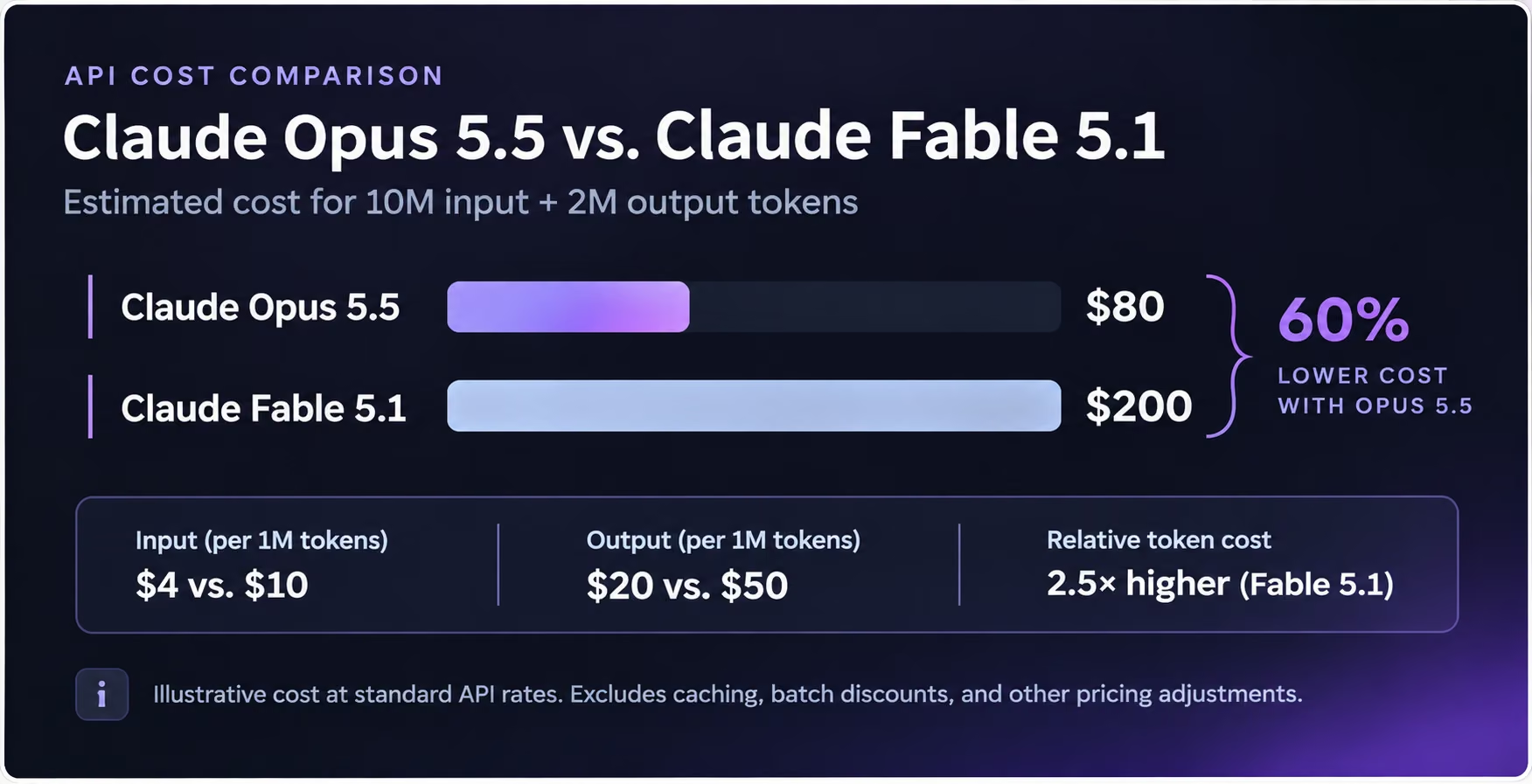
The most immediate distinction is cost. Fable 5.1 charges 2.5 times as much per input and output token as Opus 5.5. However, actual task costs depend on token consumption, including the reasoning tokens generated at High effort.
Another important difference is that Opus 5.5 defaults to Medium effort, while Fable 5.1 defaults to High. Therefore, a comparison using their default settings would not represent the same configurations examined in this article.
Neither model is automatically the better choice for every workload. Their relative value depends on task complexity, completion time, token usage, and output quality.
What High Effort Changes in Each Model
High effort determines how much computational work a Claude model can devote to generating a response. It influences reasoning depth, thinking-token consumption, tool usage, and response time.
Unlike a fixed thinking-token budget, High effort doesn't assign an identical number of reasoning tokens to every request. Instead, the model adapts its thinking to the task's complexity, potentially spending more resources on difficult problems and less on straightforward questions.
Both Claude Opus 5.5 and Claude Fable 5.1 use adaptive thinking, but their High-effort configurations need to be evaluated independently.
Claude Opus 5.5 at High Effort
Claude Opus 5.5 defaults to Medium effort. Switching to High allows it to devote more computational resources to demanding tasks, such as debugging complex applications, analyzing extensive documents, and coordinating multistep workflows.
At High effort, Opus can use additional tokens to reason through problems, evaluate alternative approaches, and manage tool interactions. However, higher effort does not guarantee a better answer for every task.
For routine assignments, Medium effort may already produce satisfactory results with lower token consumption and faster responses.
Also Read: Claude Opus 5.5 high vs low effort for how effort changes cost and results on Opus.
Claude Fable 5.1 at High Effort
Claude Fable 5.1 uses High as its default effort setting. Anthropic recommends this configuration as a starting point for demanding reasoning and long-horizon agentic work.
At High effort, Fable can allocate reasoning resources to complex problems involving multiple dependencies, sustained planning, and successive tool interactions.
Users can increase effort to XHigh or Max for particularly demanding workloads. However, these settings may consume additional tokens and increase response times, making them less practical when High effort already delivers acceptable results.
Also Read: Claude Fable 5.1 high vs low effort for the same view on Fable.
Does High Effort Mean Equal Reasoning Power?
Not necessarily. Although both models support the same effort setting, High does not represent a standardized computational budget across Claude models.
Each model can differ in how it allocates reasoning tokens, approaches complex tasks, and decides when additional thinking is necessary.
Consequently, comparing the models at High effort provides a consistent configuration label, but not identical computational conditions.
These differences matter most in coding and agentic workflows, where a model may need to reason through several steps, use external tools, and revise its approach before completing an assignment.
Reasoning and Long-Horizon Work Compared
Claude Opus 5.5 and Claude Fable 5.1 can handle complex assignments that require more than answering a single question. Both can analyze large amounts of information, work through dependencies, and use tools to complete multistep tasks.
However, the distinction isn't simply that Fable offers deeper reasoning while Opus prioritizes speed. Anthropic's published evaluations show that Opus 5.5 is highly competitive across demanding workloads, making actual task performance more important than model positioning alone.
Complex Reasoning and Problem-Solving
Opus 5.5 is designed for demanding knowledge work, including analyzing technical information, resolving interconnected problems, and completing assignments involving multiple constraints.
Fable 5.1 is positioned for particularly challenging reasoning tasks where conventional approaches may fall short. Anthropic recommends considering it when evaluations show that Opus 5.5 cannot consistently meet the required quality threshold.
For example, consider a business analyzing a complicated operational problem involving financial data, contractual requirements, and several possible courses of action. Both models could examine the evidence and prepare recommendations. The key difference is how accurately each identifies dependencies, handles conflicting information, and supports its conclusions.
High effort gives both models room to reason through these problems, but it does not establish that either will produce better results in every situation.
Long-Horizon Planning and Execution
Long-horizon tasks require an AI model to maintain progress across multiple steps, often while interacting with external tools or responding to unexpected results.
Consider an assignment involving reviewing a large repository, identifying the cause of recurring software failures, implementing changes, and validating the results. Success depends on more than reasoning accuracy at an individual step. The model must also maintain task context, recover from unsuccessful attempts, and complete the original objective.
Opus 5.5 is designed for sustained agentic coding and knowledge work. Fable 5.1 also targets long-running assignments, including multistep research and complex document workflows.
For either model, the practical measure of success is whether it completes the entire assignment reliably, rather than how convincingly it explains an individual decision.
What Do the Published Evaluations Tell Us?
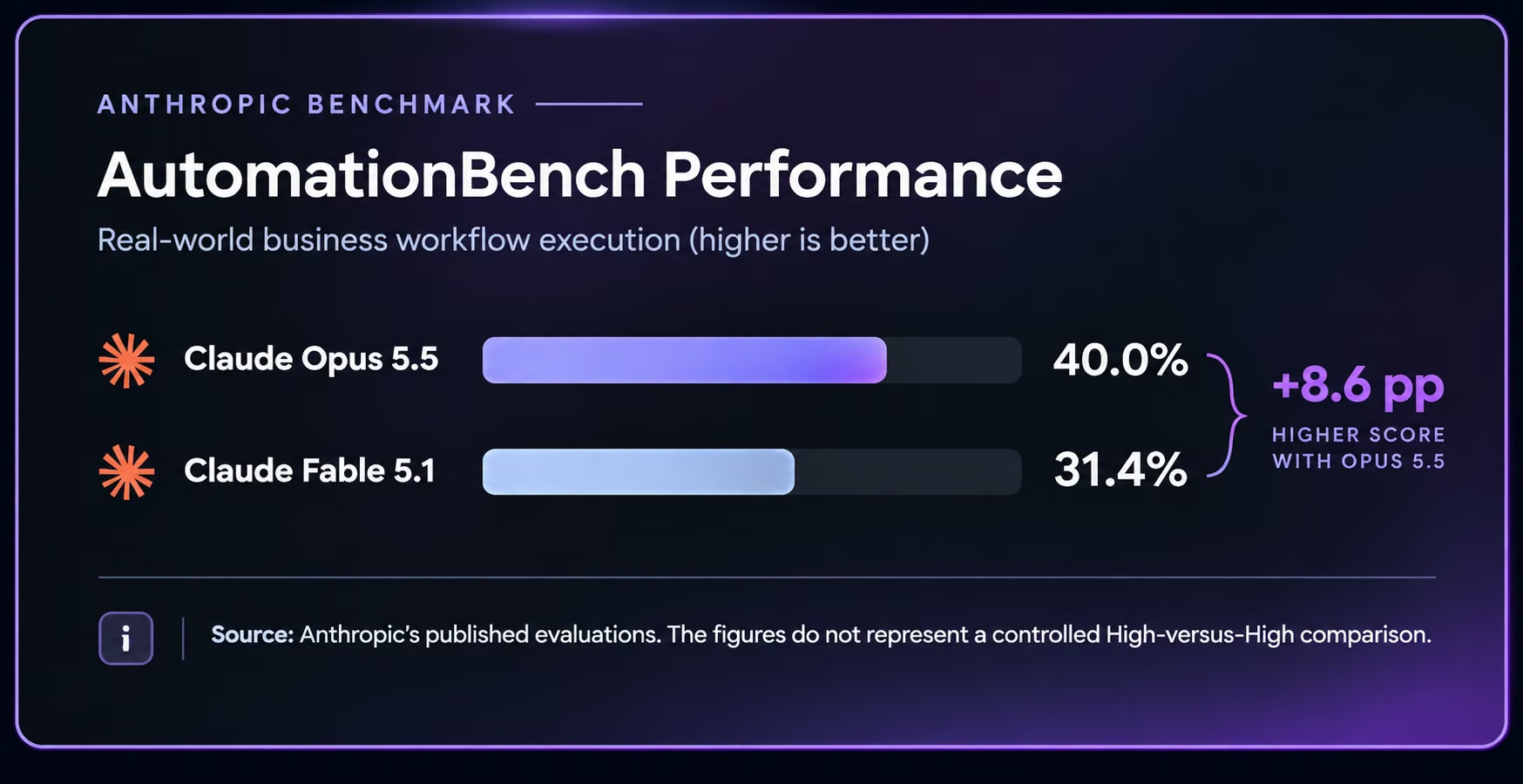
Data Source: Anthropic
Anthropic's published comparisons indicate that Opus 5.5 performs strongly against Fable 5.1 across several knowledge-work and agentic evaluations.
For example, Opus 5.5 achieves a higher reported score on GDPval-AA v2.1, a knowledge-work evaluation, and on AutomationBench, which examines business workflow execution.
These results challenge the assumption that the more expensive model must necessarily deliver better performance.
However, the published scores should not be interpreted as definitive evidence that Opus 5.5 at High effort outperforms Fable 5.1 at High effort. Benchmark configurations, testing conditions, and effort settings must be considered before drawing that conclusion.
The practical takeaway: Opus 5.5 is a strong starting point for complex reasoning and long-running work. Fable 5.1 remains worth evaluating for especially demanding tasks where it can meaningfully improve completion quality or reliability.
Also Read: Claude Opus 5.5 benchmarks and Claude Fable 5.1 benchmarks for the scores behind these comparisons.
Coding, Computer Use, and Agentic Performance Compared
Coding and agentic workflows test whether an AI model can complete practical assignments, not merely generate convincing answers. These tasks may involve modifying multiple files, executing commands, interacting with software, and checking whether the final result works.
Claude Opus 5.5 and Claude Fable 5.1 both support these workflows. However, Anthropic's published evaluations suggest that Opus 5.5 can deliver competitive or stronger results while using fewer resources.
Coding and Software Development
Claude Opus 5.5 performs particularly well on complex development assignments involving large codebases, debugging, and coordinated changes across multiple files.
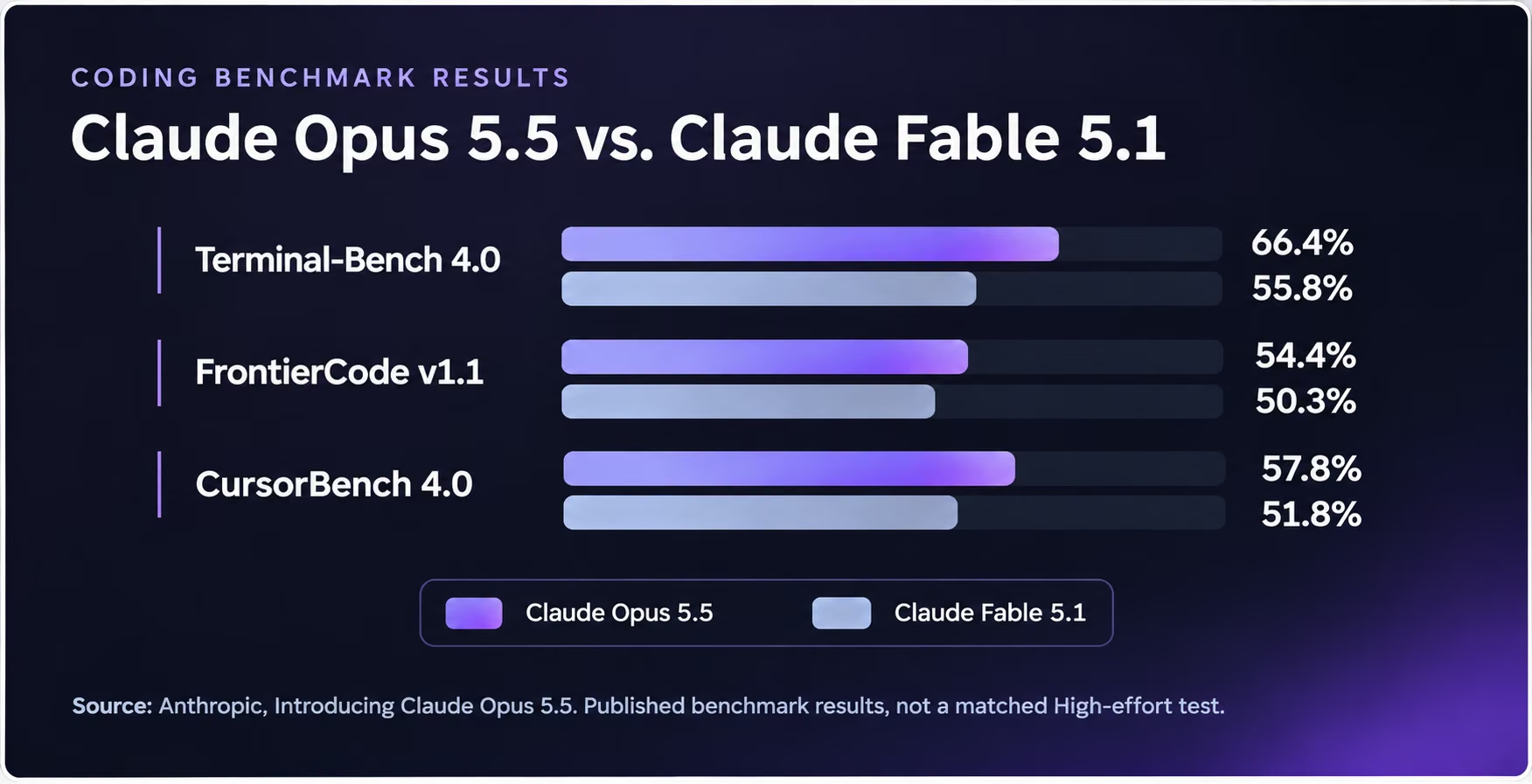
In Anthropic's published evaluations, Opus 5.5 scored 66.4% on Terminal-Bench 4.0, compared with 55.8% for Fable 5.1. It also led on FrontierCode v1.1, scoring 54.4% against Fable's 50.3%.
These benchmarks assess different aspects of coding performance. Terminal-Bench evaluates an agent's ability to complete command-line tasks, while FrontierCode examines the quality of code changes.
Importantly, the reported results do not establish a controlled High-versus-High comparison. Anthropic reports Opus 5.5's Terminal-Bench result at xHigh effort, while its other headline results generally use Max effort.
The results are therefore useful indicators of overall capability, rather than definitive evidence of performance at the configurations examined in this article.
Data Source: Anthropic
Computer Use and Software Interaction
Computer-use capabilities allow AI agents to interact with applications through interfaces rather than relying exclusively on text-based instructions or APIs.
This becomes useful when an assignment involves navigating a website, entering information into forms, or working across several applications.
On OSWorld 2.1, Anthropic reported partial scores of 81.8% for Opus 5.5 and 80.7% for Fable 5.1. The relatively small difference suggests competitive performance on this evaluation, although the figures do not establish a controlled High-versus-High comparison or guaranteed success rates in real-world workflows.
However, these results should not be interpreted as guaranteed success rates for everyday business workflows. Actual performance depends on the software environment, available tools, permissions, and task complexity.
Agentic Workflows and Task Completion
Agentic performance combines reasoning, tool use, planning, and execution. An effective agent must identify the next action, use the appropriate tool, assess the outcome, and continue until the objective is achieved.
For example, an AI agent tasked with updating a customer database might need to identify duplicate records, validate information, make changes, and prepare a summary of its actions.
The challenge is maintaining accuracy throughout the workflow, particularly when individual steps depend on previous results. To build one of these workflows with your own steps and review points, an AI agent builder lets you describe the agent in plain language.
Anthropic's internal testing offers a practical example of the differences between these models. When asked to translate the HAProxy software from C into Rust, both models produced rewrites that passed nearly all regression tests. However, Opus 5.5 completed the assignment in 9.5 hours, compared with 12 hours for Fable 5.1, at a reported 51% lower cost.
This example illustrates why completion time and resource consumption matter alongside output quality. However, it represents a specific internal test, not a universal performance advantage across every agentic task. If you want to try a migration like that on your own codebase, you can build a custom coding agent with a coding agent builder, set the regression tests it must pass, and decide where a person reviews before anything merges.
Speed, Token Use, and Cost Compared
Claude Opus 5.5 and Claude Fable 5.1 differ substantially in API pricing and expected response speed. While both support High reasoning effort, the cost of completing a task depends on how many input and output tokens each model uses.
API Pricing Comparison
Anthropic lists the following standard API rates:
At published rates, Fable 5.1 costs 150% more per token than Opus 5.5. For example, consider a workload consuming 10 million input tokens and 2 million output tokens.
Also Read: Claude Opus 5.5 pricing for its caching and batch discounts.
How High Effort Affects Token Consumption
High effort influences the number of tokens a model uses for reasoning, explanations, and tool interactions. However, it does not impose a fixed token budget.
Two models given the same assignment at High effort may generate different numbers of reasoning tokens, perform different tool operations, and take different amounts of time.
Consequently, the 2.5× difference in published token rates does not necessarily translate into a 2.5× difference in the cost of completing an actual task.
For an accurate comparison, users should measure the total tokens consumed and the number of successfully completed assignments.
Speed and Response Time
Anthropic categorizes Opus 5.5 as having moderate latency and Fable 5.1 as slower.
This suggests Opus may be better suited to workflows where response time matters, including interactive development and frequent tool calls.
However, these classifications are qualitative. They do not establish a fixed response-time difference, particularly at High effort.
Long-running workflows also require considering the time spent executing tools, recovering from errors, and completing follow-up steps.
Ultimately, the more useful measure is the cost and time per successfully completed task, rather than token pricing or response latency in isolation.
Where Each Configuration Falls Short
Even at High effort, Claude models can encounter difficulties during complex, multistep workflows. Anthropic acknowledges that errors in agentic systems can accumulate across tool interactions, making reliable task completion and evaluation essential.
Limitations of Claude Opus 5.5 (High)
- Not every difficult task benefits from additional reasoning: High effort can increase token consumption without meaningfully improving over Medium for relatively straightforward assignments.
- Complex workflows can still fail: Opus may misinterpret requirements, make incorrect assumptions, or struggle to recover from errors during extended tool-based tasks.
- Maximum reasoning capability requires separate evaluation: High effort is not Opus's highest available setting. Particularly difficult assignments may benefit from testing xHigh or Max, although higher settings can increase resource consumption.
Limitations of Claude Fable 5.1 (High)
- Higher resource requirements: Fable's higher API rates make it harder to justify for routine assignments or large-scale workloads unless it delivers measurable quality improvements.
- Slower responses: Its higher latency can affect interactive workflows and applications that involve frequent tool interactions.
- Additional reasoning does not guarantee successful execution: Like Opus, Fable can make mistakes in multistep workflows, particularly when instructions are ambiguous or external tools return unexpected results.
Limitations Shared by Both Models
Both configurations require appropriate safeguards when used for consequential tasks.
For example, an AI agent updating financial records or modifying production software should operate with clearly defined permissions, validation checks, and human approval for sensitive actions.
Their large context windows also do not guarantee perfect recall or interpretation of every detail in a lengthy document or conversation.
Ultimately, High effort can support more demanding reasoning, but it cannot replace reliable tools, clear instructions, testing, and human oversight.
Which Configuration Should You Choose?
For most users, Claude Opus 5.5 at High effort is the more practical starting point. Its lower API pricing, competitive benchmark performance, and support for complex reasoning and agentic workflows make it suitable for a broad range of demanding tasks.
Claude Fable 5.1 at High effort is worth considering when a particular workload requires additional reasoning capability and testing demonstrates that it delivers better results.
The right choice depends on what you're trying to accomplish.
When Should You Consider Switching to Fable 5.1?
Start by testing Opus 5.5 on representative tasks. If it consistently meets your requirements, switching to a more expensive configuration may offer little practical benefit.
However, if Opus struggles with a particular class of problems, test Fable 5.1 using the same inputs, tools, and evaluation criteria.
Compare the results based on accuracy, successful task completion, human intervention, execution time, and total API cost. A more expensive model becomes worthwhile when its measurable improvements justify the additional resources.
For businesses developing AI-powered applications or internal workflows, this evaluation should reflect actual operating conditions rather than relying exclusively on published benchmarks.
Conclusion
Claude Opus 5.5 (High) offers a compelling combination of reasoning capability, coding performance, and cost efficiency, making it a practical choice for most demanding workloads. Claude Fable 5.1 (High) remains an alternative for particularly complex assignments where testing demonstrates a meaningful improvement in results.
Rather than choosing solely on benchmark scores or model positioning, evaluate both configurations against your actual requirements. The better model is the one that completes your tasks accurately, reliably, and at a justifiable cost.
For businesses looking to put AI capabilities into practice, Emergent offers a way to build full-stack applications and internal tools using natural-language instructions. Instead of managing the entire development process manually, teams can focus on defining requirements, testing functionality, and refining the resulting application.

Describe it. Build it. Launch it.
- End-to-End Creation
- No Code Needed
- Live in Minutes

Most AI app builders stop at prototypes. Emergent creates production-ready apps you can actually launch.
- Production-ready apps
- Web & mobile apps
- Deploy in minutes





