



TL;DR
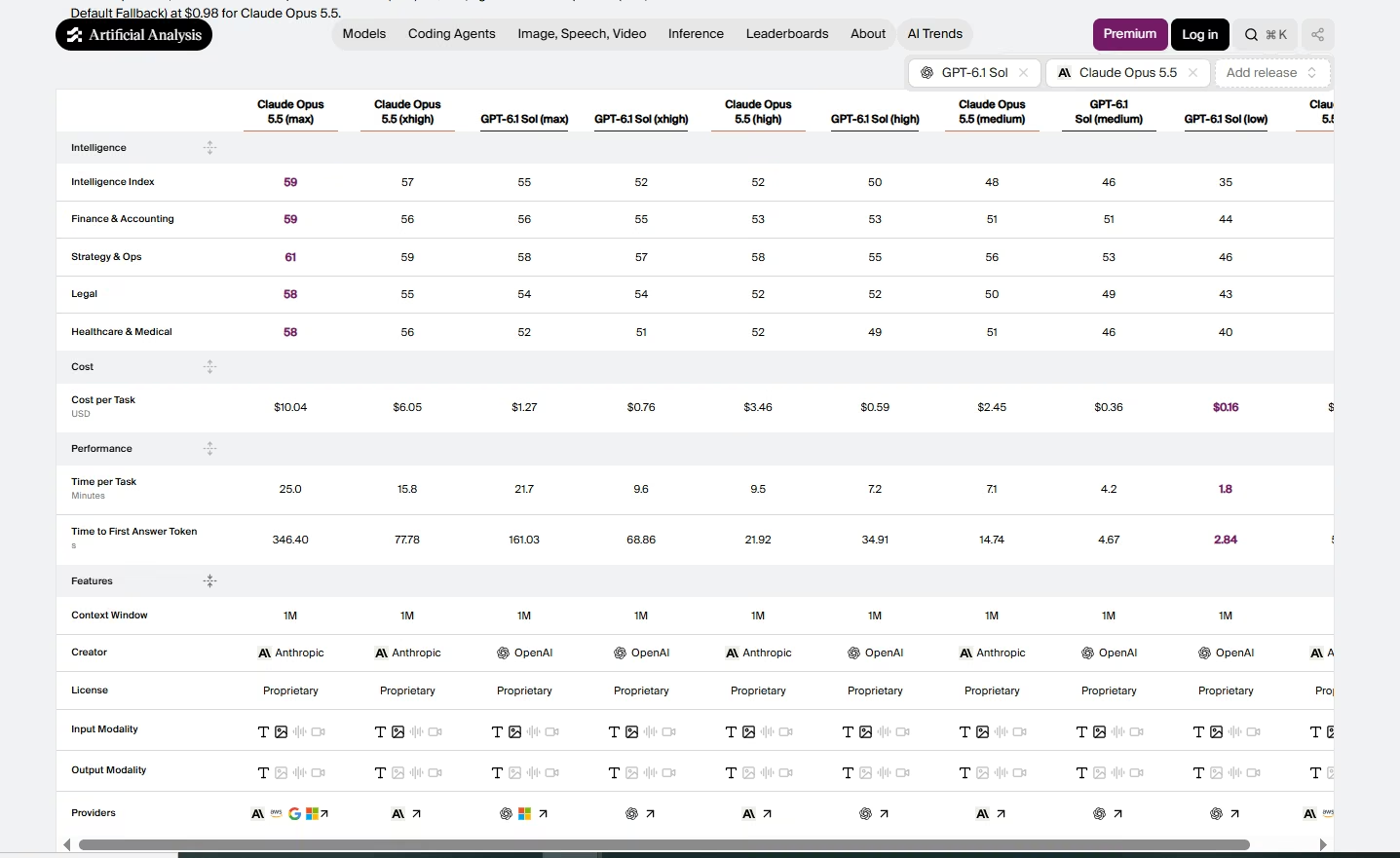
- Neither model wins outright. Claude Opus 5.5 low and GPT-6.1 Sol low both score 35 on the Artificial Analysis Intelligence Index (v5.0.1), so the right pick depends on your workload.
- Sol leads on FrontierCode 2.0 (20.2% vs 15.8%) and CritPt v2 (62.5% vs 36.0%). Opus leads on HLE-Diamond (41.7% vs 38.2%), Terminal-Bench-Science (24.3% vs 11.0%) and AA-Briefcase (1,279 vs 1,114).
- Sol is far cheaper: $0.16 per Intelligence Index task versus $0.98 for Opus.
- Opus streams tokens faster (107 vs 53 per second), but Sol starts sooner and finishes the average task faster.
- Choose Sol for cost-efficient coding and high-volume automation, and Opus for scientific and knowledge-intensive work.
Claude Opus 5.5 low and GPT-6.1 Sol low both score 35 on the Artificial Analysis Intelligence Index, yet Opus costs about six times more per task and each model wins different evaluations. This means that matching benchmark scores can hide very different costs.
That makes the headline score a poor basis for choosing. For Claude Opus 5.5 low vs GPT-6.1 Sol low, the better approach is to match the model to your workload and your cost per task.
This article compares the two on benchmarks, coding, research, agentic work, speed, cost per task, pricing and specs, then shows which AI model to use for each type of work.
Same Effort, Same Intelligence, Different Trade-offs
The tied score is a weighted composite of nine evaluations, and each model wins some of them. Opus 5.5, is positioned for demanding reasoning, coding and long-horizon agentic work. GPT-6.1 Sol, sits one tier below GPT-6 Astra and targets coding, computer use and professional work. For a broader view, see Claude Opus 5.5 vs GPT-6 Astra.
Low effort matters because many production workloads run there to control latency and spend. All figures below come from Artificial Analysis's release comparison, which labels the Opus setup "Low, Default Fallback." Scores at other effort levels differ, so low-effort results cannot be inferred from maximum-effort ones.
Head-to-Head Benchmark Results
The models split the wins, which is why the overall score ties.
| Benchmark | GPT-6.1 Sol (Low) | Claude Opus 5.5 (Low) |
|---|---|---|
| Intelligence Index v5.0.1 | 35 | 35 |
| AA-Briefcase v1.1 | 1,114 | 1,279 |
| AutomationBench-AA | 52.6% | 52.9% |
| Terminal-Bench 4.0 | 30.8% | 31.3% |
| FrontierCode 2.0 | 20.2% | 15.8% |
| AA-Omniscience v1.1 | 38 | 39 |
| GDP.pdf | 27.0% | 25.6% |
| HLE-Diamond | 38.2% | 41.7% |
| CritPt v2 (Hard Subset) | 62.5% | 36.0% |
| Terminal-Bench-Science 0.1 | 11.0% | 24.3% |
Sol's clearest leads are CritPt v2 and FrontierCode 2.0. Opus's are Terminal-Bench-Science, AA-Briefcase and HLE-Diamond. The rest are near-ties within about one point.
Coding and Software Engineering: Where Each Model Pulls Ahead
Sol has a modest edge on low-effort coding, and it reverses at higher effort. On FrontierCode 2.0, which tests agentic software engineering in open-source repositories, Sol scores 20.2% to Opus's 15.8%. On Terminal-Bench 4.0, which measures agentic coding and terminal use, they are nearly tied at 30.8% and 31.3%.
At max effort, Artificial Analysis reports Opus ahead on FrontierCode 2.0, 46.4% to 40.6%. Sol's lead describes the cheap end of the range, not the models in general.
that benchmarks can miss much of the job like understanding unfamiliar codebases, fixing bugs, refactoring, and interpreting test failures. Test on your own repositories before committing.
Verdict: Sol is the stronger and cheaper low-effort coding choice. Evaluate Opus if you plan to run coding work at higher effort.
Research, Physics, and Knowledge Reliability
Opus is stronger on the science and knowledge benchmarks, while Sol wins the physics evaluation. Opus leads on HLE-Diamond (41.7% vs 38.2%), a reasoning and knowledge test, and on Terminal-Bench-Science 0.1 (24.3% vs 11.0%), which covers agentic scientific research workflows in a terminal.
Sol leads on CritPt v2, Hard Subset (62.5% vs 36.0%), a physics reasoning test. It is the largest gap in the comparison and it favors Sol.
Two results are near-ties. AA-Omniscience v1.1 measures knowledge reliability; Opus scores 39 and Sol 38. GDP.pdf tests professional document reasoning; Sol scores 27.0% and Opus 25.6%.
A confident answer is not necessarily a reliable one, so verify any figures a model cites in research work.
Verdict: Opus fits scientific workflows like Terminal-Bench-Science and HLE-Diamond. Sol fits physics-style reasoning and is competitive on document-heavy work.
Agentic Knowledge Work and Automation
Both models are nearly identical on agentic automation benchmarks, so cost and knowledge-work quality break the tie. On AutomationBench-AA, which covers agentic SaaS workflows, Sol scores 52.6% and Opus 52.9%. On Terminal-Bench 4.0 they land at 30.8% and 31.3%.
AA-Briefcase v1.1, an agentic knowledge-work benchmark, separates them: Opus scores 1,279 and Sol 1,114. That suggests an Opus advantage on those tasks, not across every business workflow.
An agent plans actions, calls tools, processes results and recovers from errors. At scale, every difference in per-task spend multiplies, so Sol's $0.16 versus Opus's $0.98 matters most for high-volume automation.
Teams can use an AI app builder to wrap an agent in a working interface, such as an internal request-management tool. Building the application and choosing the model are separate decisions, and the workflow still needs integrations, permissions and testing.
For the mechanics, see how to build AI agents from scratch.
Verdict: Both are equally competitive on automation. Sol is the better value, and Opus leads on AA-Briefcase.
Speed, Latency, and Responsiveness
Sol starts responding sooner and finishes the average benchmark task faster, while Opus streams tokens at a higher rate.
| Speed metric | GPT-6.1 Sol (Low) | Claude Opus 5.5 (Low) |
|---|---|---|
| Output speed | 53 tokens/s | 107 tokens/s |
| Time to first token | 2.84 s | 5.08 s |
| End-to-end time, single-request workloads | 66.82 s | 53.27 s |
| Time per Intelligence Index task | 1.8 min (108 s) | 3.0 min (180 s) |
Opus generates about twice as many tokens per second, while Sol begins answering about 2.2 seconds earlier. Across a full Intelligence Index task, Sol finishes about 72 seconds sooner because it has a lower measured task time. However, Artificial Analysis’s end-to-end single-request measurement favors Opus, at 53.27 seconds versus 66.82 seconds for Sol. These are evaluation measurements, not guaranteed latencies; real times depend on prompt length, tool calls and load.
Verdict: Sol is better for faster first responses and lower time per Intelligence Index task. Opus is better for raw streaming speed and faster completion of Artificial Analysis’s measured single-request workloads.
Token Use and the Real Cost per Task
Sol has a substantially lower cost per task, reflecting its lower token pricing and more efficient benchmark-task spend.
| Metric | GPT-6.1 Sol (Low) | Claude Opus 5.5 (Low) |
|---|---|---|
| Average cost per Intelligence Index task | $0.16 | $0.98 |
Sol’s cost per task is about 84% lower. These are benchmark workloads, not price quotes: actual cost depends on input and output tokens, caching, tool calls and task complexity.
This guide to AI agent cost covers estimating the whole workflow.
Verdict: Sol has a large efficiency advantage. Opus can still pay off if its stronger results on specific tasks reduce retries or review time.
Pricing and Value for Money
Sol costs half as much as Opus per token at standard rates, and its cached-input rate is also half.
| Price per 1M tokens | GPT-6.1 Sol | Claude Opus 5.5 |
|---|---|---|
| Input | $2.00 | $4.00 |
| Output | $10.00 | $20.00 |
| Cached input | $0.10 | $0.20 |
| Cache write | $2.50 | $5.00 |
A request with 100,000 input and 10,000 output tokens, uncached, costs $0.30 on Sol and $0.60 on Opus.
For very long prompts, check each provider’s current long-context pricing before assuming Sol’s standard 50% price advantage applies. Long-context rates, billing thresholds, and maximum input limits can differ from standard short-context pricing.
Verdict: Sol offers better value on list price and task cost. Opus is reasonable when its capabilities justify the premium.
Also Read: GPT-6.1 Terra pricing and Claude Opus 5.5 pricing for caching, batch, and long-context rates on each side.
Context Window and Technical Specs
Both models offer about one million tokens of context and up to 128,000 output tokens, so capacity rarely decides the choice.
| Specification | GPT-6.1 Sol | Claude Opus 5.5 |
|---|---|---|
| API model ID | gpt-6.1-sol | claude-opus-5-5 |
| Context window | 1M tokens | 1M tokens |
| Maximum output | 128,000 tokens | 128,000 tokens |
| Reasoning control | Effort levels: low, medium (default), high, xhigh, max | Adaptive thinking (always on), effort low to max |
| Input / output | Text and images / text | Text and images / text |
Effort is the main dial for trading quality against latency and spend, which is why this comparison stays at low effort.
Verdict: Context and output capacity are comparable. For very long prompts, check each provider’s current long-context pricing before assuming standard rates apply.
When to Choose Opus and When to Choose Sol
Choose Sol when cost, cost efficiency and fast first responses matter most. Choose Opus when scientific reasoning and knowledge-work quality matter more than price.
Choose GPT-6.1 Sol for: cost-sensitive, high-volume applications; coding like FrontierCode 2.0; physics-style reasoning like CritPt v2; workflows that need a fast first response; and document-heavy tasks.
Choose Claude Opus 5.5 for: scientific workflows like Terminal-Bench-Science; knowledge-intensive tasks like HLE-Diamond; agentic knowledge work like AA-Briefcase; long outputs where streaming speed helps; and coding you plan to run at higher effort.
You do not need one model for everything. Teams can route simple, high-volume steps to Sol and reserve Opus for harder ones. To see how Sol at low effort compares with a higher-tier Anthropic model, read GPT-6.1 Sol low vs Claude Fable 5.1 high. For a cheaper Claude tier, see what is Claude Sonnet 5.5.
A Practical Decision Framework
The best answer to "which AI model should I use" comes from testing both on your own workload. This table summarizes where each leads at low effort.
| Evaluation factor | Prefer GPT-6.1 Sol | Prefer Claude Opus 5.5 |
|---|---|---|
| API pricing | Lower ($2 / $10) | Higher ($4 / $20) |
| Cost per task | $0.16 | $0.98 |
| FrontierCode 2.0 | Higher (20.2%) | Lower (15.8%) |
| CritPt v2 | Higher (62.5%) | Lower (36.0%) |
| HLE-Diamond | Lower (38.2%) | Higher (41.7%) |
| Terminal-Bench-Science | Lower (11.0%) | Higher (24.3%) |
| AA-Briefcase | Lower (1,114) | Higher (1,279) |
| Time to first token | Faster (2.84 s) | Slower (5.08 s) |
| Output speed | Slower (53/s) | Faster (107/s) |
Before committing, run a small evaluation:
- Define the workload, such as coding, document analysis, research or automation.
- Prepare realistic test cases from your actual application.
- Test both models with identical prompts and tools.
- Measure quality, cost and completion time together, including corrections needed and tool calls.
- Choose on the whole result, not one benchmark or price.
To turn a workflow into a product, Emergent's AI app builder lets you describe an application in natural language and work toward an interface, backend and database, then review and request changes.
Teams use it to build an internal tool with AI or as an AI dashboard builder for reporting. If you want to build software without coding, the same approach applies. Verify model integrations and test the full workflow before production.
Conclusion
Claude Opus 5.5 low and GPT-6.1 Sol low are equal on overall intelligence, but they are built for different trade-offs. Sol is the more economical starting point: it costs $0.16 per Intelligence Index task versus $0.98 for Opus, starts responding sooner, and finishes the average benchmark task faster. It also leads on FrontierCode 2.0 and CritPt v2, making it a strong default for cost-sensitive coding, physics-style reasoning, and high-volume automation.
Opus is the better candidate when scientific reasoning, knowledge-intensive work, or agentic knowledge work matters more than price. It leads on HLE-Diamond, Terminal-Bench-Science, and AA-Briefcase, and its faster token streaming can help with longer outputs. For teams that need both, route high-volume work to Sol and reserve Opus for the tasks where its strengths justify the premium.
Choosing a model is only one piece of the work. A model can write code, draft responses, or reason through a problem, but on its own it does not give you a working product. You still need an interface, a backend, a database, and somewhere to deploy it. Emergent covers that part. Describe what you want in plain English, and Emergent builds a full-stack app, whether that is an internal tool, a customer-facing chatbot, or a dashboard. If your app needs AI features, the Universal Key connects it to Claude models without a separate Anthropic account, so the model you picked here becomes one part of something people can use.

Describe it. Build it. Launch it.
- End-to-End Creation
- No Code Needed
- Live in Minutes

Most AI app builders stop at prototypes. Emergent creates production-ready apps you can actually launch.
- Production-ready apps
- Web & mobile apps
- Deploy in minutes





