




You spent twenty minutes describing a bookstore into existence: four pages, real copy, a working contact form, no code touched. Now you're staring at Google, wondering if any of it counts.
I built that exact site in Emergent (Fernbrook Books, a hypothetical neighborhood bookstore) in 14 credits and 22 minutes, with four pages of real copy and zero placeholder text. The harder question came next, and it wasn't about the writing.
Do AI websites rank on Google? The answer is a specific, checkable list, and most of it has nothing to do with which tool built the site. By the end, you'll know what's on that list and which checks to run first.
Do AI Websites Rank on Google? The 30-Second Answer
Do AI websites rank on Google? Yes, and it's not close.
Google's documentation on AI-generated content says using AI doesn't affect a page's ranking on its own; the finished content is evaluated under the same standards as any other page.
What determines whether it ranks is the same short list it always has been: whether the page is crawlable and indexable, and how it scores on relevance, quality, and Google's other signals. I ran this exact list against my own build, crawlable and indexable first, everything else after.
What Determines Whether It Ranks
Five things shape the outcome:
- Quality over origin: A page earns its ranking on how useful and complete it is, with no automatic penalty or boost for using AI, so who typed it isn't part of the equation.
- Spam prevention: Google targets mass-produced pages with no real value, regardless of the tool used.
- Technical SEO: Crawlability and rendered content decide whether a page gets indexed at all. Core Web Vitals and mobile usability feed into how it ranks once it's in.
- Human review: Reviewing AI output before publishing catches the errors that keep a page under the quality bar. Google doesn't score the review directly, only the page it produces.
- E-E-A-T signals: Google weighs experience, expertise, authoritativeness, and trust in a page, no matter how it was made.
How Google Evaluates an AI-Built Page
What earns the ranking are the E-E-A-T signals covered above, and none of them depend on how the page got made.
A manually built page with thin, generic copy can lose to an AI-built page with a specific, useful answer, and the reverse can happen too. The bar is the same: does the page help the person who searched for it?
Can Google Tell a Page Was Built by AI?
No. Google's ranking systems don't run an AI-detection step before scoring a page. As covered above, the guidance says the focus stays on quality, not on how the page was produced.
Ahrefs' study of 600,000 top-ranking pages found close to zero correlation between how much AI content a page carried and where it ranked, and 86.5% of those pages contained some AI-generated text.
One exception shows up at the very top. A Semrush analysis of 42,000 blog posts found purely AI-generated content held the number one spot just 9% of the time, against 80% for human-written content. Both studies relied on AI detectors, which carry a real error rate, so treat the exact percentages as directional.
AI-Built Websites vs. Manually-Built Websites: What's the Difference for SEO?
The two approaches still carry different risk profiles, and knowing where each trips up saves you from chasing the wrong fix.
Where the two approaches differ:
The manual edge is narrow, and it's only about defaults: server-rendered output is more likely crawlable on first load. Regarding sitemaps and meta tags, the two end up in the same place, since generated ones still need checking.
What Puts an AI-Built Site's Rankings at Risk
The Rendering Risk
Some AI website and app builders output pages that render client-side, in the visitor's browser. Google's guidance on JavaScript and SEO confirms Google can render these pages, though rendering can fail when required resources are blocked or incompatible. Server-side rendering or pre-rendering avoids the issue, regardless of who wrote the copy.
A visitor's browser runs the script, and the page fills in perfectly, but a crawler hitting the same page can get a nearly empty shell, with the real content queued to load later, or never. That's an indexing problem: great copy won't rank if it never appears in Google's rendered HTML.
The Scale Risk
Google's spam policies name generative AI as one example of scaled content abuse, defined as generating many pages “for the primary purpose of manipulating search rankings and not helping users.”
Scraping and content-stitching sit in the same category, which tells you what the policy is measuring: scale and intent, not the tool. Scale and intent decide the violation, regardless of which tool created the pages. AI makes that pattern easier to run at scale.
What moves the needle:
Should You Worry About This?
What sinks a site is a specific, checkable failure: content Google can't render, or pages with nothing in them worth ranking. AI origin isn't on that list.
Two risks apply to this build: content missing from the rendered HTML, and a pile of thin pages. Fernbrook Books cleared the rendering check outright.
The thin-page risk never came up, because the build prompt demanded substantive copy on all four pages. That was my instruction, not the tool's default, so it says nothing about what an unprompted build would produce.
You're probably fine if:
- Your rendering check shows real content in the HTML.
- Your pages serve a purpose beyond ranking manipulation.
Slow down and check if:
- You've never checked what a crawler sees on your site.
- You're publishing at scale before checking a single page.
How I Checked My AI-Built Test Site's Rendering and Crawlability
I built a small, four-page test site in Emergent, Fernbrook Books, a hypothetical neighborhood bookstore that sells used and rare fiction. It's a throwaway build made purely to run this audit against; it was never taken live, marketed, or given a visitor.
The Build
I used a single detailed prompt, the way an actual power user would brief a tool for a real project:
Build a small marketing website for Fernbrook Books, a hypothetical independent neighborhood bookstore selling used and rare fiction, with four pages: a home page introducing the shop and its inventory, an about page on the shop's history and the owner's background, a staff picks page with three original write-ups on specific books, each a real paragraph rather than a one-line blurb, and a contact page with hours, address, and a simple inquiry form.
Every page needs its own title tag, meta description, one clear H1, and at least 150 words of real body copy, no placeholder Lorem Ipsum anywhere.
Structure the navigation so all four pages are one click from the home page, and generate an XML sitemap automatically listing every page.
I want to check, page by page, whether the actual written content shows up in the page's HTML source, not only after JavaScript finishes loading, since I'll run each page through a crawler-rendering check once the build is done.
Skip e-commerce, checkout, and any payment flow. This is a technical test build only, never meant to go live for real customers or take a real order, so don't build anything that assumes the shop is open for business.
14 credits and 22 minutes later, I had a working first draft, and nothing on it needed rewriting before the checks could start.

The Technical Checks
Right after the build finished, I ran every page through Google's Rich Results Test, which shows the rendered HTML after JavaScript runs.
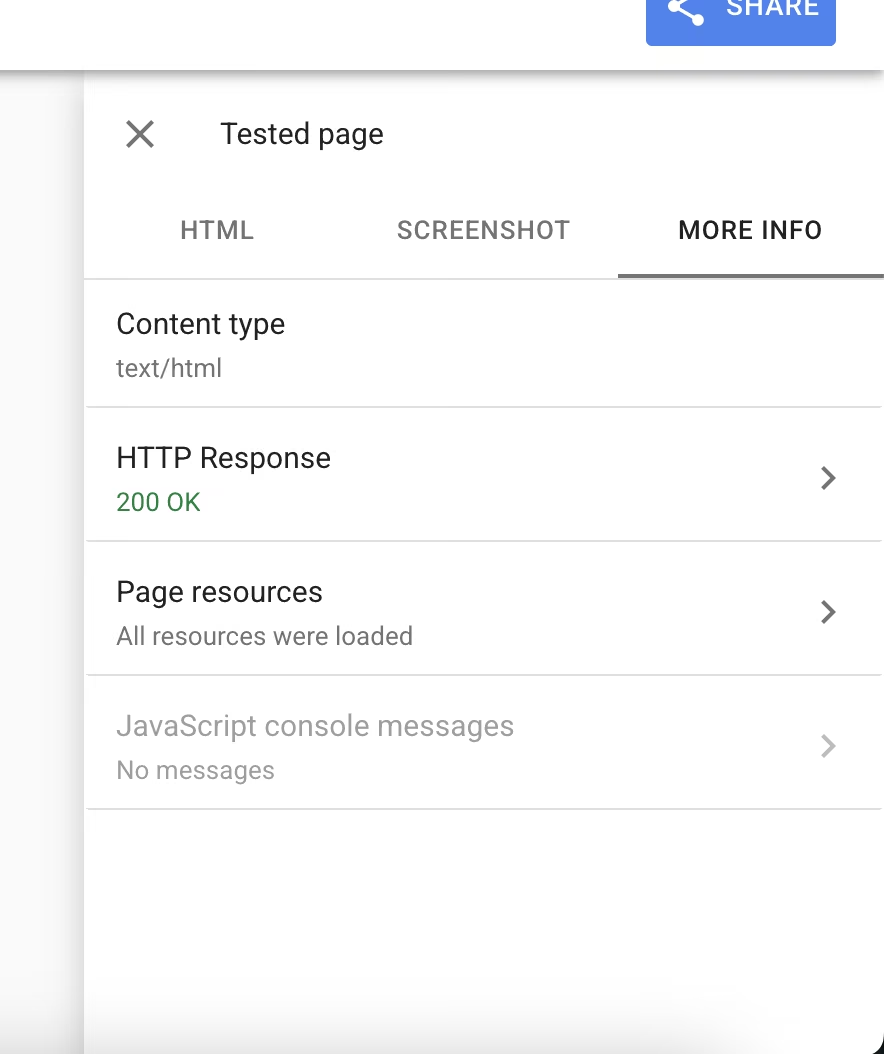
Confirming the actual indexed version would take Search Console's URL Inspection tool, which requires owning the property, something Fernbrook Books never had. That left the rendering check as the closest available test, so it went first, before touching the sitemap or robots.txt.
All four pages rendered successfully, with the readable copy already visible in the rendered HTML. Sitemap.xml generated automatically and listed all four URLs, and robots.txt wasn't blocking anything crawlable, so neither needed a fix. It's a real result for this one build. I wouldn't stretch it into a guarantee that every AI-built site renders the same way by default.
The Duplicate-URL and Indexing Checks
The next potential risk is duplicate URLs; canonical and redirect settings determine whether Google treats them as separate pages or consolidates them into a single page.
Fernbrook Books never had a domain attached, so I couldn't test this directly. Google's guidance on consolidating duplicate URLs treats a www and non-www version as duplicates and recommends redirecting the unused one or declaring a canonical, a five-minute fix.
Crawling then follows a documented pattern: Google's guidance on requesting a recrawl puts it at a few days to a few weeks, with indexing a separate, unguaranteed step after.
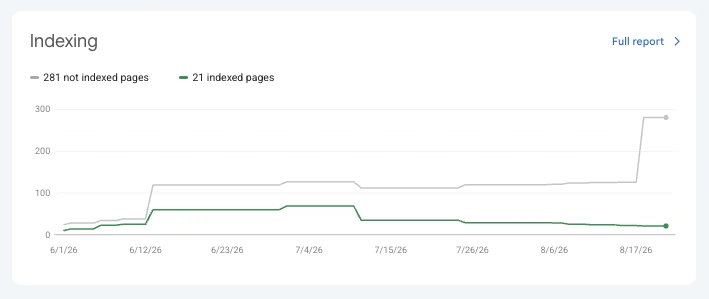
A separate AI-generated site I created has been live for about three months. Of its 302 pages, only 21 are indexed.
Search Console shows 281 total impressions and a single click over that span, at an average position of 51.3.
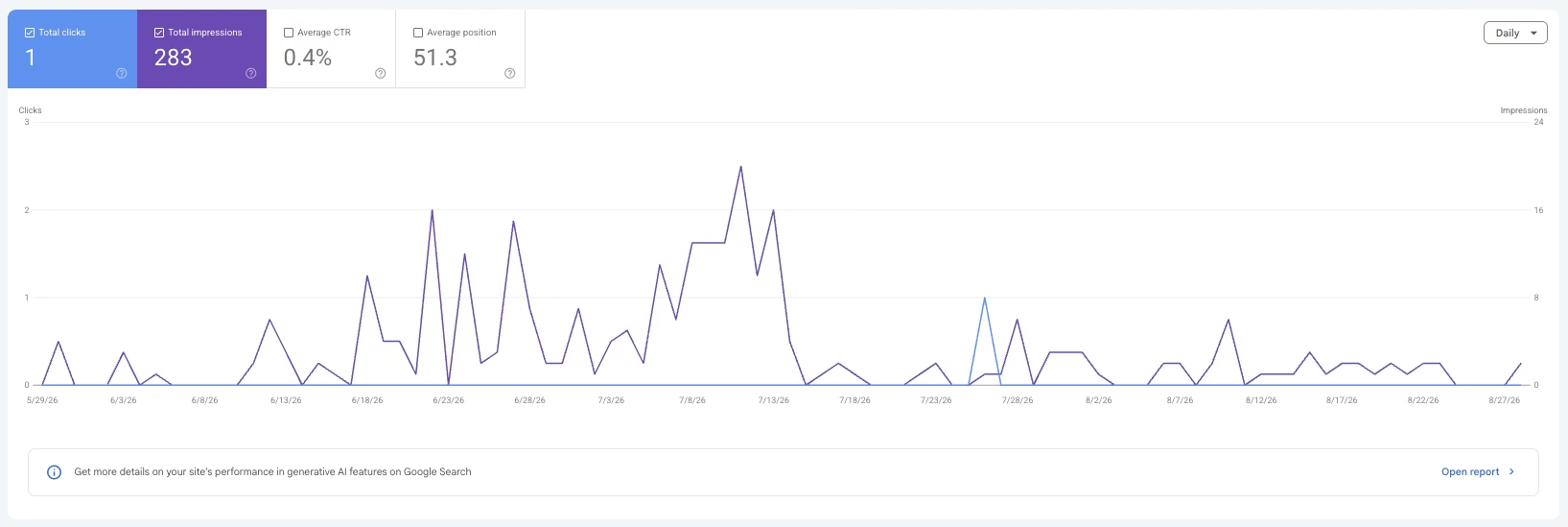
That's one data point. Ahrefs' 2025 study on ranking timelines found only 1.74% of newly published pages reach Google's Top 10 within a year, with the average #1 page five years old.
Search Engine Land's report on SE Ranking's 16-month AI content experiment tracked 2,000 AI-generated articles across 20 new domains with no human editing. 71% were indexed within 36 days, but only 3% of pages remained in the Top 100 by month three, down from over 28% of ranking URLs at the one-month mark. Getting indexed and staying ranked are two different milestones, and the first tells you almost nothing about the second.
If you haven't built your own site yet, the full build walkthrough covers the process end to end.
How to Get Started with an AI-Built Website in 6 Steps
Here's the condensed version of these checks for your own build:
- Write a detailed build prompt: Spell out every page's content. Emergent works from plain-language prompts, so the more specific you are here, the less you'll need to fix later.
- Run a crawler-rendering check on every page: Check what a crawler receives, separate from your browser view.
- Confirm sitemap.xml and robots.txt: Make sure wanted URLs are listed, and nothing needed is blocked.
- Check for duplicate URL variants: Test the www and non-www versions, and any staging subdomain.
- Submit to Search Console: Watch coverage; indexing status shows up there.
- Recheck at the two-week mark: Indexing timing shifts, so a second look catches what you missed.
If you're ready to test that for yourself, we recommend our idea to live website in a day guide.
Common Mistakes to Avoid
These three show up even after the checks above are done right:
- Trusting the browser preview: A page can look finished in your own browser and still have no real content for a crawler to read. Check the rendered HTML before you trust the preview.
- Skipping the duplicate-URL check: A www and non-www version of the same domain look identical to a visitor. Skip this check, and Google is left to pick the canonical version for you, which usually works out but adds a variable you don't control.
- Scaling before confirming value: The specific pattern Google's spam policies target is publishing many pages primarily to manipulate rankings rather than to help users, faster than you can justify each one. A tool that builds a page in minutes makes that line easy to cross without noticing.
The Real Answer
AI websites rank on Google on the same two conditions any site does: Google can crawl and index the page, and the page earns its spot on quality and relevance. Fernbrook Books cleared the technical part; whether the content is good enough is Google's call, site by site, and no rendering check can settle that.
A manually built site hits the same wall if Google can't render its content or the pages provide little value. Execution decides the outcome, no matter which tool built the site.
One habit worth building either way: an author byline when a reader would wonder who wrote a page, and an AI disclosure when they'd wonder how it was made, per Google's own guidance. Neither is a ranking requirement, but both reinforce the E-E-A-T signals already covered.
How Emergent Helps You Build a Site That's Ready to Rank
You can know exactly what to check and still end up with a site that doesn't clear the bar.
Emergent takes SEO requirements in the build prompt the same way it takes everything else, so the first version you check is already close to the version you'd want indexed.
Use the generated SEO structure as a starting point, then verify what a crawler sees. That sequence leaves fewer problems to catch later.
If you're still deciding which tool to use, best AI website builders and the beginner shortlist are both good starting points.
A 2026 Regulatory Note
Ranking and legal disclosure are separate checklists. As of August 2, 2026, the EU's AI Act carries transparency duties for AI-generated content, narrower than the headlines suggest.
The text-labeling duty applies only to text published 'with the purpose of informing the public on matters of public interest.' It doesn't apply where the content has undergone human review or editorial control and a person or company holds editorial responsibility for publishing it.
A separate duty falls on the tool's provider, not the publisher: systems that generate synthetic text must mark their output in a machine-readable format. A small marketing site with a named human behind it is unlikely to trigger the publisher-side labeling duty at all.
If your audience includes the EU, treat this as a separate compliance question from anything Google's ranking systems care about, and check current guidance directly since enforcement details are still being finalized.

Most AI app builders stop at prototypes. Emergent creates production-ready apps you can actually launch.
- Production-ready apps
- Web & mobile apps
- Deploy in minutes







