Google's Gemini 4 Carbon and OpenAI's GPT-6 Astra are competing at the frontier of artificial intelligence, with both models targeting complex reasoning, coding, and demanding professional workflows. However, choosing between them requires more than comparing headline benchmark scores.
Gemini 4 Carbon brings Google's latest advances in reasoning and AI capabilities, while GPT-6 Astra represents OpenAI's flagship approach to solving complex problems, writing code, and completing multi-step tasks. Their differences become particularly important when evaluating real-world performance, API costs, and suitability for AI-powered applications.
This comparison examines Gemini 4 Carbon vs. GPT-6 Astra across intelligence benchmarks, coding, agentic capabilities, speed, context handling, and pricing. It also considers where each model may be the better choice for developers, businesses, and users building AI-powered workflows.
Methodology: This comparison is based on official documentation from Google DeepMind and OpenAI, alongside published benchmark measurements from Artificial Analysis and other evaluation providers. No independent hands-on testing was conducted for this article. Benchmark results may vary depending on reasoning configuration, evaluation methodology, and testing date.
Gemini 4 Carbon vs. GPT-6 Astra: Quick Comparison
The following table summarizes their key specifications and performance indicators.
Gemini 4 Carbon vs. GPT-6 Astra specifications and reported performance. Sources: Google DeepMind Gemini 4 Carbon Model Card, Google's Carbon announcement, and OpenAI's GPT-6 Astra documentation. Prices are in USD. The Intelligence Index figures are the historical v5.0 results reported by Google, not necessarily the latest leaderboard scores.
What Do These Differences Mean?
Gemini 4 Carbon offers a broader set of native input modalities and significantly lower introductory API pricing. Its large context window also supports workflows involving extensive documents, repositories, and multimodal inputs.
GPT-6 Astra offers a slightly larger documented context window and a defined maximum output allowance of 128,000 tokens. It remains competitive across complex reasoning, coding, and computer-use benchmarks.
However, specifications alone do not determine which model performs better. Actual results depend on the task, reasoning settings, available tools, and the evaluation methodology. The following sections examine these differences using benchmark evidence and practical examples.
Gemini 4 Carbon vs. GPT-6 Astra: Reasoning and Intelligence Benchmarks
Gemini 4 Carbon and GPT-6 Astra are designed to handle complex reasoning tasks, but their performance varies across different evaluations. Intelligence benchmarks measure capabilities such as mathematical reasoning, scientific problem-solving, knowledge work, and multi-step decision-making.
Google DeepMind's November 2026 model card provides several direct comparisons between the two models. These results suggest that Gemini 4 Carbon performs particularly well in scientific reasoning and long-context tasks, although GPT-6 Astra remains competitive across demanding evaluations.
How Do Their Benchmark Scores Compare?
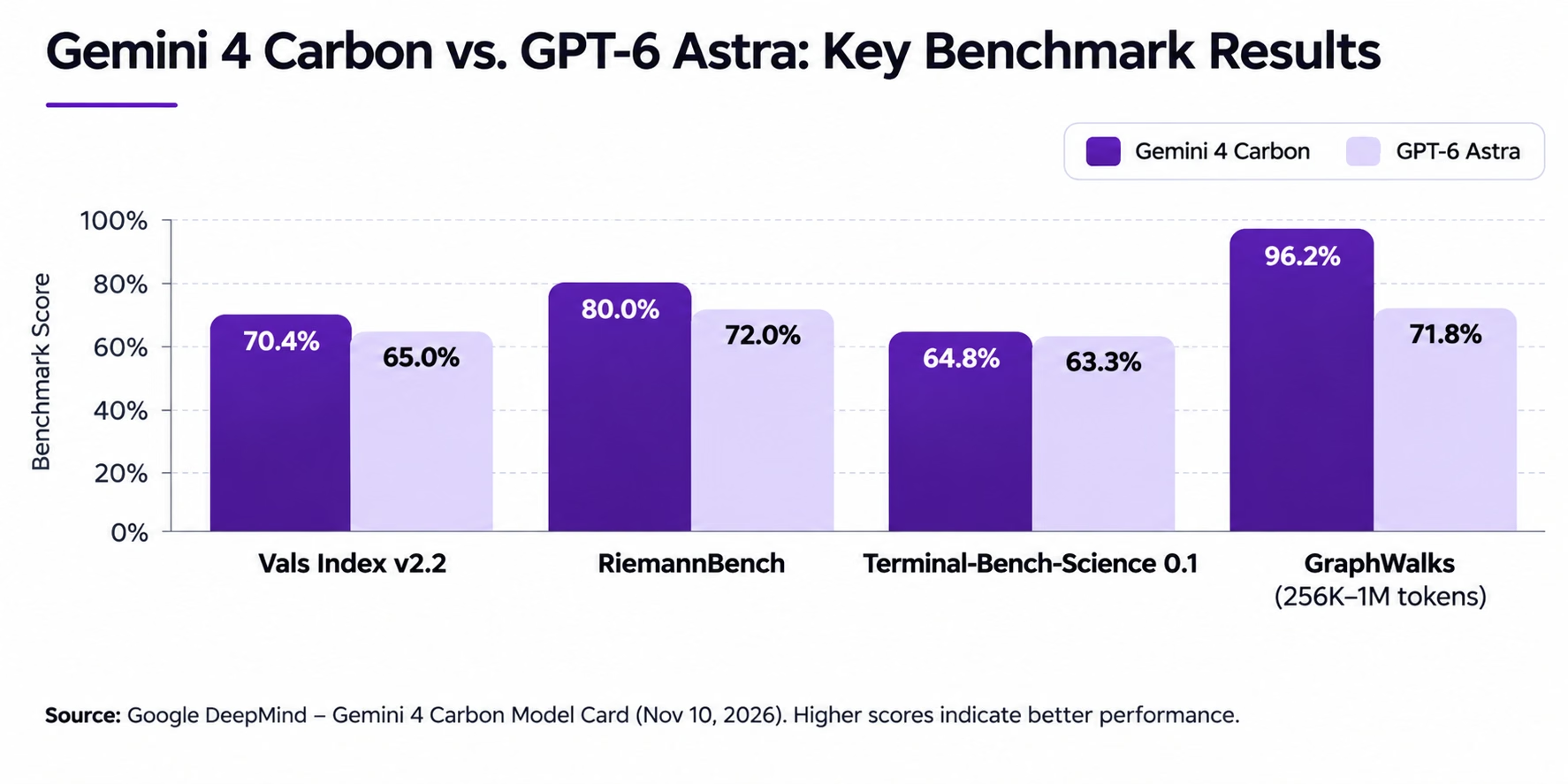
Selected Gemini 4 Carbon and GPT-6 Astra benchmark results reported in Google's November 2026 model card, using October 2026 evaluations. Higher scores indicate better performance within each benchmark. Source: Google DeepMind — Gemini 4 Carbon Model Card. These are reported results, not a fresh independent retest.
Source: Google DeepMind Model Card
The results highlight three important differences.
General intelligence: Carbon leads Astra by two points on the historical Artificial Analysis Intelligence Index v5.0 results reported by Google. However, the index combines several evaluations, and its rankings can change as models and testing methodologies are updated.
Scientific reasoning: Carbon scores 80.0% on RiemannBench, compared with Astra's 72.0%. It also holds a smaller advantage on Terminal-Bench-Science 0.1. These results suggest stronger performance on the particular scientific tasks evaluated, rather than establishing superiority across every scientific discipline.
Long-context reasoning: Carbon achieves 96.2% on GraphWalks, compared with Astra's 71.8%. This is a substantial difference on a benchmark designed to test reasoning over large amounts of interconnected information. However, performance on GraphWalks does not guarantee the same advantage across all long-document or repository-analysis tasks.
What Do Independent Evaluations Show?
Artificial Analysis provides an additional perspective through its independently measured comparison of Gemini 4 Carbon (High) and GPT-6 Astra (Max). In the figures checked on November 11, 2026, Carbon scores 60 on the Artificial Analysis Intelligence Index, compared with Astra's 57.
Carbon also leads on several individual evaluations, including Terminal-Bench 4.0, while Astra performs better on certain software engineering and professional reasoning benchmarks. However, the comparison uses different reasoning configurations, so the results should not be interpreted as a controlled evaluation at equivalent reasoning effort.
For businesses and developers, these results highlight the importance of evaluating models under comparable conditions. Google's published benchmark figures and Artificial Analysis's updated measurements provide useful evidence, but they should not be combined into a single ranking without accounting for evaluation dates, reasoning configurations, and methodology. The right choice ultimately depends on the reasoning tasks involved, acceptable latency, and cost per successful task.
For Carbon's own scores across the full Index, see our Gemini 4 Carbon benchmarks guide.
Gemini 4 Carbon vs. GPT-6 Astra: Coding and Agentic Capabilities
Coding performance involves more than generating syntactically correct code. Advanced AI models must also understand existing codebases, identify bugs, run tests, work with development tools, and complete multi-step tasks.
Gemini 4 Carbon and GPT-6 Astra demonstrate strong capabilities in these areas. However, benchmark results suggest that their relative performance depends on the type of software engineering task.
Which Model Performs Better on Coding Benchmarks?
Google DeepMind's November 2026 model card reports the following results:
Selected coding and agentic benchmark results reported by Google DeepMind. Source: Gemini 4 Carbon Model Card, November 2026. Results reflect the reported evaluation configurations and should not be treated as identical real-world testing conditions.
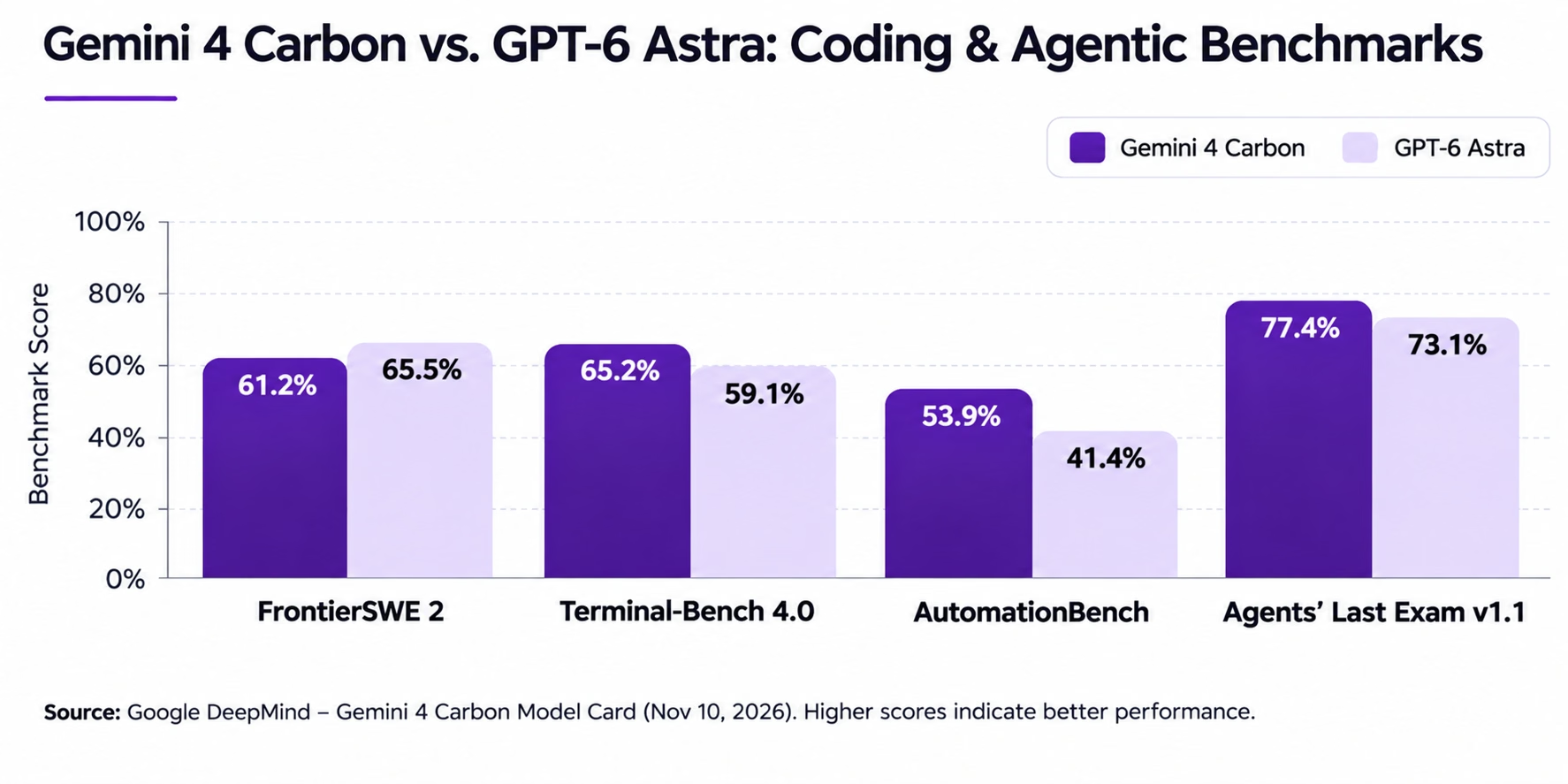
Source: Google DeepMind: Gemini 4 Carbon Model Card.
The results reveal several differences.
Software engineering: GPT-6 Astra scores 65.5% on FrontierSWE 2, compared with Carbon's 61.2%. This gives Astra an advantage on the software engineering tasks included in that evaluation, which is relevant to developers maintaining and modifying existing applications.
Terminal-based coding: Carbon scores 65.2% on Terminal-Bench 4.0, ahead of Astra's 59.1%. This suggests stronger performance under the benchmark's terminal-based development conditions, where models must work through technical tasks using command-line tools.
Multi-step agentic tasks: Carbon leads Astra on Agents' Last Exam v1.1, scoring 77.4% against 73.1%. The result supports Carbon's capabilities on the evaluated agent tasks, although it does not establish that Carbon is more reliable across every autonomous workflow.
The difference on SWE-sweep is just 0.1 percentage points. Such a narrow margin should not be interpreted as a meaningful practical advantage without additional statistical evidence.
Which Model Is Better for AI Agents and Workflow Automation?
AI agents differ from conventional chatbots because they can use tools, interact with software, and carry out sequences of actions toward a defined goal.
For example, an AI agent might receive a customer inquiry, retrieve relevant information, update a CRM record, and prepare a follow-up response. Completing this workflow requires the model to maintain context, select appropriate actions, and handle intermediate results.
AutomationBench offers one way to evaluate these capabilities.
Workflow automation and computer-use benchmark results. Source: Google DeepMind, Gemini 4 Carbon Model Card.
Carbon leads Astra by 12.5 percentage points on the AutomationBench evaluation reported by Google DeepMind. This indicates stronger performance on the tested Zapier-based automation tasks, although results may differ across other platforms and real-world workflows.
However, the models perform similarly on the reported OSWorld-2.1 offline subset, with Carbon ahead by only 0.6 percentage points. This suggests that their relative performance can change considerably depending on the agent environment and evaluation criteria.
For businesses, benchmark performance is only one consideration. Reliable automation also requires appropriate tool permissions, error handling, human approval for consequential actions, and monitoring of completed tasks.
An agent that reads a customer inquiry, updates a CRM record, and drafts a reply is a workflow you can build yourself. An AI agent builder lets you define those steps and mark which actions need a person's approval first.
What Does This Mean for Application Development?
GPT-6 Astra's FrontierSWE 2 result makes it a strong candidate for software engineering workflows involving existing codebases, debugging, and application maintenance.
Gemini 4 Carbon's results on Terminal-Bench 4.0 and AutomationBench make it worth considering for terminal-based development and multi-step business automation.
However, neither model's benchmark performance guarantees that it will independently produce a production-ready application.
For users building applications with AI, the key considerations are whether a model can understand requirements, generate functional features, identify errors, and improve an application through testing and iteration.
For how other models rank on this kind of work, see our best AI models for coding guide.
Gemini 4 Carbon vs. GPT-6 Astra: Speed and Latency
Speed matters when AI models are used for coding, customer-facing applications, and automated workflows. However, a model's response speed is not determined by a single metric. The time required to begin responding, generate output, and complete an entire task can vary considerably.
Artificial Analysis provides performance measurements for Gemini 4 Carbon (High) and GPT-6 Astra (Max).
How Fast Are Gemini 4 Carbon and GPT-6 Astra?
Speed and latency measurements for Gemini 4 Carbon (High) and GPT-6 Astra (Max), captured on November 11, 2026. These figures represent a dated snapshot rather than continuously updated values. Results may change as Artificial Analysis refreshes its measurements. Source: Artificial Analysis: Model Comparison.

Gemini 4 Carbon generates output at approximately 2.1 times GPT-6 Astra's measured rate. It also records a shorter time to first token and lower mean end-to-end latency for the evaluated single-request workloads.
However, GPT-6 Astra completes the average Intelligence Index task in 23.0 minutes, compared with Carbon's 26.1 minutes. This shows that faster output generation does not necessarily translate into faster completion of complex tasks.
Token consumption provides additional context. Carbon uses approximately 123,000 output tokens and 72,200 reasoning tokens per evaluated task, compared with Astra's 52,000 output tokens and 35,800 reasoning tokens. These differences can affect processing time and cost.
Importantly, the comparison uses Carbon at High reasoning effort and Astra at Max. The results therefore represent the tested configurations rather than an equal-effort comparison.
What Does This Mean for Real-World Applications?
For interactive applications, response latency can affect the user experience. A shorter wait before the first response may be beneficial for AI assistants, document-processing interfaces, and applications where users expect timely feedback.
For complex coding and research tasks, total completion time and successful task execution may matter more than how quickly the model starts responding.
Businesses should evaluate speed alongside accuracy, token consumption, and cost per successful task when choosing a model for production workloads.
Gemini 4 Carbon vs. GPT-6 Astra: API Pricing and Cost Efficiency
API pricing is an important consideration when choosing an AI model for business applications, coding agents, and automated workflows. While Gemini 4 Carbon has substantially lower published token rates than GPT-6 Astra, actual costs also depend on reasoning effort, token consumption, caching, and the number of attempts required to complete a task.
How Much Do Gemini 4 Carbon and GPT-6 Astra Cost?
Standard API token pricing in USD, excluding applicable taxes and additional tool charges. Sources: Google's Gemini 4 Carbon availability announcement and OpenAI's GPT-6 Astra documentation. Pricing verified November 11, 2026.
At introductory rates, Carbon's input and output tokens cost 80% less than Astra's standard rates. After Carbon's introductory period ends on November 30, its published input and output prices will still be 60% lower.
GPT-6 Astra also applies higher rates to requests exceeding 272,000 input tokens. For these requests, OpenAI charges twice the standard input and cached-input rates and 1.5 times the standard output rate across the entire request. This can increase costs for workflows involving exceptionally large documents or codebases.
Why Does Token Consumption Matter?
A lower price per token does not necessarily translate into a proportionately lower cost per completed task.
Artificial Analysis measurements accessed November 11, 2026, show the following token consumption:
Artificial Analysis model comparison. Figures are dynamic and reflect different reasoning configurations.
Carbon generates approximately 2.37 times as many output tokens per evaluated task as Astra in this comparison. Its reasoning-token usage is also approximately twice as high.
These measurements help explain why Carbon's lower token prices should not be interpreted as an equivalent reduction in the cost of every workload.
Each rate card is broken out in our Gemini 4 Carbon pricing and GPT-6 Astra pricing guides.
Which Model Offers Better Cost Efficiency?
Using the reported average output-token counts and standard API rates, we can estimate the output-token component of a benchmark task's cost.
Illustrative calculation: Average output tokens per task multiplied by the published output-token price per million. These figures are not independently measured total task costs.
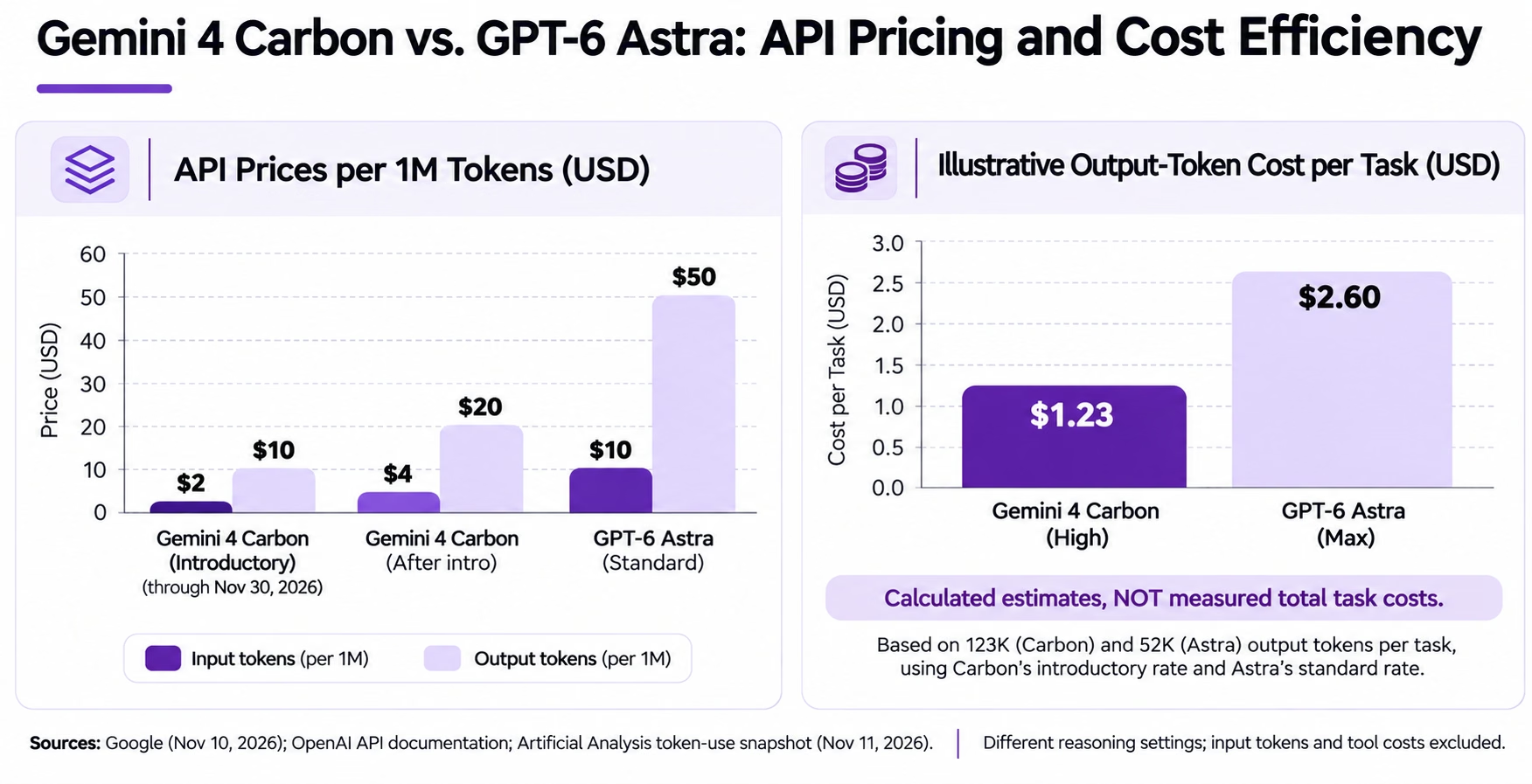
Sources: Google: Gemini 4 Carbon Pricing, OpenAI: GPT-6 Astra, and Artificial Analysis: Model Comparison.
Artificial Analysis also reports a broader cost-per-task metric. In its comparison of Gemini 4 Carbon (High) and GPT-6 Astra (Max), Carbon costs $7.76 per evaluated task, compared with $6.24 for Astra. These figures use the pricing assumptions and evaluation configurations shown by Artificial Analysis and should not be directly equated with the introductory-rate, output-only estimates above. They demonstrate why lower token prices do not necessarily translate into lower total costs for complex workloads.
Under this simplified calculation, Carbon's output-token cost is approximately 53% lower than Astra's at introductory rates. After the introductory period, the estimated difference narrows to approximately 5%.
The illustrative estimates exclude input tokens, caching effects, additional tool charges, and other workload-specific costs. They also compare Carbon at High reasoning effort with Astra at Max. Accordingly, neither the output-only calculation nor the published cost-per-task figures establish which model would be more economical under identical reasoning settings and production workloads.
For production applications, developers should therefore evaluate the total cost of successfully completing a representative task, rather than selecting a model solely on its advertised price per million tokens.
Gemini 4 Carbon vs. GPT-6 Astra: Context Window and Multimodal Capabilities
A model's context window determines how much information it can process within a request. This becomes important when analyzing lengthy documents, reviewing software repositories, or working with multiple sources of information.
Gemini 4 Carbon and GPT-6 Astra both support context windows of approximately one million tokens. However, they differ in the types of inputs they accept and how their context limits are documented.
How Do Their Context Windows Compare?
Context window and input/output capabilities. Sources: Google DeepMind: Gemini 4 Carbon Model Card and OpenAI: GPT-6 Astra API Documentation.
Both models can handle substantial amounts of text, making them suitable for tasks involving extensive documentation, large codebases, and multi-document analysis.
Astra provides a slightly larger documented context window of 1,050,000 tokens, with a maximum output limit of 128,000 tokens. Google's Cloud documentation lists Carbon's maximum output at 1,048,576 tokens, although its input and output must share the available context budget. These limits describe capacity rather than the amount of text either model will reliably generate in a single response.
However, a larger context window does not automatically mean better long-context reasoning. Models must also retrieve relevant information, maintain relationships between details, and apply that information accurately.
Google's reported GraphWalks results, discussed earlier, indicate stronger performance for Carbon on that particular long-context reasoning benchmark. Those results should not be generalized to every document-analysis task.
Which Model Offers Better Multimodal Capabilities?
Gemini 4 Carbon supports text, image, audio, and video inputs. This allows developers to build workflows involving multiple types of information without necessarily converting every source into text before submitting it to the model.
For example, a business could use Carbon to analyze a combination of written reports, product images, and recorded presentations.
GPT-6 Astra supports text and image inputs. It can therefore process written instructions, documents, screenshots, and visual information, but direct audio and video input are not listed among its supported API modalities.
This does not prevent developers from building audio- or video-based applications using OpenAI's broader ecosystem. However, those workflows may require additional models or preprocessing steps.
For applications that primarily involve text, documents, and screenshots, both models offer relevant capabilities. Carbon has a clearer advantage when native audio and video understanding are essential.
Ultimately, developers should evaluate multimodal support alongside processing accuracy, integration requirements, latency, and cost.
Gemini 4 Carbon vs. GPT-6 Astra: Which Should You Choose?
Choosing between Gemini 4 Carbon and GPT-6 Astra depends on the tasks you want to accomplish, your budget, and the capabilities your applications require.
Published benchmarks suggest that both models are competitive across advanced reasoning, coding, and agentic workflows. However, neither consistently outperforms the other across every evaluation.
Which Model Is Better for Different Use Cases?
Use-case recommendations based on published specifications and benchmark results. Sources: Google DeepMind's Gemini 4 Carbon Model Card, OpenAI's GPT-6 Astra documentation, and Artificial Analysis. Recommendations are indicative rather than guarantees of performance.
When Should You Choose Gemini 4 Carbon?
Gemini 4 Carbon is worth considering when your application requires native multimodal inputs, extensive context handling, or multi-step workflow automation.
Its reported advantages on Terminal-Bench 4.0 and AutomationBench also make it a promising option for developers working with tool-driven applications.
Carbon's lower published API prices may appeal to businesses processing large volumes of requests. However, its higher token consumption in the evaluated reasoning configuration means that actual workload costs should be measured rather than inferred from token rates alone.
When Should You Choose GPT-6 Astra?
GPT-6 Astra remains a strong option for demanding software engineering tasks, particularly those resembling the FrontierSWE 2 evaluation.
It may also suit workflows where its available development tools, integration options, and model behavior align better with an existing application architecture.
Although Astra has higher published API token rates, its lower output-token consumption in the compared Artificial Analysis configurations demonstrates why pricing alone should not determine model selection.
Is There an Overall Winner?
Gemini 4 Carbon has advantages across several published benchmarks, native input modalities, and API pricing. GPT-6 Astra performs better on certain software engineering evaluations and remains competitive in complex agentic tasks.
There is no universal winner. Businesses should select a model based on representative workloads, accuracy requirements, integration needs, latency, and total cost per successful task.
Both models now have newer versions. Our GPT-6.2 Astra vs Gemini 4 Carbon comparison covers the current Astra.
Conclusion
Gemini 4 Carbon and GPT-6 Astra are both capable AI models, but their strengths differ. Carbon leads on several published reasoning, automation, and terminal-based coding benchmarks while offering broader native multimodal support and lower API token prices. Astra remains competitive, particularly in software engineering tasks, where it outperforms Carbon on FrontierSWE 2.
Choosing an AI model is only one part of building useful software. With Emergent, users can turn natural-language instructions into functional applications, test their features, and deploy them without manually writing extensive code. This helps businesses move beyond comparing AI models to putting AI-powered solutions into practice.

Describe it. Build it. Launch it.
- End-to-End Creation
- No Code Needed
- Live in Minutes
Most AI app builders stop at prototypes. Emergent creates production-ready apps you can actually launch.
- Production-ready apps
- Web & mobile apps
- Deploy in minutes