



Gemini 4 Hydrogen pricing starts at $1.50 per million input tokens and $7.50 per million output tokens, according to Google's published pricing information. Launched on November 12, 2026, Hydrogen has a reported Artificial Analysis Intelligence Index score of 51 at High thinking effort and 54 at XHigh. Gemini 4 Argon has a reported score of 50, although differences in benchmark versions and evaluation settings limit direct comparisons.
Gemini 4 Argon and Carbon are listed at $2 per million input tokens and $10 per million output tokens through November 30, 2026. From December 1, those rates are scheduled to double to $4 and $20, making Hydrogen 62.5% cheaper at the listed token prices, assuming its rates remain unchanged.
Gemini 4 Hydrogen is developed for fast, routine agent tasks. Gemini 4 Hydrogen supports four thinking levels: low, medium, high, and xhigh, and a unified 1,048,576-token limit shared between input and output. A single foreground segment can generate up to 65,536 output tokens, while supported long-decode workflows can extend generation up to the remaining token limit.
According to Google's early testing reports, Gemini 4 Hydrogen delivered up to 2.8x faster execution and used 12% to 23% fewer tokens than Gemini 3.8 Flash in selected partner workflows involving SQL, analytics, and complex coding tasks. These are workload-specific observations, not guaranteed improvements across all applications.
Gemini 4 Hydrogen Pricing at a Glance
This compares Gemini 4 Hydrogen pricing with its previous models, Gemini 4 Argon and Gemini 4 Carbon, along with its positioning.
Prices per 1M tokens as of November 13, 2026.
What Is Gemini 4 Hydrogen
Google launched Gemini 4 Hydrogen on November 12, 2026, focusing on speed and efficiency for everyday coding and agentic workflows. The model is designed to work alongside Carbon and Argon in workflows that use multiple AI models. While Carbon and Argon handle long-horizon reasoning, Google positions it as an upgrade for organizations still running Gemini 3.8 Flash.
In workflows involving multiple models, Carbon can handle complex reasoning while Hydrogen takes on coding, testing, and verification tasks. This approach can help teams work more efficiently without relying on the more expensive model for every task.
Hydrogen supports debugging, answering questions about a codebase, making targeted code changes, and rapid iteration.
Four Thinking Levels
Gemini 4 Hydrogen offers four configurable thinking levels: low, medium, high, and xhigh. These settings let developers balance latency, token usage, and reasoning depth for the task.
Where Is Gemini 4 Hydrogen Available, and Is It Free?
Developers can use Hydrogen in the Gemini API and Google AI Studio on both free and paid tiers, and specifically on the paid tier in Android Studio. Organizations can choose it in Gemini for Business. Paid Google AI Pro and ultra-level subscribers get it in Antigravity, Google’s own coding environment.
Consumers can access Hydrogen through the Gemini app and Google Search, while eligible subscribers can use it in Google Sheets. In the Gemini app, free users may access Hydrogen through automatic model selection when it is appropriate for their prompts.
Free-tier access is subject to request and token limits, which can vary by project and usage tier. Developers can check their active limits in Google AI Studio before estimating how much testing or development they can complete for free.
Gemini 4 Hydrogen API Pricing Explained
Prices are per 1 million tokens, which is the same across the full 1 M-token context window. For smaller workloads, this translates to $0.0015 per 1,000 input tokens and $0.0075 per 1,000 output tokens. The final cost depends on the number of input, generated, and thinking tokens consumed.
Google Gemini API pricing documentation. Batch and Flex both offer a 50% reduction in token rates compared with standard pricing. Batch supports asynchronous processing, while Flex provides synchronous processing with variable latency and best-effort availability.
What Gemini 4 Hydrogen Costs In Practice
Consider 1,000 requests, each using 2,000 input tokens and 500 output tokens. Here is how much the workload would cost across different processing options.
These estimates assume the stated output-token counts include thinking tokens and exclude caching, additional service charges, and regional pricing differences. At Google AI Studio's price ($1.50 input, $7.50 output per 1M tokens), 10,000 requests a day with 1,000 input and 500 output tokens each cost $52.50 a day, or approximately $1,575 over a 30-day month. Change the numbers to match your workload, or compare them with other models.
Why Output Costs More Than It Looks
Output tokens include thinking tokens, the reasoning the model does before it answers. A response with 600 visible tokens and 1,400 thinking tokens bills 2,000 output tokens, which costs $0.015, not the $0.0045 the visible text alone suggests. Because Hydrogen defaults to the high thinking level, lowering the level on simple tasks is the fastest way to cut costs.
Gemini 4 Hydrogen vs. Argon vs. Carbon Pricing
Gemini 4 Hydrogen currently costs less per token than Argon and Carbon. The pricing gap will widen further on December 1, 2026, when the latter two models move to higher input and output rates, as illustrated below.
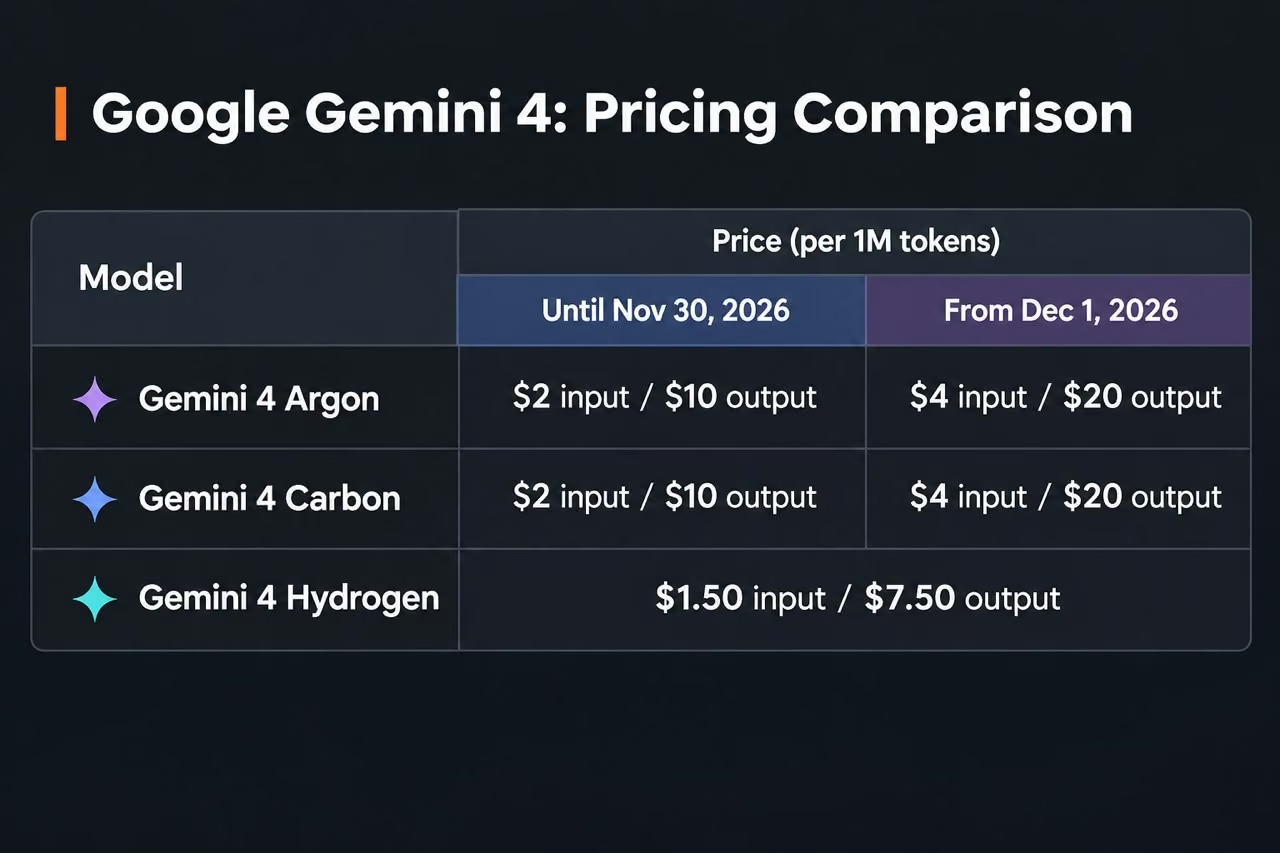
Gemini 4 Hydrogen, Carbon, and Argon standard API pricing per million input and output tokens, including the scheduled December 1, 2026 price changes.
Gemini 4 Pricing Changes from December 1, 2026
From December 1, 2026, Gemini 4 Argon and Carbon input pricing will increase from $2 to $4 per million tokens, while output pricing will rise from $10 to $20 per million tokens. Gemini 4 Hydrogen will remain at $1.50 per million input tokens and $7.50 per million output tokens, making it 62.5% cheaper at the listed rates. Teams estimating December API costs should account for this widening price gap when comparing models.
For how Carbon prices work in more detail, see our Gemini 4 Carbon pricing guide
What One Request Costs
Consider a request with 100,000 input tokens and 10,000 output tokens, without caching.
Until November 30, 2026, Gemini 4 Hydrogen is 25% cheaper than Gemini 4 Argon and Carbon based on standard input and output token prices. From December 1, when Argon and Carbon pricing increases, Hydrogen will be 62.5% cheaper per token, assuming its published rates remain unchanged.
Cost per Task, Not Cost per Token
Token prices determine the rate, but total cost depends on how many tokens a model uses to complete a task. According to Artificial Analysis, Gemini 4 Hydrogen costs $1.87 per Intelligence Index task at High thinking effort and $3.16 at XHigh. In comparison, Argon (High) costs $4.97 and Carbon (High) costs $5.48 per task. These benchmark-specific estimates highlight the importance of reasoning effort and token consumption. Actual production costs will depend on workload complexity, token usage, and task-completion rates.
For a practical comparison, test all three models on the same set of tasks and measure their total token usage, response times, and successful completions. A model with cheaper tokens may not deliver the lowest cost per completed task if it requires more reasoning tokens or repeated attempts.
Also Read: Gemini 4 Hydrogen alternatives for how six other models compare on cost per task.
What You Get for the Difference
On the Artificial Analysis Intelligence Index v5.0.1, Gemini 4 Hydrogen scores 51 at High thinking effort and 54 at XHigh. Gemini 4 Carbon (High) scores 60, while Argon (High) scores 50. Carbon leads on the reported index, although differences in thinking effort should be considered when comparing these results.
Hydrogen scores slightly higher than Argon on the reported Intelligence Index while costing less per million tokens. Carbon leads on overall benchmark performance, making it worth considering for complex reasoning tasks. However, these scores do not guarantee better results across every workload, and the lowest token price does not always translate into the lowest cost per completed task.
Also Read: Gemini 4 Carbon vs Gemini 4 Argon for how the two frontier models differ.
Conclusion
Gemini 4 Hydrogen offers the lowest standard API token rates among the three models compared, and its pricing advantage will widen on December 1 when Argon and Carbon prices double. However, the final cost depends on how many tokens a model consumes, particularly thinking tokens, and whether it completes the task successfully.
Start with Hydrogen for routine tasks, use a lower thinking level when deeper reasoning isn't needed, and route more demanding workloads to Carbon when the added capability justifies the cost. To build that routing yourself, an AI agent builder lets you describe which tasks go to which model and where a person reviews. Reassess your model selection after December 1 based on actual token usage and cost per completed task.
Choosing an AI model is only one part of building a working product. With Emergent, you can describe an application, dashboard, or internal tool in plain English and turn your idea into a functional full-stack application. The platform handles development, testing, and deployment, allowing you to focus on building and refining your product.
Get Started with Emergent, the full-stack App Builder

Describe it. Build it. Launch it.
- End-to-End Creation
- No Code Needed
- Live in Minutes

Most AI app builders stop at prototypes. Emergent creates production-ready apps you can actually launch.
- Production-ready apps
- Web & mobile apps
- Deploy in minutes





