A higher benchmark score does not always mean a better model for your workload. Gemini 4 Hydrogen and Claude Sonnet 5.5 are nearly tied on independent intelligence scores, but they perform differently across everyday AI tasks. Hydrogen is faster, costs less per task, and supports audio and video input. Sonnet 5.5 has an edge in terminal coding and computer-use automation.
That difference matters when choosing a model for a real application. A high-volume workflow may benefit more from Hydrogen's speed and lower costs, while a coding agent that works through terminals may perform better with Sonnet 5.5. This comparison examines their benchmarks, pricing, output speed, coding capabilities, context windows, and enterprise controls to help you decide which model fits your requirements.
Gemini 4 Hydrogen vs. Claude Sonnet 5.5 at a Glance
Hydrogen is the cheaper, faster, more multimodal model, and Sonnet 5.5 is the stronger terminal agent. Both offer roughly 1M tokens of context.
Pricing and scores as of November 13, 2026. Sources: Google, Anthropic, and Artificial Analysis.
What Are Gemini 4 Hydrogen and Claude Sonnet 5.5?
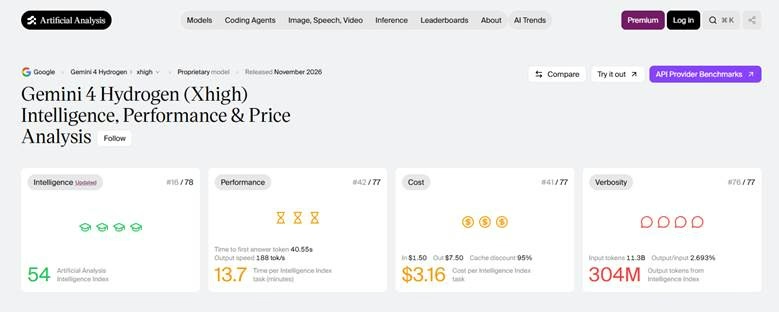
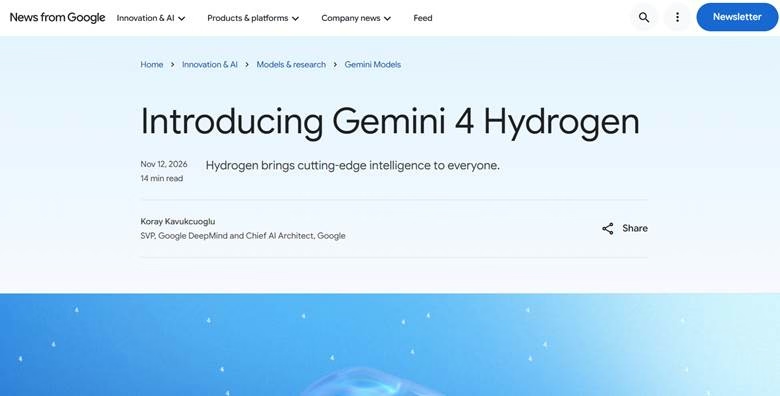
Hydrogen is Google's speed-focused model in the Gemini 4 family, and Claude Sonnet 5.5 is Anthropic's mid-tier model, released on September 28, 2026. Google calls Hydrogen its daily driver for agentic workflows, built for rapid execution while Gemini 4 Carbon and Argon handle deep, long-horizon reasoning. It replaces Gemini 3.8 Flash, finishes tasks 2.5 times faster than that model at the default setting, and is priced flat across its full context window.
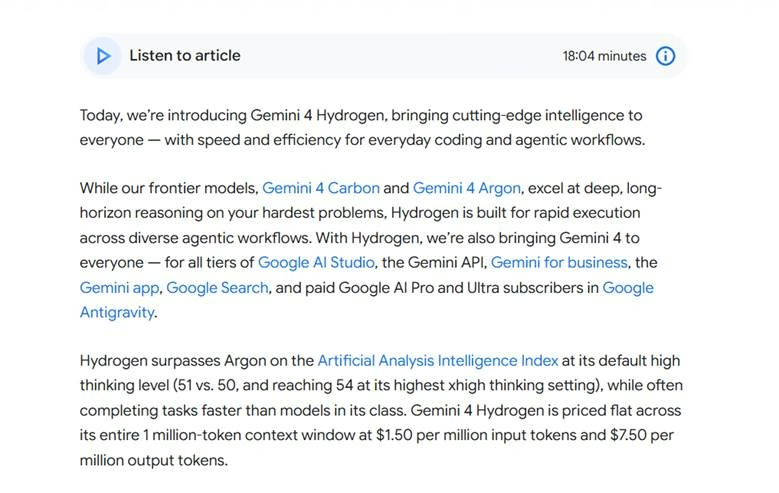
Anthropic positions it for well-scoped everyday work, while Opus 5.5 remains its stronger option for complex, open-ended tasks. Anthropic lists it at $2 input and $10 output with a 1M-token context, a 128K maximum output, and a June 2026 knowledge cutoff, and its retirement date is no sooner than September 28, 2027.
Gemini 4 Hydrogen vs. Claude Sonnet 5.5: Key Differences
The two differ most in effort controls, input types, and how they handle very long output.
- Reasoning control: Hydrogen exposes four thinking levels, including a new xhigh tier. Sonnet 5.5 runs adaptive thinking, with effort levels up to max.
- Multimodal input: Hydrogen accepts audio and video alongside text and images. Sonnet 5.5 takes text and images.
- Long output: Sonnet 5.5 allows up to 128K output tokens per response. Hydrogen's maximum output limit should be confirmed in Google's current API documentation before relying on it for long-form generation.
- Pricing shape: Hydrogen's price is flat across the whole window. Sonnet 5.5's list price is $2 and $10.
Gemini 4 Hydrogen vs. Claude Sonnet 5.5 Benchmarks
On independent data, the two are within a point of each other, but their strengths differ. The table uses Artificial Analysis's Intelligence Index v5.0.1. Artificial Analysis's earlier launch-day coverage reported Sonnet 5.5 at 56 on an earlier version of the index; the 55 figure used here is the v5.0.1 comparison.
On AA-Omniscience, Artificial Analysis reported an 8% hallucination rate for Hydrogen at xhigh versus 43% for Sonnet 5.5 at max. This is a strong result on one independent knowledge-reliability benchmark, but it should not be treated as a universal measure of factual accuracy across all tasks.
In Artificial Analysis's independent testing, Sonnet 5.5 at max scored 64% on Terminal-Bench 4.0 versus 54% for Hydrogen, and 53% on Terminal-Bench-Science 0.1 versus 50% for Hydrogen. These benchmarks cover agentic terminal coding and scientific command-line workflows.
Vendor-reported results:
Google's model card compares Hydrogen with Sonnet 5.5 across multiple evaluations, and Hydrogen leads on several, including SWE-sweep, AutomationBench-AA, HLE-Diamond, and Chartography. Hydrogen leads on:
- SWE-sweep (13.5% vs 3.1%)
- AutomationBench-AA (76.1% vs 71.8%)
- HLE-Diamond (58.8% vs 53.3%)
- Chartography (66.6% vs 61.6%)
Sonnet leads on:
- Terminal-Bench 4.1 (63.9% vs 57.0%)
- OSWorld-2.1 (83.9% vs 77.6%)
- Terminal-Bench-Science (59.9% vs 51.4%)
These are Google's own figures.
Because these are Google's own figures, each model's full independent results are worth a look. See our Gemini 4 Hydrogen benchmarks and Claude Sonnet 5.5 benchmarks guides.
Gemini 4 Hydrogen vs. Claude Sonnet 5.5 for Coding and Agentic Work
Sonnet 5.5 is the stronger terminal and computer-use agent, while Hydrogen is stronger at repository bug fixing and automation. Google says Hydrogen outperforms similar-tier models on SWE-sweep, where it must find and repair bugs without breaking existing code. On AutomationBench-AA, which covers agentic SaaS workflows, it leads Sonnet 76.1% to 71.8% in Google's table.
Independent benchmark results beyond Artificial Analysis should be interpreted cautiously during a model's launch period, because test harnesses, effort settings, and scoring rules can differ substantially. Google positions Hydrogen as a fast execution model within its broader Gemini 4 lineup.
A model that is fast and cheap per task still has to pass your tests. With a coding agent builder, you can build an AI coding agent that runs the same bug-fix and terminal tasks on each model and reports what passed.
For building agents, see how to build AI agents from scratch.
Gemini 4 Hydrogen vs. Claude Sonnet 5.5 Pricing, Speed, and Access
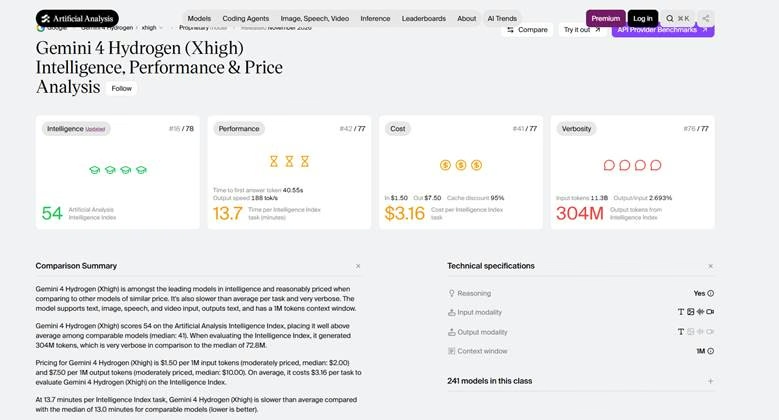
Hydrogen is 25% cheaper per token than Sonnet 5.5 and about a third of the cost per task at near-equal intelligence. The table shows list prices per million tokens.
Per-token savings are modest, but per-task savings are large because of how each model uses effort. At xhigh, Hydrogen cost $3.16 per task against $10.02 for Sonnet 5.5 at max. Lower effort settings reduce Hydrogen's cost substantially, though the exact score and cost depend on the benchmark and effort setting.
Each rate card is broken out in our Gemini 4 Hydrogen pricing and Claude Sonnet 5.5 pricing guides.
Access:
Hydrogen is rolling out across the Gemini API, Google AI Studio, the Gemini app, Google Search, and Google Antigravity. Check Google's current documentation for tier-specific availability and whether free-tier users can access it through Auto model selection. Sonnet 5.5 is available through the Claude apps, the Claude API, Claude Code, and major cloud platforms.
For cost planning, see our guide to AI agent cost.
Privacy, Data Residency, and Enterprise Controls
Both are closed-weight hosted models, so data handling follows each vendor's terms. Anthropic offers enterprise data controls that may include zero data retention and regional inference options, but availability, pricing, and retention terms depend on the plan and deployment. Review Anthropic's current Commercial Terms and documentation before sending business data.
Google's Gemini API terms may differ between free and paid usage, so review the current terms and use an appropriate paid tier for sensitive business data. Google says Hydrogen includes updated safeguards for coding and tool use. Review Google's model documentation for the specific safety evaluation methodology and results. Read each vendor's terms and DPA before sending business data.
Which Should You Choose? Gemini 4 Hydrogen or Claude Sonnet 5.5 by Use Case
Choose Hydrogen for cost, speed, and multimodal work, and Sonnet 5.5 for terminal coding and computer use.
Conclusion
Gemini 4 Hydrogen and Claude Sonnet 5.5 offer similar intelligence scores, but their strengths suit different workloads. Hydrogen is the better choice for cost-sensitive applications, faster output, and multimodal tasks involving audio or video. Sonnet 5.5 is better suited to terminal-heavy coding and computer-use automation. If your workflows involve both, you can route routine, high-volume tasks to Hydrogen and more demanding terminal operations to Sonnet 5.5. If neither fits, our Gemini 4 Hydrogen alternatives and Claude Sonnet 5.5 alternatives guides cover other models worth testing.
A model can process information, generate responses, and handle tasks, but you still need an interface, a backend, a database, and a way to connect everything. Emergent helps you build that application. Emergent is an AI app builder that creates a full-stack app with the screens, backend, authentication, and configured integrations it needs.
You can review the generated application, refine it through follow-up instructions, and test it before launch. If your application needs Claude models, Universal Key can connect them without requiring a separate Anthropic account. This takes you from choosing an AI model to building something people can actually use.
Describe it. Build it. Launch it.
- End-to-End Creation
- No Code Needed
- Live in Minutes
Most AI app builders stop at prototypes. Emergent creates production-ready apps you can actually launch.
- Production-ready apps
- Web & mobile apps
- Deploy in minutes