Gemini 4 Neon vs Opus 5.5 comes down to cost, speed, and task type. This guide compares both models on benchmarks, speed, context, and pricing to show where each one fits.
Choosing a flagship model based only on its top score can lead to higher costs and longer wait times than expected.
Gemini 4 Neon and Opus 5.5 are closely matched, but the better choice depends on the task. This difference matters more when building AI agents because each run involves repeated model calls.
Gemini 4 Neon vs Claude Opus 5.5 comes down to price, speed, and task type. This guide compares Gemini 4 Neon and Claude Opus 5.5 using independent benchmark data and official prices.
Gemini 4 Neon scores 61, compared with 59 for Claude Opus 5.5, and costs $6.44 per task, compared with $10.04. It also gives fewer incorrect answers. Claude Opus 5.5 gets more knowledge questions right and scores higher on CritPt v2.
All scores are from Artificial Analysis v5.0.1, checked on November 20, 2026. Pricing information comes from Google and Anthropic.
Gemini 4 Neon vs Claude Opus 5.5: Comparison Table
Gemini 4 Neon leads on the Intelligence Index, list price, and Artificial Analysis cost per task, though its xhigh result is being compared with Opus 5.5’s Max result. Output speed is almost level at 110 and 113 tokens per second. The table puts every headline number in one place.
Data checked on November 20, 2026. Source: Artificial Analysis v5.0.1 for Gemini 4 Neon and Claude Opus 5.5.
Gemini 4 Neon results are from Artificial Analysis xhigh; Claude Opus 5.5 results are from Artificial Analysis Max, Default Fallback. For a like-for-like xhigh comparison, Opus 5.5 scores 57. Speed, cost, and index figures come from each model’s Artificial Analysis summary page.

Gemini 4 Neon and Claude Opus 5.5: What’s Different?
Google and Anthropic built these models for different jobs. The differences below shape how each one behaves in daily use.
- Position in the lineup: Google places Gemini 4 Neon between Gemini 4 Carbon, built for the hardest long projects, and Gemini 4 Hydrogen, built for fast everyday work. Anthropic calls Opus 5.5 the first model in its Claude 5.5 family. Anthropic positions Opus 5.5 as its recommended starting model for most workloads, while Fable 5.1 is reserved for the most demanding reasoning tasks.
- Release date: Opus 5.5 was released on September 22, 2026. Gemini 4 Neon was released in November 2026, so it is the newer model.
- Thinking controls: Gemini 4 Neon offers four thinking levels. Teams set how much reasoning each job gets. Opus 5.5 cannot run with thinking switched off, and Anthropic sets medium as its default effort.
- Safety measures: When Anthropic’s safeguards flag higher-risk requests, offensive-security work may route to Claude Opus 4.8, while some dual-use biology and frontier-AI-development requests may route to Claude Opus 5. Google uses real-time checks to prevent Neon from being misused in cybersecurity and biological research. For security testing, check which model handles the task.
- Data handling: Anthropic offers Opus 5.5 with zero data retention. Check Google’s Gemini API terms for the retention rules that apply to your account.
For a wider view of the Anthropic lineup, read our guide to the latest Claude models.
Pricing: Which Model Costs Less?
Gemini 4 Neon costs 25% less than Claude Opus 5.5 on both input and output tokens. Both models sit above the median price Artificial Analysis tracks. That median is $2.00 for input and $10.00 for output per million tokens.
Data checked on November 20, 2026. Sources: Google’s Gemini 4 Neon announcement, Anthropic’s Claude Opus 5.5 announcement, and Artificial Analysis v5.0.1 (Gemini 4 Neon, Claude Opus 5.5).

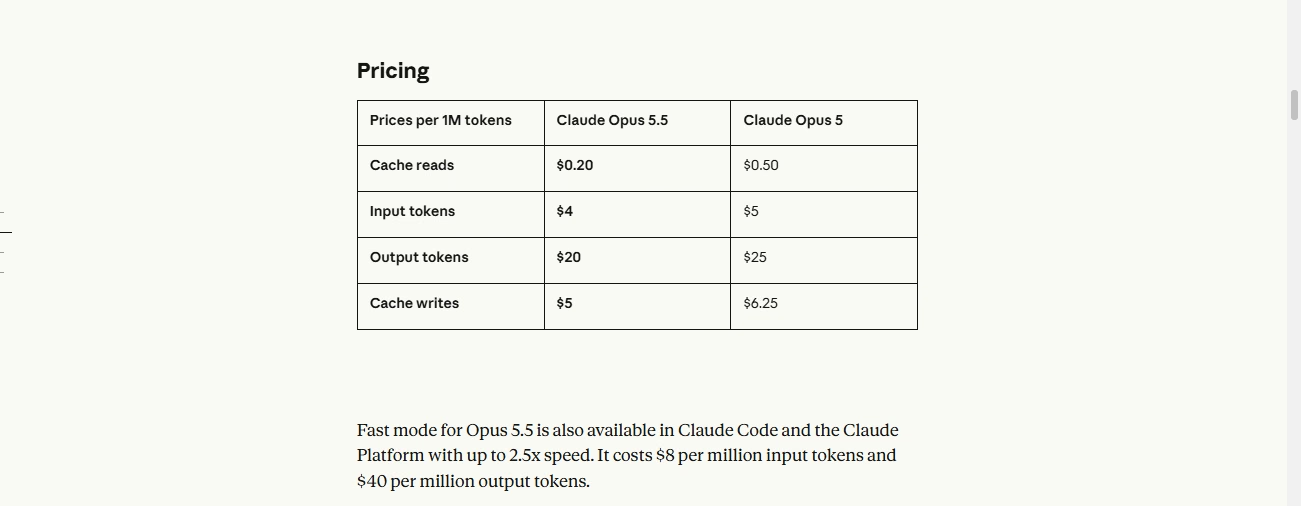
Both companies offer a 95% discount on cached input. Google gives this discount on Neon, while Anthropic charges $0.20 to read cached tokens, 95% less than its regular input price of $4.00.
Cache reads matter because repeated context drives agent costs. They can materially reduce costs because repeated instructions and files are billed at the discounted cache-hit rate. Reuse the same instructions and files across calls to cut the bill on either model.
Anthropic also sells a fast mode for Opus 5.5 in Claude Code and the Claude Platform. It runs up to 2.5 times faster at $8 per million input tokens and $40 per million output tokens. Google’s announcement does not list a matching mode for Neon.
A simple example shows the list-price gap. Take a job with 10 million input tokens and 2 million output tokens, with no caching. Gemini 4 Neon costs $60 and Opus 5.5 costs $80.
Opus's full rate card, including cache writes and batch rates, is in our Claude Opus 5.5 pricing guide.
Intelligence and Benchmark Results
Benchmarks show where each model pulls ahead. This section uses Artificial Analysis scores only, so both models face the same tests.
Artificial Analysis Intelligence Index
Gemini 4 Neon scores 61 and ranks #6 of 95 on Artificial Analysis. Claude Opus 5.5 scores 59 and ranks #10 of 95. Artificial Analysis puts the median for comparable models at 44, so both sit far above it.
The index combines results from many tests into one number. A two-point gap is small. Anthropic notes that at this level, benchmark margins are a less reliable guide to real-world differences, as stated in its Opus 5.5 announcement.
Treat the index as a starting filter. Then check the individual tests that match your work. The next two sections do that.
Reasoning and Science Benchmarks
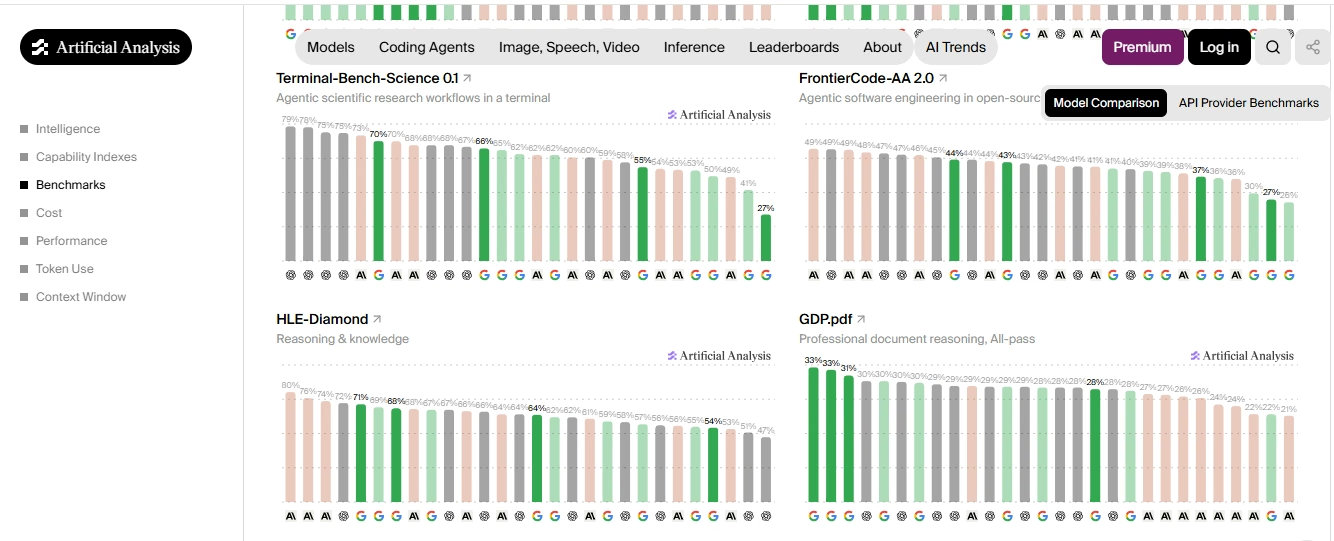
Gemini 4 Neon leads two of the three tests here. Claude Opus 5.5 takes the third.
Data checked on November 20, 2026. Source: Artificial Analysis v5.0.1 (Gemini 4 Neon, Claude Opus 5.5).
HLE-Diamond tests expert-level knowledge across different fields. Gemini 4 Neon scores 7 points higher. Terminal-Bench-Science 0.1 tests scientific tasks done through a command line, where Neon scores 8 points higher.
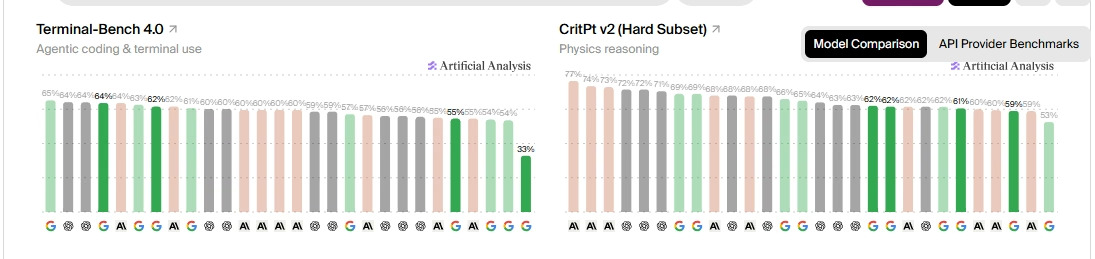
CritPt v2 uses research-level physics problems. Opus 5.5 leads here by 7 points. If your work looks like physics research, that result carries more weight than the index.
Knowledge Work and Agentic Performance
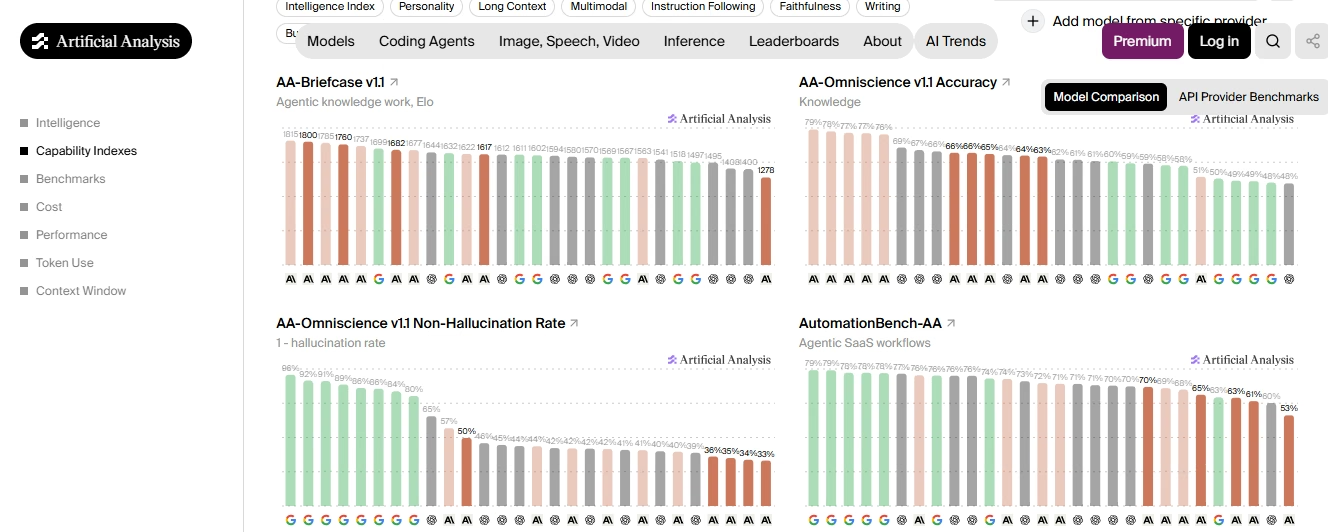
The results are closer in this group than in the science tests. Claude Opus 5.5 gets more answers right, while Gemini 4 Neon makes fewer mistakes and performs better on business tasks.
Data checked on November 20, 2026. Source: Artificial Analysis v5.0.1 (Gemini 4 Neon, Claude Opus 5.5).
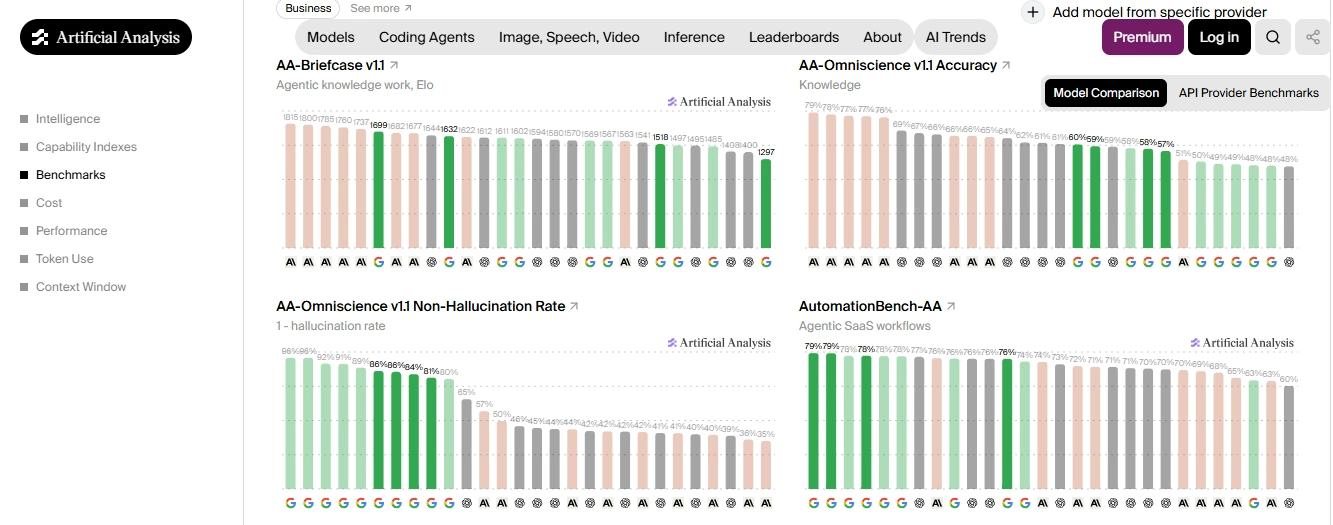
The two Omniscience rows work as a pair. Accuracy counts how many knowledge questions a model answers correctly. Non-hallucination counts how often the model avoids a wrong answer when it does not know.
Opus 5.5 gets more questions right, 66% to 60%. Yet its non-hallucination score is 35% against 86% for Gemini 4 Neon. Opus 5.5 gives wrong answers more often when it lacks the facts. Neon holds back more often.
That 51-point gap matters when mistakes can cost money, such as in legal summaries, financial reports, or customer replies. A model that avoids guessing needs less correction.
AutomationBench tests whether an agent can complete business workflows across connected apps. Anthropic describes it as a Zapier-built test. Gemini 4 Neon leads 79% to 65% in the Artificial Analysis data.
Vendors report different AutomationBench numbers because their setups differ. This guide uses Artificial Analysis data for both models. AA-Briefcase favors Opus 5.5, 1760 to 1699, and GDP.pdf is a near tie.
Coding and Software Development Performance
Both models score the same on FrontierCode-AA 2.0. Gemini 4 Neon scores 4 points higher on Terminal-Bench 4.1.
Data checked on November 20, 2026. Source: Artificial Analysis v5.0.1 (Gemini 4 Neon, Claude Opus 5.5).
Gemini 4 Neon Benchmark Scores
Claude Opus 5.5 Benchmark Scores


Anthropic says FrontierCode checks whether code changes can pass review and be merged. Terminal-Bench 4.0 tests complex, multi-step tasks using a command line.
Since the models tie on one and are close on the other, neither has a clear lead in coding.
Treat the 4-point gap with care. Anthropic reports a standard error of 2.6 points on its own Terminal-Bench 4.1 runs for Opus 5.5. A gap that size sits near the noise level.
The vendors describe different strengths. Google says Neon handles multi-file debugging and refactoring with targeted edits. It also says Neon can direct parallel Hydrogen subagents in Google Antigravity.
Anthropic points to long jobs. An early tester used Opus 5.5 to audit and fix a 200,000-line codebase in under three hours. Opus 5 needed over 20 hours for the same job, according to Anthropic.
Both claims come from the vendors, not from the benchmark data above. Use them as leads for your own test. Run a real pull request or bug through each model before you commit.
For each model's wider score set, see our Claude Opus 5.5 benchmarks and Gemini 4 Neon benchmarks guides.
A 4-point gap inside a 2.6-point margin of error can't pick your coding model for you. Only your own pull requests can, and an AI agent that applies your repo's tests and review rules to both models gives you a fair, repeatable way to run that comparison. A coding agent builder is where you'd put that agent together.
Speed, Latency, and Token Efficiency
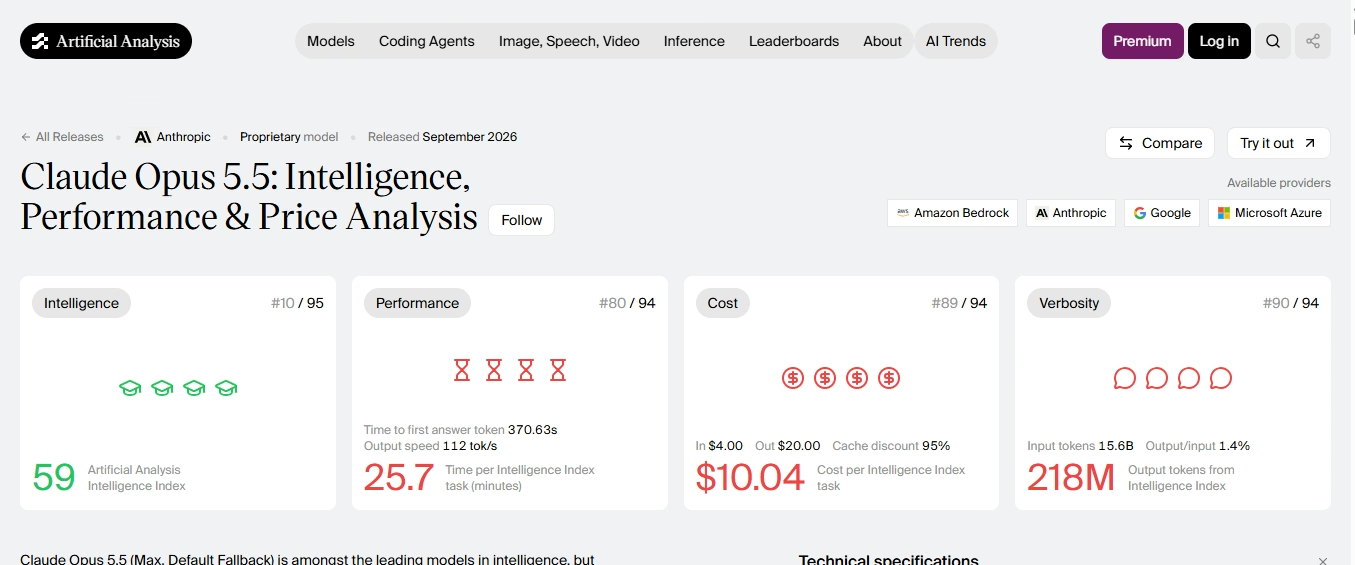
Both models generate text at almost the same speed, but Neon starts responding much sooner. It takes 56.51 seconds to begin, while Opus 5.5 takes 368.86 seconds, about 6.5 times longer.
With these settings, the wait for the first word also includes the time spent thinking. A longer wait means the model takes longer to answer. Artificial Analysis rates both models as slow at completing tasks.
Gemini 4 Neon takes 21.5 minutes to complete an index task, while Opus 5.5 takes 25.7 minutes, or 4.2 minutes (16%) longer. Both take more time than the 12.8-minute median for similar models.
Output tokens explain part of that. Gemini 4 Neon wrote 283 million tokens during the index run. Opus 5.5 wrote 218 million. The median model wrote 65.4 million, so both are very verbose.
Neon produced about 30% more text than Opus 5.5, even though it costs less per task. More text takes longer to read and can increase output costs, but it doesn't decide the total cost on its own.
Both models let you trade depth for speed. Google says Neon’s four thinking levels let teams match intelligence and token spend to each workload.
Anthropic says Opus 5.5 generates output more than 30% faster than Opus 5. Lower settings shorten the wait on both models.
For chat tools, how quickly the first response appears matters most. Users won't wait six minutes for an answer. For tasks that run overnight, cost matters more than the wait time.
Long-Context and Multimodal Performance
Both models offer a 1 million token context window. That is enough room for a large codebase or a stack of long reports. Context size alone does not separate them.
The Artificial Analysis data here includes no long-context score. So the real difference is what each model accepts. Gemini 4 Neon takes text, image, speech, and video input. Claude Opus 5.5 takes text and image input. Both return text.
Audio and video support changes your workflow. With Neon, you can send a meeting recording or a product demo clip directly. With Opus 5.5, you first convert the audio to a transcript. You also pull still frames from video.
Google says Neon can combine spreadsheets, PDFs, charts, audio, and video in one request. That helps with research briefs built from mixed files. The claim comes from Google’s announcement, not from the benchmark pages.
If your inputs are mostly text and images, this gap disappears. Both models then work with the same input types. Run a long document through each one and compare the answers against your own source.
Cost per Task: Which Model Offers Better Value?
Gemini 4 Neon costs $6.44 per Intelligence Index task. Claude Opus 5.5 costs $10.04. That is $3.60 less, or about 36% lower per task.
Artificial Analysis ranks Neon #78 of 94 on cost and Opus 5.5 #89 of 94. Both sit on the expensive end. Neon sits closer to the middle.
Scale shows the gap clearly. The figures below use the Artificial Analysis average per task.
Data checked on November 20, 2026. Source: Artificial Analysis v5.0.1 (Gemini 4 Neon, Claude Opus 5.5).
Input volume also affects the cost. Opus 5.5 used 15.6 billion input tokens during the index run, while Gemini 4 Neon used 8.12 billion. Neon's lower prices and lower input usage make it cheaper.
These numbers come from the highest reasoning settings. Daily costs drop at lower settings on both models, so test the level you plan to use.
Those vendor claims compare each model with its own predecessor. They do not compare Neon with Opus 5.5 directly. So test both at the setting you plan to use.
The better choice depends on the cost of a wrong answer. A cheaper model that avoids guessing can save time on checking answers.
A more expensive model that answers more knowledge questions correctly can save time on research. Choose based on what your work needs.
When to Choose Gemini 4 Neon vs Claude Opus 5.5
Choose the model based on the work you need it to do, not just its top score. The recommendations below are based on the data in this guide. For more help, read our guide to choosing an AI model.
When to Choose Gemini 4 Neon
- Cost per task drives the decision: Neon costs $6.44 per task, compared to $10.04. List prices are also 25% lower.
- Wrong answers carry a price: Its 86% non-hallucination score beats 35% by a wide margin.
- You need audio or video input: Neon takes speech and video directly.
- You run business workflow agents: It leads AutomationBench-AA, 79% to 65%.
- You work on hard science questions: It leads HLE-Diamond and Terminal-Bench-Science 0.1.
- Faster first response: Neon starts answering in 56.51 seconds, compared with 368.86 seconds for Opus 5.5.
When to Choose Claude Opus 5.5
- More accurate answers: It scores 66% in accuracy, compared with Neon's 60%.
- Physics research: It scores 68% on CritPt v2, compared with Neon's 61%.
- You run office-style knowledge tasks: It leads AA-Briefcase v1.1, 1760 to 1699.
- Your jobs are long and sprawling: Anthropic points to codebase-wide audits and migrations.
- You need faster responses: Fast mode is up to 2.5 times faster and costs $8 per million input tokens and $40 per million output tokens.
- You use Claude Code: Opus 5.5 works with Anthropic's own tools.
Conclusion
Choose based on your work. Gemini 4 Neon is better suited for budget-friendly agents, science questions, and different types of input. Claude Opus 5.5 is better for accurate knowledge answers and advanced physics problems.
Gemini 4 Neon scores 61 on the Intelligence Index, compared with 59 for Opus 5.5. It costs $6.44 per task, while Opus 5.5 costs $10.04.
Neon starts answering in 56.51 seconds, compared with 368.86 seconds for Opus 5.5. It also scores 86% on non-hallucination, well above Opus 5.5's 35%.
Opus 5.5 answers more knowledge questions correctly, 66% to 60%. It also leads CritPt v2, 68% to 61%. Coding results are close, with a tie on FrontierCode-AA 2.0 and a 4-point Neon lead on Terminal-Bench 4.1.
Claude Opus 5.5 is live on Emergent. Emergent is an AI agent builder that turns a plain-language description into a working, deployable app. Describe the tool or agent you need and see how Opus 5.5 handles the build.

Describe it. Build it. Launch it.
- End-to-End Creation
- No Code Needed
- Live in Minutes

Most AI app builders stop at prototypes. Emergent creates production-ready apps you can actually launch.
- Production-ready apps
- Web & mobile apps
- Deploy in minutes