GLM vs. Claude Opus at a Glance
Opus 5.5 wins on capability, and GLM-5.3 wins on price, responsiveness, and openness. The frontier pair is GLM-5.3 from Z.ai and Claude Opus 5.5 from Anthropic, both tested at Max effort.
What Are GLM and Claude Opus? Z.ai GLM vs. Anthropic Claude
GLM is Z.ai’s open-weight model family and Claude is Anthropic’s closed model family, so Z.ai GLM vs. Anthropic Claude is also a choice between self-hostable and vendor-hosted models.
GLM is sold through the Z.ai API and the GLM Coding Plan, a subscription for coding agents. Z.ai says GLM-5.3 can be used with preferred coding agents through the GLM Coding Plan; verify current tool compatibility in Z.ai’s documentation before relying on a specific agent. GLM-5.3 is open-weight.
Claude spans the Claude apps, the Claude API, Claude Code (Anthropic’s agentic coding tool), and enterprise channels. Anthropic also sells Claude through Amazon Bedrock, Google Cloud, and Microsoft Foundry.
This article uses Opus 5.5 rather than Fable 5.1 because Opus is the closer pairing on price, and Anthropic positions Opus 5.5 below Fable 5.1 in its model comparison. Z.ai has no confirmed premium tier to match Fable.
GLM-5.3 (Max) vs. Claude Opus 5.5: Key Differences
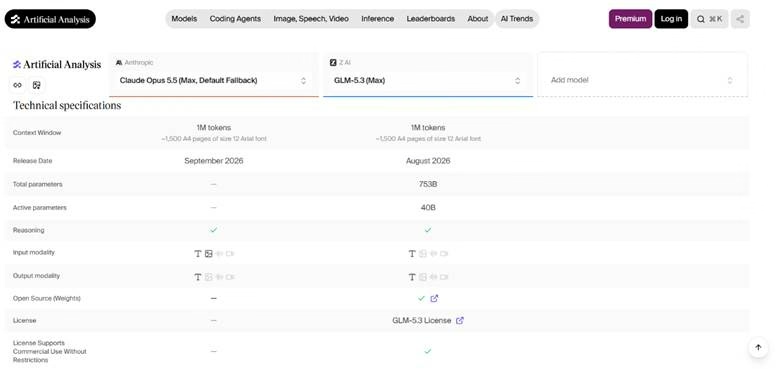
The pairing is Z.ai’s flagship against Anthropic’s flagship Opus tier, and the two differ most in input types, weights, and how they spend reasoning time. Both list a 1M-token context window and 128K maximum output.
1. Architecture and size
GLM-5.3 is a mixture-of-experts model with 753B total and 40B active parameters, per Artificial Analysis. Anthropic’s documentation describes Opus 5.5 as a hybrid reasoning model for long-running agentic coding and knowledge work but does not publish a parameter count.
2. Reasoning modes and effort settings
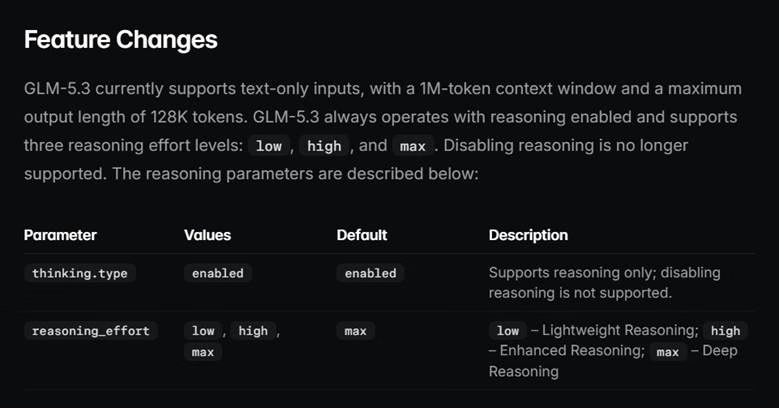
Z.ai’s GLM-5.3 always reasons, offers low, high, and max effort, and defaults to max. Opus 5.5 keeps adaptive thinking always on and defaults to medium effort. Artificial Analysis tests both at Max, which is not Opus’s default, so Max scores show its ceiling rather than typical use.

3. Context window and multimodal input
Both list 1M tokens. GLM-5.3 accepts text only, while Opus 5.5 accepts text and images, per Artificial Analysis. Audio and video support for Opus is not confirmed. Check Anthropic’s documentation before relying on it.
4. Weights and licensing
GLM-5.3 is open-weight. Artificial Analysis lists the GLM-5.3 License and indicates that it supports commercial use, but read the license text directly before production use because the source page also uses a “Commercial Use Restricted” label. Claude is closed-weight. Artificial Analysis links the GLM-5.3 license, which should be read directly before production use.
GLM vs. Claude Opus Benchmarks
Opus 5.5 leads GLM-5.3 on all nine Intelligence Index tests, usually by wide margins. The table shows Artificial Analysis’s independent Intelligence Index v5.0.1, with both models at Max effort.
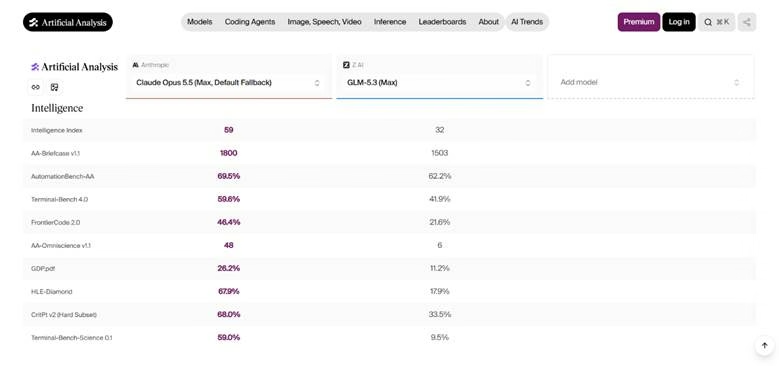
AA-Briefcase measures agentic knowledge work, AutomationBench-AA measures agentic SaaS workflows, and Terminal-Bench 4.0 measures agentic coding and terminal use, so they matter to teams building agents. FrontierCode 2.0 measures software engineering in open-source repositories, and HLE-Diamond measures reasoning and knowledge, which matters for hard research questions.
The other four tests widen the picture. Opus leads AA-Omniscience (48 vs 6), CritPt v2 physics reasoning (68.0% vs 33.5%), Terminal-Bench-Science (59.0% vs 9.5%), and GDP.pdf document reasoning (26.2% vs 11.2%). GLM-5.3 leads on cost per task and time to first token; Opus 5.5 leads on end-to-end benchmark completion time.
Effort changes the picture only slightly. Even Opus 5.5 at Low effort scores 35 against GLM-5.3 Max’s 32 in Artificial Analysis’s comparison, so Opus does not need Max to stay ahead. The same matchup against the earlier Opus 5 is in our GLM-5.3 vs Opus 5 comparison.
Vendor-reported results. Z.ai says GLM-5.3 reaches 34.5% on its own agentic coding evaluation at Max effort with about 75K output tokens per task, and that it still trails Claude Fable 5 at 39.5%.
Anthropic positions Opus 5.5 below Fable 5.1 in its model comparison. Both are vendor claims on vendor-selected tests. Claude Fable 5.1 is Anthropic’s premium model, at $10 input and $50 output per million tokens, one tier above Opus 5.5.
For each model's wider score set, see our GLM 5.3 benchmarks and Claude Opus 5.5 benchmarks guides.
GLM vs. Claude Opus for Coding
Opus 5.5 is the clear coding leader on published independent data: 59.6% vs 41.9% on Terminal-Bench 4.0 and 46.4% vs 21.6% on FrontierCode 2.0, both per Artificial Analysis. GLM-5.3 closes part of the gap on price, since a failed attempt costs far less.
Tooling. The GLM Coding Plan lets you run GLM models inside coding agents, and Z.ai says GLM-5.3 can be used with your preferred coding agents. Claude Code is Anthropic's agentic coding tool. Confirm current plan names, supported agents, and limits before buying. For a closer look at GLM-5.3 on its own, see our GLM-5.3 review.
Hands-on check. Run one prompt on both models at Max effort, one shot: build a single-file kanban-board web app. Record the model snapshot (glm-5.3, claude-opus-5-5), effort level (Max), date, and platform, and attach screenshots.
Use the result as a small hands-on check, and do not generalize from one test.
GLM's low price makes retries cheap, but only if you can see which attempts passed. A coding agent builder lets you build an AI coding agent that logs pass and fail per run against your own tests.
GLM vs. Claude Opus Pricing, Speed, and Access
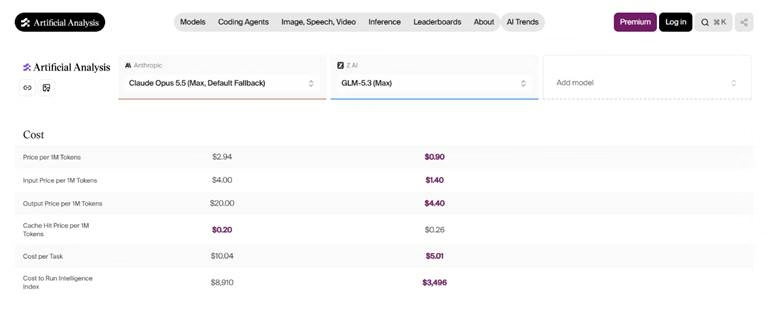
GLM-5.3 costs about 35% of Opus 5.5 on input and 22% on output at list price, and half as much per task. Standard API rates per million tokens:
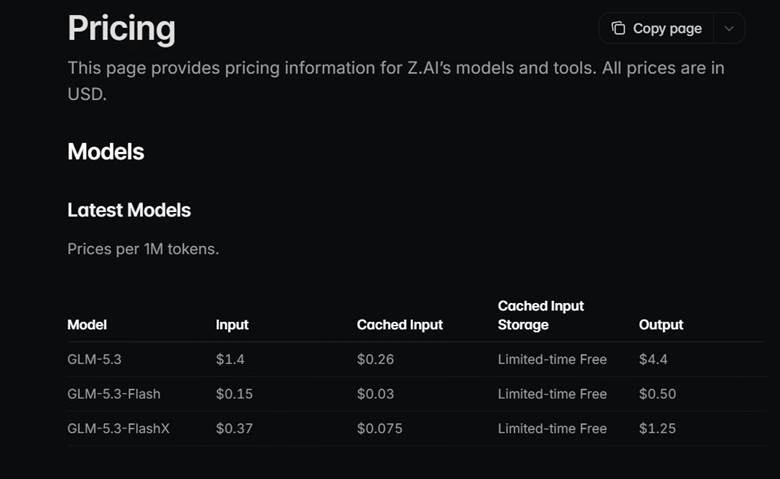
FlashX is Z.ai’s faster, higher-priced fast tier, while Haiku is Anthropic’s lowest-cost tier at volume; compare measured latency and quality on your workload before choosing. Opus 5.5 also offers a fast mode at $8 / $40 and US-only inference at 1.1 times standard pricing.

Cost per task
- Artificial Analysis reports $5.01 per task for GLM-5.3 and $10.04 for Opus 5.5, and $3,496 vs $8,910 to run the full index.
- GLM’s lower price carries through because it uses fewer tokens: 119k output tokens per task against 173k.
Each rate card is broken out in our GLM 5.3 pricing and Claude Opus 5.5 pricing guides.
Speed
The two trade off, as the table shows.

Opus generates tokens about 68% faster and completes an Intelligence Index task sooner (25.3 vs 29.3 minutes). But at Max effort, Opus takes about 405 seconds, roughly 6.8 minutes, before returning its first token, while GLM-5.3 returns its first token in about 3 seconds.
GLM’s first user-visible answer token still arrives after about 86 seconds, so it is faster to begin streaming, not necessarily faster to deliver a finished answer. These are evaluation measurements, not guaranteed latencies.
Access
For GLM: the Z.ai API, the GLM Coding Plan, and supported coding agents.
For Claude: the Claude app, Claude API, Claude Code, Amazon Bedrock, Google Cloud, and Microsoft Foundry.
Open Weights, Privacy, and Data Residency
GLM-5.3's weights are public, while Claude is available only as a hosted service. Open weights can enable self-hosting and fine-tuning and reduce dependence on a single hosted API, though they do not eliminate operational dependence on infrastructure and tooling. At 753B total parameters, GLM-5.3 is a large deployment. Confirm hardware, licensing, and operational requirements before committing.
With Claude there is no self-hosting, so you depend on Anthropic's API pricing and availability or on a cloud partner.
Residency and retention:
- Z.ai: Confirm the current API data-retention, training, and residency terms directly in Z.ai’s privacy policy, terms, and DPA before sending sensitive data. Independent summaries are not a substitute for the governing policy.
- Anthropic: Anthropic says US-only inference is available at 1.1 times standard pricing. For data retention, training use, residency, and zero-retention arrangements, rely on Anthropic’s current Commercial Terms, Privacy Policy, and API documentation rather than secondary summaries; these terms can change.
Read each vendor's terms, privacy policy, and DPA directly before sending sensitive data.
Which Should You Choose? GLM or Claude Opus by Use Case
Choose Opus when capability matters most, and choose GLM when cost, responsiveness, or self-hosting does.
If neither fits, our GLM-5.3 alternatives and Claude Opus 5.5 alternatives guides cover other models worth testing.
Conclusion
GLM vs. Claude Opus at the frontier is a question of how much capability you are buying. Opus 5.5 scores 59 to GLM-5.3's 32 and wins all nine index tests, while GLM-5.3 costs half as much per task and can be self-hosted.
Choose Claude Opus 5.5 when intelligence, complex coding, science and reasoning, or long-running knowledge work is the priority. Choose GLM-5.3 when a fast first token, lower cost per task, or open-weight deployment matters most.
Choose GLM-5.3-FlashX or Claude Haiku 5.5 when volume, latency, or unit economics dominate, and consider Claude Fable 5.1 only when the premium tier's capability justifies its higher price.
Once you have picked a model, Emergent can help you build web apps and mobile apps through conversation, including frontend and backend work.
Start Building on Emergent today.

Describe it. Build it. Launch it.
- End-to-End Creation
- No Code Needed
- Live in Minutes
Most AI app builders stop at prototypes. Emergent creates production-ready apps you can actually launch.
- Production-ready apps
- Web & mobile apps
- Deploy in minutes