GPT-6.2 Sol costs $2 per million input tokens and $10 per million output tokens, the same as GPT-6.1 Sol. On November 17, 2026, OpenAI released the model as their efficient choice for everyday work and coding. The sticker price is just part of the cost. The actual cost depends on caching, batching, effort, and the length of the reasoning prompt.
This guide lists all the rates, compares them to other models, and shows the actual cost of real tasks so that you can budget accordingly.
What is GPT-6.2 Sol?
GPT-6.2 Sol is an efficient reasoning model designed for OpenAI's daily tasks, coding and agent use cases. OpenAI released it using the company's cutting-edge model, GPT-6.2 Astra, for the most challenging projects. Sol is called by the developers via the API as GPT-6.2-sol.
Sol can take text and image input and return text. OpenAI says it has a 1,050,000-token context window and a 128,000-token output limit, per its model page that eesel reported. Artificial Analysis will round up the window to 1M Tokens. The knowledge cut-off date is 1st June 2026. Sol is proprietary, and OpenAI has not revealed its size.
There are several ways to access it. Plus, Pro, Enterprise and Edu users get Sol in ChatGPT Work and Codex. Developers pay per token via the API. We will focus on API pricing, as that is where the cost can change.
How much does GPT-6.2 Sol cost per million tokens?
The standard cost for GPT-6.2 Sol API is $2.00 per million input tokens and $10.00 per million output tokens. OpenAI's launch post indicates that Sol maintains its cost structure in line with GPT-6.1 Sol; therefore, upgrading will not increase the cost.

Simply, you pay for what you send, what the model remembers from earlier requests, and what it writes back. Output costs five times more than input, so long answers drive the bill.
Reasoning tokens fall under the output category. When reasoning takes longer, the amount billed will be much higher than what the actual output suggests. Artificial Analysis further breaks down a composite price of $1.47 per million tokens at a 7:2:1 ratio.
How much does cached input save on GPT-6.2 Sol?
Cached input saves 95%. A cached token costs $0.10 per million, or 1/20 of the fresh rate. Caching is used if your prompt is a 100% match for a recent request. The smallest prefix that can be cached is 1,024.
Look at an example that has been worked out. For each of the 1,000 requests, you send a 50,000-token knowledge base.
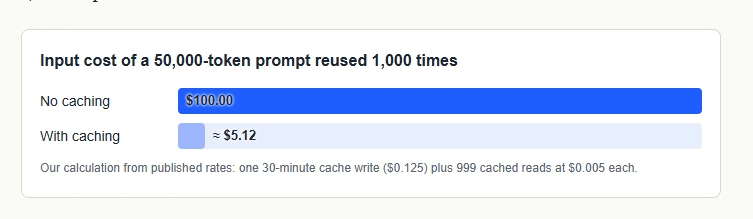
There is no additional charge for cache writes. Each input token is billed at a single rate—either the fresh rate, the cached rate, or the write rate. Use stable text at the beginning of the prompt and add new text at the end. Changes to the prefix break the match.
Test to determine whether caching is operational in your setup. In a separate test, eesel discovered that GPT-6.2 Sol couldn't store anything from the top-level instructions field. The same text is cached when inserted into a developer message. OpenAI hasn't confirmed this behaviour. For the initial calls, use cached tokens from the usage block.
Which discount tiers does GPT-6.2 Sol offer?
GPT-6.2 Sol was released with only Batch, Background, Fast and Ultrafast tiers, but not Flex. The price of Batch is half that of regular. The faster and the quicker, the more expensive the answer. The pricing below is from OpenAI's pricing page as presented by eesel. Verify them on OpenAI's page before budgeting.
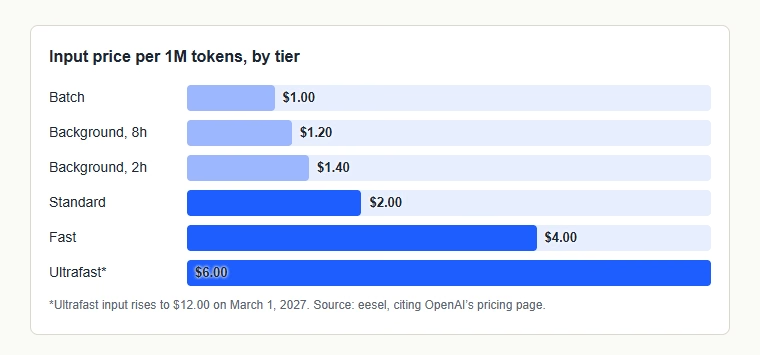
The more patient you are, the less you pay. Run overnight jobs on Batch. Keep user-facing chat on Standard. Pay for Fast only when waiting costs you more than the premium.
Background requests are 30% or 40% below Standard, depending on a 2-hour or 8-hour window. These are in a public beta. If you used a Flex tier on GPT-6.1 Sol, it would have a problem if that tier wasn't available. These jobs are now scheduled in Batch/Bg mode. According to OpenAI documentation, regional data residency costs an additional 10%.
If you are moving from the previous Sol, our GPT-6.1 Sol pricing guide shows the rate card you are leaving behind, including its tiers.
What does the 272K long-context rule cost?
A request larger than 272,000 input tokens has higher rates for each token. Input rises to $4.00, cached input to $0.20, and output to $15.00 per million. The higher rate applies to all tokens, not just those over the line.
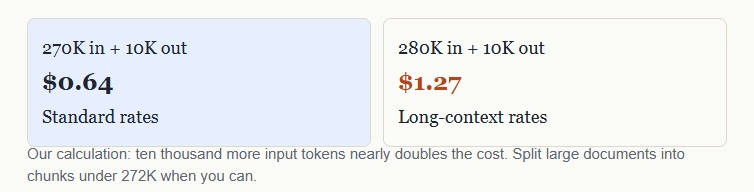
This rule forms a cliff, not a slope. Whole codebases or long contracts cross the line without pipeline warnings. Count the tokens before requesting. When sitting near 272K, use either the command “cut prompt” or break down the task.
How does reasoning effort change GPT-6.2 Sol’s cost per task?
High reasoning effort is costly, with little gain in score. Calculating reasoners will charge $10 for every million outputs. Five effort levels were tested using Artificial Analysis. Max used approximately 25% more output tokens to achieve a score of 57, while Medium used approximately 53% of the output tokens to achieve a score of 53.
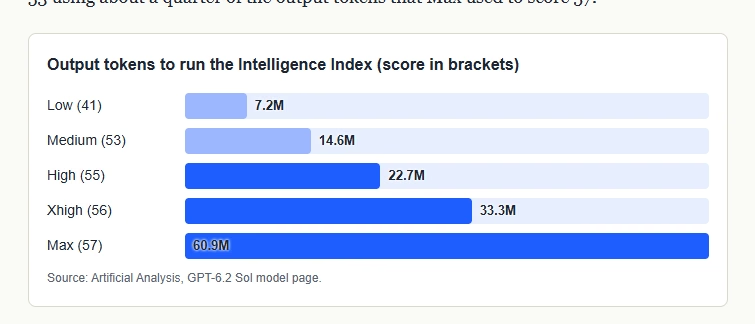
Max thinks the longest. You wait over a minute for the first word, and you pay for every thinking token. Start at Medium and move up only if answers fall short.
Output tokens are nearly doubled when switching from Xhigh to Max, with an additional point. Also, according to eesel, the API will not accept a reasoning setting of “none,” meaning Low is the lowest price you can get. When the task is short, such as providing a brief support response, there is little difference between Low and Medium, as there is very little reasoning either way.
The scores in this table come from Artificial Analysis, and our GPT-6.2 Sol benchmarks guide shows how Sol performs on each test behind them.
How does GPT-6.2 Sol pricing compare with other models?
The cost per token of GPT-6.2 Sol equals Claude Sonnet 5.5 and is one-fourth the cost of GPT-6.2 Astra. GPT-6.1 Terra is the only one of these that is less expensive. Standard API charges per million tokens are listed below.
A per-token table is used to bury the true difference. Here is the cost of one request, with 100,000 input tokens and 20,000 output tokens at the standard rates.
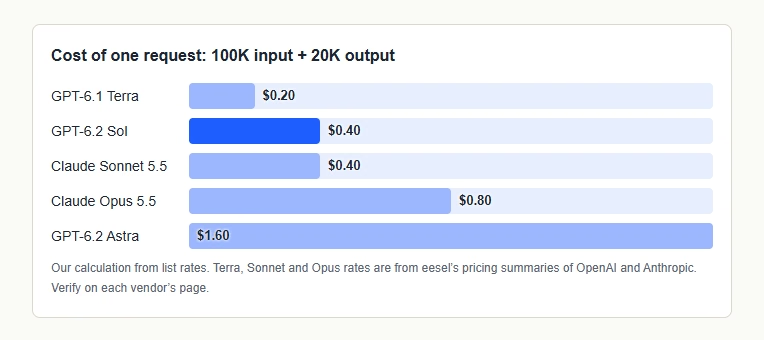
There are three differences other than the sticker. First, long prompts: Eesel has a single rate throughout its 1M window, and Sol doubles input beyond 272K. Second, cache holds: Sol's lowest write speed is 30 minutes, while Sonnet's is 5 minutes. Third, tokens per task: equal rates reward whichever model answers have fewer tokens. Test on own prompts.
What does GPT-6.2 Sol cost in real tasks?
True costs depend on cache effectiveness and job size rather than the cost of the part itself. The table below shows the cost of four commonly performed jobs.
In plain terms: a support reply costs about half a cent. A long coding session costs a few dollars, and caching cuts that bill by more than two-thirds. Batch halves any job you can wait for.
Who should use GPT-6.2 Sol?
Sol is suitable for teams that are looking for a mid-range coding and reasoning solution. OpenAI is best for mundane tasks, while Astra is for the toughest jobs. Use Sol for volume activities like coding help, document work and support drafts. Move up to Astra if Sol's responses aren't adequate.
Use a low-cost option like Terra for simple tagging or triage, such as when intelligence is less important than cost. Select Sol for scenarios where high quality is essential for value, and prompts repeat frequently, where caching is beneficial. Don't use Max effort for live chat since it will make people mad if there is a delay in the first token.
How can you lower your GPT-6.2 Sol bill?
There are 5 strategies that help you save a lot of money.
- Cache stable prompts. Start with reusable text without changing it.
- Batch for delayed tasks. This reduces both rates by half.
- Start with the medium task. Migration advice from OpenAI, according to Eesel, suggests starting with medium tasks.
- Keep input below 272K tokens. Break up large inputs.
- Limit output size. It is five times more expensive than input.
Conclusion
GPT-6.2 Sol pricing is $2 per million input tokens and $10 per million output tokens, while caching, batching, and effort settings determine the final bill. It is on par with Claude in rate, costs one-fourth as much as Astra, and has an Artificial Analysis score of +57. Try it with your own prompts, cache those that repeat, and stick to prompts under 272K tokens.
Looking to turn a model like this into a working application? Since you better understand your business and your target clients, Emergent is an AI-powered app builder that builds web and mobile apps from natural language instructions. From customised dashboards and CRM to other features, including AI-backed capabilities, you can ask it to develop them for you. While a traditional developer may take more than a few days, its fast app-building can give you a prototype in minutes or hours to review, then give you access to the original as soon as you decide.
Start building with Emergent.
Describe it. Build it. Launch it.
- End-to-End Creation
- No Code Needed
- Live in Minutes

Most AI app builders stop at prototypes. Emergent creates production-ready apps you can actually launch.
- Production-ready apps
- Web & mobile apps
- Deploy in minutes