AI cold calling agents can help businesses automate initial outreach, qualify leads, and schedule sales meetings without requiring a human representative to handle every call. They can be useful for sales teams that manage large prospect lists and want to reduce repetitive calling tasks.
Building one involves more than connecting an AI model to a phone system. You need to define its calling goals, configure conversation flows, connect your CRM and telephony tools, and establish rules for consent, opt-outs, and human handoffs.
No-code AI agent builders can simplify this process by letting you configure workflows through natural-language instructions rather than writing all the code yourself. If you are trying to learn to create an AI cold calling agent, this guide is for you. It explores how to create an AI cold calling agent without code, from architecture to launch.
What Is an AI Cold Calling Agent?
An AI cold calling agent is a voice-based AI system. It reaches out to potential clients and conducts conversations on behalf of a business. It is basically an AI system that makes cold calls for a business. It uses speech technology and an AI model to hold conversations.
It understands the customer's response and then chooses the next steps accordingly. This means it can adapt its replies to what someone says. It can ask questions, identify interest, and follow predefined conversation rules. Depending on its integrations, it can also update CRM records or book meetings.
Usually, businesses use an AI cold calling agent for:
- Lead qualification
- Appointment scheduling
- Initial outreach
- Lead routing
- Call documentation
How an AI Cold Calling Agent Works: The Architecture
The basic way an AI agent works is simple. It first understands what the customer is saying, and then decides an appropriate action to be taken. For this, it combines speech recognition, an AI model, instructions, and external tools. Each component handles a specific part of the conversation. Together, they let the agent communicate and perform defined actions.
The main components of an AI cold calling agent include:
How a Call Moves Through the System
A typical call follows this sequence:
- Lead selection: Before the call is made, the lead is selected. The system retrieves an eligible prospect from the approved list.
- Call initiation: Once the lead has been selected, the dialer places the call through the configured telephony service.
- Speech recognition: As the call gets connected and the conversation starts, the system converts the lead’s spoken response into text.
- AI processing: As the system receives the response in the form of text, it is interpreted using the conversation history and instructions.
- Voice response: After interpreting the response, the system decides the appropriate reply, and the speech synthesis delivers it.
- Action execution: Beyond the voice conversation, the agent also updates the CRM, checks a calendar, or transfers the call whenever required.
The process keeps repeating until the conversation ends. To ensure the agent does not continue the conversation unnecessarily, it must have well-defined exit conditions.

How to Create an AI Cold Calling Agent: Step-by-Step
Traditionally, AI agents were built from scratch through coding. But with a no-code AI agent builder, you can now build your agent without writing a single line of code. Depending on the platform you choose, you can build an agent from basic to advanced by configuring its purpose, conversation, integrations, and calling rules. The actual steps may differ across platforms, but the principles of building AI agents, remain the same:
Step 1 - Define your goal and single use case
Before you actually build your agent, first define it. Have a clear goal and use case for your AI cold calling agent. Start with one task instead of the whole workflow. Define it clearly, document it completely, and automate it. For instance, you can start with inbound inquiries or scheduling introductory meetings. Some questions that you must answer at this stage include:
- What should the agent accomplish during a call?
- Which prospects are appropriate for this campaign?
- How will you measure qualified leads, completed bookings, or another outcome?
- Which questions and actions fall outside the agent’s responsibilities?
Once you have successfully automated the first task, you can add more parts of the process to it.
Step 2 - Check your consent basis and scrub the list first
A major part of a successful cold calling campaign is reaching the right customer base. Just because you have a number doesn't mean it's a potential lead. So before you give the list to the agent, review how the data was collected and whether the proposed outreach is permitted. Requirements depend on the recipient’s location, call type, and applicable laws.
- Verify the source and permitted use of each contact record.
- Check for relevant consent requirements and do-not-call restrictions.
- Remove opted-out contacts and numbers that are ineligible for outreach.
- Keep records showing the basis for contacting each prospect.
Step 3 - Pick your platform
Choose a no-code platform that supports your use case. Check whether it supports outbound voice calls and your required integrations. Some factors to look into include:
Also, calculate the likely cost of your expected call volume. You can review the cost to build an AI agent when estimating broader development expenses.
Step 4 - Connect your lead source, CRM, and dialer
For the agent to work flawlessly, all parts of the workflow must be well connected. So ensure you connect the systems that supply lead information and handle calls. Import a small, approved contact list before connecting your entire database. Fields that must be made accessible to the agent usually include:
- Name and phone number of the potential customer
- Details about the company and the relevant lead
- Details from previous interactions, if any
- Consent and qualification status for the outreach
- Call outcome and follow-up status
- Technology like CRM, dialer, telephony, etc.
- Clear exit conditions
Step 5 - Write the call script (opener, discovery, objections, booking)
Before agents start making calls, they must have a clear script. The script should guide the conversation without forcing every response into a fixed sequence. It should provide clear objectives and instructions for the agent to handle common variations. A good script has the following elements:
- Opening: The opening identifies the business and explains the call’s purpose.
- Discovery: During discovery, the agent asks relevant questions about the prospect’s needs.
- Objections: Objections help in preparing factual responses to common concerns.
- Next steps: Next steps enable the agent to offer a meeting or transfer when appropriate.
- Fallbacks: Fallbacks explain what to do when the agent lacks an answer.
Step 6 - Add the AI disclosure and DNC handling
Regulations around AI for commercial purposes are getting strict. It is therefore better to make the AI disclosure upfront. It also builds trust with customers, as they do not feel lied to. The agent should also provide opt-out or “Don’t call me again” (DNC) options.
To ensure your DNC works properly, test spoken opt-outs. Test the system even with variations in wording. The system should reliably record the request and prevent further prohibited outreach.
Step 7 - Set the handoff and meeting-booking rules
AI cold calling agents are not a complete replacement for humans. Your agent should identify situations that require human intervention and transfer the call. For that, clearly define such situations. They usually include complex questions, strong buying interest, complaints, or repeated misunderstandings.
If the agent can't transfer the call, there should be a fallback. A fallback is an alternative action the AI agent takes when it cannot complete the intended task or handle a situation. But never let the agent claim that an action succeeded without confirmation.
Step 8 - Sort out caller ID and phone numbers (branded ID, avoid spam-likely)
In a cold call, it is crucial that your caller ID and phone numbers don't look spam-like. A call from a suspicious-looking ID may never get picked up. Make sure to configure legitimate phone numbers and accurate caller identification.
Use verified business identity features to help recipients recognize your calls wherever it's available. No setup can guarantee carriers will display your number as intended, so avoid spoofing numbers or rotating them to evade spam detection.
Step 9 - Test on yourself, then launch as a campaign
Run test calls before contacting prospects. Test normal conversations and unusual responses to understand where the agent struggles.
Your test checklist should check if:
- There were any interruptions, silence, accents, and unclear speech
- What were some common objections and unexpected questions?
- How did the agent handle disclosure and opt-out requests?
- Did the agent correctly make calendar bookings and human transfers?
- Did the agent make CRM updates?
Staying Compliant: Consent, Disclosure, and DNC
When building an AI agent, the question is not only how to build an AI agent for cold calling. It is how to build an agent that's efficient and compliant. Compliance should be a crucial part of the build from step one. Make sure that the agent complies with the regulations in the jurisdictions it operates in.
Understand the Rules That Apply to AI-Generated Calls
AI cold calling may fall under telemarketing, automated-call, privacy, and AI transparency rules. Don't assume that cold calling by an AI agent will have the same regulations that apply to human agents. In the US, the Federal Communications Commission (FCC) has clarified that AI-generated voices fall within the Telephone Consumer Protection Act’s artificial-voice provisions.
One great way to do this is to automate compliance within the workflow. Use automated checks to make compliance part of everyday operations. You can loop in your legal counsel to ensure that the requirements are actually being met.
Consent and Do-Not-Call Requirements
Consent and Do-Not-Call requests may feel like a roadblock in your cold calling campaign, but you must always honor those. Maintain a list with applicable consent requirements and contacts against relevant do-not-call requests.
Make sure that your agent verifies the contact's eligibility before each campaign. It should also prevent opted-out contacts from re-entering future calling lists.
AI Disclosure, Caller Identification, and Recording
Make sure that your agent identifies the business and provides required disclosures. Check whether applicable laws require explicit AI identification or additional caller information.
If your agent is recording the call, check the applicable regulations for that as well. Call recording may involve separate consent and notification rules. Review those requirements before storing recordings or transcripts.
Above all, do not mislead prospects about the agent’s identity, the purpose of the call, or the offer being discussed.
Build Your Cold Calling Agent Without Code Using Emergent
Emergent is an AI agent builder that lets you build applications by describing their requirements in natural language. You can use it to develop an interface or workflow for a cold-calling system, subject to the telephony, voice AI, CRM, and other integrations your use case requires. Verify that the necessary services are supported and configured before relying on the application for live calls. For a voice-specific build, see the voice AI agent builder.
As an AI-powered agent builder, Emergent lets you describe your idea in natural language. All you have to do is give it a prompt of what you want.
- Describe the agent’s purpose and expected behavior.
- Specify the target audience, conversation objective, and boundaries.
- Explain exit conditions and boundaries.
Once you describe what you want, the agent may ask clarifying questions. The questions come with prompted answers. If you do not see your answer there, you can choose to further explain it as well.
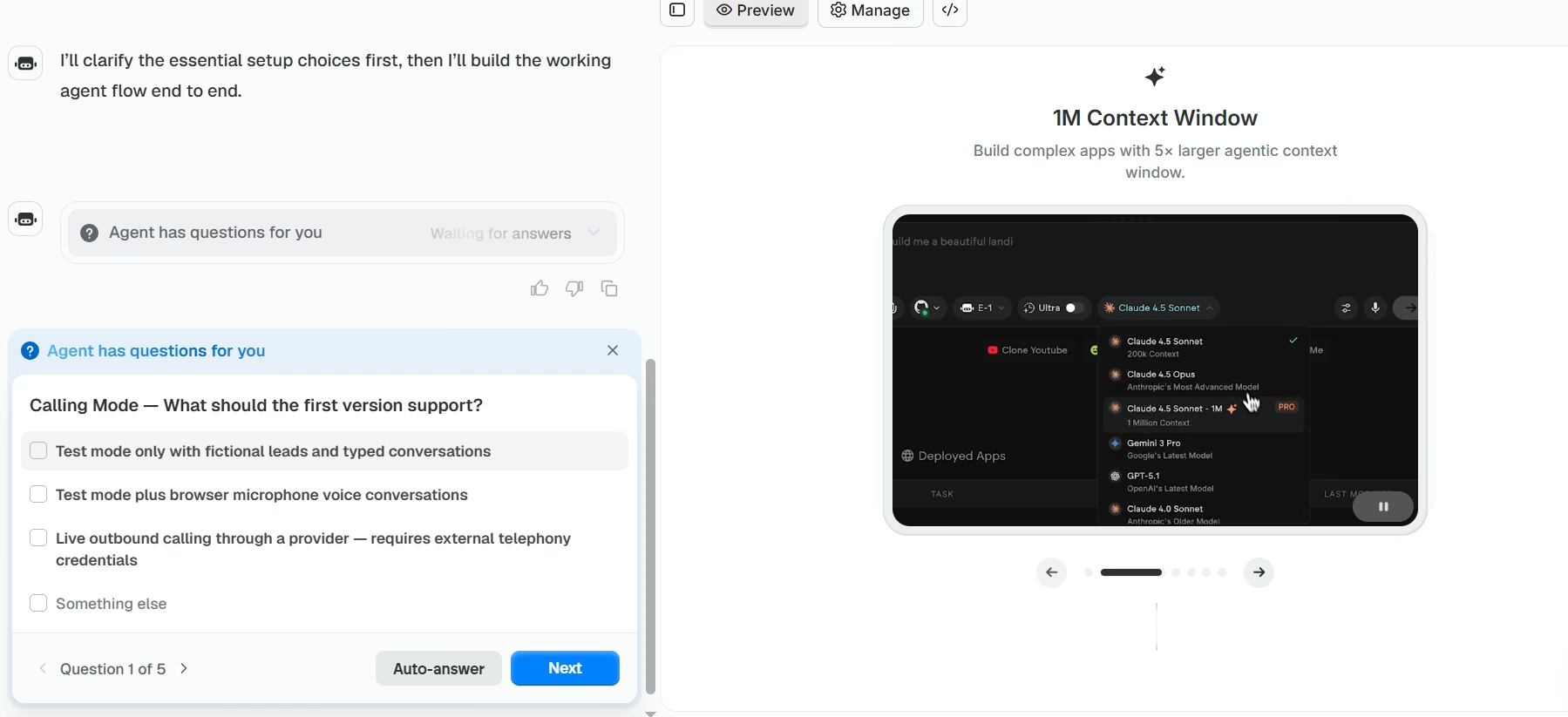
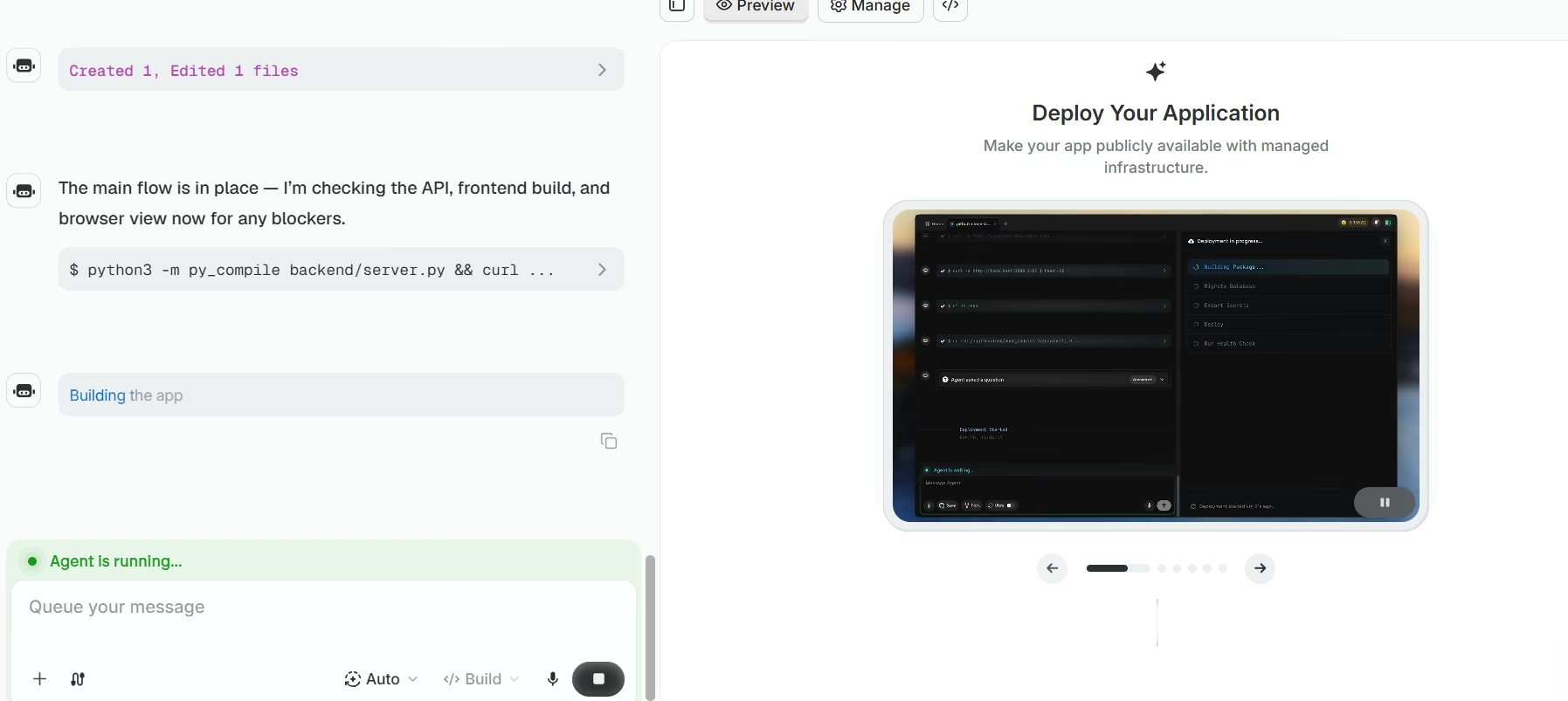
Once you have answered the clarifying questions, the agent starts working on your idea. In the meantime, if you have any doubts or additional questions for the agent, you can queue them for later.
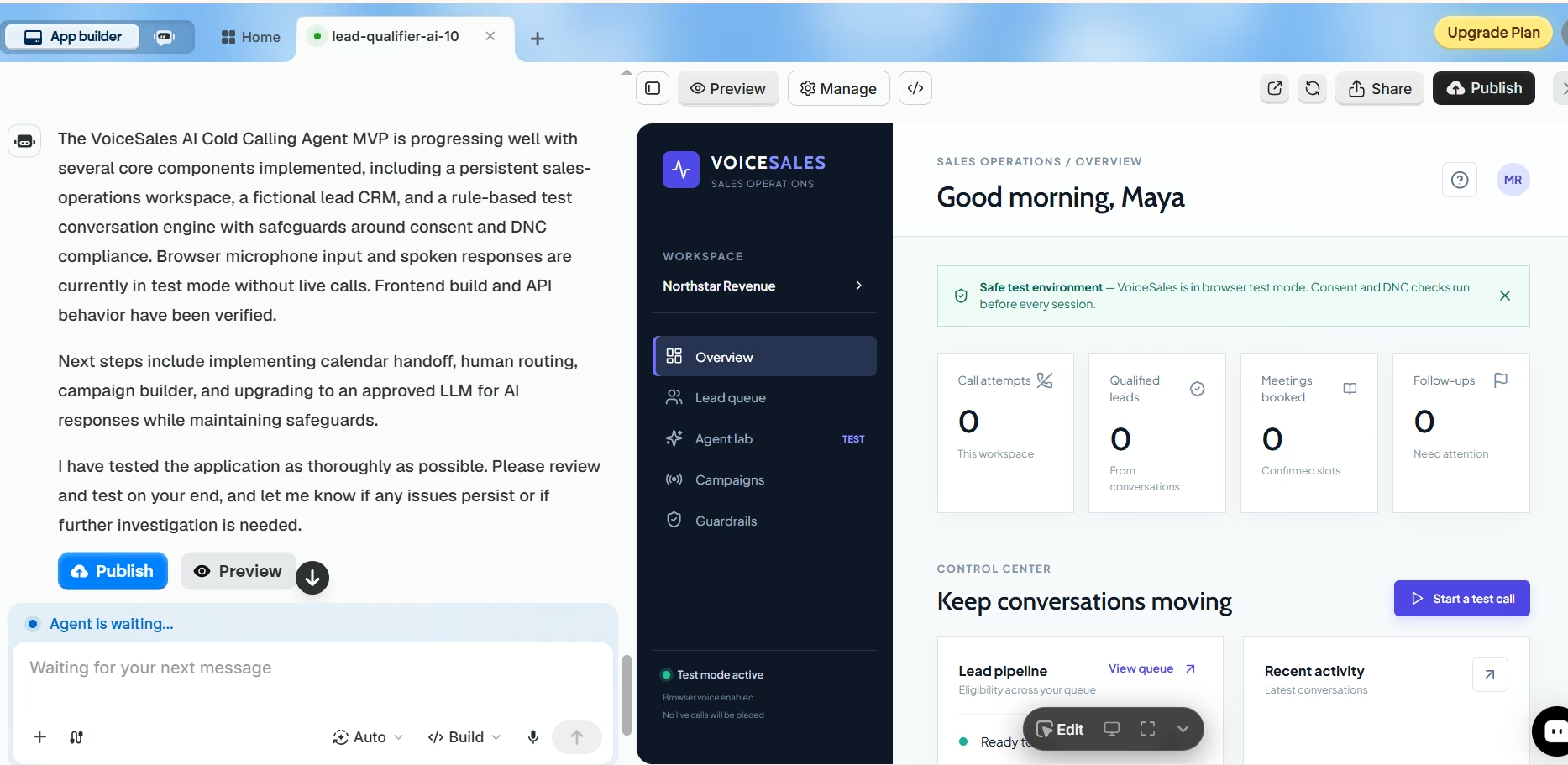
After completing the tasks, the agent will let you know. It will describe what's done and prompt you toward the next steps to be taken. Your product will appear on the screen, with options to edit or publish it.
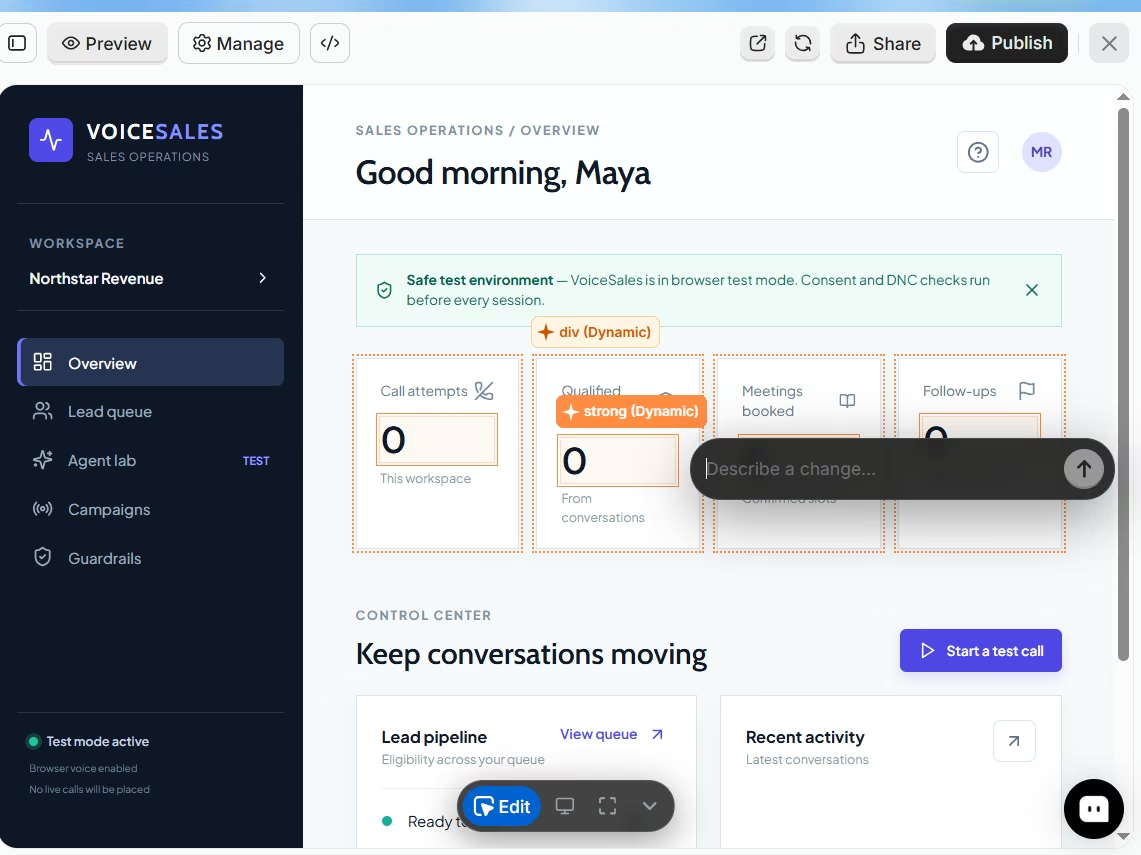
Now, it's your turn to test, review and revise. You can easily edit the app or give immediate instructions on what needs to be changed.
Conclusion
Creating an AI cold calling agent without code involves defining its purpose, connecting the right tools, setting up conversation flows, and testing its responses. You also need to account for consent, opt-outs, caller identification, and human handoffs before launching the agent.
Emergent can help you build the application and workflows behind your AI cold calling agent using natural-language prompts. You can describe your requirements, refine the application, and test its functionality as you build. With the right integrations and clear instructions, you can work toward an agent that fits your business needs and supports your cold calling process.
Most AI app builders stop at prototypes. Emergent creates production-ready apps you can actually launch.
- Production-ready apps
- Web & mobile apps
- Deploy in minutes