Kimi vs. ChatGPT comes down to Kimi K3.1 Pro versus GPT-6.1 Sol: similar list prices, different strengths. Here is how they compare on benchmarks, cost, coding, and open weights.
Kimi vs. ChatGPT at a Glance
Kimi K3.1 Pro vs. GPT-6.1 Sol are the closest like-for-like pair is each lab's frontier model at the same $2 input and $10 output list price. Kimi K3.1 Pro (Moonshot AI, released October 2026) and GPT-6.1 Sol (OpenAI, released September 2026) cost the same per token, so the differences are capability, tokens consumed, speed, and whether you can download the weights.

This article compares K3.1 Pro with GPT-6.1 Sol, not GPT-6 Astra, because Astra costs five times Sol’s standard input and output price ($10 versus $2 input, and $50 versus $10 output per million tokens). Confirm its current ChatGPT plan availability and pricing, because OpenAI’s plan-level packaging can change. Moonshot has no confirmed premium tier to match it.
Astra's full rate card, including caching and long-prompt rates, is in our GPT-6 Astra pricing guide.
What Are Kimi and ChatGPT? Moonshot AI Kimi vs. OpenAI ChatGPT
Kimi is Moonshot AI's model family and product line, and ChatGPT is OpenAI's consumer product built on its GPT models. Moonshot AI Kimi vs. OpenAI ChatGPT is therefore partly a product comparison and partly a model comparison, which is why this article anchors on models.
Kimi spans the Kimi.ai web and mobile apps, the Kimi Work desktop app, the Kimi Code coding tool, and the Kimi API. Moonshot’s strategy includes open weights. Its prior Kimi K3 model was reported as a 2.8-trillion-parameter open-weight model under a custom license; verify the original release page and license before repeating those details.
ChatGPT is OpenAI's assistant, sold through a range of consumer and business plans. Around it sit the OpenAI API, Codex for coding, and enterprise channels. OpenAI's current GPT-6 lineup has four tiers:
Kimi K3.1 Pro vs. GPT-6.1 Sol: Key Differences
The two are the closest pair on price, so the real differences lie in architecture, reasoning controls, and weights. Sol is OpenAI's balanced frontier tier below Astra, and K3.1 Pro is Moonshot's flagship, so each is what most teams would actually deploy.
1. Architecture and size
Moonshot calls K3.1 Pro its most capable 3T-class open-weight model, a post-trained version of Kimi K3 with substantially more post-training compute. Artificial Analysis lists 2.8 trillion total and 104 billion active parameters. OpenAI has not published Sol's size.
2. Reasoning modes and effort settings
Artificial Analysis lists both models as reasoning models and benchmarks GPT-6.1 Sol at Max effort. Moonshot reports its own K3.1 Pro results with reasoning effort set to max. Compare models at the same effort setting when reading benchmark scores, and confirm the reasoning controls available through your chosen API or product surface.
3. Context window and multimodal input
Both list a 1M-token context window and accept text and images as input with text output, per Artificial Analysis. Audio and video support is not confirmed, so check each vendor's documentation before relying on it.
4. Weights and licensing
K3.1 Pro is an open-weight model. Moonshot said full weights would be released in November 2026, and Artificial Analysis currently lists the model as open-weight under the Kimi K3.1-Pro Licence. GPT-6.1 Sol is closed-weight. Verify the current repository, license text, and any commercial-use conditions before deploying.
Kimi vs. ChatGPT Benchmarks
GPT-6.1 Sol leads the overall index by nine points, while Kimi K3.1 Pro leads three agentic tests. The table uses Artificial Analysis’s independent Intelligence Index v5.0.1. Sol is benchmarked at Max effort; Kimi’s listed result is from Kimi’s API.
AA-Briefcase measures agentic knowledge work, AutomationBench-AA measures agentic SaaS workflows, and Terminal-Bench 4.0 measures agentic coding and terminal use. These matter to teams building automations.
FrontierCode 2.0 measures agentic software engineering in open-source repositories, while HLE-Diamond measures reasoning and knowledge.
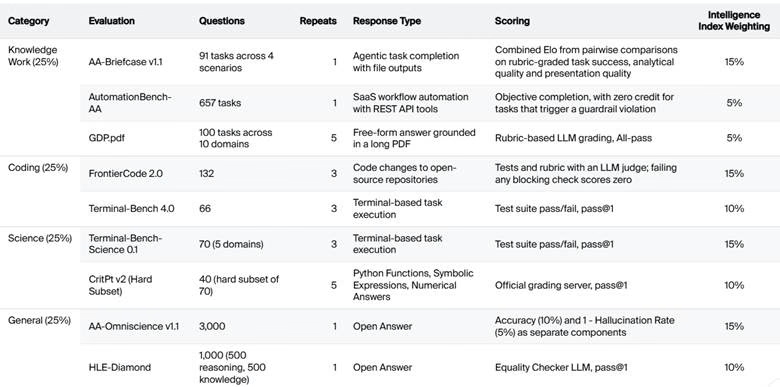
Sol also leads the other three index tests that are not shown. AA-Omniscience (42 vs 30), CritPt v2 (70% vs 50%), and Terminal-Bench-Science (58% vs 34%). They are effectively tied on GDP.pdf, with Kimi at 31.4% and Sol at 31.0%. Artificial Analysis updates its index and reruns evaluations periodically, so check the live comparison page for current results.
For Sol's scores across the full Index, see our GPT-6.1 Sol benchmarks guide. The earlier Kimi K3 is covered in our Kimi K3 benchmarks guide.
Vendor-reported results:
Moonshot reports 65.7% on Terminal-Bench 4.0 for K3.1 Pro, ahead of GPT-6 Astra (58.2%) and just behind Claude Opus 5.5 (66.4%), using the Claude Code harness at max effort. Those are Moonshot’s own runs against Astra, not Sol.
In an independent data-analysis test cited by Plotly, Sol reportedly passed 43 of 43 questions for $2.61, while Kimi passed 42 of 43 for $13.47. Treat this as a single-task-category result, not a general measure of model quality.
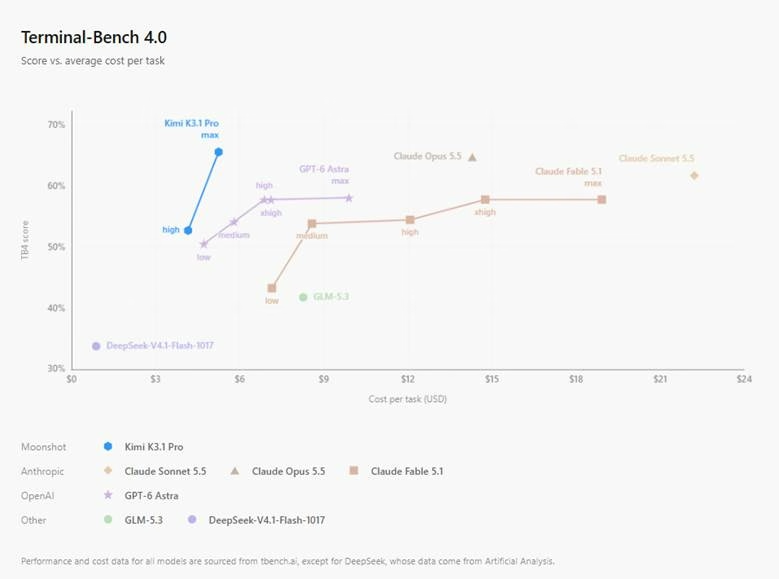
GPT-6 Astra is OpenAI’s premium model and is not the main comparison because it sits in a higher price tier.
Kimi vs. ChatGPT for Coding
Coding is split. Kimi K3.1 Pro leads Terminal-Bench 4.0 (67% vs 56%), and GPT-6.1 Sol leads FrontierCode 2.0 (41% vs 25%), both per Artificial Analysis. Terminal tasks favor Kimi in these runs, while repository-level engineering favors Sol.
Tooling:
Kimi’s coding tool is Kimi Code, where you select K3.1 Pro with the /model command. Moonshot also says K3.1 Pro works with game engines such as Unity, Unreal Engine, and Godot. OpenAI’s equivalent is Codex, where GPT-6.1 Sol is available to Plus, Pro, Business, Enterprise, and Edu users. Confirm current product names and plan limits before buying.
Proposed hands-on check: Run one prompt on both models at the same effort level, one shot: build a single-file habit-tracker web app. Record the model snapshot (kimi-k3.1-pro, gpt-6.1-sol), effort level, date, and platform, and attach screenshots.
Label the result as a small hands-on check, and do not generalize from one test.
Ten checkable requirements are easy to run once and hard to rerun every time a model updates. A coding agent builder lets you build an AI coding agent that replays the same checklist on each new snapshot.
Kimi vs. ChatGPT Pricing, Speed, and Access
Per-token prices match at the frontier tier, but Sol costs less per task and finishes tasks faster. The table shows standard API rates per million tokens.
Moonshot says K3.1 Pro Highspeed delivers 2–3 times the speed of K3.1 Pro. Verify the current Highspeed price directly on Moonshot’s pricing page before using it in a cost comparison.
OpenAI’s separate Fast mode doubles the standard short-context rates for Sol and Astra. Sol is $4 input / $20 output, and Astra is $20 input / $100 output per million tokens. For requests above 272K input tokens, OpenAI lists Sol’s long-context rate at $4 input and $15 output per million tokens.
OpenAI also lists cached input at $0.10 per million tokens for GPT-6.1 Sol, $1.00 for GPT-6 Astra, $0.05 for GPT-6.1 Terra, and $0.01 for GPT-6 Luna. Artificial Analysis reports a blended price of $1.54 per million tokens for Kimi and $1.47 for Sol under its 7:2:1 cache-hit/input/output assumption.
Cost per task:
Artificial Analysis reports $3.68 per task for K3.1 Pro and $1.27 for Sol, and $3,153 vs $1,124 to run the full index. Cost per task reflects pricing and token use across input, cache, reasoning, and output tokens. Kimi used 113 million output tokens across the index, against Sol’s 63.7 million.
Sol's caching, Batch, and long-prompt rates are laid out in our GPT-6.1 Sol pricing guide, and our guide to AI agent cost shows how token use drives the real bill.
Speed:
The two trade off, as the table shows.
Sol generates faster and completes Intelligence Index tasks in about half the time. At Max effort, Sol’s time to first answer token is about 175 seconds, slightly ahead of Kimi’s 181 seconds. Kimi’s first token arrives sooner, but that initial token is not necessarily an answer token. Pick based on whether your users wait on one reply or on a long agent run.
Access:
Kimi K3.1 Pro and K3.1 Pro Highspeed are available on Kimi.ai, Kimi’s mobile apps, Kimi Work, Kimi Code, and the Kimi API. Moonshot says Kimi Enterprise administrators can enable K3.1 Pro for their organization; access is off by default at launch.

OpenAI says GPT-6.1 Sol is available to Plus, Pro, Business, Enterprise, and Edu users in ChatGPT Work and Codex; it is not yet available in Chat. Developers can also access it through the OpenAI API.
Open Weights, Privacy, and Data Residency
Open weights are Kimi’s clearest advantage. Moonshot said full K3.1 Pro weights would be released in November 2026, and Artificial Analysis currently lists K3.1 Pro as open-weight under the Kimi K3.1-Pro Licence. Confirm the current repository, license text, and commercial-use conditions before deploying.
Open weights can enable self-hosting, fine-tuning, and reduced dependence on a single vendor. K3.1 Pro is a large 2.8-trillion-parameter model, so confirm Moonshot’s current hardware requirements, repository availability, and license terms before planning a deployment. OpenAI’s models are closed-weight and are accessed through OpenAI’s API, ChatGPT surfaces, and cloud partners.
Residency and retention, from vendor documentation:
OpenAI: OpenAI says regional processing/data-residency endpoints carry a 10% uplift for eligible models released on or after March 5, 2026. Confirm the supported regions, endpoint availability, and zero-data-retention eligibility in OpenAI’s current documentation before sending sensitive data.
Moonshot: Moonshot says Zero Data Retention is available to Kimi API customers. Review Moonshot’s current terms, privacy policy, and enterprise documentation for data-handling, residency, and organizational-account controls before sending sensitive data.
Which Should You Choose? Kimi or ChatGPT by Use Case
Choose by workload. Sol for broad capability and cost per task, Kimi for open weights and agentic or terminal work, and Luna for volume.
Conclusion
Kimi vs. ChatGPT comes down to what you need from an AI model. GPT-6.1 Sol offers stronger overall benchmark performance and lower cost per task, while Kimi K3.1 Pro provides an open-weight alternative for teams that want more control over deployment. GPT-6 Luna is another option for high-volume, cost-sensitive workloads, while GPT-6 Astra targets tasks that justify a premium model.
However, choosing a model is only one part of building with AI. Turning an idea into a working application also involves designing interfaces, setting up backends, managing databases, configuring user authentication, and connecting integrations. This is where Emergent fits into the picture.
Emergent is a vibe coding and app builder platform. You describe what you want in plain language, and Emergent turns it into a working application that you can review, refine through follow-up prompts, and keep building on as the code develops.
Rather than building every component from scratch, founders and builders can use Emergent to move from an idea to a working application while choosing from supported AI model families. This makes it a practical option for those who want to put AI capabilities to work without having to manage every part of the development process manually.
Describe it. Build it. Launch it.
- End-to-End Creation
- No Code Needed
- Live in Minutes

Most AI app builders stop at prototypes. Emergent creates production-ready apps you can actually launch.
- Production-ready apps
- Web & mobile apps
- Deploy in minutes