



TL;DR
- Sonnet 5.5 costs $2 per million input tokens and $10 per million output tokens. Opus 5.5 costs $4 and $20. Cache reads cost Opus 5.5: $0.20 per million tokens and Sonnet 5.5: $0.10 per million tokens.
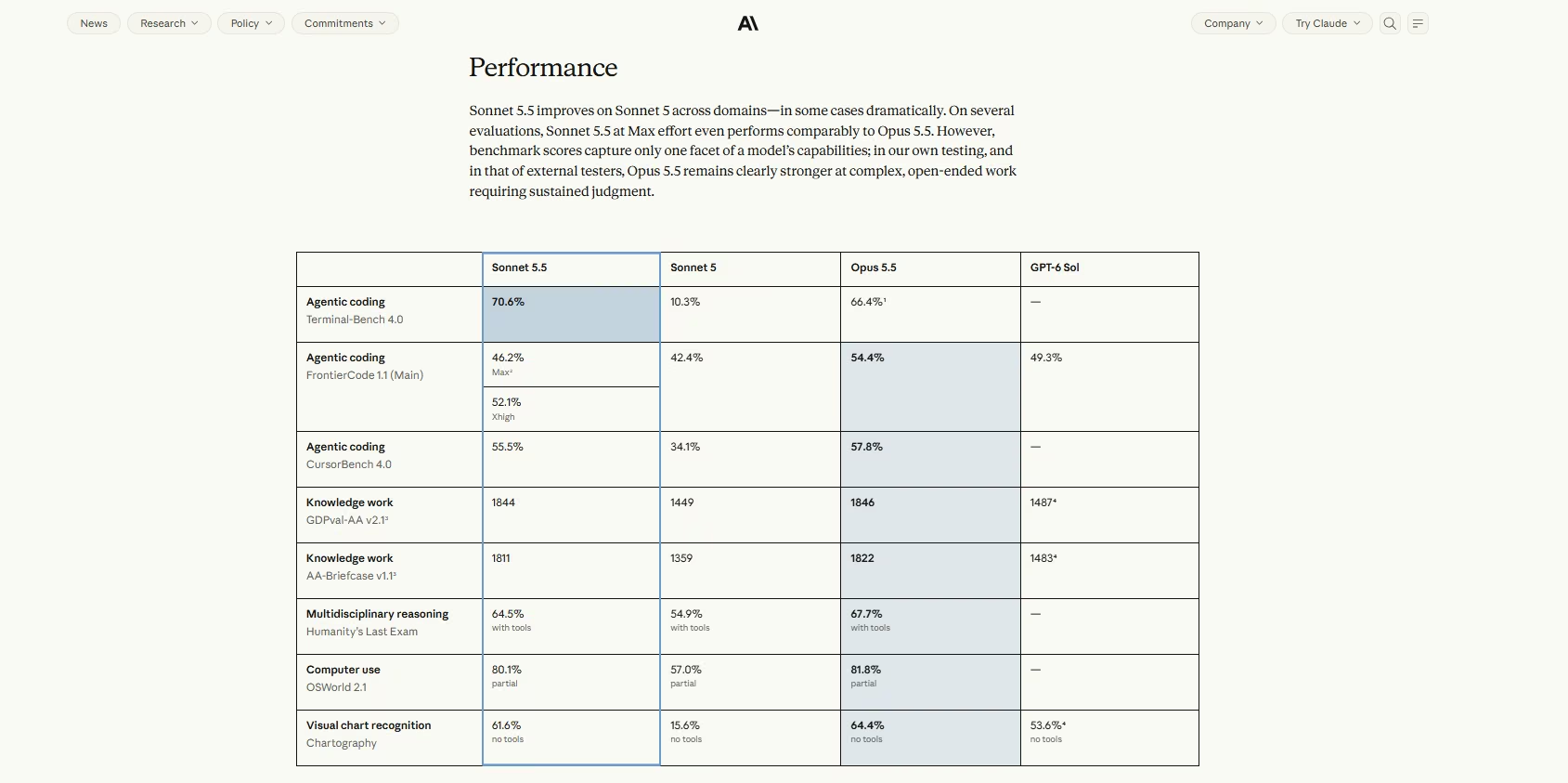
- Opus 5.5 leads on most published benchmarks, with the widest margins on demanding coding, computer-use, and chart-recognition work. Sonnet 5.5 is within a few points of Opus 5.5 on several professional-work benchmarks.
- In Anthropic’s published Terminal-Bench 4.0 results, Sonnet 5.5 scored 70.6% at Max effort, while Opus 5.5 scored 66.4% at XHigh effort. These results use different effort settings, so they should not be read as a like-for-like comparison.
- In Artificial Analysis’s current measurements, Opus 5.5 at High effort generates about 105 tokens per second, while Sonnet 5.5 at High effort generates about 139 tokens per second.
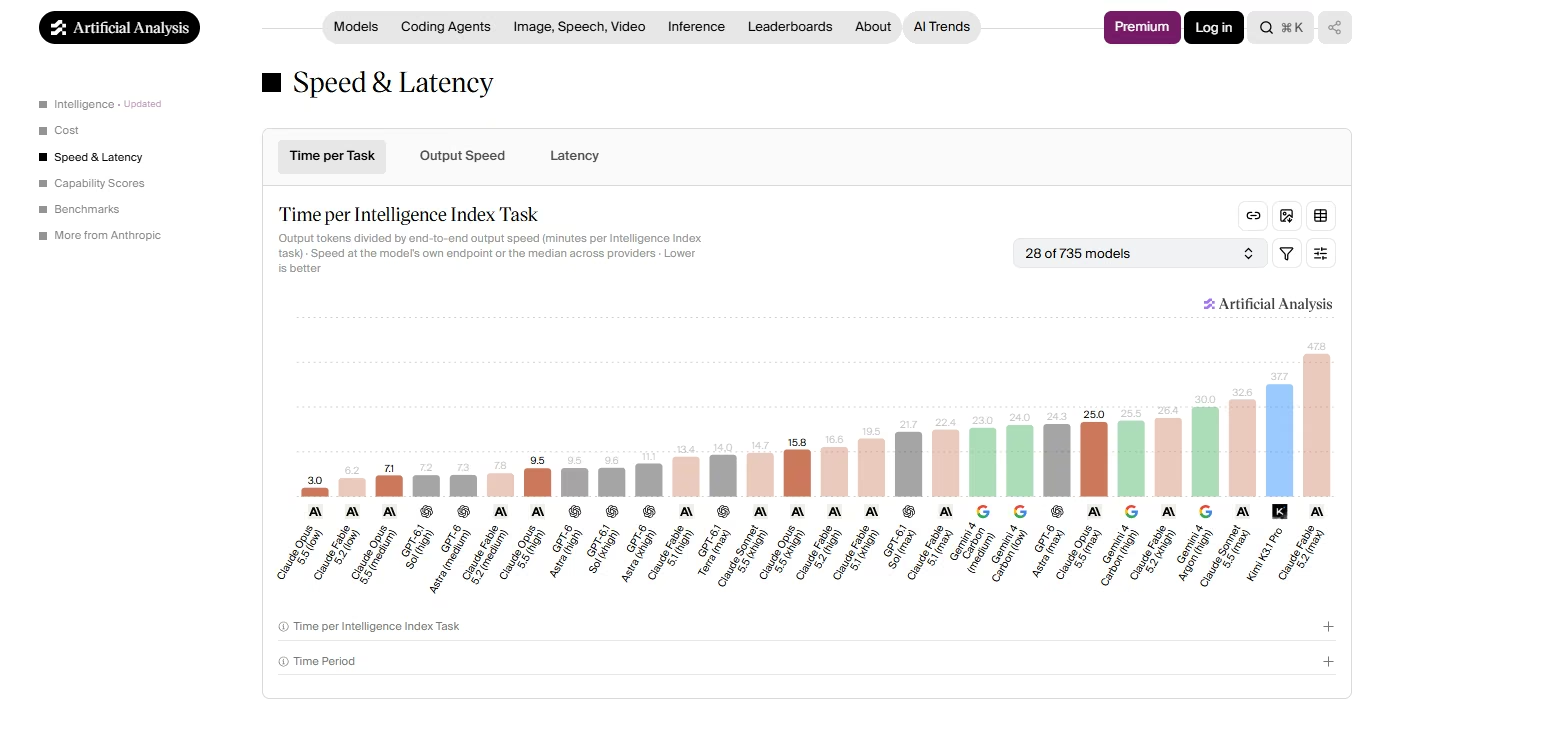
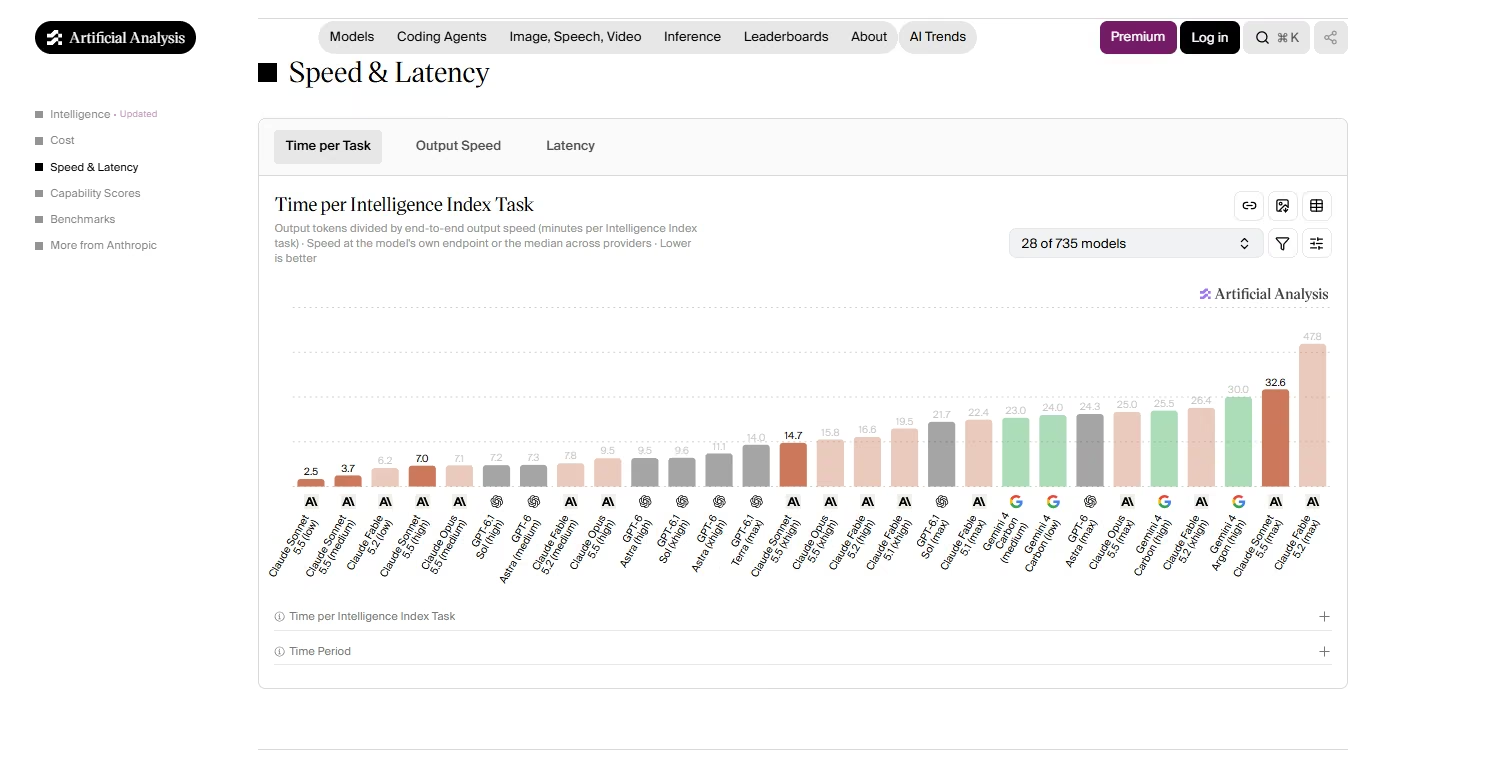
- Sonnet's lower token prices do not guarantee lower total task costs. Compare token usage and cost per successful task on your own workloads.
Anthropic’s Claude 5.5 family includes Claude Opus 5.5, Claude Sonnet 5.5, and Claude Haiku 5.5. In the Artificial Analysis measurements referenced for this comparison, Claude Opus 5.5 generates approximately 105 output tokens per second, while Claude Sonnet 5.5 generates approximately 139. These figures reflect measured throughput under the tested configurations and may vary with reasoning effort, provider, and workload.
Effort level is the third variable that changes the quality, cost, and latency trade-off. At high effort, both models allocate more reasoning to each task. This can improve accuracy on complex tasks, but it also increases token consumption, cost per task, and latency.
A simple price comparison can mislead. Sonnet 5.5 costs half as much per token ($2 and $10 per million tokens vs. $4 and $20 for Opus 5.5). Yet total cost per task also depends on the tokens each model consumes, so the price gap does not always translate directly into a cost gap. Benchmarks add a second layer of nuance. Sonnet 5.5 is within a few points of Opus 5.5 on several professional-work evaluations, while Opus 5.5 holds a clear lead on demanding coding, computer-use, and autonomous workloads.
In this article, we compare Claude Opus 5.5 (high effort) and Claude Sonnet 5.5 (high effort) across coding, agentic work, reasoning, speed, and cost, along with published benchmarks. It then answers the question most leaders ask: Which Claude model should I use?
Opus 5.5 High and Sonnet 5.5 High at a Glance
Anthropic released Claude Opus 5.5 on 22 September 2026 and Claude Sonnet 5.5 on 28 September 2026. Compared with their respective predecessors, Opus 5.5 generates output more than 30% faster and costs about 40% less to run on typical workloads; Sonnet 5.5 runs more than 30% faster and costs up to 30% less for most work.
Both models use adaptive thinking and offer Low, Medium, High, XHigh, and Max effort levels. Both are available through the Claude API, Anthropic’s products, and major cloud platforms, including AWS, Google Cloud, and Microsoft Azure.
The following summary compares the two at the configuration most executives will actually run: high effort.
| Dimension | Claude Opus 5.5 (High) | Claude Sonnet 5.5 (High) |
|---|---|---|
| Input price (per million tokens) | $4 | $2 |
| Output price (per million tokens) | $20 | $10 |
| Cache read per million tokens | $0.20 | $0.10 |
| Cache write per million tokens | $5 | $2.50 |
| Fast mode | Available at premium pricing | Not available |
| Default API effort | Medium | High |
| Output Speed | About 105 tokens per second at High effort | About 139 tokens per second at High effort |
| Strength | Large-scale reasoning, open-ended, and agentic work | High-volume, latency-sensitive, and well-scoped tasks |
| Typical role | Primary model for hard problems | Subagent model and workhorse |
What is Claude Opus 5.5?
Opus 5.5 is a major upgrade from Opus 5. It is Anthropic’s newest Opus model and its recommended starting point for most workloads. Early testers reported large performance gains on complex tasks. According to Anthropic, one early tester used Claude Opus 5.5 to complete a 680,000-line code migration in less than a day. This is a vendor-reported example, not an independently replicated benchmark.

What changed from Opus 5
- Claude Opus 5.5 always reasons before answering a request.
- The model costs less. Its prices fell about 20% to $4 per million input tokens and $20 per million output tokens. Cache reads fell 60%, from $0.50 to $0.20 per million tokens.
- Typical workloads were 40% cheaper to run in default settings in the Anthropic test. Plus, it uses fewer tokens per task.
- According to Anthropic, Opus 5.5 generates output more than 30% faster than Opus 5.
- Opus 5.5 writes more clearly. Writing clarity was one of the most common areas of feedback on Opus 5, so the new model uses less technical jargon and follows writing instructions more closely.
What is Sonnet 5.5?
Sonnet 5.5 is the second member of Anthropic’s Claude 5.5 model family. Opus 5.5 is built for complicated tasks requiring judgment; Sonnet 5.5 is designed for everyday tasks like fixing bugs and creating polished spreadsheets, slides and documents. Anthropic positions Sonnet 5.5 as particularly strong for design-oriented work.
What High Effort Changes in Each Model
Claude Opus 5.5 and Sonnet 5.5 expose five effort levels: Low, Medium, High, XHigh, and Max. Here is a glimpse of those five effort levels and what they do.
| Levels | What Anthropic Says It Does |
|---|---|
| Low | It does jobs like subagents where speed and low cost matter the most |
| Medium | Agentic work that requires speed, cost, and quality all in balance |
| High | It does jobs like complex coding, difficult reasoning problems, and agentic tasks |
| XHigh | Long-horizon agentic and coding work that takes over 30 minutes with large token budgets |
| Max | Tasks that require the deepest reasoning, with no limit on spending tokens |
Effort controls how much reasoning capacity a model applies during or before the response. Higher effort improves accuracy on hard problems, even when it requires more output tokens, latency, and spend. Effort is therefore not just a quality setting; it is also a cost and latency control. The two models default differently.
On the Claude Platform, Sonnet 5.5 defaults to High effort, while Opus 5.5 defaults to Medium. In Claude apps and Claude Code, the default effort is Medium for both. This is a practical detail that's easy to miss. If a team adopts both models without switching their default settings, they aren’t comparing like-to-like. Sonnet 5.5 will run at a higher effort setting than Opus 5.5 unless the team changes the default.
To be explicit, for a fair comparison, you must switch Opus's default to High instead of Medium. High effort improves accuracy on demanding tasks, but increases token consumption and latency. It provides most of the accuracy benefit needed to do professional work without exhausting the token consumption of XHigh and max. The relationship between effort, cost, and accuracy varies by task.
- Sonnet 5.5 scored 70.6% on Terminal-Bench 4.0 at Max effort. Its cost per task rises with effort, so the best operating point depends on the accuracy a workload requires.
- Opus 5.5’s published Terminal-Bench 4.0 result is 66.4% at XHigh effort, with a standard error of ±2.6 percentage points. Small score differences should therefore not be overinterpreted.
The results suggest that model choice should depend on the task, effort setting, token consumption, and measured success rate, not on token price alone. This is the core insight of this comparison: the right question is not simply which model is cheaper.
Also Read: Claude Opus 5.5 high vs low effort for how effort changes cost and results on the larger model.
Reasoning and Complex Work Compared
According to Anthropic, Claude Sonnet 5.5 includes safety classifiers designed to prevent reasoning extraction. These safeguards help protect against model-distillation attacks but should not be interpreted as eliminating every possible extraction risk.
Anthropic says Opus 5.5 improves behaviors that contributed to recent cybersecurity incidents, including motivated or biased reasoning.
Both models are closer than their price difference suggests in knowledge and reasoning work. But Opus retains an edge, consistently on the hardest problems.
Professional and Knowledge Work
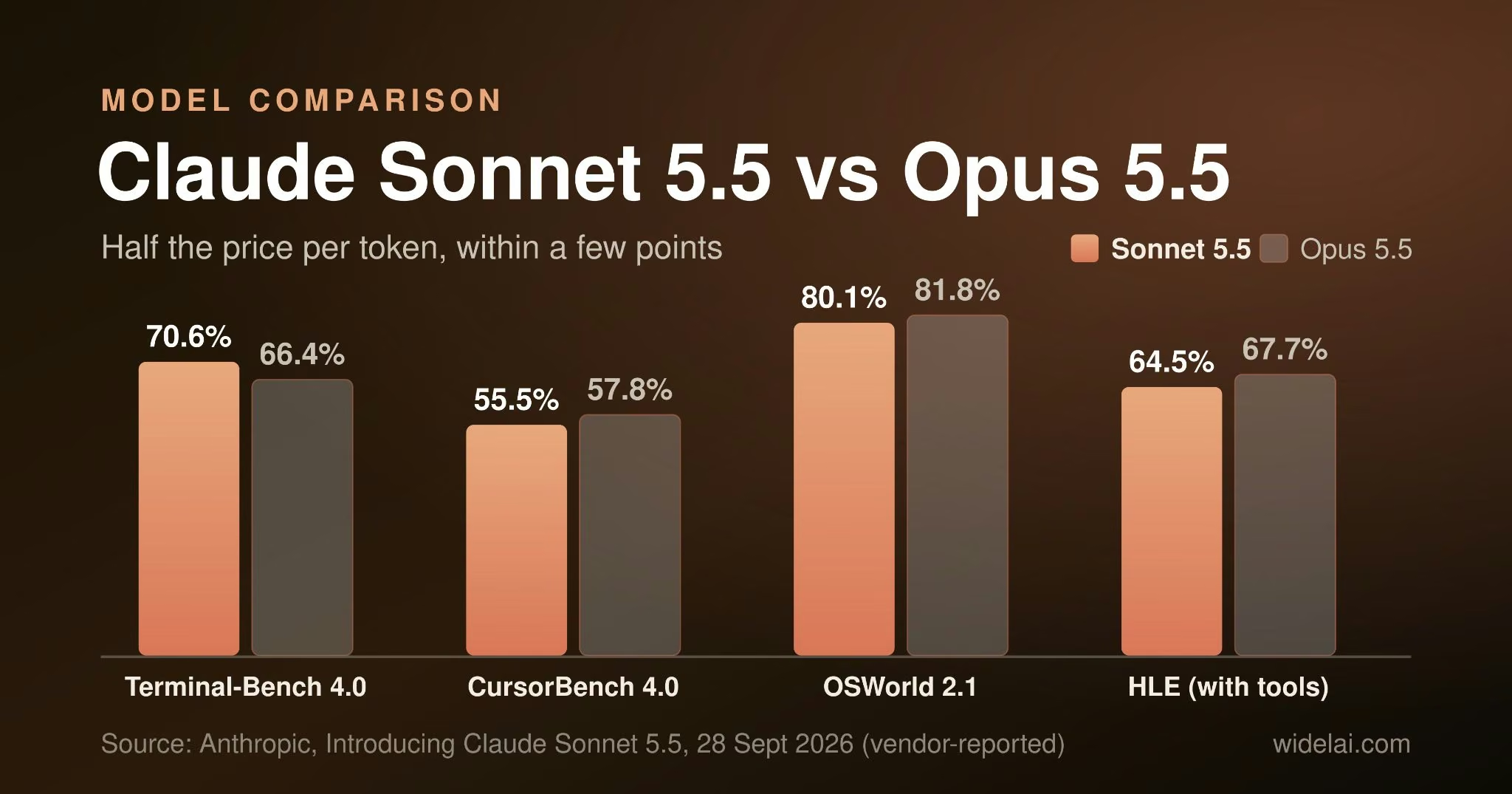
On Humanity’s Last Exam with tools, Sonnet 5.5 scored 64.5%, versus 67.7% for Opus 5.5. On other benchmarks that are designed to reflect professional tasks, Sonnet nearly levels with Opus 5.5. On GDPval-AA v2.1, an Elo-style benchmark for real-world professional work, Sonnet 5.5 scored 1844, and Opus 5.5 scored 1846.
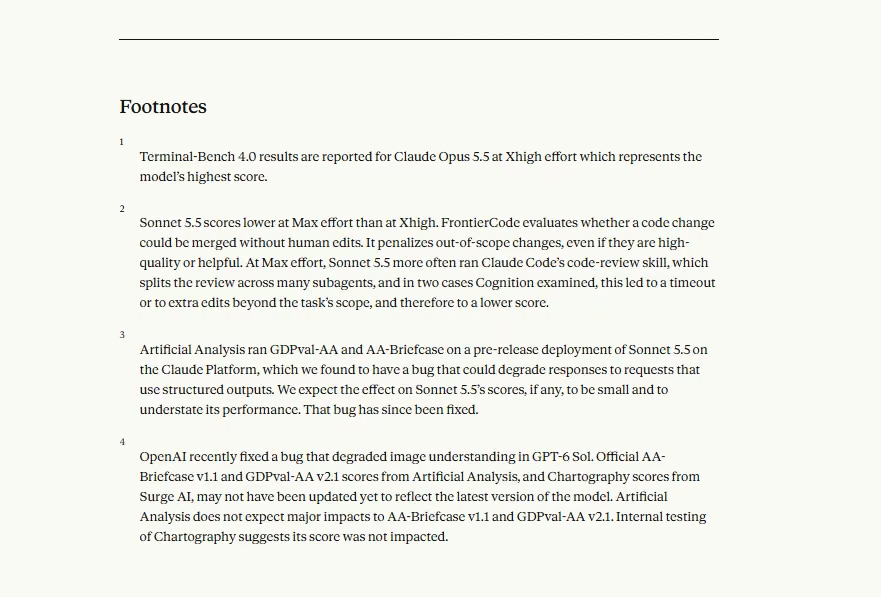
Anthropic notes that Artificial Analysis ran Sonnet 5.5 on a pre-release deployment with a structured-output bug, which may have understated its GDPval-AA result. On AA-Briefcase v1.1, an Elo-style benchmark, Sonnet 5.5 scored 1811, and Opus 5.5 scored 1822. For business executives, this suggests that Sonnet 5.5 is a credible default for analysis, document, and business-process work.
Source: Artificial Analysis
Hard Reasoning and Multimodal Tasks
Opus leads on Humanity’s Last Exam with tools, 67.7% versus Sonnet’s 64.5%, and on Chartography without tools, 64.4% versus 61.6%. On the computer-use benchmark, OSWorld 2.1, Opus again leads by 1.7 percentage points. Anthropic’s launch page describes Opus as stronger on complex and open-ended tasks.
Here is a quick comparison between the two.
| Benchmark | Sonnet 5.5 | Opus 5.5 | Result |
|---|---|---|---|
| Terminal-Bench 4.0 | 70.6% | 66.4% | Sonnet wins by 4.2. However, Sonnet at Max effort; Opus at XHigh effort. Not a same-effort comparison. |
| GDPval-AA v2.1 | 1844 | 1846 | Opus ahead by 2 Elo points |
| AA-Briefcase v1.1 | 1811 | 1822 | Opus ahead by 11 Elo points |
| OSWorld 2.1 | 80.1% | 81.8% | Opus ahead by 1.7 |
| Chartography | 61.6% | 64.4% | Opus ahead by 2.8 points.(Source) |
| CursorBench 4.0 | 55.5% | 57.8% | Opus ahead by 2.3 points (Source) |
| FrontierCode 1.1 | 52.1% at XHigh effort; 46.2% at Max effort | 54.4% | Opus ahead by 2.3 |
Table 1. Sonnet 5.5 vs. Opus 5.5: Opus leads on six of seven benchmarks by small margins, while Sonnet leads on Terminal-Bench 4.0 at a higher effort setting than Opus.
Source: Anthropic's official Claude Opus 5.5 and Claude Sonnet 5.5 benchmark disclosures. Results reflect the evaluation configurations reported by Anthropic; reasoning-effort settings may differ across benchmarks.
For Opus 5.5’s scores in full, including the tests not shown in this table, see our Claude Opus 5.5 benchmarks guide
Knowledge, Accuracy and Honesty
For high-stakes work, evaluate factual accuracy, source citation, and refusal behavior on your own prompts and documents. The available primary launch materials do not establish a reliable head-to-head hallucination-rate difference between these two models.
Coding and Agentic Performance Compared
Coding and autonomous agents are where model selection can have the largest financial consequences, because these workloads can consume the most tokens.
Coding Benchmarks
Sonnet 5.5 represents a major coding improvement over Sonnet 5. At High effort on FrontierCode, it scored 10 points higher than Sonnet 5 at the same setting. However, Opus 5.5 still leads on Anthropic’s published FrontierCode, CursorBench, and Terminal-Bench comparisons.
On Terminal-Bench 4.0, Claude Sonnet 5.5 scores 70.6% at Max reasoning effort, compared with Claude Opus 5.5's 66.4% at XHigh effort. Since the models were evaluated at different reasoning-effort settings, these results should not be interpreted as a strictly like-for-like comparison.
The Sonnet result is its headline score; Anthropic does not present these figures as a same-effort comparison.
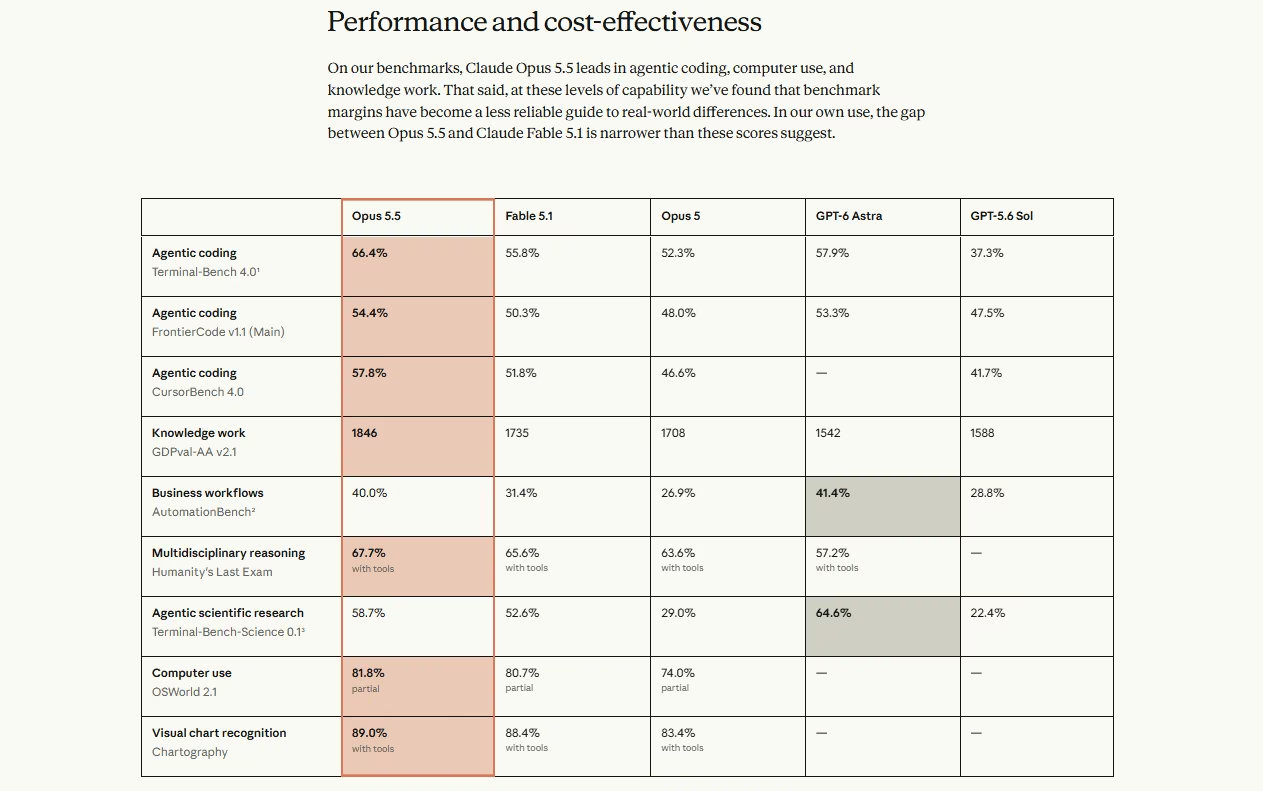
Anthropic’s system cards note that safeguard fallbacks affected a larger share of Opus 5.5 trials than Sonnet 5.5 trials, so the results are not perfectly clean like-for-like comparisons.
As you can see above, Opus leads on most comparative rows. On FrontierCode 1.1, which tests whether an agent’s changes would be accepted into the codebase, Opus scored 54.4%, while Sonnet 5.5 scored 52.1% at XHigh effort and 46.2% at Max effort.
Sonnet's Max-effort score is lower than its XHigh-effort score. This result suggests that more reasoning does not always improve performance. Source
Agent Loops and Subagents
For long-running agent work, measure tool calls, retries, output tokens, wall-clock time, and successful-task rate on your own workflows. Anthropic’s customer evidence indicates that Opus 5.5 can reduce steps and token use on some agentic workloads, but that does not establish a universal Opus advantage over Sonnet.
A common and effective architectural approach is to let Opus plan and delegate sub-tasks to Sonnet. If you are building internal software, an AI app builder can help you prototype both the orchestration layer and the interface.
Speed, Token Use, and Cost Compared
This section matters most to finance and procurement teams because list pricing is a starting point, not a forecast of real-world task cost.
Pricing
| Cost Element | Opus 5.5 | Sonnet 5.5 |
|---|---|---|
| Input per million tokens | $4 | $2 |
| Output per million tokens | $20 | $10 |
| Cache write, 5 minutes | $5 | $2.50 |
| Cache write, 1 hour | $8 | $4 |
| Cache read | $0.20 | $0.10 |
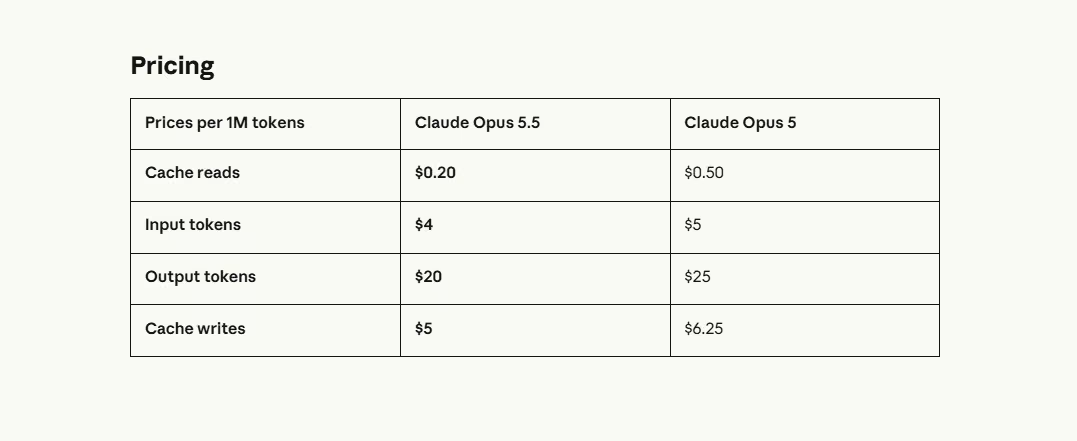
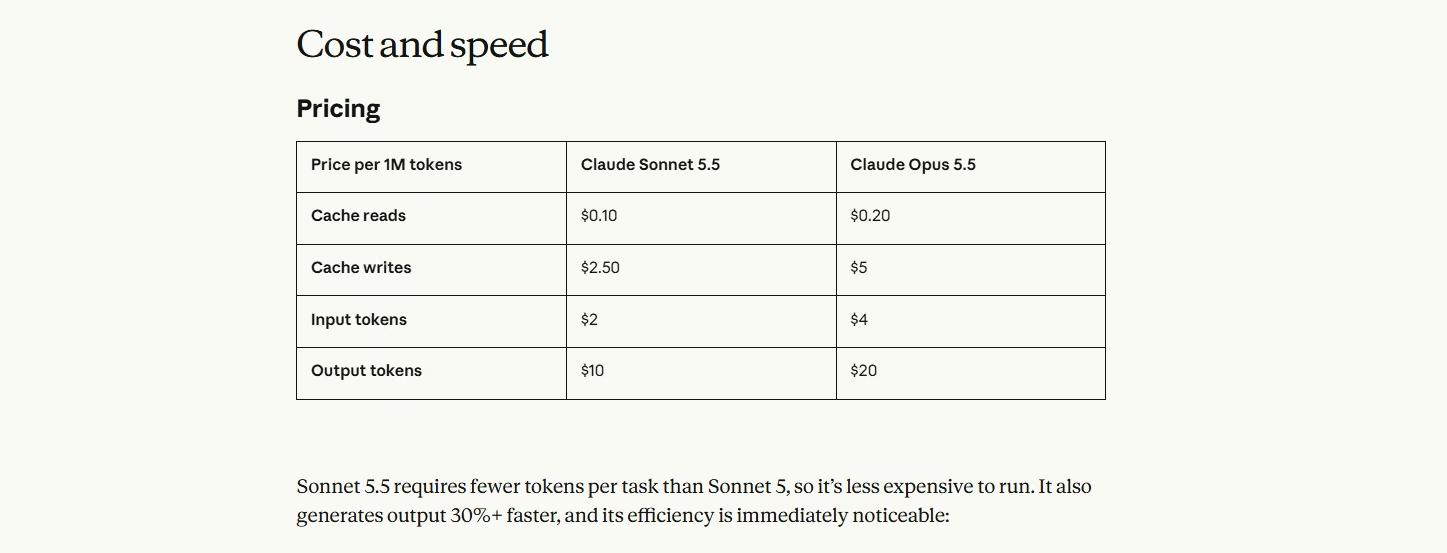
The Opus 5.5 versus Sonnet 5.5 pricing difference is exactly two-to-one for input, output, cache writes, and cache reads. Sonnet costs $0.10 per million cached input tokens versus Opus’s $0.20. However, the total cost per completed task may differ because each model can consume different numbers of tokens, use different effort settings, and require different numbers of attempts.
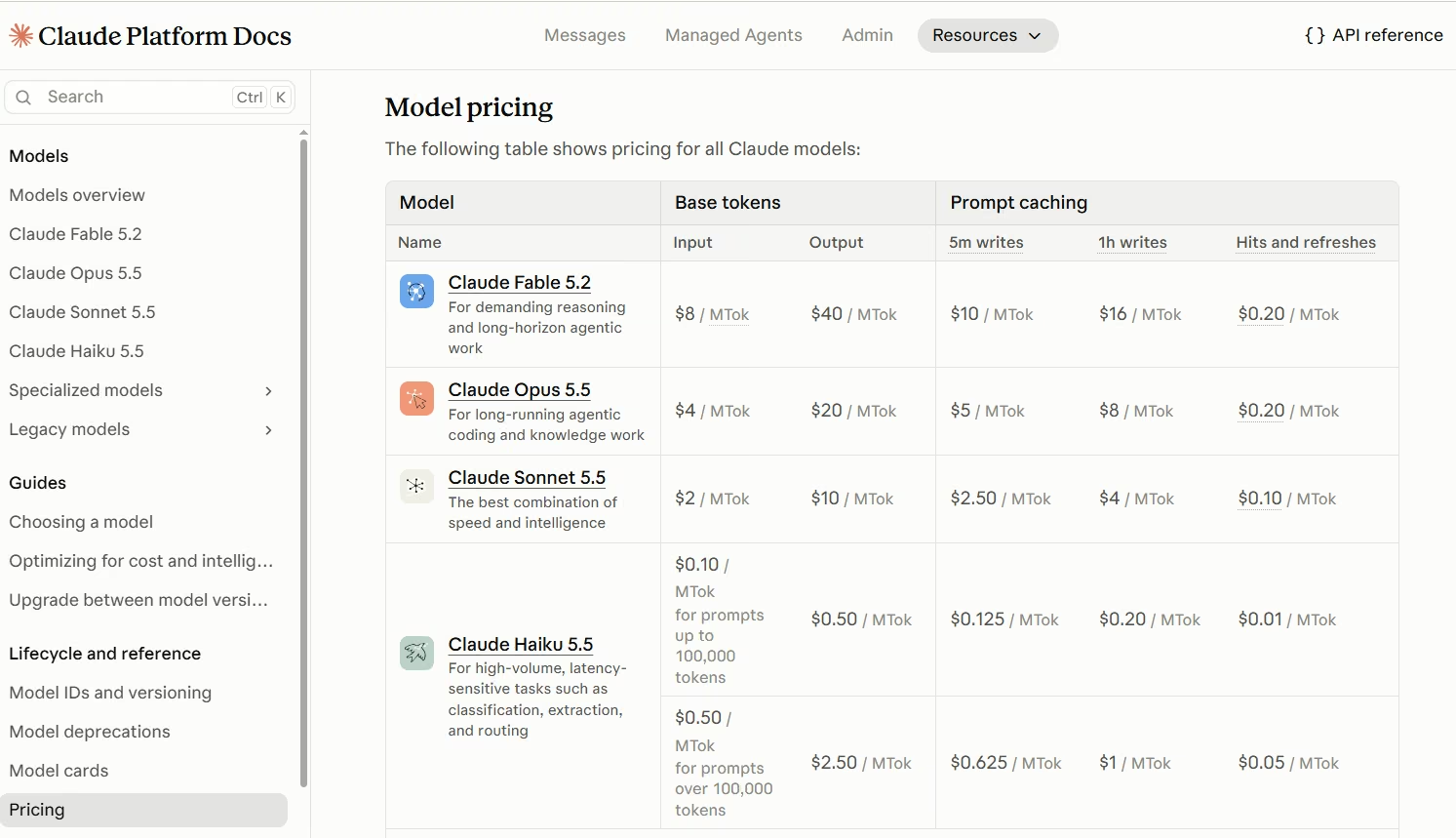
Also Read: Claude Opus 5.5 pricing and Claude Sonnet 5.5 pricing for caching, batch, and cost-per-task detail on each.
Tokens Per Task
Price per token isn't the whole story; it’s only part of it. Cost per task depends on input, output, and cache tokens, each multiplied by its applicable price. Token consumption varies substantially by task and effort level. Measure input tokens, output tokens, cache usage, retries, and successful-task rate on your own workloads before choosing a model.
At higher effort settings, Sonnet’s cost per task can rise. The lowest-cost model for a given workload is the one with the lower cost per successful task, not necessarily the lower price per token. Effort level, token consumption, cache usage, retries, and task success rate all affect the final cost per task.
Building a cost-per-task view
The more useful metric is cost per successful task, not cost per token. Instrument your workloads to capture tokens, latency, effort level, and each run’s pass/fail result, then compare results by model.
Where Each Configuration Falls Short
No model configuration is applicable universally. Here is a list of weaknesses most likely to affect your business decision.
Opus 5.5 at High Effort
- Slow output can degrade interactive experiences unless you use fast mode, which costs more.
- Opus 5.5 costs twice as much as Sonnet 5.5 per input and output token, making it a more expensive choice for high-volume workloads. Its higher price is easier to justify when stronger performance reduces retries, manual intervention, or total task completion time.
- Because Opus 5.5’s Claude Platform default is Medium, teams must set effort explicitly to achieve High-effort performance.
Sonnet 5.5 at High Effort
- Sonnet 5.5 trails Opus 5.5 on several demanding reasoning, coding, computer-use, and chart-recognition benchmarks, including Humanity's Last Exam, FrontierCode, CursorBench, OSWorld, and Chartography. Teams handling complex, open-ended work should test both models on representative tasks before deciding.
- Token consumption varies by task and effort level. Set output limits based on measured token usage, since overly low limits can truncate valid responses.
- At higher effort settings, Sonnet’s cost per task rises. On FrontierCode 1.1, Sonnet 5.5 scored 52.1% at XHigh but 46.2% at Max, showing that more reasoning does not always improve a benchmark result.
Which Configuration Should You Choose
The practical answer is to use both models, with explicit routing rules. The following framework translates the evidence into decisions.
Choose Sonnet 5.5 at high effort when
- The volume is high and unit economics matter. For example, customer support, internal copilots, and document processing.
- Interactive assistants and real-time tools benefit from lower latency.
- The model runs as a subagent, performing a small, narrow task assigned by an orchestrator.
- Retrieval or tools supply the needed facts, reducing reliance on the model’s recall.
Choose Opus 5.5 at high effort when
- The task is long or open-ended, such as multi-file engineering, complex analysis, research synthesis, or a large refactor.
- It works autonomously in agent loops when rework is expensive and errors compound.
- The work requires a very large context window.
- When an incorrect answer could have serious consequences, such as legal, financial, or compliance-sensitive analysis, accuracy per attempt matters more than price per token.
Conclusion
Opus 5.5 is the better choice for long, ambiguous, or high-stakes work, such as multi-file engineering, complex analysis, and autonomous agent loops. Sonnet 5.5 is the better choice for high-volume, latency-sensitive, and well-scoped tasks, where its lower token price and faster output matter most. The practical approach is to use both: Opus for planning and complex work, Sonnet for execution and subagents.
Once you have chosen a model, Emergent's AI app builder helps you turn it into a working product. Describe the app, internal tool, or dashboard you want in plain English, and Emergent can build the interface, backend, database, logins, and integrations. Use Opus 5.5 for complex planning and agentic work, and Sonnet 5.5 for fast, high-volume execution; then review, refine, and test the result before launch.

Describe it. Build it. Launch it.
- End-to-End Creation
- No Code Needed
- Live in Minutes

Most AI app builders stop at prototypes. Emergent creates production-ready apps you can actually launch.
- Production-ready apps
- Web & mobile apps
- Deploy in minutes





