TL;DR
- A traditional CRM keeps your real estate business organized. It saves leads, contacts, properties, deals, notes and follow-ups.
- But an AI CRM does more. It can prioritize leads, summarize conversations, write follow-ups, identify patterns, and automate repetitive tasks.
- A traditional CRM may suffice for teams that want a straightforward lead management and deal-tracking solution. AI can relieve your agents of repetitive tasks such as lead sorting, data entry, and follow-ups, which could otherwise take hours.
- Stop asking yourself whether AI CRM or traditional CRM is better. It's about whether your CRM software makes your agents more productive in their selling efforts or in managing the CRM system.
- If your CRM is already in place and isn't a good fit, you can build one around how your agency works.
Real estate is still a people business that runs on relationships. But the truth is, real estate requires a generous amount of administrative work. Your agent may receive a query in the morning, schedule a property visit in the afternoon, and then follow up on another query with other requirements. Juggling buyers and sellers can shift potential returns.
Now imagine doing the same routine 10x over, and it becomes a job in itself.
Both types of systems can serve as a centralized source for contacts, properties, leads, activities, and deals. What distinguishes the two solutions is how they process information after you enter it.
Modern sales platforms already offer AI-generated summaries, automated lead research, and AI-assisted engagement. You can build a real estate CRM on Emergent. It can turn your ideas into something that ships your thinking and the software that runs it.
What Is a Traditional Real Estate CRM?
A traditional real estate CRM is software that helps manage relationships and sales processes in one place. Pipedrive is an example of a traditional CRM builder that offers you a library of templates and multiple visuals with detailed client descriptions. But setup time can be the real trade-off.
A CRM can store all your buyer data. Your agents will eliminate the need to keep buyer data in spreadsheets, phone contacts, emails, notebooks, and separate property lists.
Some common real estate activities that a traditional real estate CRM can handle are:
- Buyer and seller contacts
- Lead information
- Property preferences
- Listings
- Deals and opportunities
- Calls and emails
- Showing schedules
- Follow-up reminders
- Sales pipelines
- Team assignments
- Note and history of interactions
- Reports and dashboards
For instance, if an agent receives a question from someone seeking a three-bedroom apartment.
The agent can create a lead, set the buyer's budget and desired location, add matching properties, assign the appropriate follow-up, and move the lead from one pipeline stage to another. The CRM keeps the process organized.
Where does traditional CRM work well?
If the team’s workflow is already defined, a traditional CRM can work well. It can provide consistent data storage, activity and sales pipeline tracking and reporting, integration with other sales tools, and user permissions.
But this level of intelligence still has limits. A traditional CRM can suggest 150 sales leads but cannot specify which 10 deserve attention today.
What Is an AI Real Estate CRM?

An AI real estate CRM combines traditional CRM features with artificial intelligence.
Contacts, properties, deals, and activities still live in the CRM. The AI then uses that information to interpret and automate parts of the team's workflow.
An AI-powered CRM can analyze signals and help determine which lead has a higher chance of converting, rather than displaying 150 leads.
Modern CRM systems commonly use predictive lead scoring. For example, if you build a real estate CRM on Emergent, it can score leads and opportunities using predictive models to help sales teams prioritize their work.
Similarly, in the real estate sector, AI-driven workflows have the potential to streamline teams:
- Focus on buyer and seller leads.
- Summarize previous conversations
- Identify overdue follow-ups
- Draft personalized messages
- Categorize inquiries
- Match and connect clients with listings.
- Analyze pipeline activity
- Surface potential opportunities
- Implement automation for routine administrative work.
Understand the AI real estate CRM vs. traditional CRM comparison before choosing the best CRM for real estate agents. AI doesn't necessarily replace the CRM's core. Instead, it can enhance that structure.
Read More: How to build a real estate CRM with AI
AI Real Estate CRM vs Traditional CRM: At a Glance
The table below shows the AI CRM and traditional CRM for real estate differences.
| Feature | Traditional CRM | AI Real Estate CRM |
|---|---|---|
| Contact management | Yes | Yes |
| Lead management | Yes | Yes |
| Property management | Often available | Often available |
| Sales pipeline | Yes | Yes |
| Follow-up reminders | Rule-based/manual | Can be automated and AI-assisted |
| Lead prioritization | Usually manual or rule-based | Can use predictive signals |
| Data analysis | Reports and dashboards | Reports plus AI-generated insights |
| Interaction summaries | Usually manual | Can be AI-generated |
| Message drafting | Usually manual/templates | Can be AI-assisted |
| Workflow automation | Predefined rules | Rules plus AI-assisted workflows |
| Lead research | Manual | Can be AI-assisted |
| Customization | Depends on platform | Can include AI-assisted customization |
| Human oversight | High | Still important |
*Different versions of CRM systems vary in capability based on their plans and integration types. The term “AI CRM” doesn't refer to a specific product classification, so businesses should rely on the system's features rather than its name.
Feature-by-Feature Comparison
Here are the core features that matter most for businesses evaluating AI real estate CRM vs traditional CRM feature comparison.
Lead Management
Traditional CRMs are good for organizing and recording leads. An agent can see where a lead is coming from, when they were contacted, which property they're interested in, and where they're in the sales process.
But AI can do more than this.
An AI-powered CRM can analyze historical activity and other signals to prioritize leads. Modern CRM workflows can incorporate predictive scoring to identify leads more likely to progress through the sales funnel.
If your real estate agency receives hundreds of requests, this can make a difference.
Traditional CRM: "These are your leads."
AI CRM: "These are the leads to look at first, and here is why."

Source: AI-assisted lead management can help agents understand lead context without manually reviewing every interaction.
Follow-Up Management
One of the most challenging aspects of real estate is follow-up. A traditional CRM can remind an agent to call a buyer tomorrow or to send an email after a property showing. AI can make follow-up more personalized.
An AI workflow could determine, for instance, that:
- The buyer has been looking at several homes but hasn't been active recently.
- The seller hasn't been contacted after a viewing.
- An inactive lead has started communicating again.
- There is an overdue follow-up task.
The system can then display the relevant record or trigger a predefined workflow.
The purpose isn't to eliminate the agent from the relationship. It's to minimize the information the agent has to track.
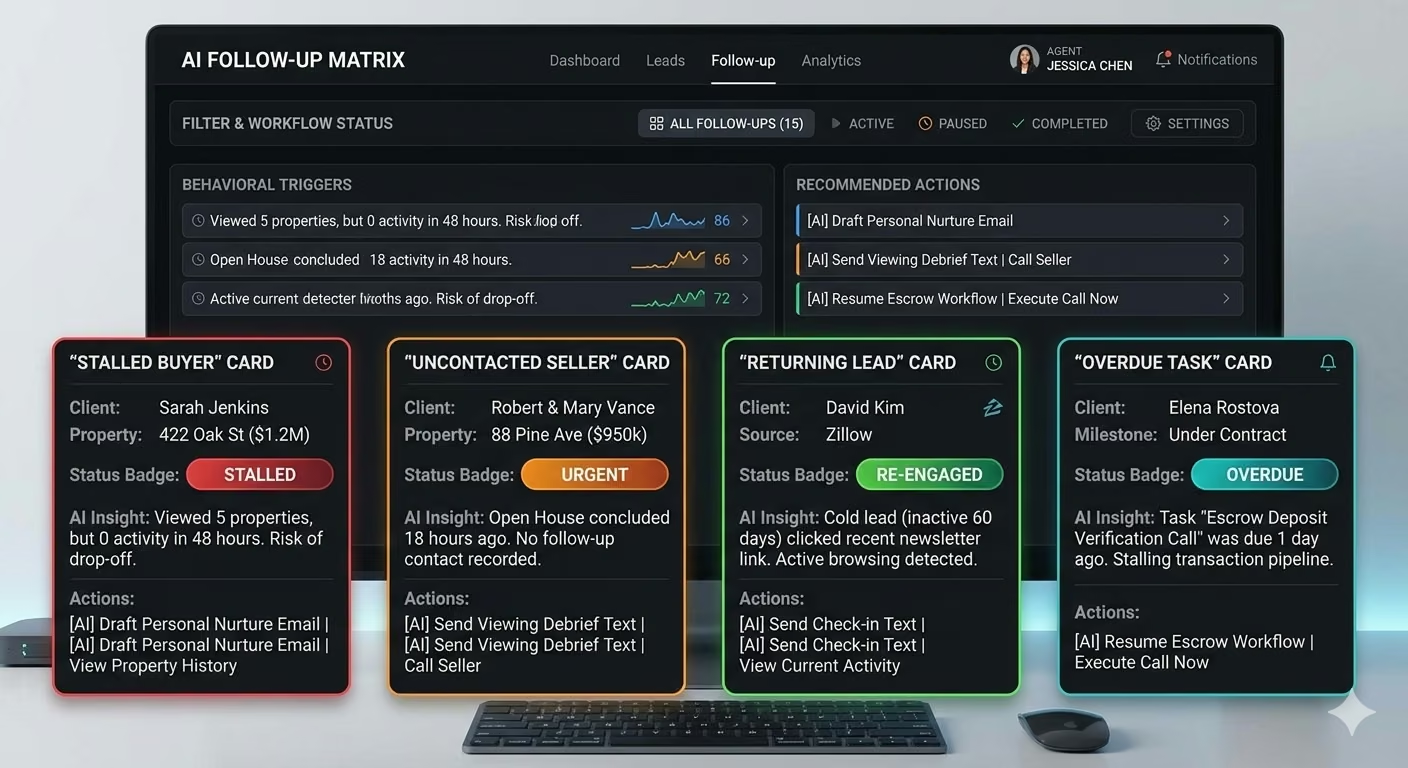
An AI Real Estate Follow-Up Management Dashboard simplifies client nurturing by dynamically analyzing buyer and seller behavior to surface actionable next steps.
Lead Qualification
Traditionally, CRM qualification relies on fields and rules.
For example:
- Budget: $1 M
- Location: New York
- Property type: 3 BHK
- Timeline: 3 months
The agent can review these criteria to determine whether the lead is worth pursuing. Agents can combine these criteria with other signals and past interactions, and an AI CRM can use this data to help prioritize.
AI-powered lead research, qualification, and engagement features are now available in select enterprise CRM systems.
Use AI scores as a guide or decision-support tool, not as predictions. Results may be affected by data quality, volume, and the model itself.
Property Matching
One area of matching that is especially applicable to real estate is property matching.
A traditional CRM can enable an agent to narrow down properties by:
- Location
- Budget
- Property type
- Number of bedrooms
- Size
- Availability
AI could enable more flexible matching by understanding requirements in natural language and considering multiple attributes.
For example:
Look for something that is near the subway station, preferably a newer project with good rental potential, around $20k.
An AI-powered system could convert the request into "searchable" parameters, rather than relying solely on manually pointing to the right fields.
This is a useful feature. However, if the underlying property data isn't well-formed or high quality, it's less useful.
Communication
Traditional CRMs usually offer templates and communication tracking. AI-powered CRMs can help create or summarize communications.
For instance, an agent could ask:
"Outline the previous three conversations with this buyer.
This CRM could summarize the notes instead of opening multiple records and reading each one.
AI can also generate follow-up messages using previously stored CRM data. While this saves time, agents should review AI-generated communications before sending, especially when they include sensitive client details, pricing, negotiations, or commitments.
Reporting and Analytics
Most of the traditional CRMs offer dashboards with metrics like:
- Number of leads
- Conversion rates
- Deal value
- Pipeline stages
- Agent performance
- Revenue
- Follow-up activity
AI can add another layer of understanding to those numbers.
Rather than just observing a drop in conversions, a team could leverage an AI assistant to query:
What was the highest drop-off point in our pipeline this quarter?
Or:
What was the source of the highest number of closed deals?
This puts CRM analytics into a more conversational mode.
Automation
Typically, traditional CRM automation relies on predetermined rules.
For example:
- When: A new lead is created
- Then: Give it to Agent A
- Then: Make a subsequent task
AI systems can add intelligent support to those workflows.
Today's CRM solutions are increasingly intertwined with automation and AI-powered research, recommendations, scoring and agentic workflows.
Automation does not need to be designed haphazardly, however. If you send the wrong message to a high-value client, it can create more issues than it solves.
Benefits of an AI CRM for Real Estate
The main reason to choose an AI CRM isn't just because it has "AI”. It is because AI can cut down the manual workload involved in the sales process. Here are the benefits of AI CRM vs traditional CRM for real estate.
Better Lead Prioritization
For teams that get hundreds of leads, it's not always feasible to use one approach for every lead.
AI can score and prioritize leads, so agents can focus on what matters most. Predictive lead scoring is a key feature of today's CRM software.
Less Administrative Work
Agents spend time taking notes, looking up records, summarizing calls, and setting up follow-up tasks. AI can handle some of these tasks, letting agents focus on client interactions.
Improved access to information
An AI assistant can make CRM information easier to retrieve. An agent could type a few questions in plain language and get a summary of the relevant information, rather than searching through several fields.
More Consistent Follow-Ups
Automated reminders and workflows can minimize the risk of losing leads. This is especially useful during high-volume periods when agents manage many pipelines.
More Actionable Insights
Traditional reports just tell teams what happened. AI can provide insights into the meaning of the data and patterns you can explore.
Greater Workflow Flexibility
Real estate businesses come in different forms.
The pipelines of a residential brokerage, commercial real estate company, property developer and independent agent can be quite different.
When a business wants to build a workflow around its process instead of following an existing template, an AI-powered builder can help.
Limitations and Trade-Offs of an AI CRM
While AI CRM might seem like a promising solution, not all real estate companies will need it.
Data Quality Still Matters
AI can't instantly turn poor data into reliable insights.
Lead records that lack complete information, are outdated, or aren't updated often in the CRM can make AI-generated recommendations less useful.
AI can make mistakes
AI-generated summaries, classifications, recommendations and messages can be inaccurate.
However, human oversight cannot be replaced, especially for client interactions and business decisions.
Still needs planning for implementation
While an AI CRM doesn't mean you won't need to set up:
- What data should be collected?
- How leads should be qualified
- Learner outcomes and what are the critical stages in the pipeline?
- Who owns each stage
- What actions require human approval?
The technology can ease implementation, but the business still needs a clear process.
Cost Can Vary
A CRM subscription can include AI functionality, be a separate add-on, or be sold separately.
AI CRMs aren't automatically more expensive or more affordable than traditional CRMs. Companies should evaluate the platform's overall cost, AI capabilities, integrations, implementation, and maintenance.
Which One Should You Choose?
The right one isn't about how "modern" your business is; it is about your workflow.
If you prefer a more traditional CRM platform, choose one.
- Your team has a relatively simple sales process.
- Contact and deal management are key areas of focus.
- Your lead volume isn't too high.
- Agents prefer manual control of qualification.
- You have some great workflows in place.
- You would see minimal benefit from incorporating advanced AI features.
An AI CRM is a better choice when:
- You're getting a lot of leads through your team.
- Agents dedicate a lot of time to administrative tasks.
- Follow-ups frequently get missed.
- You're looking for AI-driven lead prioritization.
- Your team requires quicker access to CRM information.
- You need to streamline repetitive tasks.
- Your real estate process is very personalized.
Not all companies see traditional CRM and AI CRM as two distinct worlds, and for good reason. AI capabilities are gradually becoming part of the mainstream CRM landscape, which means a regular CRM can become AI-feature-rich over time.
The better question is: “Do you really need a lot of intelligence and automation in your team?”
Read More: How to build a real estate CRM with AI
Build Your Own Real Estate CRM Without Code Using Emergent
While off-the-shelf CRM software can be strong, a familiar issue remains: your business needs to fit the software.
The sales pipeline is a simple model that doesn't always fit real estate teams.
A residential brokerage might require buyer pipelines as well as seller pipelines. A property developer might require project, unit and buyer management. A commercial team might need more time to move deals and more detailed property information.
This is where an AI CRM builder can help.
To use Emergent's AI real estate CRM builder, you can type a natural-language description of the CRM you want to build and get a working app without coding. If you are a Pro member, the E-3 autonomous builder makes the process even easier. According to Emergent, the builder can create the UI, database, workflows, and automations for the process you describe.
What Could You Build?
A tailored real estate CRM can encompass the following features:
- Buyer and seller management.
- Property and listing records.
- Lead intake
- Buyer-to-property matching
- Showing coordination
- Follow-up automation
- Deal pipelines
- Commission tracking
- Team dashboards
- You can create custom fields and views.
- Integrations with other tools
Here's a prompt to begin with:
“Develop a CRM for a real estate agency that handles residential properties and captures leads from referrals and ads, has a property and showing tracking system, has two pipelines (buyer and seller), automatically assigns new leads to agents, reminds agents to follow up, and features a dashboard for current deals and commissions.”
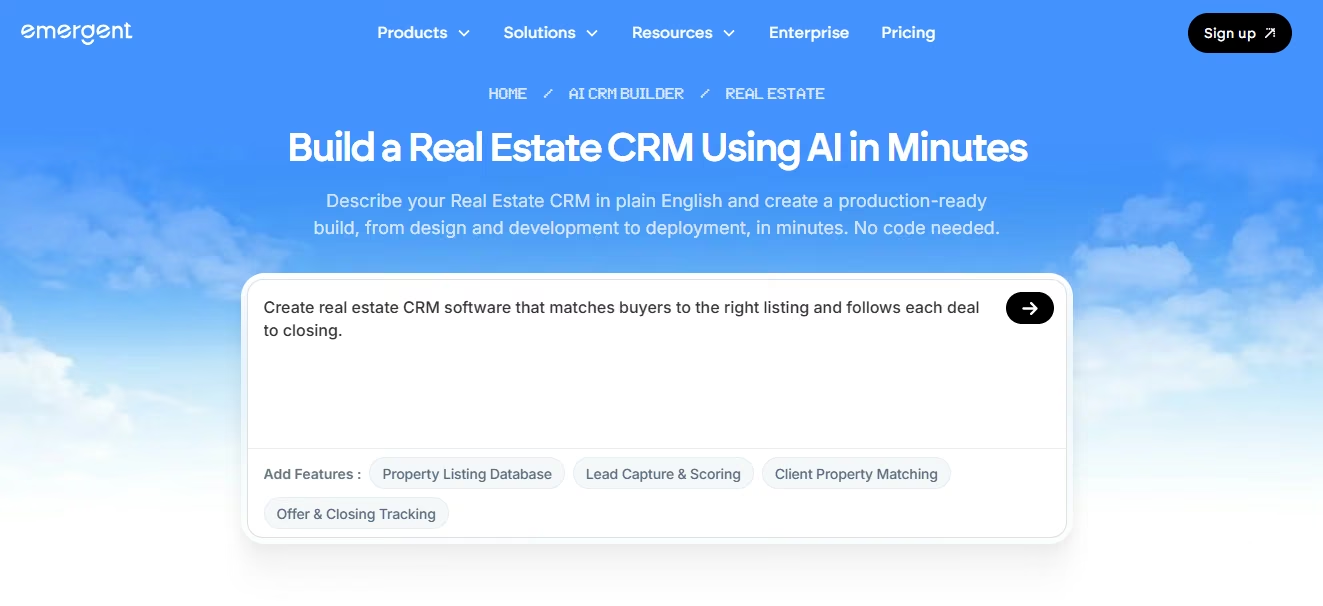
Emergent's real estate CRM builder uses this prompt-to-application workflow. Then you can further define the created CRM by modifying fields, views, stages, and workflows.
If you want to build a CRM outside the real estate use case, you can explore an AI CRM builder.
That isn't just about speed. It's about starting your process and not forcing it into a template.
This is because, for existing software, the best CRM for real estate agents guide can also help you choose a CRM.
The Bottom Line
The argument of AI real estate CRM vs. traditional CRM isn't really a matter of technology for technology's sake.
A traditional CRM is still valuable if the primary need is to organize leads, contacts, properties, and deals. The value of AI is realized when a team needs the system to go beyond mere information retention, such as to prioritize leads, summarize interactions, automate repetitive tasks, or identify valuable insights.
A CRM system that merges the best of both worlds: the structure and reliability of a traditional CRM, and the intelligence and automation of AI, might be the best course of action for expanding real estate companies.
If you can't find a CRM system that fits your team's workflow, you can build a real estate CRM yourself using your ideas. With an AI-enabled builder like Emergent, teams can describe their processes in plain terms and turn requirements into a functional real estate CRM.

Most AI app builders stop at prototypes. Emergent creates production-ready apps you can actually launch.
- Production-ready apps
- Web & mobile apps
- Deploy in minutes