Claude Duet and ChatGPT Dots are both always-on AI agents. This means they can keep working on connected apps while you are away, use a cloud computer, and ask before taking consequential actions. But they make different trade-offs.
Claude Duet is Anthropic’s lower-cost, work-focused research preview, currently limited to US Claude Pro, Max, and Ultra subscribers on a waitlist. ChatGPT Dots are OpenAI’s more broadly available agents, included with ChatGPT Pro and Business Premium, with more visible agent controls and deeper ties to Slack, Teams, and Codex.
This comparison covers features, pricing, access, privacy, and early real-world performance so you can choose based on how you already work.
Claude Duet vs. ChatGPT Dots at a Glance
Duet is an Anthropic research preview for US Claude subscribers, and Dots are OpenAI’s always-on agents included with higher-priced ChatGPT plans. Both are persistent agents that act on your connected apps. The table summarizes the main differences.
What Are Claude Duet and ChatGPT Dots?
Claude Duet is Anthropic's proactive agent app, and ChatGPT Dots are OpenAI's always-on agents inside ChatGPT. Each is meant to take ongoing responsibility for your work rather than answer one prompt at a time.
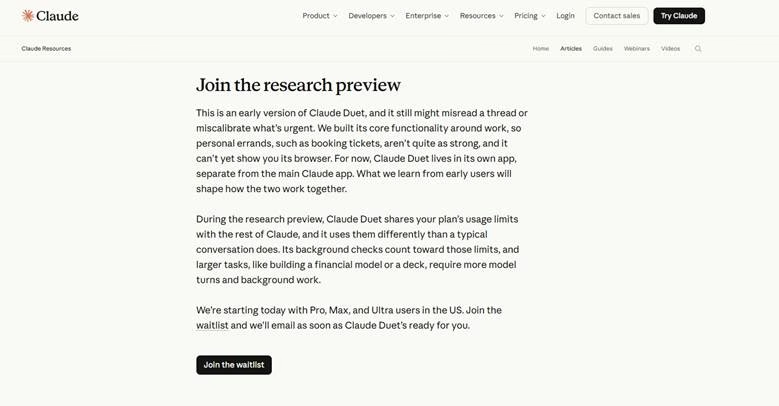
Claude Duet was announced on October 21, 2026 as a standalone app where Claude acts as a proactive agent. It sends a morning brief across your connected apps, checks them through the day, messages you when something needs attention, and completes tasks you assign.
Anthropic built it for professionals and small-business owners and designed it around Claude Opus 5.5. It carries over your memory, skills, and connected apps from your Claude account.

ChatGPT Dots were announced on September 29, 2026. OpenAI describes a dot as an always-on agent that takes ongoing responsibility and keeps making progress between conversations.
It is powered primarily by GPT-6 Astra, can also draw on GPT-6.1 Terra for parts of its work, has its own cloud computer, and works across apps you choose to connect, including Slack and Microsoft Teams.

The name "Dots" is a product term: each person starts with a primary dot, and OpenAI says teams of Dots working together are planned. For the model underneath, see Claude Opus 5.5 vs GPT-6 Astra.
Claude Duet vs. ChatGPT Dots: Key Differences
The two agents differ most in model, reach, and how much of their work you can see. They are close on the basics, with cloud computers, connected apps, memory, and approval prompts before consequential actions.
1. Underlying model
Duet runs on Claude Opus 5.5, while Dots primarily run on GPT-6 Astra and can also draw on GPT-6.1 Terra for parts of their work. On Artificial Analysis’s Intelligence Index, Claude Opus 5.5 at Max effort scores 58, while GPT-6 Astra at Max effort scores 53.
At medium effort, Opus 5.5 scores 51 and Astra scores 50. These are model-level results, not benchmarks of Duet or Dots as products, so they do not by themselves prove which agent performs better in real workflows.
2. How each one works proactively
Duet checks your connected accounts every few hours, because Anthropic says checking nonstop would use up plan limits much faster. Both can message you first, and neither promises an instant reaction to a new event.
3. Where you talk to it
Duet lives in its own app, separate from the main Claude app, and you can message it by typing or voice in one ongoing thread. Dots are reachable in ChatGPT, Slack, and Teams, with a limited texting beta for select US Pro users. A dot cannot initiate a call to you, but you can call your dot from its ChatGPT mobile conversation.
4. Browser and computer visibility
You can open a dot’s cloud computer from its profile to view and interact with it, and use the Take over control when needed.
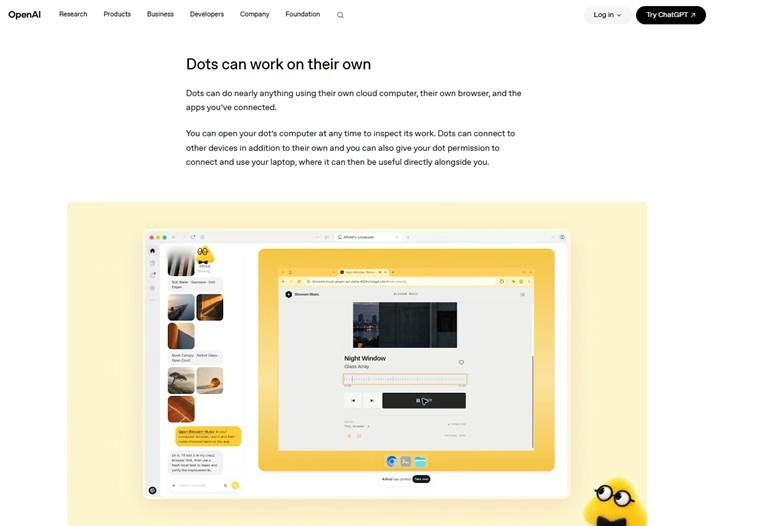
Duet has its own virtual machine and browser, but Anthropic says it cannot yet show the browser. Dots can also use your own computer if you connect it, and that access starts turned off.
5. Coding and delegation
A dot can create tasks in Codex cloud environments you have already set up, and in ChatGPT Work. Anthropic says Duet can prototype and build web apps, and Every's reviewer reports it can see Claude sessions on his computers but cannot direct them.
A dot can hand work to Codex and Duet can only watch Claude sessions, so neither runs your own review steps. A coding agent builder lets you build an AI coding agent that follows your repo's tests and checks.
Claude Duet vs. ChatGPT Dots: Features and Real-World Performance
No independent benchmark covers either product, so the best evidence is vendor documentation and early hands-on reviews. Treat reports of how well each agent finishes real jobs as anecdotal.
Anthropic’s examples come from early testers and Anthropic employees. A broker said Duet flagged a showing booked on the wrong day, and a brand strategist said it prepared a call brief and noticed the call fell right before her flight. Anthropic adds that Duet can still misread a thread or misjudge what is urgent, and that personal errands such as booking tickets are weaker than work tasks.
Every's Dan Shipper, who uses both, calls Duet the first personal agent he would label a pro tool. He found it split recurring topics into channels and sent useful suggestions. His dot had become less proactive and lost a task without alerting him.
Duet had weaknesses too. Its email drafts were worse than his Dot's, its scheduled runs could not reach his custom connectors, and it had no real voice mode beyond transcription. Every received early access from Anthropic and says Anthropic had no input on the review.
Use these as one reviewer's experience. Run a real task, such as preparing tomorrow's meetings from your calendar and email, on both before paying for either. For a closer look at one side, see our ChatGPT Dots review.
Claude Duet vs. ChatGPT Dots Pricing and Access
Duet is cheaper to reach, but it is limited to US subscribers on a waitlist, while Dots cost more but are open to more regions. Neither has a separate subscription.
Usage works differently. Duet shares your Claude plan's usage limits, and its background checks count toward them. Chatting with a dot does not count toward ChatGPT usage limits, but tasks it starts in Codex or ChatGPT Work do, and OpenAI said the first month after launch included extended limits for deeper work.
For eligible Enterprise workspaces, Dots are free to preview from November 4 through November 18, 2026; billing begins on November 18. OpenAI has not published pricing for additional Dots.
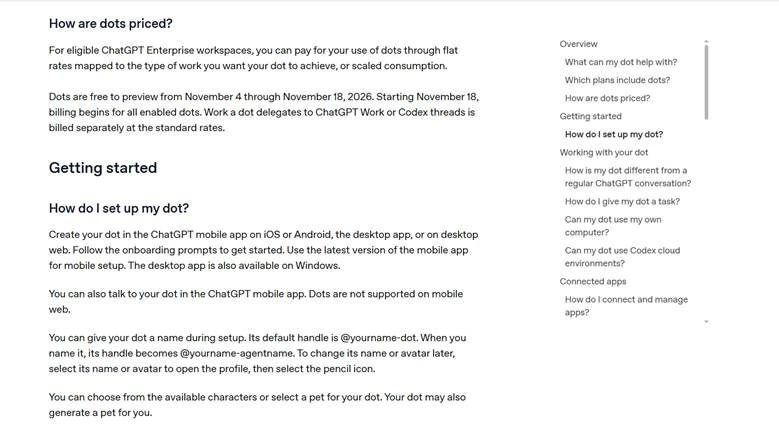
Regions and eligibility also differ. Pro users in the European Economic Area, Switzerland, and the UK cannot use Dots, though Business Premium works across supported regions. Duet is US-only for now. Anthropic has not announced a date for wider access.

Privacy, Safety, and Enterprise Controls
Both agents ask before sensitive actions, and both document how they handle credentials and data, with different emphasis. Read each vendor's terms before connecting business accounts.

Claude Duet:
- Approvals: before sending a sensitive message, paying, signing, or deleting, it shows the action, destination, and content, including every recipient. Trading securities and moving money between accounts stay off-limits even with approval.
- Credentials: Anthropic says Duet never directly sees your passwords or sign-in tokens, which follow the credential-handling design used for Claude Managed Agents.
- Sensitive information: a separate classifier checks each outgoing message. It is designed to reject requests to share the strictest tier of information, including credit card numbers and government identification, and requires explicit instruction before sharing other sensitive information such as health or financial details.
- Memory: Duet keeps conversation history and memory until you delete or reset it. Disconnecting an app stops new access, but what Duet already learned stays until you reset its memory.
ChatGPT Dots:
- Approvals: custom rules let you choose whether an action proceeds without asking, proceeds if pre-approved, needs approval, or hands off to you.
- Training: OpenAI says it does not use content from ChatGPT Business, Enterprise, or Edu workspaces to improve its models by default. On personal plans you can control it.
- Admin controls: Enterprise admins can control Slack and Teams access, cloud browser use, cloud network access, cloud computer use, and password-manager use. During the November 4–18 admin preview, Enterprise admins must enable Dots. From November 18, Dots will become available by default in eligible Enterprise workspaces unless an admin opts out.
- Memory: disconnecting an app does not delete information a dot already obtained. Deleting a dot ends access to it and starts deletion of its own saved memories. Its main conversation is archived, while separate Work or Codex chats are kept. Scheduled tasks must be reviewed and stopped separately.
OpenAI also says it is working with Microsoft to manage specialist Dots in Agent 365, with no timeline given.
Where Each Agent Falls Short
Duet's main limits are access and visibility, and Dots' main limits are price and rollout. Both are young products, and OpenAI and Anthropic each say they can make mistakes.
Claude Duet:
- US-only waitlist for Pro, Max, and Ultra, with Team and Enterprise excluded.
- Cannot show you its browser yet.
- Lives in a separate app from Claude, and background checks use your plan limits.
- Reviewers report weaker email drafts than Dots and no custom-connector support in scheduled runs.
ChatGPT Dots:
- The cheapest individual route is a $100-a-month Pro plan, and Free, Go, and Plus are excluded.
- Available to Pro users outside the EEA, Switzerland, and the UK; Dots can be created in the ChatGPT mobile app, desktop app, or desktop web.
- No standalone email address and no outbound calls at launch.
- Pricing for additional Dots has not been published, and Enterprise dot billing begins on November 18, 2026.
Which Should You Choose? Claude Duet or ChatGPT Dots by Use Case
Choose Duet if you are a US Claude subscriber who wants a low-cost way in, and Dots if you already live in ChatGPT.
Conclusion
Claude Duet and ChatGPT Dots serve similar purposes, but the better choice depends on your existing tools, budget, and how much control you want over an agent's work. Duet is a more affordable option for US-based Claude subscribers who want a work-focused agent. Dots make more sense for ChatGPT users who need broader access, browser visibility, and integrations with Slack, Teams, or Codex. Since both are still early products, testing them on a small, clearly defined workflow is a sensible starting point.
For businesses that need more than a personal AI agent, building custom agents and workflows is another option. Emergent is an AI agent builder that turns natural-language requirements into working agents, including the screens, backend, logins, and integrations. That lets teams build agents around their own workflows rather than relying entirely on a general-purpose one.
Describe it. Build it. Launch it.
- End-to-End Creation
- No Code Needed
- Live in Minutes
Most AI app builders stop at prototypes. Emergent creates production-ready apps you can actually launch.
- Production-ready apps
- Web & mobile apps
- Deploy in minutes