



TL;DR
- Gemini 4 Hydrogen targets complex reasoning, coding, and multi-step AI workflows, while Gemini 3.8 Flash remains suited to simpler, high-volume tasks.
- Google's published benchmarks show substantial improvements in coding and agentic performance with Hydrogen.
- Hydrogen's current API token rates are twice Flash's, making workload-specific cost evaluation important.
- Both models support multimodal workflows, but developers should verify model-specific output limits and features.
- Choose based on task success, latency, token consumption, and application requirements rather than benchmark scores alone.
Google introduced Gemini 4 Hydrogen on November 12, 2026, as a faster, more capable alternative to Gemini 3.8 Flash. The new model focuses on coding, multi-step AI agent workflows, and everyday productivity tasks. But does it deliver enough improvement to justify switching from Flash?
According to Google's launch announcement, Gemini 4 Hydrogen completes tasks 2.5 times faster than Gemini 3.8 Flash at its default High thinking setting. It also scores 57% on Terminal-Bench 4.1, compared with Flash's 18.2%, suggesting a substantial improvement in its ability to execute technical tasks. These figures come from Google's published evaluations rather than our independent testing.
Hydrogen also introduces four thinking levels, a 1 million-token context window, and API pricing of $1.50 per million input tokens and $7.50 per million output tokens. However, stronger benchmark performance does not automatically make it the better choice for every workload. Actual value depends on response quality, execution speed, token consumption, and the complexity of the task.
This comparison evaluates Gemini 4 Hydrogen and Gemini 3.8 Flash across reasoning, coding, agentic performance, speed, pricing, and practical use cases, drawing on Google's published evaluations and independent benchmark data.
Gemini 4 Hydrogen vs. Gemini 3.8 Flash: At a Glance
Gemini 4 Hydrogen builds on Gemini 3.8 Flash with stronger reasoning, coding, and agentic capabilities. The table below compares their specifications, performance, and API pricing.
| Feature | Gemini 4 Hydrogen | Gemini 3.8 Flash |
|---|---|---|
| Developer | Google DeepMind | Google DeepMind |
| Model generation | Gemini 4 | Gemini 3 |
| Primary focus | Coding, reasoning, agentic workflows | Fast, general-purpose AI tasks |
| Context window | 1,048,576 tokens, unified input/output | 1M input tokens |
| Default thinking level | High | Medium |
| Available thinking levels | Low, Medium, High, xHigh | Low, Medium, High |
| Intelligence Index | 51 (High), 54 (xHigh) | 31 (High) |
| Terminal-Bench 4.1 | 57% | 18.2% |
| Task execution | 2.5× faster, Google-reported | Baseline |
| Input price per 1M tokens | $1.50 | $0.75 |
| Output price per 1M tokens | $7.50 | $3.75 |
| API availability | Gemini API, Google AI Studio | Gemini API, Google AI Studio |
Gemini 4 Hydrogen vs. Gemini 3.8 Flash: specifications, benchmark performance, and API pricing as of November 13, 2026. Sources: Google's official model documentation, Gemini API Pricing, and Artificial Analysis. Benchmark results may vary by evaluation methodology.
What's New in Gemini 4 Hydrogen?
Gemini 4 Hydrogen introduces greater control over reasoning effort, improved tool execution, and support for collaborative AI development workflows.
Introducing Gemini 4 Hydrogen. AI-generated illustration inspired by Google's official announcement. Source: Google Blog
Four Thinking Levels for Different Workloads
| Thinking level | Suitable workloads |
|---|---|
| Low | Text classification, simple queries, and routine responses |
| Medium | Summarization, document analysis, and everyday productivity |
| High (default) | Coding, debugging, complex reasoning, and multi-step workflows |
| xHigh | Difficult problems requiring deeper analysis and verification |
The xHigh setting provides additional reasoning depth for difficult tasks, although higher thinking levels may increase latency and token consumption.
Improved Coding and Tool Execution
According to Google, Hydrogen can navigate large codebases, identify bugs, and modify relevant files without unnecessary changes. It can also adjust its approach when tool calls fail, or searches return no results, making it useful for multi-step workflows.
Multi-Model Collaboration With Google Antigravity
Google Antigravity's Orchestrator allows multiple Gemini models to collaborate within a development workflow. According to Google, the combined system achieved near-Carbon success rates on Terminal-Bench 4.0 while using 24% less quota and completing tasks 19% faster on average.
These figures reflect Orchestrator's performance, not Hydrogen's standalone capabilities.
Gemini 4 Hydrogen vs. Gemini 3.8 Flash: Benchmark Performance
Published benchmarks show Gemini 4 Hydrogen's improvements in coding, reasoning, and agentic tasks. However, not all evaluations use identical conditions, making it important to distinguish direct comparisons from standalone model scores.
Coding and Agentic Performance
One of Hydrogen's most significant improvements appears in Terminal-Bench 4.1, which evaluates how effectively AI agents complete technical tasks in terminal-based environments.
| Benchmark | Gemini 4 Hydrogen | Gemini 3.8 Flash |
|---|---|---|
| Terminal-Bench 4.1 | 57.0% | 18.2% |
Terminal-Bench 4.1 performance comparison. Source: Google's Gemini 4 Hydrogen launch announcement, November 12, 2026. Results are Google-reported.
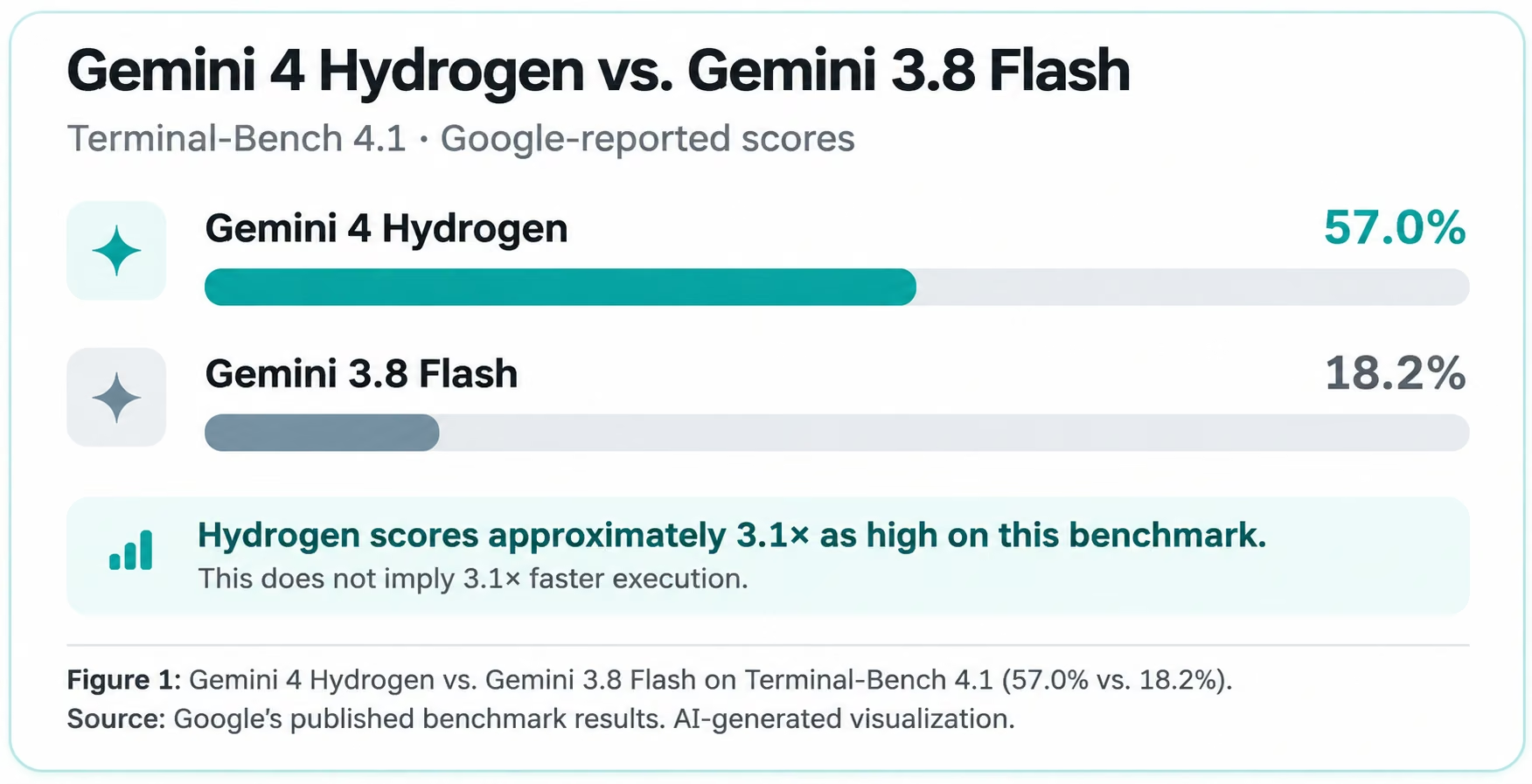
Gemini 4 Hydrogen vs. Gemini 3.8 Flash on Terminal-Bench 4.1 (57.0% vs. 18.2%). Source: Google's published benchmark results. AI-generated visualization.
Hydrogen scores more than three times as high as Flash on Terminal-Bench 4.1, indicating stronger performance on terminal-based coding and agentic tasks. However, benchmark results do not guarantee equivalent improvements in every real-world development workflow.
Also Read: Gemini 4 Argon benchmarks for how another model in the same family scores on similar tests.
Reasoning and Knowledge Work
Google DeepMind also reports Hydrogen's performance across professional knowledge work, scientific reasoning, and automation benchmarks.
| Benchmark | Gemini 4 Hydrogen | What It Measures |
|---|---|---|
| Agents' Last Exam v1.1 | 71.6% | Professional knowledge-work tasks |
| AutomationBench-AA | 76.1% | Workflow automation |
| HLE-Diamond | 58.8% | Advanced reasoning |
| MKA | 53.4% | Multimodal knowledge work |
| OSWorld-2.1 | 77.6% | Computer-use tasks |
Gemini 4 Hydrogen benchmark results. Source: Google DeepMind's official Gemini 4 Hydrogen model card. These are vendor-reported scores; directly comparable Gemini 3.8 Flash results were not established for these exact benchmark versions.
These results demonstrate Hydrogen's performance across reasoning, automation, and multimodal tasks. However, they should not be treated as direct improvements over Flash because matching results for the same benchmark versions and evaluation settings have not been established. For Flash’s own results, see our Gemini 3.8 Flash benchmarks guide.
Reliability and Task Completion
Google reports that Hydrogen produces more than five times fewer fabricated claims than Gemini 3.8 Flash in its internal evaluations. The model can also revise its approach after unsuccessful tool calls or empty search results, potentially improving reliability in multi-step workflows.
These findings are Google-reported and have not been independently verified in this comparison.
Gemini 4 Hydrogen vs. Gemini 3.8 Flash: Speed, Latency, and Efficiency
Google claims Gemini 4 Hydrogen completes tasks 2.5 times faster than Gemini 3.8 Flash at Hydrogen's default High thinking level. However, task completion speed differs from raw token generation speed, as complex workflows also involve reasoning, tool calls, and verification.
Task Completion Speed vs. Output Speed
AI model speed can be evaluated using three different metrics:
- Time to first token (TTFT): How long the model takes to begin generating a response.
- Output speed: How many tokens the model generates per second.
- End-to-end task completion: How long it takes to finish a complete task, including reasoning, tool calls, and verification.
Efficiency in Multi-Step Workflows
Hydrogen's stronger agentic capabilities may reduce retries in workflows involving database queries, external tools, or automated reporting. However, higher thinking settings can increase latency and token consumption. Developers should therefore evaluate total execution time and resource usage rather than relying on response speed alone.
What Do Independent Speed Measurements Show?
Artificial Analysis data accessed on November 13, 2026, reports approximately 7.9 minutes per Intelligence Index task for Gemini 4 Hydrogen at High reasoning, compared with 14.7 minutes for Gemini 3.8 Flash at High.
Based on these figures, Hydrogen requires approximately 46% less time on this metric. The result differs from Google's reported 2.5× task completion improvement because the evaluations use different methodologies.
Google also reports that early enterprise partners observed 2–2.8× faster execution and 12–23% lower token consumption in selected complex workflows. These findings are workload-specific and should not be generalized to every task.
Gemini 4 Hydrogen vs. Gemini 3.8 Flash: Pricing and Cost Comparison
Gemini 4 Hydrogen offers stronger reasoning and agentic capabilities, but its higher API pricing raises an important question: does better performance justify the additional cost?
For businesses building AI applications, the answer depends on more than the price per million tokens. Token consumption, reasoning effort, and the number of attempts required to complete a task can all influence the final cost.
API Pricing: Hydrogen vs. Flash
| Pricing metric | Gemini 4 Hydrogen | Gemini 3.8 Flash |
|---|---|---|
| Input tokens (per 1M) | $1.50 | $0.75 |
| Output tokens (per 1M) | $7.50 | $3.75 |
| Standard pricing from January 1, 2027 | $1.50 / $7.50 | $1.50 / $7.50 |
| Free API tier | Available, rate-limited | Available, rate-limited |
Standard Gemini API pricing in USD as of November 13, 2026. Input and output rates are per million tokens. Sources: Google Gemini API Pricing and Google's Hydrogen announcement. Flash's scheduled January 2027 pricing is also documented in contemporary pricing coverage
Hydrogen currently costs twice as much as Flash for both input and output tokens. However, this price difference is scheduled to disappear on January 1, 2027, when Flash's standard rates increase to match Hydrogen's.
How Much Does a Typical Workload Cost?
Consider an application processing 10 million input tokens and generating 2 million output tokens monthly.
| Cost component | Hydrogen | Flash |
|---|---|---|
| 10M input tokens | $15.00 | $7.50 |
| 2M output tokens | $15.00 | $7.50 |
| Total monthly cost | $30.00 | $15.00 |
Illustrative monthly API costs calculated using published November 2026 standard rates. Assumes identical billable token volumes, no caching discounts, and no additional tool charges. Output-token usage may include thinking tokens.
Under these assumptions, Hydrogen costs an additional $15 per month. Actual costs may differ due to reasoning-token consumption, retries, caching, and additional services.
A model that completes a workflow successfully on its first attempt may ultimately cost less than one that requires multiple attempts, even when its per-token price is higher.
Which Model Offers Better Value?
Flash remains the lower-cost option for high-volume, relatively simple tasks through December 2026. Hydrogen may offer better value for coding, debugging, and multi-step automation where stronger performance reduces repeated work.
Once their standard prices converge in January 2027, developers will have an even stronger reason to evaluate Hydrogen as a replacement for Flash. However, existing applications should still be tested for output consistency, latency, and compatibility before migration.
The key takeaway: Lower token prices do not always translate into lower costs per completed task.
Gemini 4 Hydrogen vs. Gemini 3.8 Flash: Context Window and Multimodal Capabilities
Both Gemini 4 Hydrogen and Gemini 3.8 Flash support large-context processing and multimodal inputs, making them suitable for applications that work with more than plain text. However, a large context window does not automatically guarantee accurate retrieval, reasoning, or summarization across every part of a document.
Context Window and Long-Document Processing
Both models offer approximately one million input tokens of context. This lets developers submit extensive documents, code repositories, and supporting information in a single request, subject to the model's applicable limits.
For example, a financial research application could analyze annual reports, management commentary, and supporting disclosures together rather than processing each document separately.
The practical difference lies in how effectively each model uses that information. Hydrogen's stronger reasoning capabilities may help with tasks requiring connections across multiple documents, while Flash remains suitable for straightforward extraction and summarization.
However, context-window size alone does not establish which model is more accurate on long-document tasks. That requires comparable retrieval and reasoning evaluations.
Multimodal Input and Output Capabilities
Both models can process text, images, audio, and video. Hydrogen additionally introduces a unified input-output context limit and extended generation capabilities, making it particularly relevant for producing lengthy, structured deliverables.
| Capability | Gemini 4 Hydrogen | Gemini 3.8 Flash |
|---|---|---|
| Input context | 1M tokens, shared with output | Up to 1M tokens |
| Text and document analysis | Supported | Supported |
| Image understanding | Supported | Supported |
| Audio and video understanding | Supported | Supported |
| Extended output generation | Up to 1M tokens using long decode | Separate output limits |
| Single foreground output segment | Up to 65,536 tokens | Model-specific output limits apply |
Context and multimodal capabilities. Sources: Gemini 4 Hydrogen model card, Gemini 3.8 Flash model card and Google Cloud developer guide
Hydrogen's extended output capability is particularly useful for generating lengthy reports, structured documents, and code. However, the one-million-token limit is shared between input and output. Generating beyond the standard 65,536-token foreground segment also requires supported long-decode mechanisms.
For businesses, the practical advantage is greater flexibility in handling complex information and producing substantial deliverables. Flash remains a viable option for routine multimodal processing where extended generation and deeper reasoning are unnecessary.
Gemini 4 Hydrogen vs. Gemini 3.8 Flash: Coding and AI Agent Performance
Coding and AI agent development are among the most important areas of improvement in Gemini 4 Hydrogen. While Gemini 3.8 Flash can generate code, explain programming concepts, and assist with debugging, Hydrogen is designed to handle more complex development workflows involving multiple steps.
The distinction becomes particularly relevant when an AI model must do more than produce code. Building a functional application may involve interpreting requirements, creating components, managing application state, handling errors, and validating the final output. For how this kind of work differs from a code assistant, see our guide to what is agentic coding.
Coding Capabilities: Where Hydrogen Has an Advantage
Benchmark performance alone does not establish how well either model builds applications for everyday business users.
For example, generating a React dashboard requires more than writing syntactically correct code. The application must also respond correctly to user actions, update its data, and handle invalid inputs. If the dashboard is the goal, an AI dashboard builder can build it from a plain-language description and keep the data views in one place.
Hydrogen's stronger reasoning and tool-use capabilities could be advantageous for these tasks, particularly when development requires several iterations. Flash may remain sufficient for smaller coding requests, such as writing individual functions, fixing simple errors, or explaining existing code.
Also Read: Best AI models for coding for how Google’s models rank against the rest.
AI Agent Performance and Tool Reliability
According to Google, Gemini 4 Hydrogen can adapt when tool calls fail or searches return no results. This makes it potentially useful for AI agents that must recover from unsuccessful operations during multi-step workflows.
For businesses, these capabilities matter when automating processes involving several connected systems. An AI agent that can identify an unsuccessful operation and attempt an appropriate correction may require less manual intervention. To build that recovery step into a workflow of your own, an AI agent builder lets you describe the steps and where a person reviews.
Gemini 4 Hydrogen vs. Gemini 3.8 Flash: Which Model Should You Choose?
Choosing between Gemini 4 Hydrogen and Gemini 3.8 Flash depends on the complexity of your tasks, performance requirements, and budget. Hydrogen offers stronger reasoning and agentic capabilities, while Flash remains a practical option for simpler, high-volume workloads.
The following comparison highlights where each model may be more suitable.
| Use case | Recommended model | Why? |
|---|---|---|
| Complex coding and debugging | Gemini 4 Hydrogen | Stronger performance on agentic coding benchmarks |
| AI agents and multi-step automation | Gemini 4 Hydrogen | Improved tool use and error recovery |
| Advanced reasoning | Gemini 4 Hydrogen | Additional xHigh thinking level |
| Routine content summarization | Gemini 3.8 Flash | Lower current API pricing for straightforward tasks |
| High-volume text classification | Gemini 3.8 Flash | More economical for repetitive, low-complexity workloads |
| Complex document analysis | Gemini 4 Hydrogen | Stronger reasoning capabilities for connected information |
| Simple chatbot responses | Gemini 3.8 Flash | Lower cost when advanced reasoning is unnecessary |
| Automated software development | Gemini 4 Hydrogen | Better suited to multi-step coding workflows |
Recommended use cases for Gemini 4 Hydrogen and Gemini 3.8 Flash. Recommendations are based on published capabilities, benchmark results, and November 2026 API pricing, rather than direct hands-on testing. Sources: Google's Hydrogen announcement and Gemini API pricing.
Should Existing Flash Users Upgrade?
Gemini 4 Hydrogen is worth evaluating for applications that depend on coding, multi-step automation, or complex reasoning. Google's published results indicate substantial improvements over Gemini 3.8 Flash in these areas.
However, migration should depend on actual workload requirements. Teams running high-volume summarization, classification, or simple chatbot applications may find Flash sufficient, particularly while its lower promotional pricing remains available.
Before switching, compare both models using representative prompts and evaluate task success rates, latency, token consumption, and output consistency.
Also Read: Gemini 4 Carbon vs Claude Opus 5.5 for how Google’s top model compares with Anthropic’s flagship.
Conclusion: Gemini 4 Hydrogen vs. Gemini 3.8 Flash
Gemini 4 Hydrogen offers a meaningful upgrade over Gemini 3.8 Flash, particularly for coding, complex reasoning, and multi-step AI workflows. Google's published evaluations indicate stronger performance, while independent benchmarks provide additional evidence of its capabilities.
However, Gemini 3.8 Flash remains a practical choice for simpler applications where existing performance is sufficient. The better model is not necessarily the one with the highest benchmark scores, but the one that completes the required work reliably and cost-effectively.
For businesses looking to turn AI capabilities into working applications, platforms such as Emergent can help bridge the gap between model capabilities and deployable software. Ultimately, choosing between Hydrogen and Flash should come down to the complexity of the application, expected usage, and performance requirements.

Describe it. Build it. Launch it.
- End-to-End Creation
- No Code Needed
- Live in Minutes

Most AI app builders stop at prototypes. Emergent creates production-ready apps you can actually launch.
- Production-ready apps
- Web & mobile apps
- Deploy in minutes





