GPT-6.2 Astra pricing is straightforward, and it's hard to overpay. The list price is $8.00 per 1M input tokens and $40.00 per 1M output tokens. The final bill will depend on three factors: reasoning effort, caching, and processing tier selection. The model was released by OpenAI on 17 November 2026.
This guide explains all GPT-6.2 Astra API pricing tiers, provides examples of real workloads and their cost, and highlights the quickest ways to reduce spend.
GPT-6.2 Astra Pricing at a Glance
The Standard-tier price for GPT-6.2 Astra is $8.00 per 1M input tokens and $40.00 per 1M output tokens. An output token costs five times as much as an input token, so most of the bill comes from long answers.
All the rates from OpenAI's pricing page are listed below. All prices are per 1M tokens.
The meaning of the table, in simple terms:
Input is the text and images you send to the model
- Output is what the model writes back. It includes its reasoning.
- Cached input is a repeated part of your prompt that the model has already seen. It is far cheaper.
- Cache write is a one time fee to store a prompt for reuse. You choose a 30-minute or 12-hour window.
- Each tier is a trade-off between speed and price. Batch is the cheapest and slowest. Ultrafast is the fastest and most expensive.
The Short and Long context toggle is also on OpenAI's page. Before sending very large prompts, have a look at long-context rates there. The model has a 1M-token context window.
How to Read GPT-6.2 Astra Token Prices
Token prices are quoted per 1M tokens, and one token corresponds to about four characters of English text. You send and receive tokens, and you have to pay for each one. The cost of short and long requests is the same within a single tier.
You can send one request at a time. If you send 10,000 input tokens and receive 2,000 output tokens (on the Standard tier).
- Input: 10,000 ÷ 1,000,000 × $8.00 = $0.08
- Output: 2,000 ÷ 1,000,000 × $40.00 = $0.08
- Total: $0.16
Output tokens include reasoning tokens. GPT-6.2 Astra is a reasoning model; it thinks before answering. This thinking is called output from OpenAI's reasoning models. If the model takes a long time to think but gives a short, clearly understandable answer, it can still earn extra marks.
Prompt Caching Cuts Input Cost by 95%
The largest of these is a cached input. The cost is $0.40 per 1M tokens, compared with $8.00 for fresh input. That's a 95% discount, and Artificial Analysis shows the same.
Caching has a small upfront cost. A 30-minute cache write costs $10.00 per 1M tokens, which is 25% higher than the normal input rate. A 12-hour write costs $20.00 per 1M tokens, which is 2.5 times the input rate.
The initial write fee is quickly recouped:
- There is an additional fee of $2.00 for a 30 minute write, per 1M tokens. $7.60 is saved for every cache read. One read is charged for the additional expense.
- A 12-hour write costs $12.00 extra per 1M tokens. Two reads cover it.
Example: A 20M-token system prompt is sent every time it is used with a support bot. For more than 1000 requests, that's 20M input tokens.
The example assumes that all requests will be in the cache. The actual hit rate is lower, so use $8.20 as a best case. Place static (unchanging) material first in your prompt and variable material last. Caching: "matches repeated prefixes".
Batch and Background Requests Cost 30% to 50% Less
This new batch pricing will reduce the cost of the GPT-6.2 Astra API to just $4.00 per 1M input tokens and $20.00 per 1M output tokens. Use it for work that can be postponed. Document tagging, evaluations and bulk summaries are good examples.
OpenAI also offers special discounts on eligible background requests. The rate is 30% lower than the Standard rate for the 2 hour completion window and 40% lower for the 8 hour window. Please refer to OpenAI's background mode guide to ensure that a request meets the criteria.
Background rates are my calculation, based on the percentages OpenAI stated. Put simply, the more time OpenAI takes, the less you pay.
Fast and Ultrafast Modes Cost 2x to 6x More
Fast mode doubles the Standard price, and Ultrafast triples it. Fast costs $16.00 input and $80.00 output per 1M tokens. Ultrafast costs $24.00 and $120.00 through February 28, 2027. From March 1, 2027 (Pacific time), Ultrafast costs 6x Standard, or $48.00 and $240.00.
Pay for these tiers only if latency affects revenue or user experience. A live coding agent is a fair use case. A nightly report is not. The pricing page does not mention the speed increase OpenAI promises, so it is best to test it on a different workload before committing.
At high reasoning effort, speed matters more. GPT-6.2 Astra was measured by Artificial Analysis at Max to take 206.68 seconds to reach the first answer token. It took 3.87 seconds at Medium effort.
Reasoning Effort Changes Your Real Cost
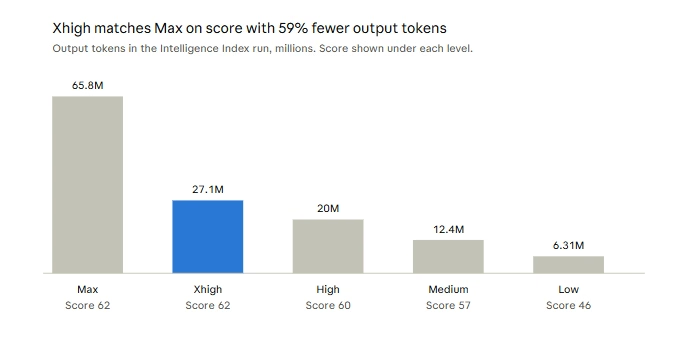
If you are willing to do some work, you can save about 10x on your bill at the same price per token. Five effort levels were tested in Artificial Analysis. The more effort, the more output tokens, and this is the costly side.
Xhigh has a similar score to Max, with approximately 59% fewer output tokens. Medium: 57 and approximately 81% fewer. Low drops to 46; that's a very high-quality loss in comparison.
The $40.00 per million output tokens price puts the output value at approximately $2,632 for the Max run. The cost of Xhigh is roughly $1,084. It costs about $496 for medium. These are my estimates and don't include input costs.
Artificial Analysis states that the average cost of an Intelligence Index task is $4.00 for Max effort. It has a blended price of $5.88 per 1M tokens, based on a 7:2:1 ratio of cached input to fresh input to output. The 3 model is the most intelligent, and 65 is the cheapest of 95 models. It is costly compared to other models, whose median input is $2.00 and output is $10.00.
A good rule of thumb is to begin at Xhigh or High. Only go to Max if your tests show a real gain in quality.
For the full score, speed, and token breakdown, see our GPT-6.2 Astra benchmarks guide.
GPT-6.2 Astra vs Other OpenAI Models
The cost of GPT-6.2 Astra is 20% lower than GPT-6 Astra and 4x higher than GPT-6.2 Sol. These are OpenAI’s Standard rates per 1M tokens.
Result: The new model delivers a 20% reduction in input/output costs. Its cached input rate is 60% lower ($0.40 against $1.00).
The budget option is GPT-6.2 Sol. It scores 57 on the Artificial Analysis Intelligence Index, 5 points below Astra at Max. Pick Sol if 57 is satisfactory. To see where that 57 comes from and how Sol scores test by test, read our GPT-6.2 Sol benchmarks guide.
There is also a legal version of the model, gpt-6.2 astra law, offered by OpenAI at the same $8.00 per input and $40.00 per output price. It's on special offer until at least 31st December 2026. For the earlier flagship's rate card, see our GPT-6 Astra pricing guide, and for what the cheaper tier offers.
Also Read: GPT-6.2 Astra vs Claude Fable 5.2 and GPT-6.2 Astra vs Gemini 4 Carbon.
What Real Workloads Cost
The cost of a workload with 100M input tokens and 20M output tokens is $1,600 per month on Astra Standard. This cost varies by tier and caching, as shown in the table. Assumptions: No additional reasoning overhead beyond the stated output.
Use $800 per month for output (half of the $1600 monthly total). The month's savings from caching are $608. Batch removes half of a row. Sol reduces Standard's bill by 75%.
In real bills, reasoning is longer if the model reasons at length, since reasoning tokens count as output. Do a trial on a sample before forecasting your own token use.
How to Set a Budget Before You Build
First, set the price for output tokens in your GPT-6.2 Astra budget, since that determines the bill. Estimate how many tokens a typical answer requires, multiply that by the number of answers you expect per month, and charge $40.00 per million tokens. Add input costs at $8.00, plus the $0.40 share input. Add a 20% buffer for reasoning tokens and retries. Use one week of real traffic, compare it to the forecast, and adjust effort and tier accordingly.
Extra Charges Beyond Tokens
However, there is no single rate for the entire bill. The following charges are listed on OpenAI's pricing page:
- Regional processing: As of March 5, 2026, there will be a 10% uplift for models released in regions with data residency endpoints. GPT-6.2 Astra qualifies. FedRAMP endpoints also offer a 10% bonus.
- Web search: Web search is $10.00 per 1,000 calls, plus search content tokens at model rates.
- File search: $2.50 per 1,000 tool calls. Storage is $0.10 per GB per day and includes 1 GB of free storage.
- Containers: Hosted Shell and Code Interpreter are priced at $0.03 per 1 GB per 20 minutes.
- Cloud platforms: Models on Amazon Bedrock and Microsoft Azure incur fees on those platforms. See their pricing pages for Astra's rate.
Seven Ways to Lower Your GPT-6.2 Astra Bill
GPT-6.2 Astra prices can be brought down by more than half by following some tips.
- Cache static prompts. Cached inputs cost 95% less. Start your query with system prompts and reference texts.
- Batch your non-essential queries. Batching will reduce your input and output rate by half.
- Use the background mode. Opt for a 2-hour or 8-hour batch to save 30% to 40% on costs.
- Reduce reasoning capacity. Try Xhigh and High before going for Max.
- Send easy jobs to Sol. Direct your easy queries to GPT-6.2 Sol, while keeping hard ones for Astra.
- Restrict output length. Output is five times more costly than the input. Be concise in your request.
- Forget Fast and Ultrafast. Do not pay 2x to 6x for these modes unless speed pays for itself.
To put tip 5 into practice, an AI agent builder lets you describe which tasks go to Sol, which go to Astra, and where a person reviews.
When GPT-6.2 Astra is Worth the Price
When the cost of a wrong answer exceeds the cost of the tokens, Astra is worth the money. The Intelligence Index includes agentic coding, terminal use, professional document reasoning, and physics reasoning. Astra ranks 3rd among all 95 models. Use it on hard, high-value work.
Astra is not suitable for high-volume, simple tasks. Classification, short replies, and routine extraction are cheaper with GPT-6.2 Sol. A routing configuration is effective. Astra does hard 10%; Sol does bulk. If you're weighing other models at this tier, our GPT-6.2 Astra alternatives guide compares five on price and results
Know your boundaries, too. Astra is a text-to-text and text-to-image system. It is exclusive, and OpenAI has not revealed its size. If you use Max effort, you will get slower first answers.
Conclusion
GPT-6.2 Astral's pricing starts at $8.00 per 1M input tokens and $40.00 per 1M output tokens. Three factors, such as caching, batching, background mode, and reduced reasoning effort, can significantly reduce costs. For normal work, use GPT-6.2 Sol; if quality is key, use Astra.
After choosing a model and a budget, you still need to select an app to install it. Emergent is an app builder that turns seemingly random sentences into a complete web or mobile application. Describe what you want to Emergent, and they create it and put it in place! Learn to create something with Emergent and make your next idea a product.
Describe it. Build it. Launch it.
- End-to-End Creation
- No Code Needed
- Live in Minutes

Most AI app builders stop at prototypes. Emergent creates production-ready apps you can actually launch.
- Production-ready apps
- Web & mobile apps
- Deploy in minutes