



TL;DR
- Overall intelligence: Claude Fable 5.2 leads GPT-6.2 Astra on the Artificial Analysis Intelligence Index, scoring 65 against 62 at maximum reasoning effort.
- Reasoning performance: Fable 5.2 performs better on HLE-Diamond and CritPt v2, while Astra leads on GDP.pdf, demonstrating different strengths across specialized tasks.
- Coding and automation: Astra leads on Terminal-Bench 4.0, AutomationBench-AA, and Terminal-Bench-Science 0.1, while Fable performs better on FrontierCode-AA 2.0.
- Speed and efficiency: Fable generates output faster at 109 tokens per second versus Astra's 49. However, Artificial Analysis estimates approximately three times lower task time for Astra on its Intelligence Index workload.
- Pricing and value: Both models charge $8 per million input tokens and $40 per million output tokens. Astra's evaluated cost per Intelligence Index task is $4.00, compared with Fable's $26.54.
- Final verdict: Astra offers a strong balance of performance and efficiency for professional workflows, while Fable is worth considering when higher overall benchmark performance or specialized reasoning is the priority.
OpenAI launched GPT-6.2 Astra on November 17, 2026, just eight days after Anthropic introduced Claude Fable 5.2. Both models target demanding tasks involving advanced reasoning, coding, research, and complex professional workflows.
Their launches have renewed an important question: which AI model is better suited to getting complex work done?
Both models can do much more than answer questions or generate text. Whether you're analysing financial data, preparing professional documents, building applications, or automating business workflows, the choice between them can affect how efficiently you get things done.
However, stronger benchmark scores do not always translate into better practical results or lower costs. In this GPT-6.2 Astra vs Claude Fable 5.2 comparison, we'll examine performance, reasoning capabilities, coding abilities, speed, pricing, and practical use cases to help you decide which model best suits your needs.
GPT-6.2 Astra vs. Claude Fable 5.2: At a Glance
GPT-6.2 Astra and Claude Fable 5.2 are flagship AI models designed for complex reasoning, coding, research, and multi-step workflows. Although their standard API token prices are identical, they differ in their capabilities, efficiency, and approach to handling demanding tasks.
| Feature | GPT-6.2 Astra | Claude Fable 5.2 |
|---|---|---|
| Developer | OpenAI | Anthropic |
| Release date | November 17, 2026 | November 9, 2026 |
| Primary focus | Complex professional work, reasoning, coding, and document creation | Advanced reasoning, agentic coding, and long-running technical tasks |
| Context window | 1.05 million tokens | 1 million tokens |
| Maximum output | 128,000 tokens | 128,000 tokens |
| Input pricing | $8 per million tokens | $8 per million tokens |
| Output pricing | $40 per million tokens | $40 per million tokens |
| Cached input pricing | $0.40 per million tokens | $0.20 per million tokens (cache reads) |
| Reasoning | Configurable reasoning effort | Adaptive thinking, always enabled |
| Input modalities | Text and images | Text and images |
| API availability | OpenAI API | Claude API and supported cloud platforms |
OpenAI GPT-6.2 Astra model documentation and Anthropic Claude Fable 5.2 model documentation. Prices represent standard API rates; caching conditions, long-context surcharges, and processing modes may affect actual costs.
Identical standard token prices don't necessarily translate into similar task costs. Reasoning efficiency, token consumption, and task success rates also influence each model's practical value.
What Is GPT-6.2 Astra?
GPT-6.2 Astra is OpenAI's latest frontier AI model, released on November 17, 2026, for demanding tasks involving advanced reasoning, software development, research, and professional workflows. It succeeds GPT-6 Astra, with improvements in task execution, coding, and output efficiency.
Unlike GPT-6.2 Sol, which prioritizes speed and affordability for everyday tasks, Astra is designed for projects requiring deeper reasoning and multi-step problem-solving.
What's New in GPT-6.2 Astra?
According to OpenAI's launch announcement, GPT-6.2 Astra introduces several improvements over its predecessor:
- Better professional deliverables: Creates presentations, spreadsheets, and documents that more closely follow supplied templates and industry conventions.
- Improved coding capabilities: Handles complex changes in existing codebases, generates cleaner code, and produces more focused tests.
- Greater task efficiency: Achieves better results while generating fewer output tokens, potentially reducing the cost of complex workflows.
- Stronger agentic capabilities: Demonstrates improved judgment when selecting tools, planning tasks, and executing multi-step workflows.
- Lower API pricing: Standard input and output token prices are 20% lower than GPT-6 Astra, while cached input pricing has decreased by 60%.
These improvements make GPT-6.2 Astra particularly relevant for businesses and individuals looking to use AI for more than generating content, including analysing data, creating professional documents, and developing functional applications.
What Is Claude Fable 5.2?
Claude Fable 5.2 is Anthropic's advanced AI model, launched on November 9, 2026, for complex reasoning, software engineering, scientific research, and long-running tasks. It builds on Fable 5.1, with improvements in coding, problem-solving, and execution efficiency.
What's New in Claude Fable 5.2?
Anthropic highlights the following improvements in its official Fable 5.2 announcement:
- Advanced coding: Handles complex software development tasks, including debugging, codebase migrations, and multi-step engineering projects.
- Improved reasoning: Tackles challenging mathematical, scientific, and technical problems requiring sustained analysis.
- Faster responses: Generates output up to 30% faster than Fable 5.1, according to Anthropic.
- Agentic workflows: Can coordinate specialized AI agents and manage complex tasks with limited human intervention.
- Better efficiency: Offers lower API pricing than its predecessor, with an optional fast mode for time-sensitive tasks.
Fable 5.2 is particularly suited to demanding technical projects where sustained reasoning, reliable execution, and the ability to work through ambiguous requirements matter more than simply generating quick responses.
Benchmark Performance: GPT-6.2 Astra vs. Claude Fable 5.2
Independent benchmarks provide a useful starting point for comparing GPT-6.2 Astra and Claude Fable 5.2. However, a higher overall score does not necessarily mean better performance across every task. Reasoning, coding, instruction-following, and agentic execution can produce different results.
Overall Intelligence and Task Quality
Artificial Analysis evaluates frontier AI models across multiple reasoning, knowledge, coding, and problem-solving benchmarks through its Intelligence Index. The results provide a broader measure of model performance than any single benchmark.
| Metric | GPT-6.2 Astra (Max) | Claude Fable 5.2 (Max) |
|---|---|---|
| Intelligence Index | 62 | 65 |
| Cost per Intelligence Index task | $4.00 | $26.54 |
Artificial Analysis: GPT-6.2 Astra vs. Claude Fable 5.2. Figures observed November 19, 2026; maximum reasoning effort. The Intelligence Index measures performance across multiple evaluations, while cost per task reflects the evaluation workload rather than a fixed real-world task price
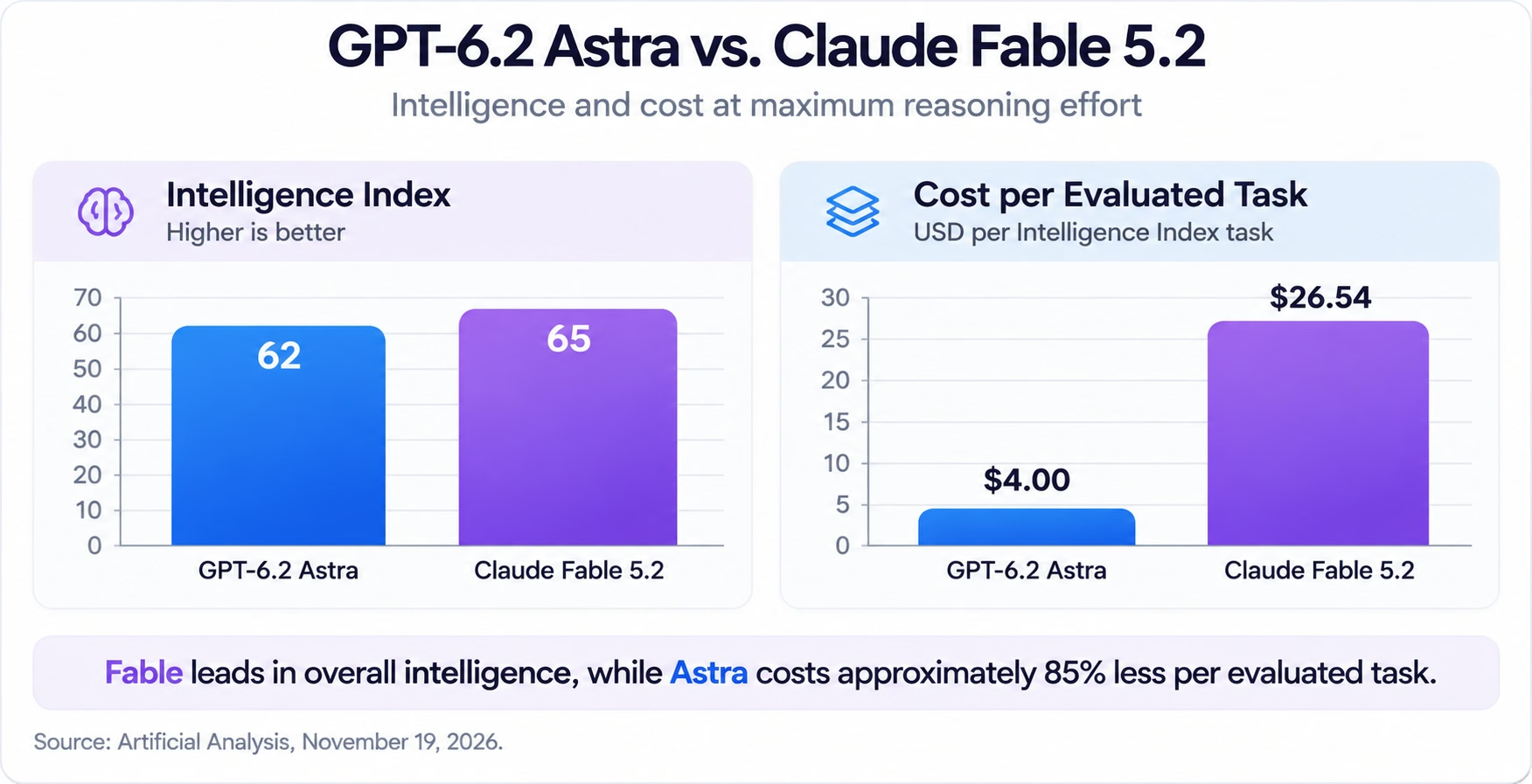
Intelligence Index and cost per evaluated task for GPT-6.2 Astra and Claude Fable 5.2 at maximum reasoning effort. Source: Artificial Analysis, November 19, 2026.
Claude Fable 5.2 leads by three points on the Intelligence Index, but GPT-6.2 Astra costs approximately 85% less per evaluated task. This highlights the trade-off between benchmark performance and evaluation cost.
For businesses and individuals handling complex, repetitive workloads, this difference could make Astra an attractive choice. Fable 5.2, meanwhile, may be preferable when achieving the highest possible task quality matters more than evaluation cost.
These figures reflect Artificial Analysis's standardized evaluation workload, not the actual cost of every real-world task. Performance and expenditure will vary depending on the task, reasoning settings, and token consumption.
Reasoning and Knowledge Benchmarks
Reasoning benchmarks measure how well AI models solve difficult problems, apply specialized knowledge, and answer questions that require more than simply remembering facts.
Artificial Analysis reports the following results for GPT-6.2 Astra and Claude Fable 5.2 at maximum reasoning effort.
| Benchmark | GPT-6.2 Astra (Max) | Claude Fable 5.2 (Max) |
|---|---|---|
| HLE-Diamond | 72.2% | 80.2% |
| CritPt v2 (Hard Subset) | 71.5% | 76.5% |
| GDP.pdf | 29.8% | 24.2% |
Artificial Analysis, GPT-6.2 Astra vs. Claude Fable 5.2 comparison. Figures accessed November 19, 2026.
Claude Fable 5.2 leads on two reasoning-intensive evaluations. It scores eight percentage points higher on HLE-Diamond, which tests advanced reasoning and knowledge, and five points higher on CritPt v2's hard subset, which focuses on challenging physics problems.
GPT-6.2 Astra performs better on GDP.pdf, scoring 29.8% against Fable's 24.2%. This evaluation measures a model's ability to reason through professional documents, giving Astra an advantage on this particular test.
What does this mean for users?
Fable 5.2 demonstrates stronger performance on the two specialized reasoning benchmarks, making it a promising option for difficult scientific and knowledge-intensive problems. Astra's lead on GDP.pdf suggests it may be competitive for document-heavy professional tasks.
However, these results should not be treated as guarantees of performance across all research, financial analysis, or document-processing workflows. The most suitable model will depend on the nature of the task and the level of accuracy required.
Also Read: Fable 5.2 benchmarks for what each test measures and how it compares with other leading models.
Coding and Agentic Performance
Coding performance is no longer limited to generating snippets of code. Modern AI models can debug applications, work with existing codebases, execute commands, and complete multi-step development tasks. These capabilities also matter to non-developers who use AI-powered tools to build applications or automate business processes.
Artificial Analysis reports the following results at maximum reasoning effort.
| Benchmark | GPT-6.2 Astra (Max) | Claude Fable 5.2 (Max) |
|---|---|---|
| Terminal-Bench 4.0 | 64.1% | 59.6% |
| FrontierCode-AA 2.0 | 45.4% | 48.8% |
| AutomationBench-AA | 77.2% | 76.4% |
| Terminal-Bench-Science 0.1 | 78.1% | 73.3% |
Artificial Analysis: GPT-6.2 Astra vs. Claude Fable 5.2. Maximum reasoning effort; accessed November 19, 2026.
GPT-6.2 Astra leads on three of the four evaluations. Its 4.5-percentage-point advantage on Terminal-Bench 4.0 suggests stronger performance in tasks involving command-line tools and software environments. Astra also leads Terminal-Bench-Science 0.1 by 4.8 points, indicating an advantage in scientific computing workflows.
Claude Fable 5.2 performs better on FrontierCode-AA 2.0, scoring 48.8% against Astra's 45.4%. This suggests Fable may be preferable for certain complex code-editing and software engineering tasks.
The two models perform closely on AutomationBench-AA, with Astra holding a marginal 0.8-percentage-point lead. The benchmark evaluates automated task execution, making it relevant to agentic workflows. However, it does not directly establish which model is better at building no-code business applications. To put either model behind an agent of your own, an AI agent builder lets you describe the steps and where a person reviews.
What does this mean for users?
GPT-6.2 Astra appears particularly competitive for executing multi-step technical tasks, working with software tools, and handling automation workflows. Claude Fable 5.2 remains a strong contender for complex coding projects where code quality and successful modifications are central requirements.
For non-technical users building applications through AI-powered platforms, these results are encouraging. However, neither model's benchmark performance guarantees that an application will work correctly without testing, refinement, or human oversight. For a coding task with a review step, a coding agent builder lets you set the checks and where a person signs off.
Instruction Following and Reliability
Strong reasoning and coding capabilities are valuable, but AI models must also follow instructions consistently and complete tasks without unnecessary corrections.
GPT-6.2 Astra and Claude Fable 5.2 are designed to handle complex, multi-step instructions. However, their benchmark results reveal different strengths rather than establishing a clear winner in overall reliability.
Astra's stronger performance on Terminal-Bench 4.0 and AutomationBench-AA suggests an advantage in certain tool-driven and automated workflows. Meanwhile, Fable's higher Intelligence Index and FrontierCode-AA 2.0 scores demonstrate its competitiveness in complex reasoning and software engineering tasks.
These results do not directly measure how consistently either model follows formatting requirements, maintains accuracy across lengthy conversations, or avoids mistakes in everyday professional work.
For businesses using AI to prepare reports, analyze data, or build applications, reliability should be assessed through practical testing alongside benchmark results.
GPT-6.2 Astra vs. Claude Fable 5.2: Speed and Efficiency
A model that generates text faster does not necessarily complete complex tasks sooner. GPT-6.2 Astra and Claude Fable 5.2 illustrate this distinction, with notable differences in output speed, response latency, and token consumption.
Speed and Response Time
Artificial Analysis reports the following performance figures at maximum reasoning effort.
| Metric | GPT-6.2 Astra (Max) | Claude Fable 5.2 (Max) |
|---|---|---|
| Output speed | 49 tokens/sec | 109 tokens/sec |
| Time per Intelligence Index task | 13.9 minutes | 41.8 minutes |
| Time to first answer token | ~209 seconds | ~245 seconds |
Artificial Analysis, 19 November 2026. Figures are indicative snapshots and may change as measurements are updated.
Claude Fable 5.2 generates output approximately 2.2 times faster than GPT-6.2 Astra. However, Artificial Analysis estimates that Astra requires approximately one-third as much time per Intelligence Index task, based on token consumption and measured output speed. This suggests Astra can be more time-efficient on the evaluated workload despite its lower raw output speed.
Astra also reaches its first answer token around 36 seconds sooner, although both models exhibit substantial latency at maximum reasoning effort.
In other words, generating text faster doesn't always mean finishing a task sooner. A model that uses fewer tokens to solve a problem may complete the work more efficiently, even if its raw output speed is lower.
GPT-6.2 Astra vs. Claude Fable 5.2: API Pricing and Cost per Task
GPT-6.2 Astra and Claude Fable 5.2 have identical standard API input and output prices. However, their caching costs and token efficiency can influence the total expenditure, particularly for applications processing large amounts of information or running repeated tasks.
API Pricing Comparison
| Pricing component | GPT-6.2 Astra | Claude Fable 5.2 |
|---|---|---|
| Input tokens (per million) | $8.00 | $8.00 |
| Output tokens (per million) | $40.00 | $40.00 |
| Cached input/cache reads (per million) | $0.40 | $0.20 |
| Cache writes, shortest listed retention (per million) | $10.00 (30 min) | $10.00 (5 min) |
| Batch API input (per million) | $4.00 | $4.00 |
| Batch API output (per million) | $20.00 | $20.00 |
Sources: OpenAI API Pricing and Anthropic Claude Fable 5.2 Documentation. Standard global pricing in USD, November 2026. Cache-write retention periods differ between providers.
For each model’s full rate card, see our GPT-6 Astra pricing and Claude Fable 5.2 pricing guides
Which Model Offers Better Value?
At standard API rates, neither model has a pricing advantage for uncached input or output tokens. Claude Fable 5.2 offers a 50% lower cache-read price, potentially benefiting applications that repeatedly process the same information.
However, API pricing alone does not determine the total cost of completing a task. Models may consume different numbers of reasoning and output tokens to produce comparable results.
As the earlier Intelligence Index comparison demonstrates, identical token prices do not guarantee similar task costs. Astra's lower token consumption across the evaluated workload highlights why businesses should consider cost per completed task alongside standard API rates.
Actual costs depend on workload complexity, token consumption, caching, and processing mode. For GPT-6.2 Astra, requests exceeding 272,000 input tokens incur double the standard input and cache rates and 1.5 times the output rate for the entire request. Businesses processing lengthy documents or large codebases should account for these charges when estimating API expenses.
Context Windows, Features, and Availability
GPT-6.2 Astra supports a 1.05-million-token context window, slightly larger than Claude Fable 5.2's 1-million-token limit. Both models support up to 128,000 output tokens, making them suitable for analysing lengthy documents, working with large codebases, and handling complex projects.
Astra supports tools such as web search, code execution, file search, and computer use through OpenAI's API. Fable 5.2 offers tool use, adaptive thinking, and long-running agentic workflows through Anthropic's ecosystem.
GPT-6.2 Astra is available through the OpenAI API, ChatGPT Work, and Codex for eligible users. Claude Fable 5.2 is accessible through the Claude API and supported cloud platforms, including AWS, Google Cloud, and Microsoft Foundry.
For most users, the small difference in context-window size matters less than tool compatibility, platform availability, and workflow requirements. Businesses handling sensitive information should also review data-retention policies. Claude Fable 5.2 requires 30-day data retention and does not support zero-data-retention arrangements without express authorization from Anthropic.
GPT-6.2 Astra vs. Claude Fable 5.2: Which Should You Choose?
The better choice depends on your workload, budget, and priorities. If you're automating repetitive business tasks, cost efficiency may matter most. For complex research or specialized technical problems, performance on relevant benchmarks may carry more weight.
Choose GPT-6.2 Astra if you:
- Want to build applications, automate workflows, or execute multi-step tasks efficiently.
- Regularly analyse lengthy documents, spreadsheets, or business information.
- Prioritize cost efficiency for complex workloads, particularly where lower token consumption can reduce overall API expenditure.
- Need an AI model for a combination of technical and everyday professional work.
Choose Claude Fable 5.2 if you:
- Prioritize the highest overall intelligence score in the evaluated benchmarks.
- Work on challenging scientific, mathematical, or knowledge-intensive problems.
- Handle complex software engineering tasks where its coding strengths may be useful.
- Value faster raw token generation for output-heavy workflows.
If you’re weighing models beyond these two, our Fable 5.2 alternatives guide compares six on price and results.
Our Verdict
GPT-6.2 Astra offers a compelling balance of reasoning, execution speed, and evaluation cost, making it an attractive option for businesses and individuals seeking practical AI capabilities.
Claude Fable 5.2 leads in overall intelligence and selected specialized benchmarks, making it worth considering for particularly demanding reasoning and coding tasks.
Neither model is universally superior. The best choice depends on whether your priority is maximizing performance on specific tasks or achieving strong results more efficiently.
Also Read: GPT-6.2 Astra vs Gemini 4 Carbon for how Astra compares with Google’s frontier model.
Conclusion
GPT-6.2 Astra and Claude Fable 5.2 demonstrate that choosing an advanced AI model involves more than comparing benchmark scores. While Fable 5.2 leads in overall intelligence, Astra offers competitive performance with substantially better efficiency on the evaluated workloads.
Ultimately, the right choice depends on what you want to accomplish. And if your goal is to turn AI capabilities into functional applications without managing the underlying technical complexity, Emergent is a vibe coding platform and app builder that lets you build and deploy applications using natural-language instructions

Describe it. Build it. Launch it.
- End-to-End Creation
- No Code Needed
- Live in Minutes

Most AI app builders stop at prototypes. Emergent creates production-ready apps you can actually launch.
- Production-ready apps
- Web & mobile apps
- Deploy in minutes





