



TL;DR
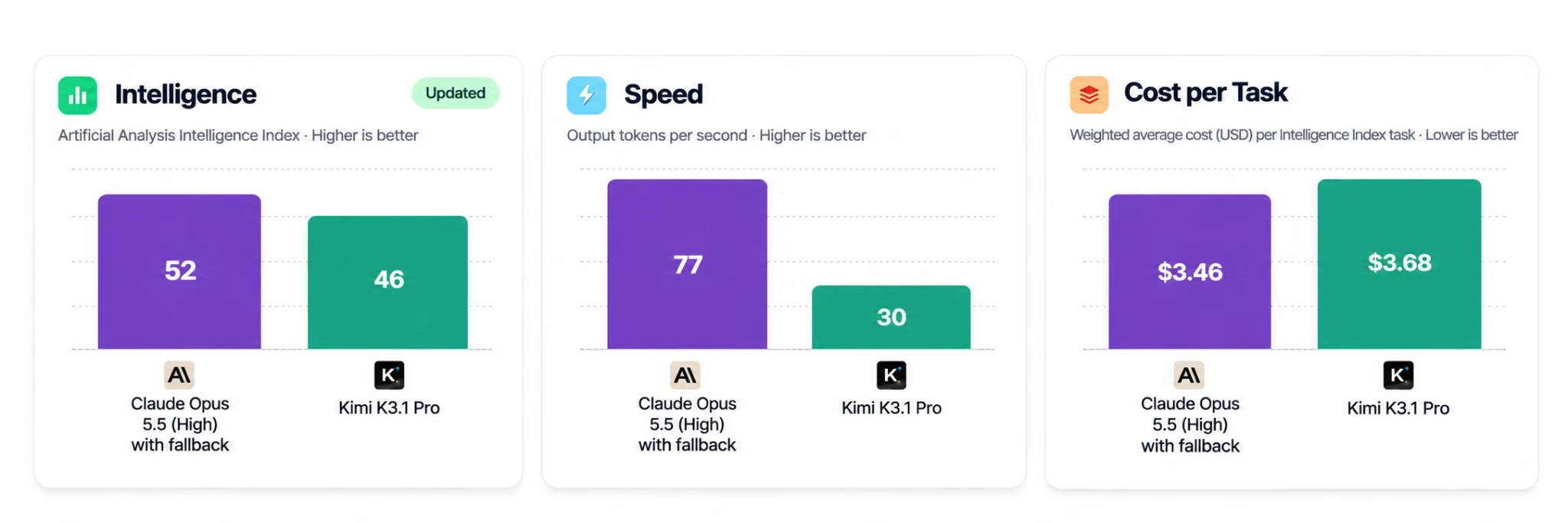
- Overall intelligence: Claude Opus 5.5 High leads Kimi K3.1 Pro on the Artificial Analysis Intelligence Index, scoring 52 against 46.
- Coding: Kimi leads Terminal-Bench 4.0, while Claude leads FrontierCode 2.0. The better choice depends on the type of coding work.
- Budget: Kimi K3.1 Pro costs half as much per input and output token as Opus 5.5. However, its benchmark cost per task is slightly higher.
- Open weights: Kimi K3 is available as an open-weight checkpoint. Kimi K3.1 Pro is available through Kimi’s hosted products and API; Moonshot says its full weights will be released by November 4, 2026.
- Data control: Self-hosting Kimi K3 provides more infrastructure control. Claude offers enterprise retention controls and approved Zero Data Retention arrangements for eligible API customers.
Kimi vs. Claude is a comparison between two AI model families built for increasingly demanding knowledge work, coding, and agentic applications.
The Kimi K3.1 Pro from Moonshot AI is compared to Claude Opus 5.5 by Anthropic against various benchmarks independently. The two have different advantages. Kimi provides affordable API token costs and good terminal agent performance while Claude gives better performance for coding and reasoning tasks.
Kimi vs. Claude at a Glance
Kimi and Claude are not single models. Both are model families with different capability and pricing tiers. This comparison focuses on Kimi K3.1 Pro and Claude Opus 5.5, their respective frontier offerings.
| Comparison | Kimi K3.1 Pro | Claude Opus 5.5 |
|---|---|---|
| Maker | Moonshot AI | Anthropic |
| Model type | Mixture of Experts (MoE) | Proprietary |
| Weights | Not publicly downloadable as of November 3 | Closed |
| Context window | 1M tokens | 1M tokens |
| Input price per 1M tokens | $2 | $4 |
| Output price per 1M tokens | $10 | $20 |
| Cached input per 1M tokens | $0.20 | $0.20 |
| Artificial Analysis Intelligence Index | 46 | 52 (High) |
| Best for | Cost-conscious agentic workflows and terminal tasks | Complex coding, knowledge work, and broader reasoning |
Pricing and benchmark scores checked on November 3, 2026. Benchmark results use Kimi K3.1 Pro and Claude Opus 5.5 High on Artificial Analysis. Pricing is in USD and may vary by platform or billing arrangement.
The first difference is cost: Kimi’s standard API rates are 50% lower than Opus 5.5’s. The second is benchmark performance. Opus leads the aggregate intelligence comparison, but Kimi performs better on selected agentic and terminal-based evaluations.
Neither result establishes a universal winner. Actual performance depends on the task, model settings, tool environment, and amount of reasoning required.
What Are Kimi and Claude?
Moonshot AI Kimi
develops the Kimi family of AI models. Its products include the Kimi web and mobile applications, Kimi Work, Kimi Code, and an API for developers.
Kimi supports several kinds of work, including document analysis, research, coding, and agentic workflows. Its product ecosystem also includes tools for working with files, building presentations, and automating tasks.
Kimi K3.1 Pro is the latest frontier model in this comparison. It has a 1-million-token context window, supports text and image inputs, and uses a reasoning-first architecture. Moonshot also offers a Highspeed version for faster interactions.
Kimi’s model family includes both hosted services and open-weight models. This distinction matters: access to a model through Kimi’s application or API does not automatically mean its weights are available for local deployment.
Anthropic Claude
develops Claude, a family of proprietary AI models. Claude is available through its consumer applications, developer API, Claude Code, and supported cloud platforms.
Claude models cover different workloads, from high-volume classification to demanding agentic coding and research. Anthropic’s current lineup includes Opus 5.5, Sonnet 5.5, Haiku 5.5, and Fable 5.1.
Claude Code is Anthropic’s coding agent. It can inspect codebases, edit files, run commands, execute tests, and work with development tools.
Kimi and Claude model lineups
| Tier | Kimi family | Claude family | Typical use |
|---|---|---|---|
| Frontier | Kimi K3.1 Pro | Claude Opus 5.5 | Complex reasoning and agentic work |
| Specialist premium | Kimi K3 | Claude Fable 5.1 | Selected advanced reasoning workloads |
| Mid-tier | Kimi K2.6 and K2.7 | Claude Sonnet 5.5 | General coding and knowledge work |
| Fast and high-volume | kimi-k3.1-pro-highspeed | Claude Haiku 5.5 | Classification, extraction, and routing |
This article compares Kimi K3.1 Pro with Claude Opus 5.5 because both target demanding workloads. This does not mean every Kimi tier matches the corresponding Claude tier.
Kimi K3.1 Pro vs. Claude Opus 5.5: Key Differences
Why compare these two models? They both offer long context, multimodal inputs, and reasoning capability. But their architectures and performances vary.
1. Architecture and size
Kimi K3 uses a Mixture-of-Experts architecture. Moonshot's technical specs state that the total parameter count is 2.8 trillion, with 104 billion parameters active. In an MoE architecture, only a part of the expert neural network is active for each token.
K3.1 Pro is a post-trained version of K3, with additional post-training compute and changes designed to improve performance across agentic tasks.
Anthropic has not published an equivalent parameter count or complete architecture specification for Claude Opus 5.5. A direct parameter-size comparison is therefore not possible.
2. Reasoning modes and effort settings
Both models support reasoning, but their controls differ.
Kimi K3.1 Pro keeps thinking enabled and exposes reasoning-effort settings. Its default is max, with lower settings available for workloads that do not require the same reasoning depth.
Claude Opus 5.5 uses adaptive thinking. Its documented default effort is medium, although developers can select other supported effort levels.
These settings affect token consumption, latency, and task quality. A benchmark comparison should therefore identify the tested configuration instead of treating model names alone as sufficient information.
3. Context window and multimodal input
Both models support a context window of approximately one million tokens. This allows applications to provide extensive documents, codebases, and conversation history within a single request.
Both accept text and image inputs and generate text outputs in the configurations compared here.
A large context window does not guarantee accurate retrieval from every part of a long document. Retrieval quality still depends on the prompt, document structure, task complexity, and model behaviour.
4. Weights and licensing
This is one of the most important differences.
Kimi K3 has publicly available weights under the Kimi K3 License. The license permits use, modification, deployment, and fine-tuning, subject to its stated conditions.
Kimi K3.1 Pro is a different version. According to Moonshot's announcement dated November 3, 2026, the full weight of its program will be available on November 4. This must not be mistaken for a completed release already made public.
Claude Opus 5.5 remains proprietary. Developers access it through Anthropic’s services and supported cloud platforms rather than downloading its model weights.
Kimi vs. Claude Benchmarks
Artificial Analysis provides an independent comparison of Kimi K3.1 Pro and Claude Opus 5.5. The following figures use Claude Opus 5.5 at high effort.
| Benchmark | What it measures | Kimi K3.1 Pro | Claude Opus 5.5 High | Leader |
|---|---|---|---|---|
| Intelligence Index v5.0 | Overall performance across nine evaluations | 46 | 52 | Claude |
| AA-Briefcase v1.1 | Agentic professional knowledge work | 1,675 | 1,682 | Claude |
| AutomationBench-AA | Multi-step automation | 73% | 63% | Kimi |
| Terminal-Bench 4.0 | Practical terminal-based coding tasks | 67% | 57% | Kimi |
| FrontierCode 2.0 | Advanced coding and software engineering | 25% | 36% | Claude |
| HLE-Diamond | Difficult expert-level questions | 37% | 56% | Claude |
Source: Artificial Analysis model comparison. Scores reflect the tested configurations and benchmark versions. Higher is better.
The results show why an aggregate score should not be the only selection criterion.
Intelligence Index: This combines nine evaluations across knowledge work, automation, coding, and reasoning. Opus leads with 52 against Kimi’s 46.
AA-Briefcase: This evaluates professional knowledge work, including the quality and usefulness of completed tasks. The two models score closely, with Opus slightly ahead.
AutomationBench-AA: This tests whether a model can complete structured, multi-step automation tasks. Kimi leads in this comparison.
Terminal-Bench 4.0: This evaluates coding agents on realistic terminal tasks. Kimi’s higher score makes it an interesting option for terminal-oriented development.
FrontierCode 2.0: This measures more advanced software engineering performance. Opus has a clear lead in this evaluation.
HLE-Diamond: This tests difficult questions across expert-level subjects. Opus performs substantially better in this comparison.
What about vendor-reported results?
Moonshot has also published its own K3.1 Pro benchmark comparisons. Its launch results report 65.7% on Terminal-Bench 4.0 for Kimi and 66.4% for Opus 5.5. The same report shows Kimi ahead on selected evaluations, including SWE-Marathon v1.1.
These figures should remain separate from Artificial Analysis results. The test harness, model settings, benchmark versions, and evaluation sources can differ. Vendor-reported results are useful evidence, but independent measurements provide another perspective.
One more model deserves mention: Claude Fable 5.1 is Anthropic’s more expensive specialist tier, priced at $10 per million input tokens and $50 per million output tokens. Artificial Analysis reports a score of 53 for its Max configuration on the earlier v4.3.2 index; that figure should not be directly compared with the K3.1 Pro v5.0 score above.
Also Read: Claude Opus 5.5 benchmarks and Kimi K3 benchmarks for the scores behind each model.
Kimi vs. Claude for Coding
Coding is a major reason developers compare Kimi and Claude. Both families offer dedicated coding tools, but the benchmark results show different strengths.
Terminal-Bench 4.0 and FrontierCode 2.0
Kimi K3.1 Pro scores 67% on Terminal-Bench 4.0, compared with 57% for Claude Opus 5.5 High. This gives Kimi an advantage on the terminal-based tasks represented in that evaluation.
The result changes on FrontierCode 2.0. Opus scores 36%, while Kimi scores 25%. This suggests that Claude is stronger on the advanced coding tasks represented by that benchmark.
The bottom line for founders and product teams is simple: don't pick a coding paradigm based on just one metric. Terminal execution, code writing, debugging, architecture, and major refactorings are separate tasks.
Claude Code vs. Kimi Code
Claude Code is Anthropic’s agentic coding tool. It works in the terminal and supported IDEs, and can inspect repositories, edit files, run commands, and execute tests. It can also connect to external development tools and services.
Kimi Code is Moonshot’s coding agent. It is available through a terminal CLI, desktop application, and editor integrations. It can read and modify code, run shell commands, inspect project files, and plan multi-step development tasks.
Both tools are designed to do more than generate isolated code snippets. They can work with an existing project and use feedback from commands and tests to continue a task. To build a coding agent of your own around either model’s output, a coding agent builder lets you set the steps and where a person reviews.
A reproducible app-building test
Benchmarks are useful, but a practical test can reveal which model works better in a particular development environment.
Use the same prompt with both models:
Develop a project management application with a responsive design that includes user login, a project dashboard, task creation and editing, filtering by task status, deadlines, and priorities, search, and database storage. Include validation, loading screens, and a mobile-friendly design. Add test data and tests.
Check the following requirements independently:
| Requirement | Pass condition |
|---|---|
| Authentication | Users can register, sign in, and sign out |
| Project dashboard | Projects display correctly |
| Task creation | Users can add a task |
| Task editing | Existing tasks can be updated |
| Status filters | Tasks filter by status |
| Due dates | Dates save and display correctly |
| Priority labels | Priority values appear consistently |
| Search | Search returns relevant tasks |
| Data persistence | Changes remain after a reload |
| Responsive layout | Main workflows work on mobile and desktop |
Test status: This is a proposal for a test protocol, not a ready-made hands-on test. No pass/fail scores or screenshots will be shown here. Prior to publishing, run the test one time on both platforms, with equal effort levels on both of them wherever possible and take down the model snapshot, the date, the platform and the settings used. Take screenshots of the application that was made and of the failures. Do not present the findings as a controlled comparison test if the platforms use different tools, prompts or fallback solutions.
Practicality for coding teams can matter more than small differences on the test, because the model that can build an application with fewer fixes wins regardless of the results of all evaluations. To run that same brief yourself, you can describe it to an AI app builder and check each row of the table against the generated app.
API pricing comparison
The following table uses published standard API rates. It is not a comparison of consumer subscription prices.
| Tier | Model | Input / 1M tokens | Output / 1M tokens | Cached input / 1M tokens |
|---|---|---|---|---|
| Frontier | Kimi K3.1 Pro | $2 | $10 | $0.20 |
| Frontier | Claude Opus 5.5 | $4 | $20 | $0.20 |
| Specialist premium | Claude Fable 5.1 | $10 | $50 | $0.25 |
| Mid-tier | Claude Sonnet 5.5 | $2 | $10 | $0.10 |
| Fast | Claude Haiku 5.5 | From $0.10 | From $0.50 | From $0.01 |
Pricing checked November 3, 2026. Haiku input pricing varies with prompt length. Kimi K3.1 Pro Highspeed is a separate, more expensive option. Rates exclude applicable taxes and other charges.
Kimi K3.1 Pro costs half as much per regular input and output token as Opus 5.5. However, that does not mean every completed task will cost half as much.
Also Read: Claude Opus 5.5 pricing for its caching and batch discounts, and Kimi K3 pricing for Moonshot’s rates.
Cost per task
Artificial Analysis estimates a cost of $3.68 per benchmark task for Kimi K3.1 Pro and $3.46 for Claude Opus 5.5 High.
This is a useful counterexample to the assumption that lower token prices always produce lower task costs. Kimi uses more tokens in the evaluated workload, offsetting its lower per-token price.
The figures are benchmark-specific. A production application with shorter prompts, cached context, different output lengths, or more retries can produce a different cost relationship.
Speed and latency
According to Artificial Analysis, Claude Opus 5.5 High generates approximately 80 output tokens per second, compared with 32 tokens per second for Kimi K3.1 Pro. This gives Claude an output-speed advantage.
However, Kimi has a shorter time to first token (TTFT), taking approximately 3.31s compared with 33.70s for Claude in the tested configuration.
The time to first answer token tells a different story because it also accounts for the model's reasoning time. Kimi takes approximately 66.62s to produce its first answer token, while Claude takes around 33.70s. End-to-end response time is about 82.44s for Kimi and 39.95s for Claude.
These metrics highlight an important distinction when evaluating reasoning models. A model may begin generating tokens quickly but take longer to produce its actual answer. Therefore, output speed and response latency should be considered separately when choosing a model.
Access and availability
Kimi K3.1 Pro is available through Kimi’s web and mobile products, Kimi Work, Kimi Code, and the Kimi API. Kimi also offers membership plans with different usage allowances. API billing is separate from membership benefits.
Claude Opus 5.5 is available through the Claude application and API, as well as supported cloud platforms including Amazon Bedrock, Google Cloud, and Microsoft Foundry. Claude Code can be accessed through eligible Claude subscriptions or a Claude Console account.
For application builders, API availability matters most. It allows a team to integrate a model into its own product rather than relying on a user-facing chat interface.
Open Weights, Privacy, and Data Residency
Open weights and hosted API access offer different levels of control. This distinction matters most when an application handles customer information, internal documents, or regulated data.
Kimi’s open-weight checkpoint vs. hosted API
Moonshot released Kimi K3 as an open-weight model under the Kimi K3 License. Its published specifications list 2.8 trillion total parameters, 104 billion activated parameters, and a 1-million-token context window.
The weights of the K3 model can be used by organizations interested in self-hosting, tuning, and deploying in their own infrastructure. These models will reduce reliance on a hosted inference provider; however, running such a large model requires serious infrastructure and engineering effort.
The Kimi K3.1 Pro is the most capable 3T-class open-weight model. Moonshot has stated it will release its full weights on November 4, 2026. Until then, organizations cannot use the above-mentioned license to self-host K3.1 Pro.
Claude’s closed-weight approach
Claude Opus 5.5 is proprietary. Developers access it through Anthropic and supported cloud platforms rather than downloading its weights.
This means customers depend on the provider’s infrastructure, model availability, pricing, and service terms. In return, they avoid managing the model’s inference infrastructure themselves.
Data retention and residency
Moonshot’s Kimi Open Platform privacy policy states that information may be transferred outside a user’s country and identifies Singapore as a server location for collected information. Organizations should confirm the precise scope and contractual terms before sending sensitive information.
Anthropic’s standard API policy states that inputs and outputs are generally deleted from its backend within 30 days, subject to exceptions such as legal requirements and misuse prevention. Eligible commercial API customers may obtain approved Zero Data Retention arrangements. Anthropic specifies that these arrangements apply to the API and products using the organization’s commercial API key, not automatically to consumer Claude subscriptions or every Anthropic product.
For enterprise use cases, refer to the relevant data processing agreement, data retention policy, regional hosting choices, subprocessors, and contract. The open weights feature of a model in itself does not ensure compliance. Self-hosting may help get more control over infrastructure, yet the organization is still accountable for security and other issues.
Which Should You Choose? Kimi or Claude by Use Case
The right model depends on the application, budget, and level of control required.
| Use case | Recommended option | Reason |
|---|---|---|
| Complex agentic work | Claude Opus 5.5 | Higher Intelligence Index score and stronger results on several reasoning evaluations |
| Budget-conscious API usage | Kimi K3.1 Pro | Half the standard input and output token prices |
| High-volume, fast tasks | Claude Haiku 5.5 | Anthropic positions it for fast, high-volume workloads |
| Self-hosting | Kimi K3 | Publicly available weights under the Kimi K3 License |
| Chinese-language work | Test Kimi and Claude on the target language | Choose based on task-specific quality, terminology, and output consistency |
| Enterprise compliance | Either, subject to review | Evaluate retention, hosting, contractual terms, and security controls |
| Building apps without code | Emergent with the chosen API | Build the application through natural-language instructions and integrate the model required by the workflow |
For Chinese-language applications, don't assume one model will always perform better. Test the relevant dialect, terminology, document types, and business vocabulary using representative prompts.
For no-code application development, the model and the app-building platform serve different purposes. Emergent can turn a natural-language description into a working application, while Kimi or Claude can provide the AI capabilities inside the resulting product.
Conclusion
Both Kimi and Claude are good options for companies building AI-enabled products, but they solve different problems.
First, focus on the workload, not the model leaderboard. If the project requires terminal-based agents and cheaper API tokens, give Kimi K3.1 Pro a try. If you have a lot of programming, complex reasoning, or knowledge-based tasks, consider Claude Opus 5.5.
If the company needs more infrastructure flexibility, consider evaluating the open-weight Kimi K3 rather than the K3.1 Pro cloud service. If you're working with sensitive corporate data, consider both vendors' data retention and hosting agreements.
The best way to choose is to compare both models' performance on your application's tasks, calculate the cost of one success, and pick the right option.
Create your vision with AI using Emergent.

Describe it. Build it. Launch it.
- End-to-End Creation
- No Code Needed
- Live in Minutes

Most AI app builders stop at prototypes. Emergent creates production-ready apps you can actually launch.
- Production-ready apps
- Web & mobile apps
- Deploy in minutes





