TL;DR
- A real estate CRM helps businesses manage leads, contacts, follow-ups and sales activities in one place.
- CRM pricing can be divided into different tiers, ranging from basic tools for individual agents to advanced platforms for teams and brokerages.
- The cost depends on users, features, automation, lead generation, websites and integrations.
- The advertised subscription might not be the full cost. Total Cost of Ownership (TCO) provides a more realistic estimate by including both the subscription and additional costs.
- Businesses can buy an existing CRM or build a custom one, depending on their requirements, resources and the functionality they need.
An efficient real estate CRM solution consolidates crucial business information in one place. It automates routine tasks, tracks leads through the sales pipeline, and helps you stay on top of client communication. This makes it easier to manage daily operations and close deals quickly.
But before getting a CRM, it is crucial to understand how they are priced. CRM costs can vary based on several factors. Are you an agent, team or brokerage? Do you want a simple platform or an all-in-one real estate platform? What are the pricing tiers? What does each tier include? Are there any additional costs that may appear after signing up?
Answering these questions makes it easier to estimate the real estate CRM cost for your business.
What a Real Estate CRM Costs: The Quick Answer
Today, several CRM options are on the market, designed to meet the varied needs of different users. Options range from low-cost tools for individual agents to premium platforms for larger teams and agencies. As of September 2026, the costs of different real estate CRMs look like:
| Real estate CRM | Published starting price |
|---|---|
| Lone Wolf Relationships | $33.25/month |
| Wise Agent | $49/month |
| Follow Up Boss | $58/month |
| Top Producer | $179/month |
| iHomefinder | $169/month + $250 setup |
| Rechat | $35/seat/month |
| Sierra Interactive | $299.95/month |
| RISE by MoxiWorks | $300/month |
| Real Geeks | $399/month |
| Fello | $415/month |
| CINC | $899/month for solo agents; $1,500/month for teams |
Beyond a quick glance, the prices are not directly comparable. They don't share the same features, and each tool comes in different variants and tiers. The actual cost of CRM platform for real estate is evaluated based on its features and usage, and not just monthly subscriptions.
Read More: Best CRM for real estate
Pricing Tiers: What You Get at Each Level
A pricing tier is exactly what it sounds like. It is a price level or category within a product's pricing structure. Tiers are broadly based on functionality and cost. Real estate CRMs can be divided into three pricing tiers:
At a Glance
| Pricing tier | Typical price | What you generally get | Best suited for |
|---|---|---|---|
| Low-cost | $30–$100/month | Contact and lead management Follow-up reminders Email templates Basic automation Task management Basic reporting | Solo agents and small teams |
| Mid-range | $100–$400/month | Advanced automation Lead routing Team management Marketing workflows Integrations Detailed reporting | Growing real estate teams and established agents |
| Higher-priced / all-in-one | $400–$1,000+/month | Advanced CRM Lead generation IDX website Marketing automation Lead routing Integrations Broader team or brokerage features | Established teams and brokerages |
Low-cost CRM options
Low-cost CRMs are the most affordable options. The focus is on basics like storing contacts, managing leads, tracking follow-ups and handling everyday tasks. They lack advanced features like automation, reporting, or marketing options, and suit solo agents and small teams.
Read More: CRMs for Small Business in 2026
Mid-range CRM options
With an increase in price, the CRM options get more features in the mid-range. They are designed for teams still in a growth stage and need support with automation, collaboration, reporting and integrations. The focus therefore is on automation, team management, lead routing, marketing tools and integrations.
Higher-priced and all-in-one CRM options
High-priced and all-in-one options are more than CRMs. They combine CRM services with other functions like lead generation, websites, marketing automation and other real estate-specific tools. They are more suitable for already established teams and brokerages.

What Drives the Price of a Real Estate CRM
Before you worry about how much does a real estate CRM cost, you need to first understand what drives the price of a real estate CRM. Several factors influence the final cost of your CRM, including:
Number of users
One factor that influences real estate CRM cost is the number of users. Different CRMs charge differently. Some offer a flat rate on team subscription, while others charge per user. Based on the size of your team and the charges, you can choose the more cost-effective option.
Features and automation
The features and level of automation a CRM includes also affect its overall cost. The more advanced features and automation, like lead routing, marketing workflows, reporting and AI capabilities, the higher the price. If you don't need more advanced features, or if you are a solo agent just starting out, you can start with basic features and add capabilities later as needed.
Lead generation and websites
Lead generation and lead origination are two very distinct tasks in a real estate CRM. A CRM that only organizes leads won't cost as much as one that also supplies leads and an IDX website. So, in higher-end CRMs, you are also paying for a larger marketing and lead-generation system.
Integrations
When you invest in real estate CRMs, you will want to integrate it with other aspects of your business, especially if you are aiming for centralization. You can connect your CRM with websites, email, calling systems, marketing platforms and other software. Each integration increases your CRM's overall efficiency and cost.
This is how the additional costs may look:
| Cost driver | Estimated additional cost |
|---|---|
| Number of users | $20–$100+ per additional user/month |
| Advanced features and automation | $50–$300+ per month |
| Lead generation and website tools | $100–$500+ per month |
| Integrations and API access | $50–$500+ per month, depending on complexity |

The Hidden Costs Nobody Quotes
CRMs may come with certain hidden costs that quietly increase the cost of ownership (TCO). Usually, they are not talked about, but if you know what to look for, you can plan your purchase better:
Setup and implementation
Once you subscribe to your CRM, you need it set up and installed to use it. At first glance, it looks like it's covered by the subscription fee. But some platforms may charge a separate setup and implementation fee. This is a one-time fee that includes configuring the CRM, importing existing customer and lead data, setting up workflows, connecting other tools, and preparing the system for the team to use.
If your CRM is more advanced, requires customization, has more data to migrate, or needs multiple integrations, the fee may go up accordingly. Depending on the complexity, setup and implementation fees can cost about 20%–50% of the first-year license cost.
Data migration
If you have been in the real estate business for a while and are moving from spreadsheets to your first CRM, or moving from an old platform to a new one, you will need to migrate all your data to the new CRM. While it is a one-time expense, it adds up to the overall CRM systems cost for real estate.
The total data migration cost would depend on the amount of data to be migrated, its quality and the number of systems involved. If the data needs to be cleaned, organized, deduplicated and mapped to the new CRM before it can be imported, then it may further increase the cost.
Costs usually range from $2,000–$8,000 for spreadsheet or CSV migration, $8,000–$25,000 for a basic CRM migration, and $25,000–$75,000+ for complex multi-system migrations.
Training and administration
One surprising hidden cost of a CRM is the people cost. Once you have a CRM, you need to get your team trained to use it efficiently. If the team is large, you may also need a manager to oversee the workflow, data quality and system settings after implementation. These costs aren't visible in the pricing, but they increase total cost of ownership.
On average, basic training costs $3,000–$10,000, and comprehensive training costs $10,000–$30,000. Ongoing CRM administration can add another $12,000–$25,000 per year for part-time administration or $40,000–$90,000 for a dedicated administrator.
The Bigger Cost: Leads You Lose Without a CRM
A successful real estate business depends on a smooth lead flow. If you miss new inquiries, delay follow-ups, or struggle to find customer information, you may lose opportunities.
A CRM ensures that your leads move through the pipeline without a hitch. It centralizes lead information and automates follow-up tasks. The follow-ups can combine emails, texts and tasks, with lead-routing features for teams.
However, the kind of CRM you get should be compared with your business requirements. As a solo agent with a manageable number of leads, you may not need to invest in a high-end CRM.
Similarly, a growing business with a rapidly expanding team and high leads shouldn't cut costs, because what you lose in leads may end up costing far more than what you save in CRM fees.
How to Size the Cost for Your Team
When trying to size the cost of CRM for your team, you can rely on the following three questions:
How many people need access?
Count everyone who will regularly use the CRM, including agents, managers and administrative staff. Check whether the CRM charges per user or offers team-based pricing. This gives you a clearer estimate of the base subscription cost as your team grows.
What functions do they actually need?
List the features your team will use rather than paying for every available feature. Consider whether you need basic lead tracking or advanced automation, lead routing, reporting, marketing tools and other capabilities. This helps identify the right pricing tier.
Which tools are already being paid for?
Review your current spending on websites, lead-generation platforms, email marketing, phone systems and other software. A CRM that includes some of these functions may cost more upfront but could reduce your overall software spending.
How to Compare CRM Quotes Fairly
When comparing CRM quotes, you must look beyond the subscription costs and ask questions like:
| Cost factor | Question to ask |
|---|---|
| Subscription | Is pricing per user, per team or flat-rate? |
| Billing | Is the price different for monthly and annual billing? |
| Setup | Is there a one-time implementation fee? |
| Users | What happens when another agent joins? |
| Leads | Are lead-generation services included? |
| Website | Is an IDX website included? |
| Calling | Is dialing included or an add-on? |
| Texting | Are messages included or charged separately? |
| Integrations | Are third-party integrations included? |
| Migration | Is moving existing contacts included? |
| Training | Is onboarding included? |
| Support | Is premium support charged separately? |
Remember, the best CRM for real estate agents isn't the one with the lowest quote. It is the one that gives you and your team the required features without creating a large collection of additional charges.
Total Cost of Ownership (TCO)
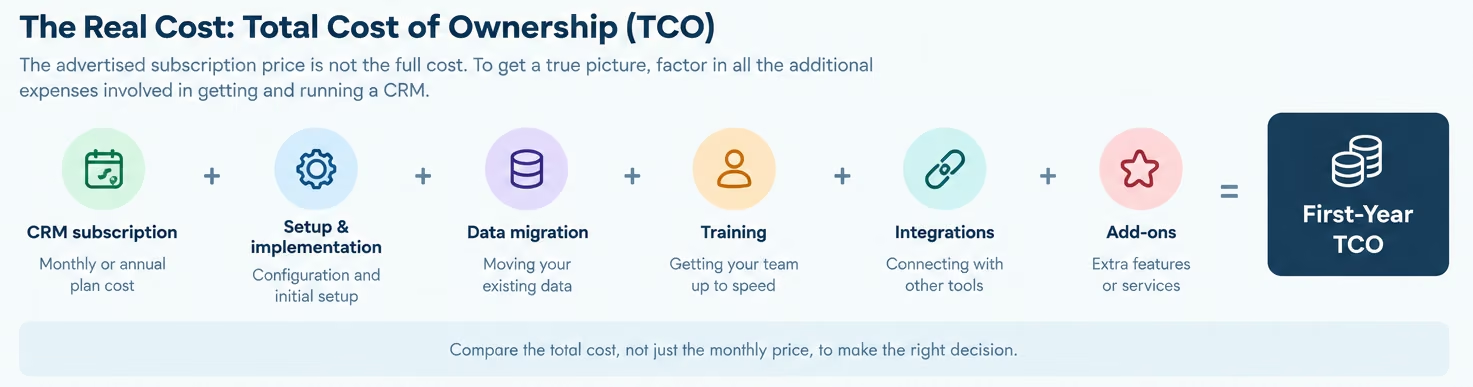
When you are trying to understand how much real estate crm software cost, make sure to look at the total cost of ownership and not just the stated subscription price. TCO is the actual cost the business bears to use and maintain the platform.
It goes beyond the advertised subscription price and includes setup and implementation, data migration, training, integrations, add-ons, and ongoing administration. Also, remember that TCO isn't just a first-year concept. While first-year TCO will be higher, it also includes ongoing annual costs.
Build vs Buy: A Cheaper Path With Emergent
One major question many face when planning to get a CRM is whether to buy or build one. The answer depends on your particular needs:
When to buy a CRM
Buying an off-the-shelf CRM can make more sense when a business needs to get up and running quickly, and its sales process fits within the features offered by existing platforms. A ready-made CRM typically provides core functions such as contact management, lead tracking, follow-ups, reporting and integrations without requiring the business to develop the software itself.
It can also be a better option for smaller teams that lack the time or resources to manage software development. The subscription cost is easier to estimate upfront, although businesses still need to account for implementation, data migration, training and add-ons.
When to build a CRM
For a business with unusual workflows, a large team or requirements that standard CRM products cannot handle, building a real estate CRM can be worth considering.
Emergent can be an option for businesses that want to build a CRM with AI around their specific requirements rather than accept the limitations of an off-the-shelf CRM.
The key is to compare total cost of ownership and required functionality, rather than assuming one approach will always be cheaper.
Read More: How to build a real estate CRM with AI

Most AI app builders stop at prototypes. Emergent creates production-ready apps you can actually launch.
- Production-ready apps
- Web & mobile apps
- Deploy in minutes