



Walmart had built more than 200 AI agents for different tasks such as customer support, inventory queries, and employee benefits, all built independently by different teams. But users increasingly faced a fragmented experience.
The company responded by organizing these capabilities behind four “super agents” serving customers, employees, sellers and suppliers, and developers. That single architectural decision says more about where ecommerce AI is headed than any feature announcement this year.
We pulled together the real deployments: Walmart's Sparky and Marty, Shopify's Sidekick and Agentic Storefronts, Klarna's AI-powered customer service, and the emerging ecommerce protocols from OpenAI, Stripe, and Google that are reshaping how products are discovered and bought.
Below are nine real-world use cases for AI agents for ecommerce, each with a named company, verified numbers, and an honest read on what's working and what isn't.
That last part matters because at least one of these deployments became a cautionary tale worth understanding before you copy the approach.
What Is an AI Agent for Ecommerce?
An AI agent is software that can plan, take multi-step actions, and complete a task with minimal human input.
A traditional ecommerce chatbot follows a decision tree: if the customer types "where's my order," show the tracking link. An agent instead looks up the order, checks the carrier's real-time status, decides whether a refund or replacement is warranted, and executes it, without a human pulling the trigger at each step.
For a broader look at agents across business functions beyond ecommerce, see our guide to the best AI agents for business.
Why Agentic Commerce Is Different From Past Ecommerce Automation
Two new protocols are quietly reshaping ecommerce: OpenAI and Stripe's Agentic Commerce Protocol (ACP), which lets ChatGPT complete checkout directly, and Google's Universal Commerce Protocol (UCP), built with Shopify, Etsy, Wayfair, Target and Walmart, and backed by more than 20 further partners.
Both exist to solve the same problem: letting an AI agent discover a product, check live inventory and pricing, and complete a purchase across any participating retailer, without a custom integration per platform.
During Cyber Week, 20% of global orders were influenced by AI and agents, according to Salesforce.
Adobe found that AI-driven traffic to U.S. retail sites increased 693.4% during the 2025 holiday season, with a 670% increase on Cyber Monday alone.
Overall, the market size for agentic AI in retail and ecommerce is estimated at about $60 billion in 2026, growing to more than $218 billion by 2031, according to Mordor Intelligence.
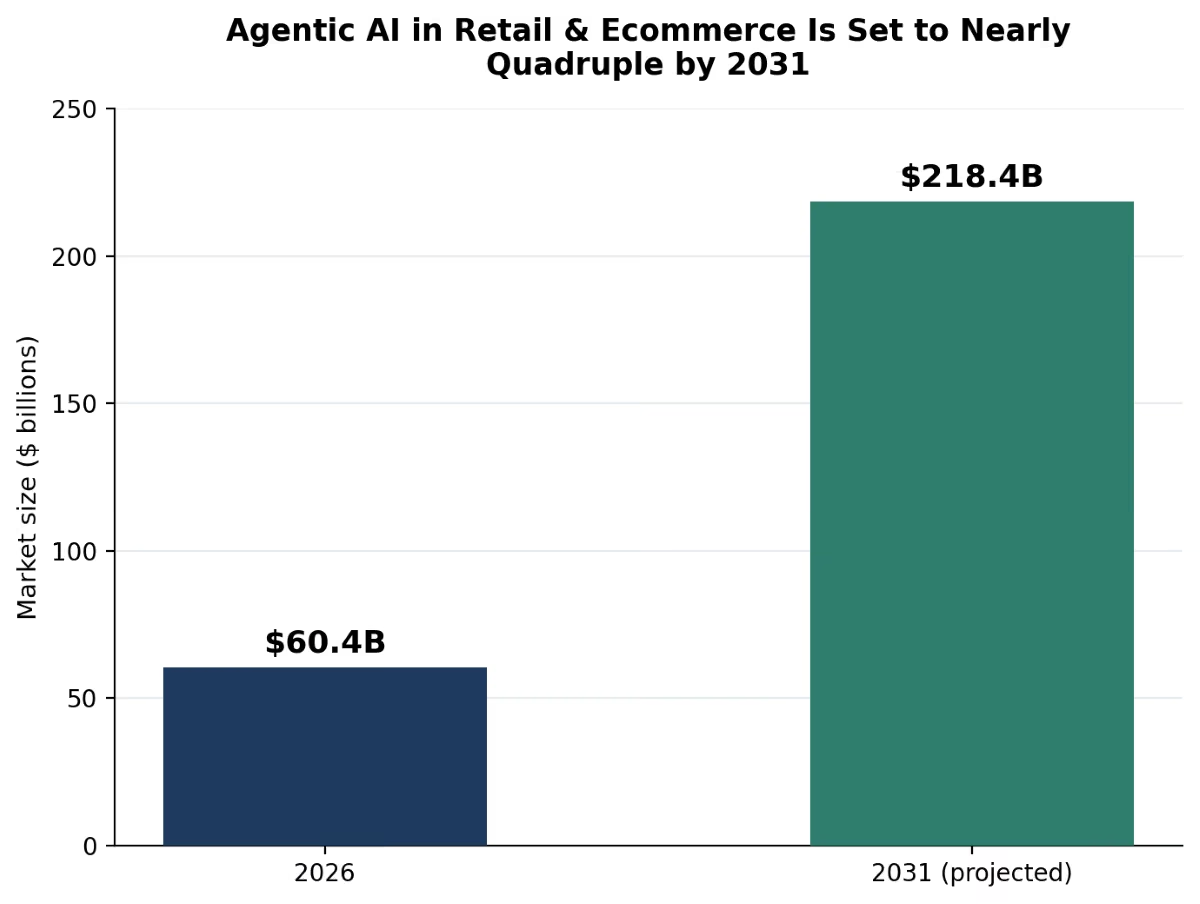
Agentic AI market size in retail and ecommerce, 2026 (estimated) vs. 2031 (projected). Source: Mordor Intelligence
9 Real AI Agent Use Cases in Ecommerce
1. Conversational Shopping Assistants
What it is: An AI agent embedded directly in a retailer's app or site that helps shoppers find products through natural conversation.
Real example: Walmart's Sparky is the customer-facing one of those four super agents, and it is where the consolidation shows up for shoppers.
Walmart reports that 81% of surveyed Walmart customers had used Sparky to check product availability or review product specifications before buying, and units purchased through Sparky more than quadrupled quarter over quarter as the company expanded what it could handle, from general merchandise into everyday groceries.
Where it's headed: Sparky can now build full purchase lists from a single prompt. Tell it you're planning a party, and it builds a curated list in one go, Walmart's own example runs from decorations to champagne and confetti.
Amazon's equivalent, Rufus, ran inside the Amazon Shopping app and on desktop and carried sponsored placements, the same move Walmart is testing with sponsored prompts inside Sparky's recommendation flow. As of May 2026, Amazon retired the Rufus name and folded it into Alexa for Shopping, a merged assistant combining Rufus's product knowledge with Alexa+.
2. Agentic Checkout: Buying Inside the AI Chat Itself
What it is: The AI platform completes the transaction inside the conversation itself, using a shared protocol to retrieve product information, check pricing, and process payment without sending shoppers to a retailer's website.
Real example: Shopify's Agentic Storefronts, built on the Universal Commerce Protocol it co-developed with Google, allow products to be purchased through AI interfaces such as ChatGPT and Microsoft Copilot, with Google AI Mode in early access. Shopify says merchants are UCP-enabled by default, without requiring a custom integration.
Keen Footwear and Pura Vida, for example, are already selling through Microsoft Copilot Checkout. Shopify reports AI-driven orders to its stores grew 15× across 2025.
The honest caveat: Agentic checkout doesn't automatically outperform a retailer's website. Walmart found that purchases completed through ChatGPT's Instant Checkout converted at roughly one-third the rate of Walmart.com itself.
That's one reason the company doubled down on Sparky as its owned surface rather than routing shoppers entirely through third-party AI platforms.
Update: By March 2026, OpenAI had stepped back from in-chat Instant Checkout across its merchants, letting them use their own checkout instead. Walmart replaced it with Sparky embedded directly inside ChatGPT, so shoppers stay within Walmart's own account and cart system.
3. Customer Support Automation
What it is: AI agents that resolve support tickets directly, issuing refunds, processing order changes, and handling cancellations and account issues, with a human only stepping in for edge cases.
Real example: Klarna's AI assistant, built with OpenAI, handled 2.3 million conversations in its first month across 23 markets and 35 languages, cutting average resolution time from 11 minutes to under 2 minutes.
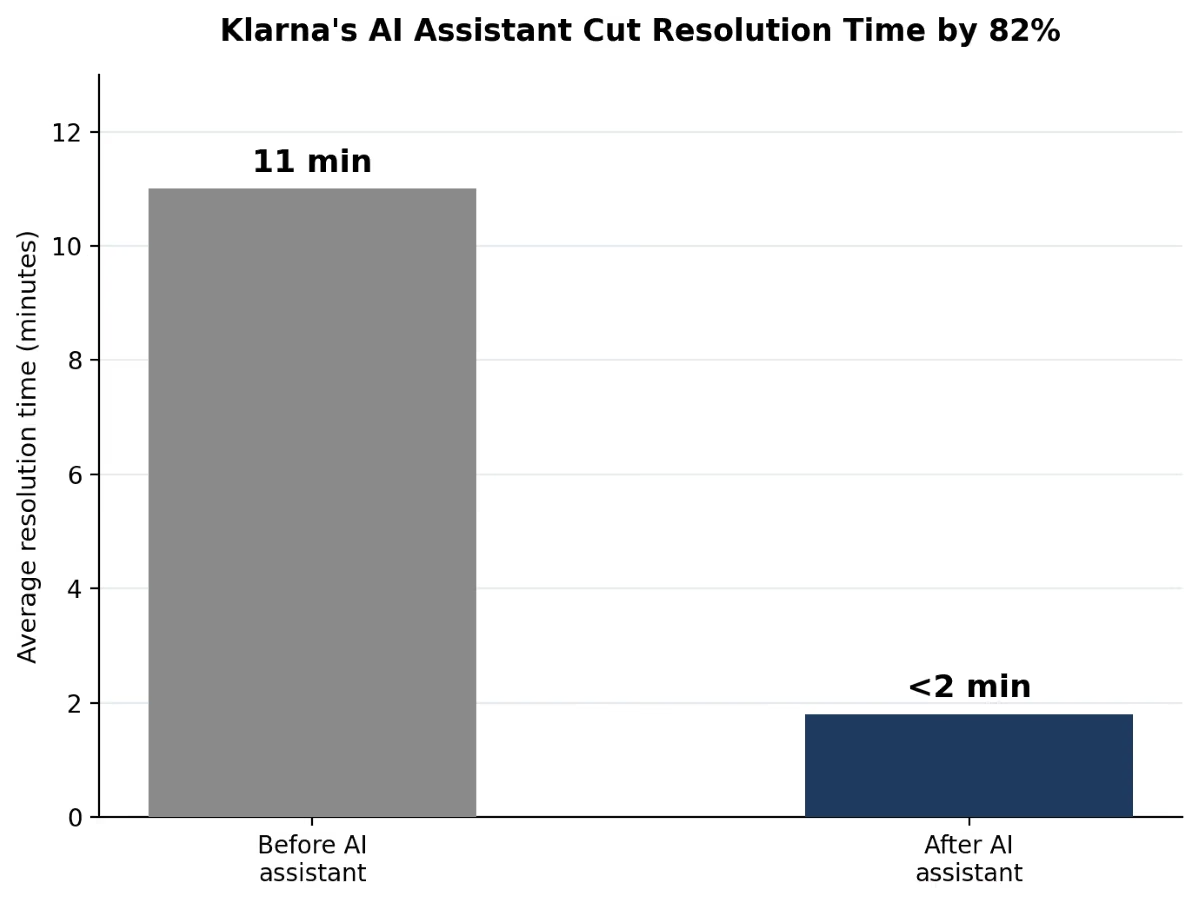
Source: Klarna's February 2024 press release; CX Dive reporting on subsequent quarters.
By late 2025, Klarna said the assistant was doing the equivalent work of 853 full-time agents and had saved the company roughly $60 million. That's the headline case study every "AI replaces jobs" article cites.
What the headline leaves out: the rehiring came first. In May 2025, Klarna CEO Sebastian Siemiatkowski told Bloomberg the cost-driven rollout had produced "lower quality," and the company began actively rehiring human support agents. The 853-agent and $60 million figures came later, after that correction.
By June, the company had settled on a hybrid framing: AI handles routine issues, while human support becomes a VIP service.
The lesson generalizes well beyond Klarna. A Gartner survey of 321 customer service leaders in October 2025 found that only 20% had actually reduced headcount due to AI, even though Gartner itself predicted that agentic AI will autonomously resolve 80% of common service issues by 2029.
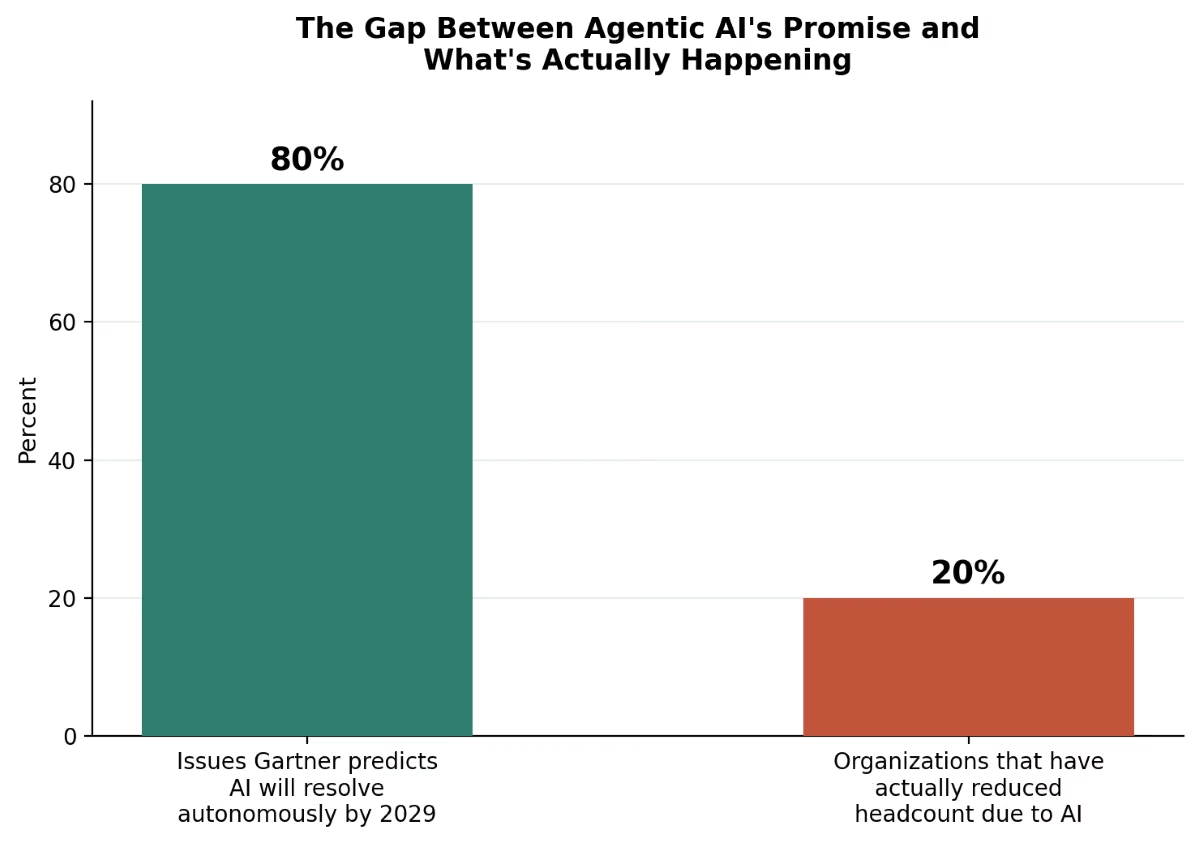
Source: Gartner, October 2025 survey of 321 customer service and support leaders (headcount figure); separate March 2025 Gartner release (80% prediction).
The gap between the prediction and today's reality is the key lesson: start with genuinely repetitive tasks and measure resolution quality alongside deflection before expanding the deployment.
4. Merchant Operations Copilots
What it is: An AI agent that works on the seller's behalf, handling day-to-day store management: writing product copy, generating images, analyzing trends, and now making direct edits to the store itself.
Real example: Shopify Sidekick has powered nearly 100 million merchant conversations to date. It can adjust themes, build customer segments, and set up automation workflows from natural language, without a developer.
Aviator Nation's Director of Ecommerce, Curtis Ulrich, described using it this way: "We can use Sidekick to validate assumptions we have about the business and add data to them. [...] We can go into Shopify now and pull out actual data that helps support those arguments."
Where it's headed: Shopify describes the direction as Sidekick evolving from an assistant into something closer to a co-founder: a system that proactively surfaces growth opportunities from a merchant's own store data.
Where it falls short: Shopify's own documentation says Sidekick presents changes for a merchant's review before applying them, not just customer-facing ones. The labor shifts from writing to editing rather than disappearing.
If you're evaluating platforms based on AI capabilities, our comparison of Shopify alternatives and competitors provides a useful reference.
5. Retail Media and Advertising Optimization
What it is: AI agents that manage ad campaign strategy for sellers and advertisers, bid optimization, keyword suggestions, and performance reporting, inside a retailer's own advertising platform.
Real example: Walmart's supplier-facing super agent, Marty, analyzes sponsored search campaign performance and recommends bid and keyword changes through plain-language chat.
The business case is clear from Walmart's own numbers: its advertising revenue grew 37% globally and 44% (excluding VIZIO) in the US in Q1 FY27.
CommerceIQ CEO Guru Hariharan frames the shift bluntly: "AI becomes truly valuable when it can understand the 'why' and take immediate action. That is the shift to Agentic Commerce."
Where it falls short: That 37% covers Walmart's whole advertising business, and Marty is still rolling out. Read it as directional evidence that AI-assisted campaign management is paying off, not as Marty's own scoreboard.
6. Inventory and Supply-Chain Optimization
What it is: Agents that monitor stock levels, demand signals, and pricing in real time, then act on it. They reorder, move inventory between locations, or change price before a human has opened the dashboard.
Real example: Amazon's newsroom announced a foundation AI model for demand forecasting that predicts what customers will want, where, and when, across hundreds of millions of products a day.
The model adds time-bound signals like weather and holiday schedules on top of sales history, the kind of regional nuance that predicts sunscreen demand in Cape Cod versus ski goggles in Boulder.
Amazon reports that these forecasts contributed to a 10% improvement in long-term national forecasts for deal events and a 20% improvement in regional forecasts for millions of popular items.
Why this matters for smaller sellers too: You don't need Amazon's scale to benefit from the same principle. A single agent that watches inventory levels and automatically flags or reorders low stock removes one of the most common causes of lost sales: being out of stock on a product that's actively converting.
Where it falls short: Amazon's foundation model currently runs in the US, Canada, Mexico, and Brazil, and it layers weather and holiday signals on top of years of its own sales history, the kind of data a smaller seller doesn't have. A smaller seller's version of this is a much simpler reorder-point agent, not a from-scratch forecasting model.
7. Personalized Recommendations and Guided Selling
What it is: Agents that go beyond "customers who bought this also bought" and actively ask questions to guide a shopper toward the right product, and answer the sizing, fit and bundle questions a shopper would otherwise ask a person.
Real example: Stitch Fix's Freestyle platform pairs algorithmic recommendations with human stylists to deliver personalized outfit inspiration, the company describes the picks as stylist-approved.
The company reported more than a 100% increase in Freestyle spending over a 90-day window specifically among users of Stitch Fix Vision, an AI outfit-visualization feature within Freestyle, not Freestyle users overall.
This is where retail-trained agents can outperform AI chat. They understand inventory constraints, seasonal demand, and product lifecycle rather than matching on keywords alone.
Where it falls short: Stitch Fix still pairs the AI layer with human stylists, so the model's cost structure depends on that human layer staying in place.
For stores that already run a support agent, adding guided-selling capability is a natural extension rather than a separate build; our breakdown of chatbot use cases covers where that transition makes sense.
8. Post-Purchase and Returns Automation
What it is: Agents that handle everything after checkout: order tracking, delivery updates, returns, exchanges, and loyalty nudges, resolving what support teams call WISMO ("where is my order") tickets with minimal human handling.
Real example: Loop Returns trained its Loop Intelligence engine on data from over 200 million shoppers and 100 million returns to automate exchanges, fraud detection, and order edits.
The company reports that 90% of brands using its AI-driven recommendations see an average 11% increase in retained revenue per return, and that its fraud detection has flagged more than £198 million, about $250 million, in at-risk refunds.
Why it's high-leverage: Post-purchase support is high-volume and highly repetitive, which is often the safest place to deploy an agent first, before categories like complex disputes or account issues.
A returns and exchange flow that resolves in minutes rather than days measurably affects whether that customer buys again. This is the category where the gap between "AI resolved my issue" and "AI frustrated me" is most visible, so it's worth erring toward transparency about when a shopper is talking to AI versus a human.
9. Marketing Content and Campaign Agents
What it is: Agents that generate and manage marketing content: product descriptions, ad creative, email campaigns, and increasingly run the campaigns themselves once the first draft is approved.
Real example: Shopify's Spring '26 Edition shipped Campaign Autopilot alongside Sidekick's content generation tools, moving from "write this for me" to running campaigns.
CommerceIQ's Content Agent operates on the same principle for brands managing product listings across multiple retail marketplaces at once. Newell Brands' CMO, Nick Hammitt, said the company used CommerceIQ to build a custom Content Agent in under 80 days and reported a 40-fold improvement in operational efficiency on the manual work it replaced.
Where to be careful: Generic AI copy at scale is easy to spot and can flatten a brand's voice. The strongest deployments train the agent on a specific brand's existing content and constrain its tone rather than letting it write freely.
These nine have more in common than the tools they used. Our principles of building AI agents guide covers the patterns underneath.
How to Choose the Right Use Case for Your Store
Not every use case above belongs in a version-one deployment. The order in which you introduce them matters.
- Start with post-purchase support, since it's the highest-volume, most repetitive category
- Add guided selling and recommendations next, once you have support data showing what customers ask about products before buying
- Layer in merchant operations tooling for in-house workflows before opening any agentic checkout surface, so your product data is clean and structured before an outside AI platform starts representing it
- Treat agentic checkout as an additional distribution channel, not a replacement for your own storefront. Walmart kept building Sparky even after joining OpenAI's checkout protocol.
- Save inventory and pricing automation for last. Build a track record with lower-stakes agents first.
Ecommerce and marketing agents overlap in practice, since the same team usually runs both. Our AI agents for marketing guide covers that side.
Lessons From Real Deployments
Scope tightly before you scale broadly. Klarna's assistant worked because it handled a narrowly defined set of consumer-fintech tasks with full account context from the start.
Resolution quality matters as much as deflection rate. The goal should not simply be to resolve as many tickets as possible without human involvement. Klarna's experience shows the risk of prioritizing cost reduction at the expense of the customer support experience.
Owning your surface still matters. Walmart's own site outconverts routing the same shoppers through a third-party AI checkout, which is why the company kept building Sparky rather than handing the journey over. Being present in ChatGPT or Copilot works best as an additive distribution layered on top of your own experience.
Customers are still wary. A 2023 Gartner survey found that 64% of consumers would prefer companies not to use AI for service at all. Disclosure and an easy path to a human still matter, even as the underlying technology gets better.
The technology outpaces the data foundation. Shopify's guidance for Agentic Storefronts emphasizes that complete, accurate, and well-structured product data helps AI agents find and understand products.
5 Best AI Support Agents for Ecommerce
The customer support automation use case above describes what these agents do. If you're shopping for one instead of building it, here are five platforms ranked by how broadly they apply, from works-with-anything to narrowest use case.
1. Fin
Fin (Intercom's AI agent) is priced per outcome, from $0.99, rather than per seat. It runs on top of the helpdesk you already have, Salesforce, HubSpot, Freshdesk, and others, or you can pair it with Intercom's own helpdesk for $29 per seat per month on top.
Best for: Teams that want to add an AI layer to a helpdesk they already run, without migrating platforms.
2. Gorgias
Gorgias is built specifically for Shopify and DTC ecommerce, with direct access to order, refund, and shipping data. It bills on ticket volume rather than seats, so adding support staff doesn't raise the base price.
Best for: Shopify-native brands that want deep order and fulfillment context built in.
3. Zendesk AI
Zendesk AI is the default choice if your help desk is already Zendesk, since the agent deploys inside the existing ticketing workflow without a migration.
Best for: Existing Zendesk shops that want the AI layer with zero platform switching cost.
4. Ada
Ada targets large enterprises already running Zendesk or Salesforce, with support for 60 languages and a vendor-assisted deployment rather than a self-serve one.
Best for: large, multilingual enterprises with the budget and headcount to manage a vendor-assisted rollout.
5. Cognigy
Cognigy specializes in voice and IVR automation, with the enterprise security certifications and data-residency options that regulated industries often require.
Best for: Phone-first support in regulated industries where voice automation is the primary channel.
Where it's honest to flag a limit: Most of these meter on usage, outcomes, resolutions, or ticket volume, so the bill tracks how busy your support queue gets. Two of them, Ada and Cognigy, don't publish pricing at all, which makes that cost hard to model before you're in a sales cycle.
Emergent is worth a look if what you actually want is a support agent built around your own policies and data, without a per-resolution meter that keeps running as your ticket volume grows.
The five platforms above cover customer support specifically. For the wider landscape of AI tools across sourcing, merchandising, and marketing, see our roundup of AI tools for ecommerce.
How Emergent Helps You Build Custom AI Agents for Ecommerce
Most of the deployments above were built by companies with dedicated AI engineering teams. That's no longer a requirement to compete on the same use cases.
Emergent offers an AI agent builder for e-commerce, and here's what that looks like in practice.
our Complete builds from a conversation: Describe the agent you want, and Emergent's specialized agents handle the interface, the logic, the data, and the integrations.
- Native Stripe integration: Connect Stripe directly for checkout, subscriptions, and refund workflows without custom payment infrastructure
- Mobile and web from one build: Ship the same agent experience to a React Native mobile app and your web storefront from one build
- Fast iteration for a fast-moving category: Agentic commerce protocols are still evolving month to month, so the ability to rebuild or extend an agent in days rather than a full engineering sprint is a genuine competitive edge
- Build from the AI chat you already use: The Emergent MCP Connector lets you build and manage Emergent apps directly from Claude or ChatGPT, without switching platforms mid-build
Worth knowing: Emergent is built for teams shipping and iterating fast. Replicating Walmart-scale infrastructure that consolidates hundreds of internal systems is a different problem, and dedicated engineering still wins there.
For the support, guided-selling, and operations agents most stores actually need, that scale gap rarely matters.
Stuck partway through a build? Emmy, Emergent's built-in chat assistant, handles the points where most builds stall: describe what you want in plain language, and it turns the conversation into a build-ready prompt, or screenshot a confusing error, and it answers in the context of your specific project.
It's web-only for now and hands off to a human when a question genuinely needs one. Try our AI agent builder here.
Most AI app builders stop at prototypes. Emergent creates production-ready apps you can actually launch.
- Production-ready apps
- Web & mobile apps
- Deploy in minutes







