Claude Fable 5 and Claude Sonnet 4.6 serve different levels of AI workloads. Fable 5 is Anthropic’s higher-capability model for demanding software engineering, complex reasoning, research, and extended agentic tasks. Sonnet 4.6 offers strong coding, computer-use, and knowledge-work capabilities at a lower API price.
In Artificial Analysis’s current Max-effort comparison, Fable 5 scores 50 on the Intelligence Index, compared with 30 for Sonnet 4.6. Fable 5 also leads on output speed and time to first token in this specific configuration.
This article compares the specific Fable 5 and Sonnet 4.6 generations, not the latest models in their respective families. Anthropic has since introduced Fable 5.2 and Sonnet 5.5.
Fable 5 and Sonnet 4.6 Model Comparison Table
Intelligence Index scores use Artificial Analysis Intelligence Index v4.3.2, comparing Fable 5 (adaptive reasoning, Max effort, Opus 4.8 fallback) with Sonnet 4.6 (adaptive reasoning, Max effort). Results can change as evaluation versions and model configurations are updated. MTok means one million tokens.
Two Anthropic Models, Two Different Bargains
Claude Fable 5 and Sonnet 4.6 belong to Anthropic’s Claude model family, but they were designed around different priorities.
Fable 5 represents Anthropic’s frontier-model approach. Introduced in June 2026, Anthropic described it as a Mythos-class model made safe for general use. The company positioned it for software engineering, knowledge work, vision, scientific research, and other demanding tasks.
Anthropic also says Fable 5 can work autonomously for longer than any previous Claude model. Its launch announcement highlights performance on complex engineering and research tasks, including a large codebase migration completed during early testing. These are vendor-reported capabilities, rather than independent guarantees that every Fable 5 deployment will achieve similar results.
Sonnet 4.6, released on February 17, 2026, takes a different approach. It brings improvements in coding, computer use, long-context reasoning, agent planning, knowledge work, and design while maintaining the more accessible pricing associated with the Sonnet family.
Anthropic described Sonnet 4.6 as its most capable Sonnet model at launch. The company also said that performance previously requiring an Opus-class model was now available with Sonnet 4.6 at a lower price.
The distinction is similar to choosing between a specialist tool for demanding projects and a capable general-purpose model for frequent use. Fable 5 prioritizes higher-end capability, while Sonnet 4.6 aims to deliver a strong balance between performance and cost.
For readers exploring other Claude model tiers, our comparisons of Claude Sonnet vs. Opus and Claude Haiku 5.5 vs. Sonnet 5.5 provide additional context.
Pricing: Is Sonnet Cheaper per Token?
Yes. Sonnet 4.6 is considerably cheaper than Fable 5 at the standard API level.
In fact, the cost of running Fable 5 is about 3.33 times that of Sonnet 4.6 for normal input and output tokens. The input tokens are also in the same ratio.
This factor becomes crucial when an application runs millions of queries or long chat sessions. An assistant for developing software or for customer service, or any other research project within the company, consumes many tokens over time. Running Fable 5 for all requests might increase the operational cost without improving anything.
Consider a workload involving 10 million input tokens and 2 million output tokens:
The present case does not include cache tokens, extra costs for tools used, and other platform expenses. This case shows the gap in standard API fees but does not indicate the future total cost of every application.
Sonnet 4.6 would be cheaper for regular usage cases when both algorithms have to perform the same work at comparable efficiency levels. However, the price of tokens alone is not the deciding factor here. The algorithm Fable 5 may be cheaper due to fewer repeated tries, faster completion of complicated requests, and reduced need for human corrections.
The right criterion for companies should be the price per successful task but not the cost per million tokens. Artificial Analysis gives a price of $8.75 per successful task for Fable 5; however, there is no data regarding the cost per task for the Sonnet 4.6 algorithm. Fable 5's full rate card is in our Claude Fable 5 pricing guide.
For more context on evaluating these expenses, see our guide to AI agent cost.
Intelligence and Benchmark Results
Fable 5 has the stronger Intelligence Index result in Artificial Analysis’s current Max-effort comparison.
The comparison uses Fable 5 with adaptive reasoning at Max effort and its Opus 4.8 fallback configuration, against Sonnet 4.6 with adaptive reasoning at Max effort.
Artificial Analysis’s Intelligence Index combines evaluations covering professional work, agentic tool use, coding, scientific reasoning, knowledge, and long-context reasoning. The 50-versus-30 result indicates that Fable 5 performs better overall in this particular configuration.
It should not be interpreted as proof that Fable 5 wins every benchmark or every individual task. The model configuration and index version matter when interpreting the result.
Sonnet 4.6 also has substantial published benchmark results. Anthropic’s official system card reports the following:
These figures come from Anthropic’s Sonnet 4.6 system card. Its benchmark table reports results averaged over 10 trials unless otherwise specified. SWE-bench Verified is averaged over 25 trials.
One methodology detail is especially important: Sonnet 4.6’s 59.1% Terminal-Bench 2.0 result was achieved with no thinking budget and without setting an effort level. It should not be described as a result obtained with default thinking enabled.
The benchmark results show that Sonnet 4.6 is not simply a lightweight alternative. It can handle substantial software engineering, computer-use, and reasoning tasks.
Anthropic’s Fable 5 launch announcement describes the model as state-of-the-art on nearly all the benchmarks it tested, with strengths in software engineering, knowledge work, vision, and scientific research. The company also says the longer and more complex the task, the larger Fable 5’s lead over its other models.
These are Anthropic’s own descriptions of its evaluation results. They should not be combined with Sonnet 4.6’s system-card figures as though both models were tested under identical conditions.
The most useful direct comparison here is Artificial Analysis’s Intelligence Index. Anthropic’s system card and launch materials provide additional model-specific evidence, but their benchmark scores should be interpreted within their respective evaluation setups.
Coding and Agentic Performance
Coding is one of the most important areas to consider when comparing these models.
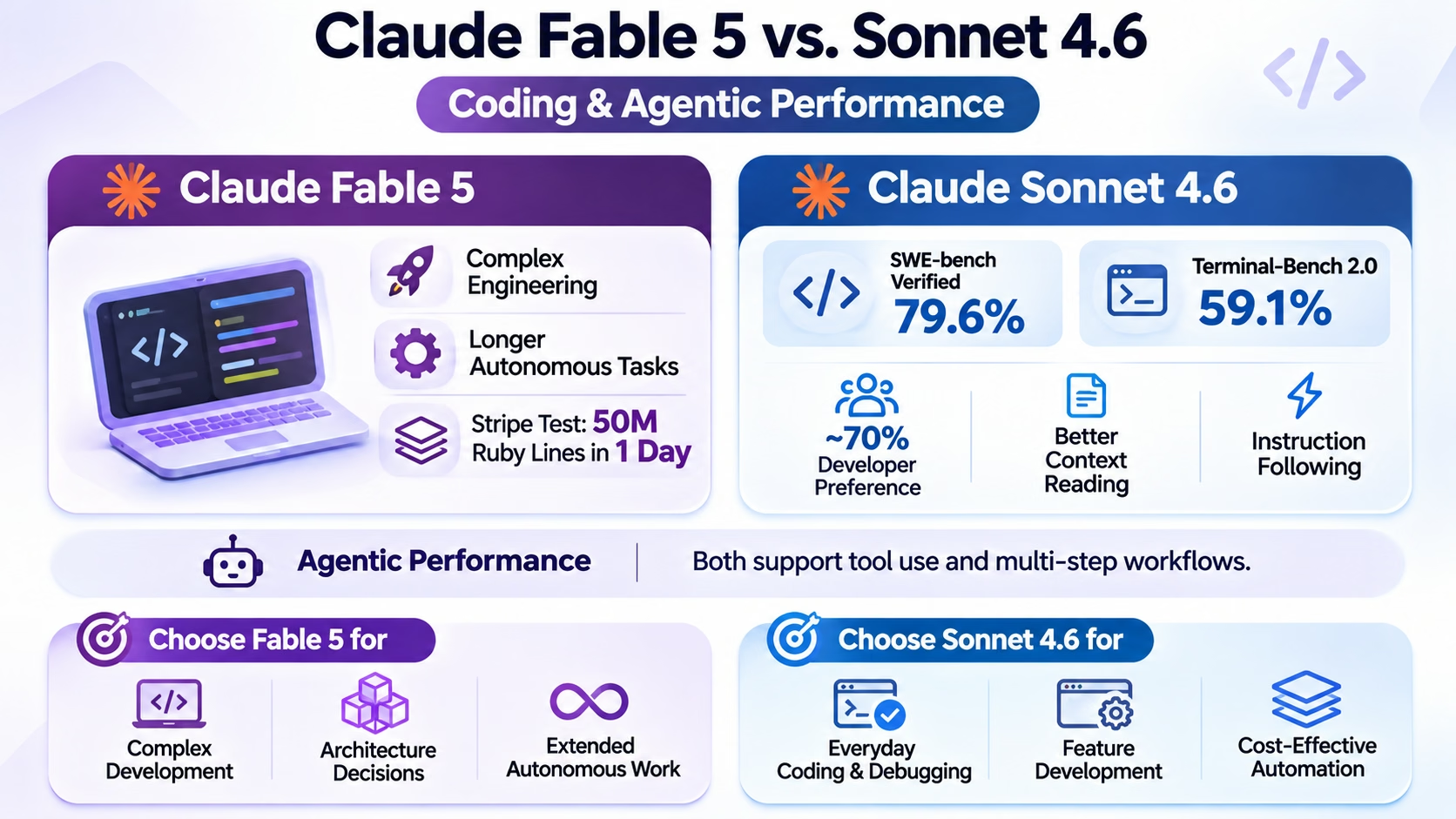
Fable 5 is designed for demanding software engineering work. Anthropic highlights its ability to work autonomously for longer and handle complex engineering tasks. Its launch announcement includes an example from Stripe: during early testing, Fable 5 worked on a migration across a 50-million-line Ruby codebase in a day. Stripe reported that the work would otherwise have taken a team more than two months to complete manually.
Anthropic also reports that Fable 5 performed strongly on Cognition’s FrontierCode evaluation, which tests difficult coding tasks against production-code quality standards. The company says Fable 5 scored highest among frontier models, even at medium effort. These are vendor- and partner-reported examples, not a guarantee of similar results across every codebase or development environment.
There is another great coding model in Sonnet 4.6. Anthropic’s system card states 79.6% on SWE-bench Verified and 59.1% on Terminal-Bench 2.0. SWE-bench is an evaluation of real-life software engineering and Terminal-Bench 2.0 is command-line tasks.
Developers in the early tests of Claude Code by Anthropic liked Sonnet 4.6 over Sonnet 4.5 in about 70% of cases. Developers were most impressed with context reading in code editing, consolidation of common logic, and instruction following during long sessions. It is Anthropic's reported preference testing with early access and is neither an independent benchmark nor a Fable 5 comparison.
It does not mean, thus, that Sonnet 4.6 cannot handle heavy work. The point here is that Fable 5 is designed for tough situations where prolonged reasoning and solving of hard problems would be useful.
In the case of regular coding, debugging, code reviewing and feature development, Sonnet 4.6 might prove a reasonable choice. However, in situations requiring difficult architecture decisions or migrations or autonomous development, Fable 5 should be considered.
Vendor scores like Sonnet 4.6's 79.6% on SWE-bench Verified won't tell you how either model handles your repo. Build an AI coding agent around your own tests with a coding agent builder.
Agentic performance follows a similar pattern. Anthropic describes Fable 5 as capable of working autonomously for longer than previous Claude models. Sonnet 4.6 also supports tool use and multi-step workflows, making it useful for automation, research, and software development.
If you are planning to develop your own automated workflows, our guide on how to build AI agents from scratch explains the main components involved.
Speed, Latency, and Token Use
Speed is not determined by model tier alone. It depends on reasoning effort, fallback behavior, output length, infrastructure, and the number of tool calls required to complete a task.
Artificial Analysis’s Max-versus-Max comparison reports the following:
Fable 5 leads on both measured speed metrics in this configuration. It generates output faster once generation begins and also starts responding sooner than Sonnet 4.6.
This is an important correction to the assumption that a higher-capability model must always take longer to respond. In this specific Max-effort comparison, Fable 5 is faster on both output throughput and first-token latency.
However, the result changes when reasoning configurations change. In Artificial Analysis’s comparison of Fable 5 at Max effort with Sonnet 4.6 in a non-reasoning, Low-effort configuration, Sonnet has substantially lower first-answer latency. That makes Sonnet a practical option for short, straightforward interactions that do not need extended reasoning.
Consequently, neither model should be labelled universally faster. The correct interpretation is that Fable 5 is faster in the Max-versus-Max comparison, while Sonnet 4.6 can respond much sooner in a lower-effort, non-reasoning configuration.
Token consumption is another important consideration. A model that uses more reasoning tokens or tool calls can cost more even when its headline input and output prices remain unchanged.
For a practical application, teams should measure:
- Time to first response.
- Total time to complete a task.
- Input and output tokens consumed.
- Number of retries or correction requests.
- Tool calls and external service costs.
- Cost per successfully completed task.
These measurements provide a more useful basis for choosing between Fable 5 and Sonnet 4.6 than a general claim that one model is faster.
When to Choose Fable and When to Choose Sonnet
The right model depends on the value and complexity of the work.
Choose Claude Fable 5 if:
- Your work involves complex technical problems.
- You need stronger reasoning for high-value tasks.
- You are building agents that must complete extended workflows.
- You work with unfamiliar codebases or demanding software engineering requirements.
- The cost premium is justified by better task completion or fewer retries.
Choose Claude Sonnet 4.6 if:
- You need a capable model for everyday development.
- Your application processes a high volume of requests.
- You want strong coding and computer-use performance at a lower price.
- You are building internal automation or productivity tools.
- Your tasks do not consistently require frontier-level reasoning.
You can also use a model-routing strategy instead of committing to one model. Let Sonnet 4.6 handle routine requests and escalate difficult tasks to Fable 5. This approach can help balance performance and API expenditure.
For teams developing internal applications, an AI app builder can help turn a product idea into a working application. If your project involves reporting or operational visibility, an AI dashboard builder can also help create dashboards for tracking workflows and business data.
Conclusion
Claude Fable 5 and Sonnet 4.6 are both different when it comes to the value proposition. Fable 5 is designed for more difficult and technically demanding tasks that require better reasoning and problem-solving abilities. Sonnet 4.6 provides superior coding, computing, and agency skills at about one-third of the price of API tokens of Fable 5.
The speed analysis brings yet another important difference. According to Artificial Analysis' Max-effort comparison, Fable 5 excels when it comes to Intelligence Index, throughputs, and first token time. Sonnet 4.6 outperforms Claude in latency only in Low-effort configuration, not Max-versus-Max scenario.
While for those working on engineering projects or conducting research, Fable 5 might be worth it due to its extra features, in other cases Sonnet 4.6 is cheaper and more cost-effective.
You do not necessarily need to choose only one. A hybrid approach can use Sonnet 4.6 for routine work and reserve Fable 5 for tasks that genuinely need additional reasoning power.
If neither fits, our Claude Fable 5 alternatives guide covers other models worth testing.
If you have an application idea but do not want to build every component manually, Emergent can help turn natural-language prompts into functional web and mobile applications using AI agents. Describe your idea, let the agents build the application, and refine it into a working product.

Describe it. Build it. Launch it.
- End-to-End Creation
- No Code Needed
- Live in Minutes

Most AI app builders stop at prototypes. Emergent creates production-ready apps you can actually launch.
- Production-ready apps
- Web & mobile apps
- Deploy in minutes