TL;DR
Custom apps for business are software tools built around your exact workflow. Off-the-shelf software is built for a broad market, so you get a faster launch but less control.
Use custom apps when your workflow is specific, manual work is costing hours every week, or generic tools keep forcing awkward workarounds. Use off-the-shelf software when speed, low setup, and a proven standard process matter more than ownership.
A spreadsheet starts as a shortcut. Then one person owns the “real” version, approvals move through email, customer updates live in three tools, and the business starts running on memory.
That’s usually the moment custom apps for business start making sense. After scoping custom app ideas for small teams, the pattern is consistent: the best builds solve one expensive workflow, not an entire company at once.
I’d build custom when the process gives you an advantage, such as a contractor’s job-tracking flow, a consultant’s client intake system, or a real estate team’s lead qualification app. I’d buy off-the-shelf software when the problem is already solved well, such as email, payroll, simple accounting, or basic scheduling.
What Are Custom Apps for Business?
Custom apps for business are software applications built for a company’s specific process, users, data, and rules. They can support internal teams, customers, partners, vendors, franchisees, or field crews.
Apple uses a narrower version of the term for its ecosystem: Custom Apps are apps built for an organization’s specific business needs, developed internally or by an external developer, and distributed privately through Apple Business after App Store Connect submission and approval.
Outside Apple, the idea is broader. A custom business app can be a client portal, approval tracker, invoice generator, inventory dashboard, field-service app, booking tool, or lead-routing system. A custom app earns its place by handling work your business already does, with fewer gaps.
A Texas roofing contractor is a good example. Off-the-shelf project management software can track tasks. But it probably won’t match how that contractor moves from storm-damage lead, to inspection, to insurance paperwork, to crew scheduling, to material order, to final invoice. A small custom app can make that exact flow visible from the office and the field.
Also read our guide on business app development to understand what it takes to go from a business process to a working custom app.
What Is Off-the-Shelf Business Software?
Off-the-shelf business software is a ready-made app built for a common business problem. You sign up, configure it, train the team, and use the vendor’s product as designed.
That works well when your process is standard. Most businesses shouldn’t build their own email platform, payroll system, tax software, password manager, or simple calendar app. Those categories are mature. The risk of building from scratch is higher than the benefit.
The pain starts when the tool is almost right. “Almost” means your team adds spreadsheets, side notes, manual exports, Zapier patches, duplicate fields, and Slack messages to cover the last 20% of the workflow. That last 20% is where off-the-shelf software gets expensive in a quiet way.
Custom Apps for Business vs Off-the-Shelf Software: At a Glance
Here’s how the two compare side by side:
| Aspect | Custom Apps for Business | Off-the-Shelf Software |
|---|---|---|
| Best For | Specific workflows | Common workflows |
| Launch Speed | Slower unless using AI app builders | Fastest |
| Workflow Fit | Built around your process | Your process adapts |
| Ownership | More control over roadmap | Vendor controls roadmap |
| Pricing Shape | Build, hosting, upkeep | Monthly or annual licenses |
| Maintenance | Your responsibility | Vendor handles core product |
| Best Example | Custom client portal | Standard CRM |
| Main Risk | Poor scoping and upkeep | Workarounds and lock-in |
Custom Apps for Business vs Off-the-Shelf Software: Key Differences
Workflow Fit
Custom apps win when your workflow is the product. If your intake process, approval chain, pricing logic, field workflow, or customer handoff is part of how you compete, don’t bury it inside a generic tool.
Off-the-shelf software wins when the workflow is ordinary. A basic customer relationship management (CRM) setup, shared calendar, or accounting flow doesn’t need a custom build unless your process has a real edge.
Here’s my rule: build the part that makes your business different. Buy the part that every business needs.
Speed to Launch
Off-the-shelf software wins on day one. You can usually start the same day, import data, invite your team, and use the default workflow.
Custom apps used to mean weeks or months before anyone clicked a working screen. That’s changing because artificial intelligence (AI) app builders can turn written instructions into working software faster than a traditional build path.
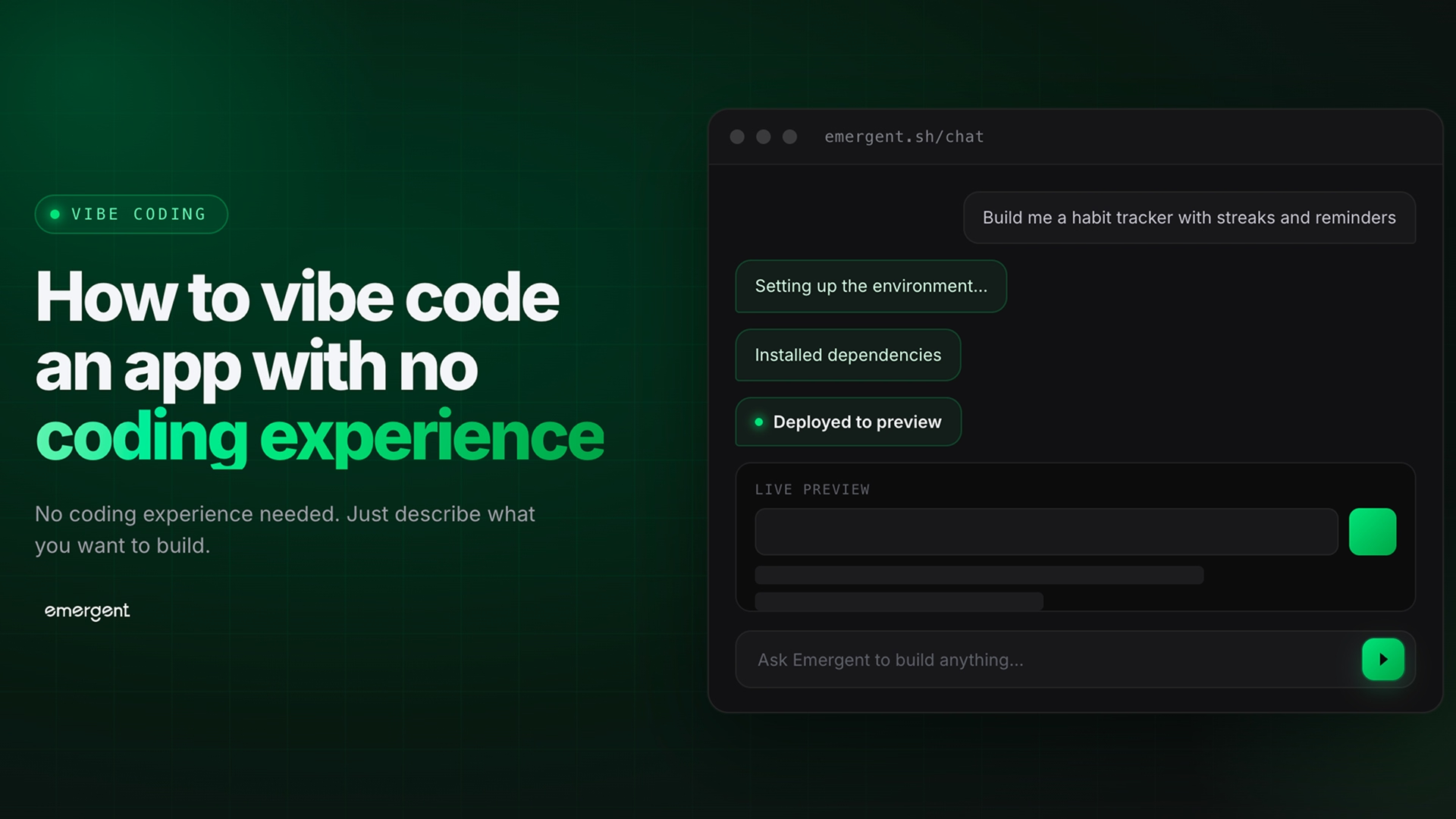
Emergent, for example, lets you describe a web or mobile app in plain language, then generate screens, data structure, login flows, payments, workflows, and integrations through prompts.
That doesn’t remove the need for testing. A fast first version still needs real users, messy data, permission checks, and someone responsible for upkeep.
Also read our guide on how to create a business app in an afternoon to see how fast the build actually takes with an AI app builder.
Cost Structure
Off-the-shelf software looks cheaper at the start because the vendor spreads development cost across thousands of customers. You pay monthly or annually, often per user.
Custom apps cost more when you build them through a dev shop. Pell Software, for example, prices custom business apps based on project scope, complexity, and technologies, with custom quotes instead of fixed public packages.
Custom dev-shop builds usually run in phases: discovery, design, development and testing, then ongoing support. Pell Software uses custom quotes based on scope, with time-and-materials and fixed-cost project options.
AI app builders change the early cost math. Emergent starts free, and its paid tiers cost a fraction of a hand-coded build (full breakdown below).
The honest cost question is which option costs less after six months of real use, not which one is cheaper on day one.
Ownership and Control
Custom apps give you more control over the workflow, roadmap, integrations, data model, and user experience. That matters when your team has a process the market doesn’t understand.
Pell Software leans hard into this ownership angle: custom apps can eliminate recurring licensing fees, give you control over features and roadmap, and let you own your intellectual property.
Off-the-shelf software gives you less control, but you gain a vendor that handles product updates, hosting, security patches, documentation, and broad support. That trade is worth it for standard systems.
Security, Review, and Distribution
Custom apps need serious access planning. Access planning matters most when your app talks to other systems. If it connects to customer relationship management (CRM) tools, payment tools, calendars, databases, or internal software through application programming interfaces (APIs), decide who can see what before you build.
Apple Custom Apps add another layer. Each Custom App and updated version goes through Apple’s App Review process, which Apple says typically takes 1-2 days.
If the app contains sensitive business data, Apple recommends in-app authentication and encryption, and the review team needs generic test accounts or sanitized sample data to inspect the app safely.
Apple’s private distribution route works well when your business runs on iPhone, iPad, or Mac and needs private app access through Apple Business. Apple Custom Apps can be assigned to specific organizations and distributed through mobile device management (MDM) or redemption codes.
MDM is the system IT teams use to manage devices, apps, and access policies.
Maintenance
Maintenance is where custom apps either become an asset or a future mess. Someone needs to own bug reports, access changes, vendor updates, backups, payment issues, and new feature requests.
Off-the-shelf software reduces that burden because the vendor owns the core product. You still manage configuration, users, and training, but you’re not responsible for the product roadmap.
Custom apps need an owner from day one. Not “the person who asked for the app.” A real owner who checks whether the app still matches the business six months later.
When to Build Custom Apps for Business vs Buy Software
Use custom apps for business when:
- Your workflow is specific enough that generic software creates extra work.
- You’re paying for licenses but still running the real process in spreadsheets.
- Your customer experience depends on a unique portal, intake flow, quote builder, or approval path.
- You need private internal distribution, especially through Apple Business for Apple-only teams.
- You want more control over your roadmap, data, and integrations.
- You can assign someone to own the app after launch.
Use off-the-shelf software when:
- The workflow is common and already solved.
- You need the tool live today.
- Your team doesn’t have time to test and manage a custom system.
- Compliance, support, and vendor reliability matter more than custom workflow fit.
- You’d only rebuild features that already exist elsewhere.
My take: Don’t custom-build the boring layer. Custom-build the bottleneck.
How to Build Custom Apps for Business in 2026
Start With One Painful Workflow
A good custom app starts with one broken workflow, not a giant feature list.
Write down:
- Who starts the process
- What data they enter
- Who approves it
- What happens next
- Which tools it touches
- Where work gets delayed
- What a successful outcome looks like
For example, a Brooklyn real estate team might start with lead qualification. The app could collect buyer details, score urgency, assign an agent, trigger a follow-up, and show every lead’s status in one dashboard.
That’s a better first app than “build our whole real estate operating system.”
Choose the Right Build Route
You have four practical routes:
| Route | Best For | Watch-Out |
|---|---|---|
| Off-the-shelf software | Standard processes | Workflow compromise |
| Low-code platform | Internal tools with business logic | Platform limits |
| AI app builder | Fast custom web and mobile apps | Needs careful testing |
| Dev shop | Complex, high-stakes systems | Higher cost and longer timeline |
Kissflow positions its custom app path around in-house development, outsourced teams, and no-code or low-code solutions. Its page highlights no-code process creation, page building, role-based access, and fast deployment for custom business apps.
Emergent fits the AI app builder route by supporting web apps, mobile apps, dashboards, payments, login flows, workflows, and third-party integrations through prompts and API keys.
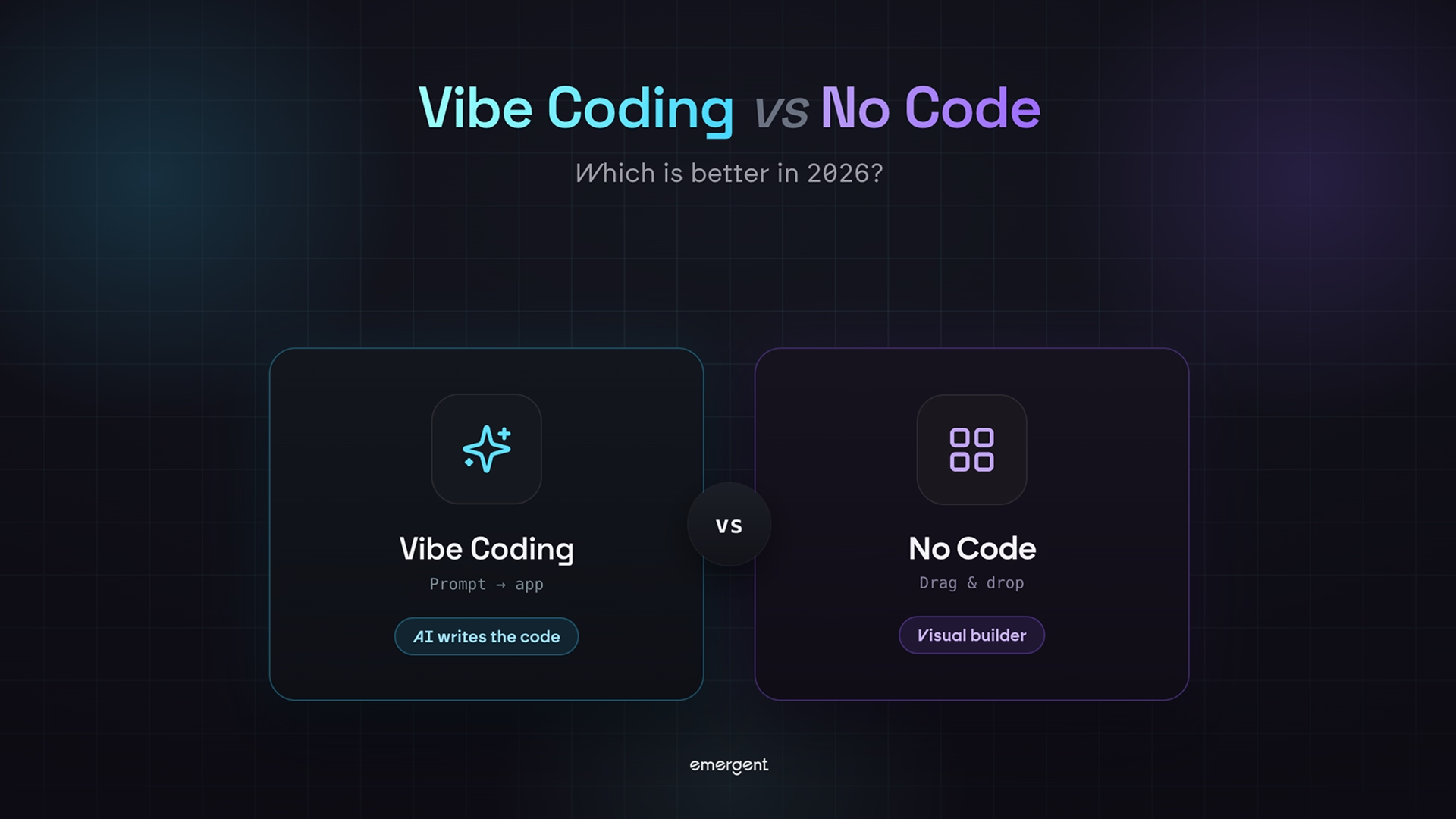
Also read our guide on Vibe Coding vs No Code to understand which build route fits your workflow before you commit to one.
Use a Specific First Prompt
A vague prompt builds a vague app. Start with the workflow, user roles, data, and outcome.
Use this prompt:
Build a custom business app for a 12-person roofing company in Texas. The app should track storm-damage leads from first call to final invoice. It needs roles for admin, sales rep, field inspector, crew leads, and customer. Include a lead intake form, inspection checklist, photo upload, estimate status, insurance paperwork tracker, job schedule, crew notes, invoice summary, and customer portal. Start with a simple dashboard showing active leads, jobs waiting on insurance, jobs scheduled this week, and unpaid invoices.
That prompt gives the builder a real business, user roles, workflow stages, and screens. You can cut features later, but you’re starting with the shape of the business instead of a generic “job tracker.”
Define Access Before Design
Access rules decide whether the app is usable.
For the roofing app:
- Admins can see every job and invoice.
- Sales reps can see their leads and estimates.
- Field inspectors can see assigned inspections and upload photos.
- Crew leads can see scheduled jobs and job notes.
- Customers can see their own project status and invoices.
Skipping this step creates expensive rebuilds. Permissions touch every screen, every database record, and every notification.
Test With Real Users Before Rollout
Test the app with the people who will use it under normal work conditions. A founder clicking through clean sample data won’t catch the same problems as a field rep using a phone with spotty service.
Run at least three checks:
- Can a new user complete the workflow without help?
- Does the app handle messy data, missing fields, and duplicate records?
- Does each role see only what it should see?
For Apple Custom Apps, add another check: the review team needs working test access or sanitized sample data if the app contains sensitive business information.
Deploy Slowly
Roll out custom apps in stages.
Start with one team, one client group, or one location. Watch what breaks. Fix the issue. Then expand.
Apple Custom Apps become visible to the assigned organization in Apple Business after approval, where only that organization can view and access the app from Apps and Books.
Emergent supports prompt-based app building, deployment, payments, user login, and web or mobile app output, which makes it a practical route for founders and small businesses that want to validate a custom workflow before hiring a full engineering team.
Also read our guide on how to build your own CRM with AI to see how a staged custom build works in practice.
Pricing for Custom App Options
Emergent Pricing
Emergent has five plans: Free at $0/month, Standard at $20/month ($17/month billed annually), Pro at $200/month ($167/month billed annually), and custom Business and Enterprise plans.
Standard includes 100 monthly credits, private project hosting, GitHub integration, and fork tasks; Pro includes 750 monthly credits, a 1M context window, Maxx (deeper-reasoning) mode, system prompt editing, custom AI agents, and priority support.
Apple Custom App Distribution Pricing
Apple Developer Program enrollment costs $99/year, with no monthly billing published. A free Apple Account includes Xcode developer tools and on-device testing.
The paid Apple Developer Program includes app distribution, App Store Connect app management, analytics, custom app distribution with Apple Business and Apple School Manager, and proprietary app distribution to employees through Apple Business.
Kissflow Pricing
Kissflow uses enterprise pricing built around fixed annual agreements, with consultation-based pricing rather than public monthly packages.
Kissflow’s pricing page includes unlimited applications, unlimited integrations, public and private cloud hosting, dashboards, workflows, reports, analytics, enterprise governance and security, 25+ AI-powered automation features, no AI or API usage surcharges, and additional services as required.
Pell Software Pricing
Pell Software uses custom quotes based on project scope, complexity, and technologies. Its pricing page supports time-and-materials work with full-visibility pricing, detailed hourly reports, and fixed-cost projects for a single agreed price.
Also read our guide on how much it costs to create an app to understand what each build route actually costs before you commit.
Common Custom App Use Cases for Business
Client Intake Apps
Client intake apps collect requests, files, approvals, and next steps in one flow. Consulting firms, law offices, agencies, clinics, and accountants all run into the same problem: the first customer handoff happens across email, forms, shared drives, and calendar links.
A custom intake app gives each client one path and gives your team one source of truth.
Field Service Apps
Field service apps help contractors, cleaners, installers, inspectors, and repair teams manage work outside the office.
Useful features include:
- Job assignments
- Site photos
- Checklists
- Customer signatures
- Parts or materials used
- Invoice status
- Crew notes
This is a strong custom-app use case because field workflows rarely match generic project management tools.
Internal Approval Apps
Approval apps help teams move requests through finance, operations, HR, procurement, or management.
Build this when approvals get lost in email or when nobody can answer, “Who has this right now?”
Customer Portals
Customer portals give clients a private place to view project status, invoices, documents, messages, and next steps.
This works well when customers keep asking your team for updates that software could show automatically.
Custom CRM Apps
A custom CRM makes sense when your sales process doesn’t match a standard pipeline. If your business sells through referrals, inspections, site visits, estimates, renewals, or partner handoffs, a generic CRM can force too much cleanup.
Don’t rebuild Salesforce for pride. Build the narrow CRM your sales team will actually use.
Also read our guide on how to build a scheduling app with AI to see how one common custom app use case comes together in practice.
What to Avoid When Building Custom Apps for Business
Don’t Build the Whole Company in Version One
The first version should solve one painful workflow. If you try to build the CRM, invoicing system, project tracker, client portal, inventory tool, and analytics dashboard together, you’ll bury the app under its own ambition.
Start with the workflow that saves the most time or prevents the most errors.
Don’t Skip Real Data
Clean demo data lies. Real data has duplicate names, missing phone numbers, old customers, weird addresses, and notes nobody should have typed into a notes field.
Test with real data before launch.
Don’t Ignore Ongoing Ownership
A custom app without an owner gets stale fast. Assign one person to manage feedback, bugs, permissions, and feature requests.
That person doesn’t need to be an engineer. They need to understand the workflow and have authority to say no.
Don’t Use Custom Apps to Avoid Process Decisions
A custom app won’t fix a process nobody agrees on. Decide the workflow first. Then build.
How Emergent Fits Into Custom Apps for Business
Emergent fits when you want to turn a specific workflow into a working web or mobile app without starting with a traditional engineering team. You describe the app in plain language, then build screens, data, workflows, authentication, integrations, payments, and deployment from prompts.
This makes the most sense for founders, consultants, agencies, operators, and small businesses that know their process better than any vendor does. You can start with a focused internal app, test it with real users, and expand only after the workflow proves useful.
A strong first Emergent project is small and specific, like:
- A proposal generator for a consulting firm
- A lead tracker for a real estate team
- A job-status portal for a contractor
- A client reporting dashboard for an agency
- A booking and payment flow for a local service business
Use Emergent when you want speed plus ownership. Use a dev shop when the app is complex, heavily regulated, or mission-critical from day one. Use off-the-shelf software when the problem is already solved.
Conclusion: Build Where the Workflow Breaks
Custom apps for business are worth building when the workflow is specific, valuable, and painful enough that generic software keeps adding work. Off-the-shelf software is still the better call for standard processes that already have reliable tools.
My recommendation is simple: buy the commodity layer, build the workflow layer.
Start small. Pick one process your team complains about every week. Scope the users, data, permissions, and outcome. Then build the smallest custom app that removes the bottleneck.
Start with the workflow that costs you the most time, then use Emergent to build the first version faster.
Try Emergent to build your custom business app.
Most builders stop at a prototype. Emergent ships real web and mobile apps, with accounts, databases, and payments included.
- Production-ready apps
- Web & mobile apps
- Deploy in minutes