Choosing between DeepSeek and Google Gemini involves more than comparing benchmark scores. Factors such as model capabilities, accessibility, ecosystem preferences, pricing, and overall performance also influence which AI model best suits a particular use case.
DeepSeek V4.1 Flash focuses on affordability, fast responses, and open-weight deployment. Gemini 4 Argon, meanwhile, targets more demanding tasks, including complex coding, scientific reasoning, and multi-step automation.
For businesses building AI-powered applications, the better choice depends on whether stronger capabilities justify higher operating costs.
This DeepSeek vs. Gemini comparison examines independent benchmarks, API pricing, response speed, coding performance, and deployment options to help you identify which model delivers better value for your requirements.
DeepSeek vs. Gemini at a Glance
DeepSeek V4.1 Flash and Gemini 4 Argon serve different priorities. DeepSeek offers lower API costs, faster token generation, and open weights, while Gemini delivers stronger overall reasoning and automation performance.
The comparison below uses DeepSeek V4.1 Flash 1017 (Max) and Gemini 4 Argon (High), based on Artificial Analysis data.
DeepSeek V4.1 Flash 1017 (Max) vs. Gemini 4 Argon (High): Model specifications, intelligence scores, and API pricing as of November 13, 2026. Sources: Artificial Analysis, DeepSeek, and Google. Gemini's introductory API pricing applies through November 30, 2026.
Gemini leads in overall intelligence, but DeepSeek offers substantially lower operating costs and greater deployment flexibility. The right choice depends on whether your application prioritizes advanced capabilities or cost efficiency.
What Are DeepSeek and Gemini? Learn what they offer
DeepSeek and Google Gemini are AI model families used for reasoning, coding, content generation, and application development. However, they differ in their model offerings, deployment options, and surrounding ecosystems.
DeepSeek offers AI models through its consumer application and developer API. Its V4.1 Flash model supports text and image inputs, coding, and agentic workflows. DeepSeek also releases model weights under the MIT license, allowing organizations to deploy and customize models on their own infrastructure.
Google Gemini is Google's AI model family, available through the Gemini app, Gemini API, Google AI Studio, and Vertex AI. Its ecosystem supports multimodal AI applications, enterprise workflows, and integration with Google's development tools. Google also offers Gemma, a separate family of open-weight models.
The two ecosystems serve different requirements:
DeepSeek and Google AI model families by positioning and deployment options, as of November 2026. Sources: DeepSeek API documentation and Google model documentation.
This article focuses on DeepSeek V4.1 Flash 1017 and Gemini 4 Argon because they offer a practical comparison of cost efficiency against advanced capabilities. Gemini 4 Carbon represents a higher-performance alternative but is not the default model in this comparison.
DeepSeek V4.1 Flash vs. Gemini 4 Argon: Key Differences
DeepSeek V4.1 Flash 1017 (Max) and Gemini 4 Argon (High) represent different approaches to AI performance. DeepSeek emphasizes computational efficiency and deployment flexibility, while Gemini focuses on advanced reasoning and complex workflows.
1. Architecture and Model Size
DeepSeek V4.1 Flash uses a Mixture-of-Experts (MoE) architecture with 552 billion total parameters. It activates approximately 8 billion parameters during input processing and 16 billion during output generation, helping reduce computational requirements.
Google has not publicly disclosed comparable parameter counts for Gemini 4 Argon. Therefore, a direct comparison based on model size is not possible.
2. Reasoning Modes and Effort Settings
Both models support configurations designed for more demanding reasoning tasks. DeepSeek offers adjustable reasoning effort, while Gemini provides different reasoning settings for balancing performance and computational requirements.
This article compares DeepSeek V4.1 Flash 1017 (Max) with Gemini 4 Argon (High), using the respective configurations evaluated by Artificial Analysis. These settings do not necessarily represent equivalent reasoning budgets.
3. Context Window and Multimodal Capabilities
Both models offer context windows of approximately one million tokens, allowing them to process extensive documents, codebases, and conversations.
DeepSeek V4.1 Flash supports text and image inputs and generates text responses. Gemini 4 Argon also supports multimodal processing, although available input types can depend on the platform and API configuration.
4. Model Weights and Licensing
DeepSeek V4.1 Flash 1017 is available with open weights under the MIT license. Organizations can download, customize, and self-host the model, subject to infrastructure requirements.
Gemini 4 Argon is a proprietary model accessed through Google's services. Organizations seeking an open-weight alternative within Google's ecosystem can consider the separate Gemma model family.
DeepSeek vs. Gemini Benchmarks
Independent benchmarks help assess how DeepSeek V4.1 Flash and Gemini 4 Argon perform across reasoning, coding, automation, and scientific tasks.
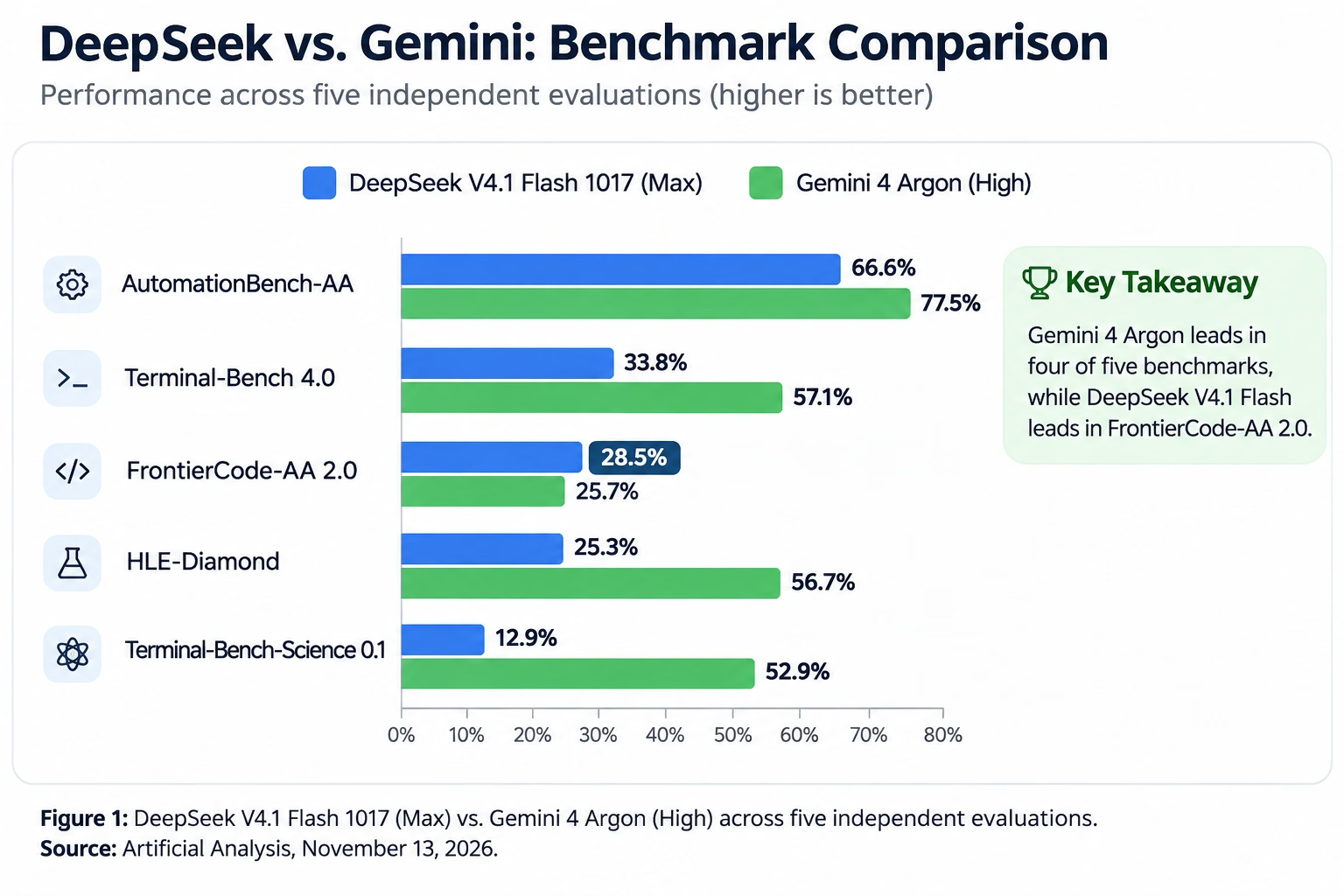
The following comparison uses DeepSeek V4.1 Flash 1017 (Max) and Gemini 4 Argon (High), as evaluated by Artificial Analysis.
DeepSeek V4.1 Flash 1017 (Max) vs. Gemini 4 Argon (High) benchmark results. Source: Artificial Analysis Intelligence Index v5.0.1, accessed November 13, 2026. Higher scores indicate better performance.
What Do These Benchmark Results Mean?
Gemini 4 Argon leads in four of the five individual benchmarks shown, alongside a higher overall Intelligence Index score of 50 against DeepSeek's 33. DeepSeek V4.1 Flash leads in FrontierCode-AA 2.0.
The individual evaluations highlight different strengths:
- AutomationBench-AA measures performance on automation tasks. Gemini's lead suggests stronger capabilities for agentic workflows.
- Terminal-Bench 4.0 evaluates terminal-based coding tasks. Gemini scores 57.1%, compared with DeepSeek's 33.8%.
- FrontierCode-AA 2.0 assesses coding changes in real software repositories. DeepSeek leads narrowly at 28.5% against Gemini's 25.7%.
- HLE-Diamond tests challenging knowledge and reasoning questions, where Gemini holds a substantial advantage.
- Terminal-Bench-Science evaluates scientific research workflows performed through a terminal. Gemini leads by 40 percentage points.
These results suggest that Gemini is better suited to demanding reasoning, automation, and scientific workloads. However, DeepSeek's FrontierCode result demonstrates that Gemini does not lead across every coding evaluation.
Benchmarks should also be considered alongside pricing, response speed, and actual application requirements. A higher intelligence score does not automatically make a model the most economical choice for every task.
For Argon's wider score set, see our Gemini 4 Argon benchmarks guide.
DeepSeek vs. Gemini for Coding
DeepSeek V4.1 Flash and Gemini 4 Argon can assist with code generation, debugging, and software development. However, their independent benchmark results indicate different strengths across coding tasks.
The coding benchmarks reveal different strengths. Gemini 4 Argon performs better on terminal-based development tasks, while DeepSeek V4.1 Flash leads in the evaluated repository-level coding tasks. This suggests that developers should assess model performance against their specific workflows rather than relying on a single benchmark.
Developer Tools and Agentic Coding
DeepSeek provides API access and downloadable model weights, giving developers flexibility to integrate its models into coding workflows or deploy them on their own infrastructure.
Google offers Gemini through its API and development ecosystem, including Google AI Studio and Gemini Code Assist. These tools support developers working on code generation, debugging, and application development.
The choice depends on the workflow. Teams prioritizing model customization and deployment control may prefer DeepSeek, while those already using Google's development ecosystem may find Gemini more convenient.
Neither ecosystem fits every repo. Argon leads Terminal-Bench by 23 points and DeepSeek leads FrontierCode by under 3, so the split depends on your tasks. Build an AI coding agent around your own tests with a coding agent builder.
DeepSeek vs. Gemini Pricing, Speed, and Access
DeepSeek V4.1 Flash is substantially cheaper than Gemini 4 Argon, making it attractive for applications that process large volumes of requests. However, pricing alone does not determine value. Response speed, reasoning efficiency, and the cost of completing a task also matter.
API Pricing Comparison
DeepSeek V4.1 Flash 1017 (Max) vs. Gemini 4 Argon (High): API pricing and benchmark evaluation costs. Source: Artificial Analysis, accessed November 13, 2026. Prices are in USD; Gemini's introductory pricing is subject to change after November 30, 2026.
At current introductory rates, Gemini 4 Argon's input tokens cost approximately 6.7 times more than DeepSeek V4.1 Flash's, while output tokens cost 8.3 times more. Artificial Analysis reports a blended price of $1.47 per million tokens for Gemini, compared with $0.18 for DeepSeek, using its standardized pricing methodology, which accounts for cached tokens.
Its benchmark cost per task is also higher at $4.97 against $0.60. These figures favor DeepSeek for cost-sensitive workloads, although actual production costs depend on token consumption, caching, and task complexity. Argon's introductory rates end November 30, so our Gemini 4 Argon pricing guide shows what changes in December.
Response Speed and Latency
Artificial Analysis reports the following performance:
DeepSeek V4.1 Flash 1017 (Max) vs. Gemini 4 Argon (High): Output speed, response latency, and task completion time. Source: Artificial Analysis, accessed November 13, 2026. Performance figures may change with subsequent evaluations.
DeepSeek V4.1 Flash generates approximately 2.4 times as many output tokens per second as Gemini 4 Argon (156 vs. 65 tokens/s). It also records a shorter average end-to-end response time of 90.31 seconds, compared with Gemini's 117.74 seconds. However, Gemini delivers its first answer token slightly sooner (40.73 vs. 43.73 seconds). These results suggest that DeepSeek offers faster overall responses, although actual latency depends on workload complexity and deployment conditions.
Availability and Access
DeepSeek is accessible through its chat application, API, and downloadable model weights. Gemini 4 Argon is available through Google's paid API and supported development platforms, including Google AI Studio and Vertex AI.
For cost-sensitive production workloads, DeepSeek offers a clear pricing advantage. Gemini may justify its higher cost when stronger reasoning and automation capabilities improve task completion.
Open Weights, Privacy, and Data Residency
The differences between DeepSeek and Gemini extend beyond performance and pricing. Model licensing, deployment control, and data-handling policies also influence their suitability for business applications.
Open Weights and Deployment Flexibility
DeepSeek V4.1 Flash 1017 is available under the MIT license, allowing organizations to download, modify, and self-host its model weights. This provides greater control over infrastructure and model customization, although operating such a large model requires substantial computing resources.
Gemini 4 Argon is closed-weight and accessed through Google's services. Google offers Gemma as a separate open-weight model family, but Gemma is not a self-hosted version of Gemini 4 Argon.
Privacy and Data Residency
DeepSeek's privacy policy states that its hosted services collect user inputs and process and store personal data in China. Organizations with geographic data restrictions should assess these terms before submitting confidential information.
Under Google's paid Gemini API terms, prompts and responses are not used to improve its products. However, Google may retain data for abuse monitoring and other service-related purposes. Businesses should review the terms and retention settings applicable to their deployment.
Self-hosting DeepSeek can provide greater control over where information is processed and stored. However, data protection still depends on the organization's infrastructure, access controls, and security practices.
For businesses handling sensitive information, the decision should consider deployment arrangements, contractual protections, retention policies, and applicable regulatory requirements rather than model capabilities alone.
Which Should You Choose? DeepSeek or Gemini by Use Case
The better choice between DeepSeek and Gemini depends on the task, available budget, and deployment requirements. While Gemini 4 Argon performs better across most independent benchmarks, DeepSeek V4.1 Flash offers advantages in pricing, response speed, and deployment flexibility.
Recommended AI models and platforms by use case, based on benchmark performance, pricing, deployment options, and documented capabilities.
For complex development and automation tasks, Gemini 4 Argon offers stronger overall benchmark performance. DeepSeek V4.1 Flash is better suited to workloads where cost efficiency, faster output, or self-hosting matters most.
If neither fits, our DeepSeek alternatives and competitors and Gemini alternatives and competitors guides cover other models worth testing.
Conclusion: DeepSeek vs. Gemini: Which Offers Better Value?
DeepSeek and Gemini offer different advantages, making the better choice dependent on how the models will be used.
Gemini 4 Argon is worth considering for complex reasoning, coding, and automation tasks where stronger capabilities can justify higher costs. DeepSeek V4.1 Flash is more suitable for cost-sensitive applications, faster output generation, and organizations that prefer open-weight deployment.
For high-volume workloads, businesses should evaluate the cost of completing tasks rather than relying solely on token prices or benchmark rankings. Testing models against actual requirements can help identify the better long-term option.
Choosing an AI model is only one part of building an application. For businesses that want to turn ideas into working software without coding, Emergent is a vibe coding and app building platform that turns plain-language descriptions into working applications.
Start Building with Emergent.
Describe it. Build it. Launch it.
- End-to-End Creation
- No Code Needed
- Live in Minutes
Most AI app builders stop at prototypes. Emergent creates production-ready apps you can actually launch.
- Production-ready apps
- Web & mobile apps
- Deploy in minutes