TL;DR
- GPT-6.1 Terra Benchmark Highlights
- Computer use: GPT-6.1 Terra scores 15 percentage points higher than GPT-5.6 Terra on Agents’ Last Exam at medium reasoning effort, according to OpenAI.
- Coding: It achieves 50.3% on Terminal-Bench 4.0 at maximum reasoning effort, compared with GPT-5.6 Terra’s published 21.5%.
- Visual reasoning: GPT-6.1 Terra scores 85.5% on MMMU-Pro in BenchLM’s benchmark record, demonstrating strong multimodal performance.
- Factuality: OpenAI reports that its internal error rate on error-inducing prompts drops from 53.6% to 16.7% at low reasoning effort compared with GPT-5.6 Terra.
- API pricing: Standard pricing is $1 per million input tokens and $5 per million output tokens, with cached input tokens costing $0.05 per million.
- Best-fit use cases: Computer-use agents, document processing, visual analysis, routine coding, and high-volume business automation.
GPT-6.1 Terra is an AI technology released by OpenAI on October 26, 2026. This AI technology was created to enhance computer use, visual reasoning, programming, and professional tasks. It improves on GPT-5.6 Terra in several areas and comes at lower API costs than the previous model. Its benchmark results highlight stronger computer-use performance, improved coding capabilities, and better factual accuracy.
According to OpenAI, GPT-6.1 Terra scores 15 percentage points higher than GPT-5.6 Terra on Agents’ Last Exam at medium reasoning effort, while reducing the cost of completing these tasks. At maximum reasoning effort, it achieves a 50.3% score on Terminal-Bench 4.0, more than twice GPT-5.6 Terra’s previously published 21.5% score.
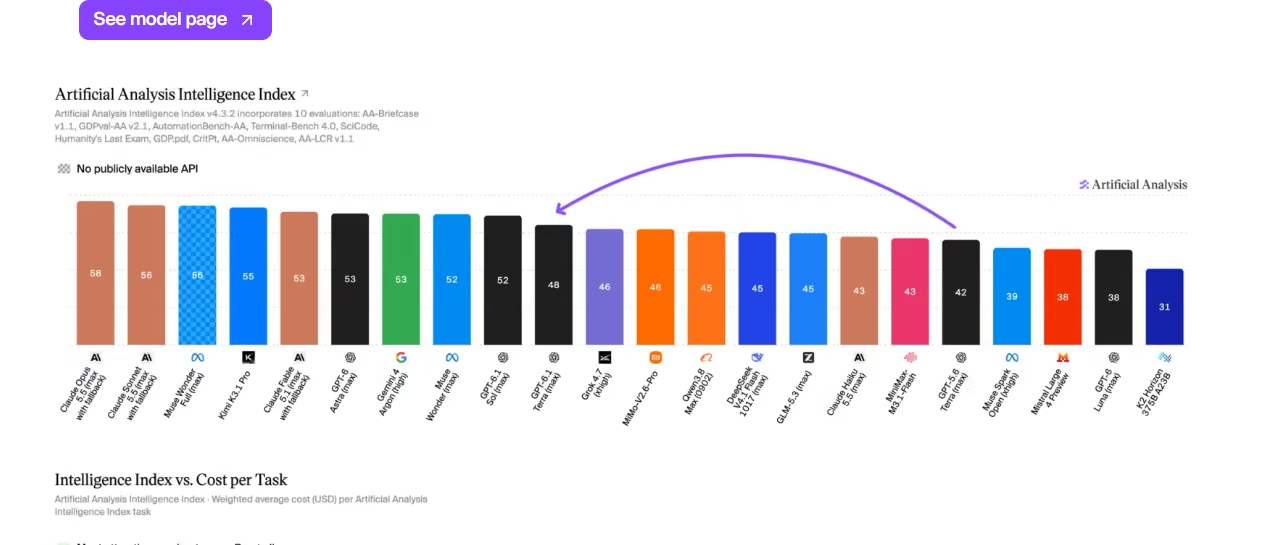
Independent evaluations provide additional context. Artificial Analysis assigns GPT-6.1 Terra an Intelligence Index score of 48, while BenchLM reports an overall decision score of 75.9 out of 100. These figures use different evaluation methodologies and should not be compared directly.
This guide examines the GPT-6.1 Terra benchmark scores, explains what each evaluation measures, and explores what the results mean for developers and businesses.
What Is GPT-6.1 Terra?
GPT-6.1 Terra is part of OpenAI’s GPT-6 model family. It combines visual understanding, computer interaction, coding, and natural-language communication in a model designed for practical work.
Unlike a model used primarily to answer questions, GPT-6.1 Terra is intended to support multi-step workflows and applications. Examples include interpreting a technical drawing, filling out a form, updating a business application, or analyzing an invoice before entering its details into accounting software.
OpenAI positions Terra around a balance of capability, speed, and cost. The model is available through ChatGPT Work and Codex for eligible Plus, Pro, Enterprise, and Edu users, as well as through the OpenAI API.
GPT-6.1 Terra Benchmark Scores at a Glance
The following table summarizes the main publicly reported results.
| Benchmark or metric | GPT-6.1 Terra result | What it measures |
|---|---|---|
| Agents’ Last Exam | 60.0% | Complex professional computer-use tasks |
| Terminal-Bench 4.0 | 50.3% | Coding and command-line problem-solving |
| Terminal-Bench-Science 0.1 | 58.3% | Scientific research workflows using code and terminal tools |
| OSWorld 2.1 offline subset | 74.2% | Desktop interaction across multistep tasks |
| MMMU-Pro | 85.5% | Multimodal understanding and visual reasoning |
| Artificial Analysis Intelligence Index | 48 | Performance across a collection of independent evaluations |
| BenchLM decision score | 75.9/100 | A separate composite assessment of model performance |
Source and methodology note: Benchmark results are drawn from OpenAI’s announcement and BenchLM’s model record. The first five scores are reported in BenchLM’s source-linked benchmark ledger. The Artificial Analysis and BenchLM composite scores use different methodologies from the task-specific benchmarks. These scores are not interchangeable, and the table should not be interpreted as a single unified leaderboard.
GPT-6.1 Terra Performance Across Key Benchmarks
1. Agents’ Last Exam: Computer-Use Performance
Agents’ Last Exam evaluates how well AI agents complete demanding professional tasks that require interpreting information and interacting with computer-based tools.
Examples include turning architectural drawings into a 3D model and reviewing an animated film shot by shot to produce a time-coded restoration log.
OpenAI reports that GPT-6.1 Terra scores 15 percentage points higher than GPT-5.6 Terra at medium reasoning effort, at approximately one-third of the cost. At maximum effort, GPT-6.1 Terra also demonstrates substantially better token efficiency than Claude Opus 5.5, according to OpenAI’s evaluation.
BenchLM records a 60.0% score for GPT-6.1 Terra on Agents’ Last Exam.
What this means for developers: These results support evaluating Terra for workflows that involve reading on-screen information, navigating applications, and executing a sequence of actions. However, benchmark performance does not guarantee that an agent will complete every business workflow reliably. Developers should test it against their own applications, permissions, and failure conditions.
2. Terminal-Bench 4.0: Coding and Command-Line Tasks
The Terminal-Bench 4.0 framework assesses agents using scenarios that require the use of command-line applications and programming. This includes debugging, code editing, and troubleshooting issues within the development environment.
OpenAI reports the following results at maximum reasoning effort:
| Model | Terminal-Bench 4.0 score |
|---|---|
| GPT-6.1 Terra | 50.3% |
| GPT-5.6 Terra | 21.5% |
GPT-6.1 Terra’s score is more than twice its predecessor’s published result. This is a substantial improvement on the reported evaluation, although the figures should be interpreted within the benchmark’s specific testing conditions.
The developers of OpenAI also point out that in the case of very complicated software-engineering work, GPT-6.1 Sol and GPT-6 Astra would be preferable over other available models.
GPT-6.1 Terra should be tested when you are performing regular debugging, terminal-based programming tasks, and tasks when the price of computing matters. In the case of more complicated architecture work or software-engineering problems, test GPT-6.1 Terra against more suitable models.
3. MMMU-Pro: Visual Reasoning and Multimodal Understanding
The MMMU-Pro test assesses the skill of answering difficult questions which need visual intelligence and knowledge spanning various fields of education.
The GPT-6.1 Terra model attains a result of 85.5% in the published record of BenchLM. It is also reported by OpenAI that the Terra model surpasses GPT-5.6 Terra in reasoning and performs similarly to GPT-6 Astra and GPT-6.1 Sol but at a lower price.
This is significant because when AI requires more interpretation than just simple text. This includes interpreting graphs, diagrams, documents, and screenshots.
4. OSWorld 2.1: Desktop and Application Interaction
OSWorld evaluates an AI agent’s ability to operate desktop environments and complete tasks involving multiple actions.
OpenAI describes GPT-6.1 Terra as surpassing GPT-5.6 Terra’s best score on OSWorld 2.1 at medium reasoning effort, at a fraction of the cost per task.
BenchLM records a 74.2% result on an offline subset of 82 OSWorld 2.1 tasks. This subset is tracked separately from the OSWorld 2.0 benchmark, so the score should not be presented as an equivalent result on OSWorld 2.0.
5. Terminal-Bench-Science 0.1: Scientific Research Workflows
Terminal-Bench-Science 0.1 evaluates AI agents on scientific tasks that involve using code and terminal tools. One example from OpenAI’s announcement involves tracking cell divisions in a time-lapse video.
GPT-6.1 Terra scores 58.3% in BenchLM’s benchmark record. OpenAI reports that, at maximum reasoning effort, the model surpasses GPT-6.1 Sol on this evaluation at a lower cost and comes within five percentage points of Claude Opus 5.5.
GPT-6.1 Terra vs. GPT-5.6 Terra: What Has Improved?
OpenAI’s release highlights three main areas of improvement: factuality, coding, and computer use.
| Area | Reported improvement | Practical significance |
|---|---|---|
| Computer use | 15-percentage-point improvement on Agents’ Last Exam at medium reasoning effort | Better performance on complex computer-based tasks |
| Coding | Terminal-Bench 4.0 score rises from 21.5% to 50.3% at maximum reasoning effort | Stronger performance on command-line development tasks |
| Factuality | Internal error rate falls from 53.6% to 16.7% at low reasoning effort | Fewer errors on the specific internal test set |
| API pricing | Standard prices are 50% lower than GPT-5.6 Terra | Lower listed token costs for comparable usage volumes |
The factuality figures deserve particular attention. OpenAI reports a decline in error rates on its internal benchmark of error-inducing prompts. This is evidence of improvement on that evaluation, not proof that GPT-6.1 Terra is free from hallucinations or factual mistakes.
The same principle applies to coding and computer use. Benchmark gains indicate progress on defined tasks, but production reliability depends on workflow complexity, input quality, and the safeguards around the model.
Artificial Analysis vs. BenchLM: Understanding the Rankings
Third-party model evaluations help contextualize vendor-reported results, but their scoring systems differ.
| Evaluation source | Reported result | How to interpret it |
|---|---|---|
| Artificial Analysis | Intelligence Index score of 48; rank #25 of 221 on the release page | A composite measure built from multiple evaluations |
| BenchLM | Decision score of 75.9/100; rank #10 of 229 in its model record | A separate composite assessment with its own scoring and evidence rules |
| OpenAI | Individual task-specific benchmark results and internal evaluations | Vendor-reported results tied to the stated evaluation conditions |
According to Artificial Analysis, the Intelligence Index includes 10 evaluations, which are Terminal-Bench 4.0, SciCode, Humanity’s Last Exam, and others.
BenchLM offers a benchmark ledger with sources and differentiates between the results that have been published and the results that lack verification or are unknown. The model record by BenchLM indicates the strengths of the system in multimodal and grounded tasks.
There is no similarity between the sources in terms of scoring systems, cohorts of models, benchmarks, and ranking criteria. The rank on one platform cannot be considered as the same rank on another platform.
For developers selecting a model, task-level results are often more useful than a single overall position. A model that performs well on visual reasoning and computer use may be a better fit for a document-processing agent than a model with a higher general reasoning score but weaker performance on the required workflow.
GPT-6.1 Terra Pricing: Is It Cost-Effective?
OpenAI lists the following standard API prices for GPT-6.1 Terra:
| Token type | Price per million tokens |
|---|---|
| Input tokens | $1.00 |
| Cached input tokens | $0.05 |
| Output tokens | $5.00 |
OpenAI states that its standard API pricing is 50% lower than GPT-5.6 Terra and GPT-6.1 Sol.
Lower token prices can make a difference in high-volume applications, including invoice processing, document extraction, customer support workflows, and computer-use agents. However, token pricing alone does not determine the cost of completing a task.
The total costs may be based on the number of model requests, input length, output length, amount of reasoning required, retries, use of tools, and ratio of the cached input. The model that takes several retries to produce an output may end up being more expensive than other models despite having low-priced tokens.
For a fair comparison, test the models on the same representative tasks and track both completion rates and the total cost per successful outcome.
For a full breakdown of token rates, caching, and processing modes, see our GPT-6.1 Terra pricing guide.
Where Does GPT-6.1 Terra Fit Best?
Based on the published results, GPT-6.1 Terra is worth evaluating for the following applications:
- Document processing: Extracting information from invoices, forms, and business documents.
- Computer-use agents: Navigating desktop applications and completing multistep workflows.
- Visual analysis: Interpreting screenshots, diagrams, charts, and technical drawings.
- Routine coding: Debugging software, executing terminal commands, and handling bounded development tasks.
- Scientific workflows: Using code and terminal tools to analyze structured research problems.
- Business process automation: Combining document understanding with data entry and other repetitive operations.
This is simply because these are possibilities that the model can do based on its capabilities, but it is not assured that it will perform these in every case.
However, before the deployment of Terra, there is a need for testing some samples, determining the completion rate of tasks, setting up fail-safe mechanisms, and human intervention for important decisions.
Final Verdict: Are GPT-6.1 Terra Benchmarks Impressive?
Compared with GPT-5.6 Terra, GPT-6.1 Terra shows clear progress in computer use, coding, visual reasoning, and factuality. With its impressive Terminal-Bench 4.0 score of 50.3% and improvements noted in Agents' Last Exam, GPT-6.1 Terra becomes highly relevant for building AI agents used in various workflows.
Its lower API pricing adds more reasons to use it in case if there is a need to work with large numbers of documents and repetitive computer operations. Nevertheless, such benchmarks cannot state that GPT-6.1 Terra is the best option for all applications; some software-engineering challenges may require a more advanced model, and third-party evaluation is also important.
In terms of development of applications with AI, the next step for teams should be to run GPT-6.1 Terra benchmarks in their actual workflow environment by using such criteria as task accuracy, latency, reliability, and price for one successful completion of a task.
With Emergent’s AI app builder, you can build that test app by describing it in plain English. Its Universal Key connects the app to GPT, Claude, and Gemini models through one credential, so you can switch models and compare usage without rebuilding integrations.
Most AI app builders stop at prototypes. Emergent creates production-ready apps you can actually launch.
- Production-ready apps
- Web & mobile apps
- Deploy in minutes