
TL;DR
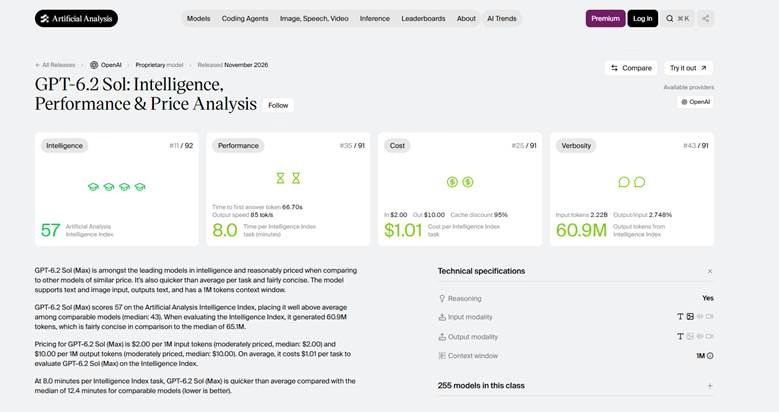
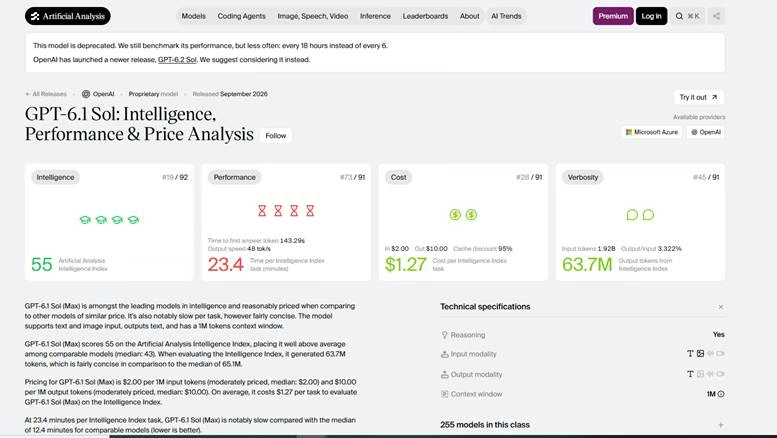
- Verdict: Upgrade for most workloads. GPT-6.2 Sol scores 57 on the Artificial Analysis Intelligence Index against 55 for GPT-6.1 Sol, and costs $1.01 per task against $1.27, at the same list price.
- Price: identical at $2 input, $0.10 cached input, and $10 output per million tokens, so any savings come from fewer tokens, not a lower rate.
- Speed: GPT-6.2 Sol finished an Intelligence Index task in 7.9 minutes against 23.3 at max effort, and returned its first answer token in about 68 seconds against 145.
- Coding caveat: Independent coding-agent evidence is mixed, so test coding agents on your own repositories before switching.
- Migration caveat: cache behavior may differ, so check your bill after a trial.
OpenAI released GPT-6.2 Sol on November 17, 2026, seven weeks after GPT-6.1 Sol, and kept the price. That makes the question simple: does the same money now buy more? On independent data, it does.
GPT-6.2 Sol scores slightly higher on intelligence, costs less per benchmark task, and completes tasks much faster. Coding-agent performance is less clear-cut, so teams relying on Codex-style workflows should test both models before migrating.
This article compares GPT-6.2 Sol and GPT-6.1 Sol on specs, pricing, benchmarks, coding, speed, and migration risks, then tells you when to switch.
GPT-6.2 Sol vs. GPT-6.1 Sol at a Glance
The two models share a price, and GPT-6.2 Sol is more intelligent, cheaper per task, and much faster in Artificial Analysis's tests.
| Dimension | GPT-6.1 Sol (Max) | GPT-6.2 Sol (Max) |
|---|---|---|
| Maker | OpenAI | OpenAI |
| Released | September 29, 2026 | November 17, 2026 |
| API model ID | gpt-6.1-sol | gpt-6.2-sol |
| API price (input / output per MTok) | $2 / $10 | $2 / $10 |
| Cached input per MTok | $0.10 | $0.10 |
| Blended price per MTok (7:2:1 cached input : input : output) | $1.47 | $1.47 |
| Intelligence Index | 55 | 57 |
| Cost per Intelligence Index task | $1.27 | $1.01 |
| Output tokens to run the index | 63.7M | 60.9M |
| Time per Intelligence Index task | 23.3 min | 7.9 min |
| Output speed | 49 tokens/s | 85 tokens/s |
Pricing and scores as of November 2026. Sources: OpenAI, Artificial Analysis.
What Changed in GPT-6.2 Sol
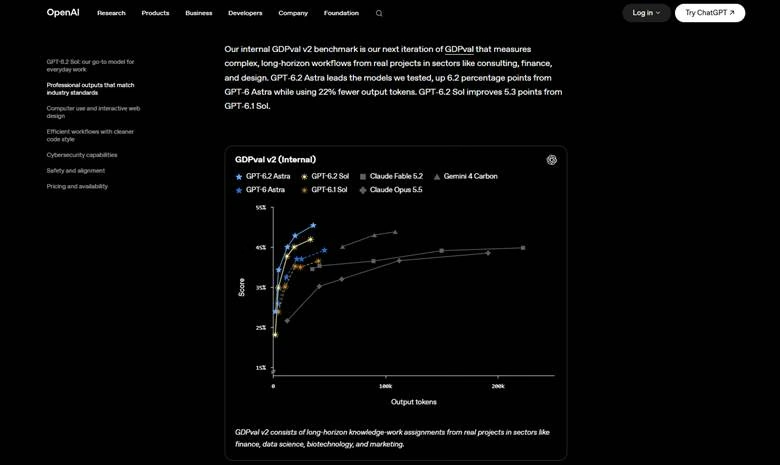
OpenAI describes GPT-6.2 Sol as smarter and more efficient than GPT-6.1 Sol, letting you finish more tasks on the same paid plan. It released the model alongside GPT-6.2 Astra, whose input and output token prices are 20% lower than GPT-6 Astra’s, at $8 input and $40 output per million tokens. Sol’s price did not change.
OpenAI reports a 5.3-point gain over GPT-6.1 Sol on its internal GDPval v2 benchmark, which tests long professional workflows. OpenAI’s charts also include GPT-6.2 Sol on Agents’ Last Exam, Terminal-Bench-Science, BenchCAD, and AutomationBench, but it does not establish precise Sol-specific gains from those charts.
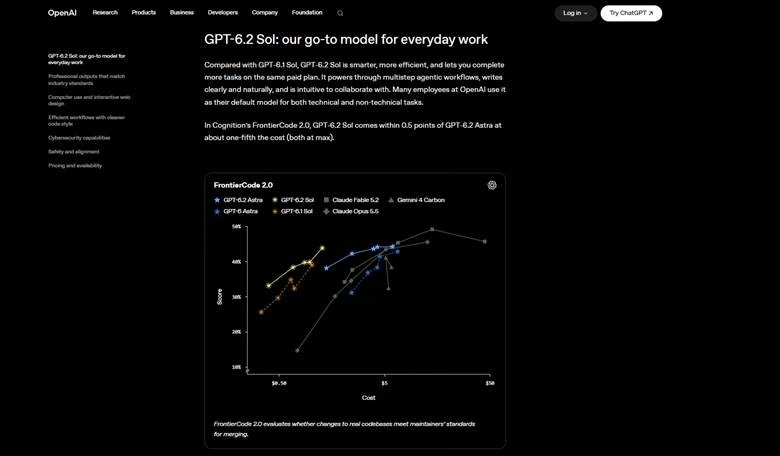
OpenAI separately says GPT-6.2 Sol comes within 0.5 points of GPT-6.2 Astra on Cognition’s FrontierCode 2.0 at max effort, at about one-fifth of Astra’s cost. These are vendor-reported results, so treat them as directional.
The model pages confirm the same context window and output limit as before. Both GPT-6.1 Sol and GPT-6.2 Sol have a 1.05M-token context window and up to 128,000 output tokens.
For the family background, see Claude Opus 5.5 vs GPT-6 Astra.
GPT-6.2 Sol vs. GPT-6.1 Sol Pricing and Cost per Task
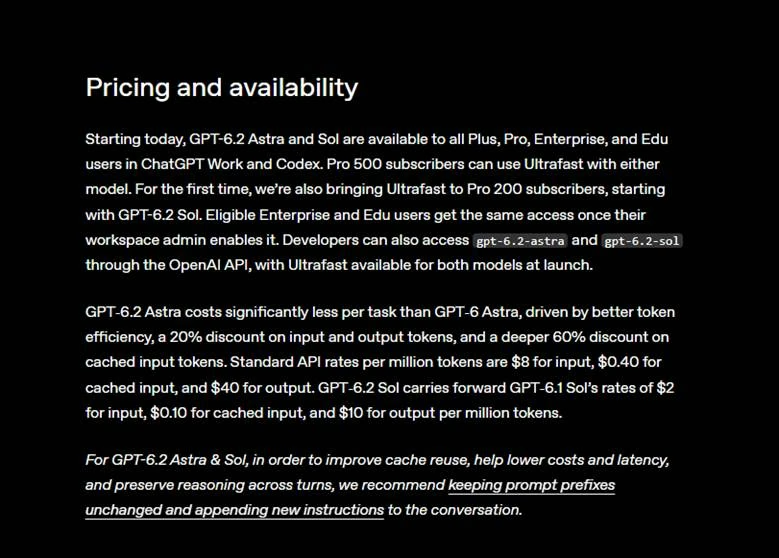
List prices are identical, but GPT-6.2 Sol costs about 20% less per task because it finishes with fewer tokens and less overhead. OpenAI's standard API pricing is unchanged.
| Price per 1M tokens | GPT-6.1 Sol | GPT-6.2 Sol |
|---|---|---|
| Input | $2.00 | $2.00 |
| Cached input | $0.10 | $0.10 |
| Output | $10.00 | $10.00 |
| Cost per Intelligence Index task (max) | $1.27 | $1.01 |
Artificial Analysis measures a 20% lower cost per task ($1.01 vs $1.27), with GPT-6.2 Sol using 60.9M output tokens to run the index against 63.7M. Effort settings change the picture a lot. For the earlier model’s full rate card, including caching, Batch, and long-prompt pricing, see our GPT-6.1 Sol pricing guide.
GPT-6.2 Sol used 33.3M output tokens at xhigh, 22.7M at high, 14.6M at medium, and 7.2M at low, so medium effort uses about 76% fewer tokens than max.
Two cost cautions apply:
- First, a developer reported that GPT-6.2 Sol did not cache text supplied in the top-level `instructions` field, whereas GPT-6.1 Sol did. OpenAI’s migration guidance also recommends keeping prompt prefixes unchanged and appending new instructions to the conversation to improve cache reuse.
- Second, OpenAI offers Ultrafast for both GPT-6.2 Sol and GPT-6.1 Sol, but its latency and billing behavior can differ by plan and access level. Check the live pricing page and your own traffic before assuming comparable effective rates.
Our guide to AI agent cost shows how to estimate it.
Intelligence and Benchmark Results
GPT-6.2 Sol leads by two index points. The two scores are 57 and 55 at max effort. OpenAI separately says GPT-6.2 Sol outscores GPT-6 Astra on its LifeVal everyday-tasks evaluation at about one-seventh of the cost. But that is a different benchmark from the Artificial Analysis Intelligence Index.
| Artificial Analysis measure | GPT-6.1 Sol (Max) | GPT-6.2 Sol (Max) |
|---|---|---|
| Intelligence Index v5.0.1 | 55 | 57 |
| Cost per task | $1.27 | $1.01 |
| Rank on the index (of 92) | 19th | 11th |
At medium effort, Artificial Analysis reports 53 for GPT-6.2 Sol against 46 for GPT-6.1 Sol, a wider gap than at max. Artificial Analysis currently lists GPT-6.2 Astra as OpenAI’s highest-scoring model on the index, at 62. For the earlier model’s own scores across coding, reasoning, and agent tests, see our GPT-6.1 Sol benchmarks guide.
For the Anthropic side, see Claude Opus 5.5 vs Opus 5 and Sonnet 5.5 vs Opus 5.5.
Coding and Agentic Performance
Coding is the one area where the upgrade is not clearly established. OpenAI says GPT-6.2 Sol comes within 0.5 points of GPT-6.2 Astra on Cognition’s FrontierCode 2.0 at max effort, at about one-fifth of Astra’s cost. However, this does not by itself establish that GPT-6.2 Sol beats GPT-6.1 Sol on every coding-agent workflow.
OpenAI’s announcement includes GPT-6.2 Sol in its Terminal-Bench-Science and coding-related charts, but the precise Sol-versus-6.1-Sol scores are not stated in the announcement text. Treat chart-based comparisons as directional and validate coding agents on your own repositories, harness, and effort setting before migrating.
In a small hands-on test, a developer ran five real coding work orders on both models at medium effort. Quality tied: both passed all five in the end and three of five first time. GPT-6.2 Sol cost 25% more overall, but one outlier drove that, and without it GPT-6.2 Sol was 13% cheaper. That is one person's workflow, not a benchmark.
For build-your-own agents, see how to build AI agents from scratch.
Speed and Latency
GPT-6.2 Sol is about three times faster per task than GPT-6.1 Sol at max effort. Artificial Analysis's timing data:
| Metric (Artificial Analysis, Max) | GPT-6.1 Sol | GPT-6.2 Sol |
|---|---|---|
| Time per Intelligence Index task | 23.3 min | 7.9 min |
| Time to first answer token | 145.15 s | 68.17 s |
| Output speed | 49 tokens/s | 85 tokens/s |
The gap comes from reasoning length and generation speed together. GPT-6.2 Sol streams about 73% faster and reaches its first answer token sooner in Artificial Analysis’s current measurements.
These figures are rolling evaluation averages and can move as Artificial Analysis refreshes them; they are evaluation measurements, not guaranteed latencies.
Privacy, Data Residency, and Access
Both models are proprietary, hosted models under OpenAI’s terms. GPT-6.1 Sol’s published standard pricing applies to prompts with up to 272,000 input tokens, and OpenAI’s GPT-6.2 migration guidance changes how the Responses API preserves reasoning and handles the top-level `instructions` field. Before sending business data, review OpenAI’s current terms, data-processing agreement, residency options, and retention settings for the specific model and endpoint you use.
GPT-6.2 Sol is available in the OpenAI API as gpt-6.2-sol and is rolling out to Plus, Pro, Enterprise, and Edu users in ChatGPT Work and Codex. It is not being added to regular Chat. Read OpenAI's terms and DPA before sending business data.
Should You Upgrade to GPT-6.2 Sol?
Upgrade most workloads now, and hold back only where coding agents or caching matter. The routing below reflects the data above.
| Use case | Recommended model | One-line reason |
|---|---|---|
| General everyday and knowledge work | GPT-6.2 Sol | 57 vs 55 at 20% lower cost per task |
| Latency-sensitive apps | GPT-6.2 Sol | 7.9 vs 23.3 minutes per task |
| Long-running agent workloads | GPT-6.2 Sol | Fewer tokens and faster completion |
| Coding agents in Codex | Test both | Independent coding-agent evidence is mixed; validate on your own repositories |
| Ultrafast or latency-sensitive plans | Test both | Ultrafast is available for both models, but effective billing and latency can vary by plan |
| Heavy prompt caching | Test first | GPT-6.2 may cache top-level `instructions` differently; keep prompt prefixes unchanged |
| Hardest tasks, price secondary | GPT-6.2 Astra | $8 / $40 per million tokens |
| Building apps without code | Emergent | Describe the app and Emergent builds it |
A safe migration: run a day of real traffic through GPT-6.2 Sol at the effort level you use, and compare quality, cost per task, and cache hit rates against GPT-6.1 Sol. To build that trial into a workflow, an AI agent builder lets you describe which tasks go to which model and where a person reviews.
Conclusion
GPT-6.2 Sol vs GPT-6.1 Sol is an easy upgrade on speed and cost and a cautious one on coding. At the same $2 and $10, GPT-6.2 Sol scores two points higher, costs about 20% less per task, and finishes an Intelligence Index task roughly three times faster.
Choose GPT-6.2 Sol for general work, latency-sensitive apps, and long agent runs. Stay on GPT-6.1 Sol, or test both, if you run coding agents or depend on heavy caching. Once you have picked a model, Emergent helps you build with it: describe the app you need and Emergent builds the screens, backend, logins, and integrations.
See the app builder and how to build software without coding.
Describe it. Build it. Launch it.
- End-to-End Creation
- No Code Needed
- Live in Minutes

Most AI app builders stop at prototypes. Emergent creates production-ready apps you can actually launch.
- Production-ready apps
- Web & mobile apps
- Deploy in minutes