
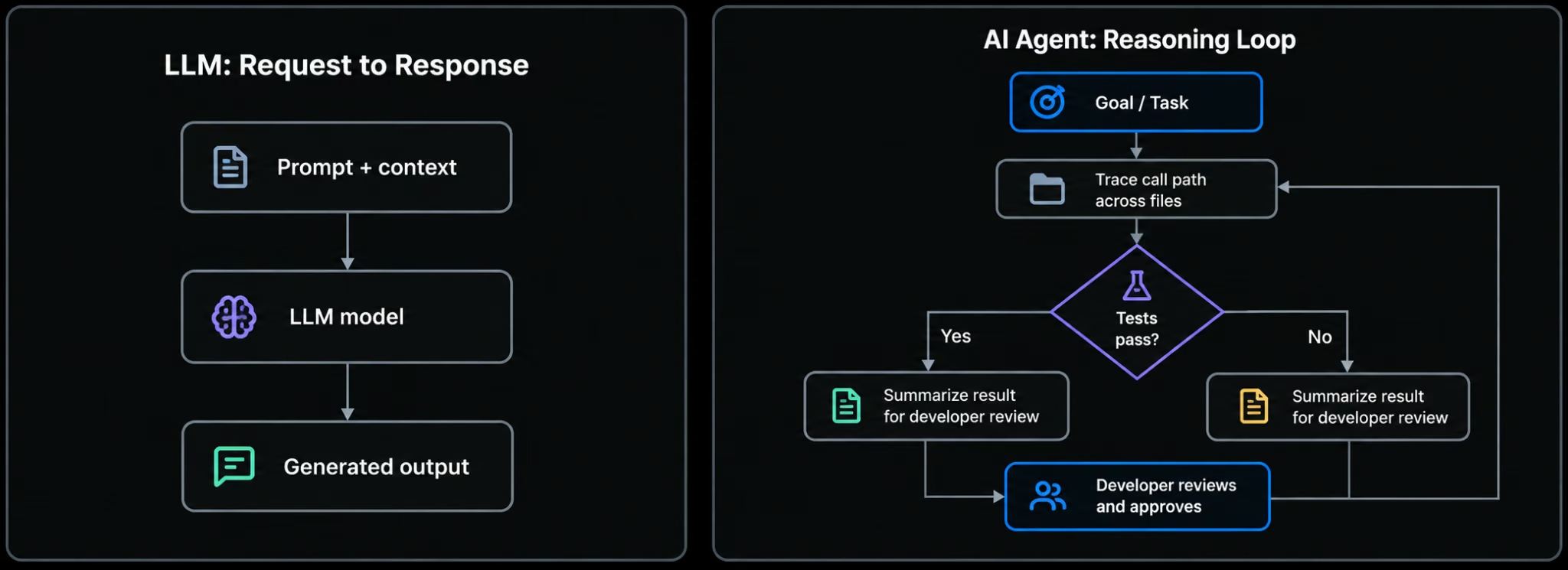
The LLM generates language, and the AI agent enables memory and implements tool use and planning for multi-stage actions. Essentially, this is a difference in scale: the LLM provides the answer, whereas the AI agent acts. Depending on the problem, either the LLM will handle tasks that require answering and generation, or the agent will be used when the task demands multiple stages and systems. In real life, the AI agent functions with LLM integration.
LLM vs AI agent matters because, in a business scenario where companies move from trial-and-error with AI to incorporating it into daily functions, a model might describe how to analyze customer feedback, while an AI agent might gather feedback and organize a report after being given the right access and tools.
What Is an LLM?
An LLM, or Large Language Model, is a sophisticated form of artificial intelligence designed to generate natural-sounding text. Commonly mentioned LLMs are GPT-4, Claude, Gemini, and Llama. LLMs are trained on huge amounts of data from books, articles, web pages, source code, and other publicly available resources. This large amount of data allows LLMs to recognize language patterns and generate natural, coherent, and contextually appropriate responses.
In order to comprehend the possibilities of LLMs, let us analyze some basic features:
- Text generation: Generates paragraphs, answers, stories, explanations, and other types of text.
- Summarization: Provides short summaries of long pieces of text.
- Classification: Identifies the class or sentiment of the text.
- Code generation: Develops functions and scripts.
- Reasoning: Performs logical operations.
These capabilities give LLMs the following main advantages. Firstly, their knowledge is universal because they learn from huge datasets. Second, LLMs excel at pattern recognition and can predict text, generating logical, well-structured responses. Finally, LLMs can be applied in problem-solving tasks, especially those that require linguistic skills and creativity.
Nevertheless, LLMs have significant disadvantages. First, they have no memory of their own and need additional mechanisms to gain it. In addition, LLMs cannot make long-term plans and cannot persist in achieving certain goals beyond the current prompt. LLMs also cannot apply any tools like APIs, databases, or browsers. Most importantly, LLMs can do nothing beyond generating text and suggesting ideas.
Key Features of LLMs
1. Natural language understanding and generation
LLMs can interpret instructions expressed in everyday language and generate responses suited to the requested format, tone, and purpose. Their outputs can include explanations, summaries, structured text, and code.
2. Contextual processing
An LLM uses the context provided in a prompt to produce a relevant response. Its ability to handle long documents or conversations depends on its context window, model capabilities, and the information supplied.
3. Reasoning and problem-solving
LLMs can help break down questions, compare options, solve problems, and explain possible solutions. However, their answers can contain mistakes, and a convincing explanation does not guarantee that the underlying conclusion is correct.
4. Adaptiveness across tasks
The same model can work in several scenarios depending on the prompt, instructions, and other accompanying details. A company could use an LLM to develop product descriptions, summarize meetings, analyze customer feedback or help developers code.
5. Limited execution without additional systems
Even though LLMs can generate a plan of action, they can't execute it. Tasks like sending emails, updating records, retrieving real-time data, and interfacing with business apps require proper tools.
For a closer look at the distinction between conversational AI and systems that can take action, read Emergent's guide to AI agents vs chatbots
What Is an AI Agent?
An AI Agent is an autonomous system created to carry out tasks, make choices, and take action with little human assistance. An AI agent extends an LLM's capabilities by combining the model with tools, planning, data access, and execution logic. Its "thinking engine" is one or more LLMs, but it also has other parts that let it use tools, plan steps, access data, and complete tasks. Simply put, an AI agent is a clever digital worker that can understand instructions, break them into steps, and carry them out.
Examining an AI agent's architecture can help you understand how it operates. Typically, an efficient AI agent consists of:
- The Reasoning/Planning module divides an objective into smaller, more doable tasks.
- Memory: Stores data for later use. This can contain vector store memory for semantic search, long-term memory for previous interactions, and short-term memory for active tasks.
- Tools: Enables the agent to communicate with actual systems. Examples include APIs, RPA scripts, databases, browsers, ERP interfaces, and email services.
- Decision engine: Helps the agent select the best course of action based on context and logic.
- Feedback loop: Enables self-correction by reviewing outcomes and adjusting strategies.
- Execution engine: Completes tasks until the objective is reached.
This gives AI bots a range of abilities. This means they can handle multi-step tasks, interface with applications and APIs, interact with databases, send emails, go online, and work within business environments. Moreover, because they learn from memory and context, they can operate independently for long periods without constant oversight.
Key Features of AI Agents
1. Goal-oriented behaviour
An agent starts with a defined objective, such as processing a support request, researching a supplier, or preparing a sales report. Its steps are selected to help achieve that objective.
2. Tool use and integration
Agents can use configured software tools, APIs, databases, browsers, and business applications. This lets them fetch information and take actions beyond text generation.
3. Multi-step execution
Rather than providing a single output, the agent can proceed in several steps. It may gather information, evaluate the data, take action, and then check whether it has fulfilled the original requirement.
4. Feedback and adaptation
Based on tool output and execution outcomes, an agent may decide on the next course of action. For instance, when a database query is partially answered, the system may repeat the process or seek clarification.
However, this does not mean all agents learn permanently from every transaction. Some rely on contextual information and logical rules instead.
5. Defined boundaries and oversight
Reliable agents need limits on what they can access and do. Permissions, validation rules, logging, approval checkpoints, and stopping conditions help prevent unintended actions.
6. Workflow integration
Agents can connect AI capabilities to existing business processes. This makes them useful for workflows where a task involves multiple systems rather than a single answer.
Organizations exploring implementation should understand the principles of building AI agents, including tool design, control mechanisms, and reliable execution.
AI Agent vs LLM: Key Differences
Understanding LLM vs. AI agent is critical for an organization to select the technology that best suits its specific requirements. Though related, they differ significantly in function and design.
Choosing Between LLMs and AI Agents
When deciding between an LLM vs AI agent, consider the task, the systems involved, and the repercussions of making a mistake. More autonomy is not always beneficial. A direct model response may be simpler, faster to develop, and more straightforward to analyze than an agent process.
When should you employ an LLM?
An LLM is typically a viable choice when the primary requirement is to evaluate data or generate output.
Consider using an LLM for:
- Content development includes writing blog articles, product descriptions, email marketing, and social media material.
- Summarization: Condensing reports, meeting minutes, research papers, and consumer comments.
- Question answering: Responding to inquiries with provided papers or a connected knowledge base.
- Coding assistance: explaining code, producing functions, and recommending debugging techniques.
- Information extraction entails converting unstructured text into organized fields for inspection or further processing.
For example, a marketing team that requires 20 different versions of an advertisement may not require the services of an agent. An LLM can produce the variations, while a person selects and refines the finest ones.
When should you utilize an AI agent?
An AI agent is more useful when a task necessitates multiple coordinated steps or contact with external systems.
Consider an agent for the following:
- Customer support: Obtaining account information, reviewing policies, and preparing responses.
- Sales operations: prospecting, updating CRM records, and planning follow-up tasks.
- Research routines include gathering information from permitted sources, comparing findings, and creating a report.
- sIT operations: Investigating warnings, gathering diagnostic data, and recommending or carrying out agreed remedial actions.
- Business process automation involves moving data between applications, verifying records, and forwarding exceptions to the appropriate person.
For example, a sales team may use an agent to review incoming leads, ensure required fields are completed, enrich records with authorized data sources, and assign qualified leads to the right representative.
The agent requires explicit guidelines for data access, record updates, and escalation. Without these safeguards, automation may bring errors on a larger scale than a manual procedure.
Also Read: Best AI agents for business, for tools tested on real work, with their guardrails.
How AI Agents Use LLMs Internally
An important note should be made here – AI agents do not substitute LLMs. On the contrary, the former leverage the capabilities of the latter and add the missing pieces to make the system operational in the physical world. To put it simply, an LLM is a brain (language understanding and idea generation), whereas an AI agent is a whole organism that includes memory, tool use, planning and execution capabilities.
In practice, an agent wraps LLM(s) and augments it with capabilities needed for the task. As a standalone model, an LLM is not able to take any actions, have memory and tool capabilities. An agent fills in the gaps by connecting LLM output to workflows, APIs, databases, applications and feedback. In this way, it becomes possible to create autonomous systems that can perform multi-step tasks.
Agents can also leverage several LLMs at once for each part of the process. For instance, the research AI agent could be composed of:
- one LLM reading and interpreting papers;
- another LLM producing structured summaries;
- external tools for citation extraction, source validation and storing of notes.
By orchestrating these models and tools, AI agents turn comprehension into actionable knowledge, which is why they are far more capable and independent than a single LLM.
Real-World Examples
LLM vs AI agent can support similar business functions, but they operate at different levels of the workflow.
1. Marketing and content operations
An LLM can draft articles, generate campaign ideas, and summarize performance reports. An agent could collect approved performance data, identify pages that meet predefined review criteria, prepare recommendations, and create tasks for the content team. Human review remains important before publishing content or changing live pages.
To build one around your own review rules, you can build a marketing agent that collects performance data and drafts recommendations for your team.
2. Customer support
For example, in this scenario, the LLM processes customer inquiries, which can be complaints, status requests or other inquiries. Once the inquiry is understood, the AI agent identifies the customer’s profile, checks the order or ticket status, adds appropriate data to the CRM system, and responds appropriately. For a version built around your own help content and escalation rules, a customer support agent builder lets you describe what the agent can look up and when it hands off.
3. Software development
The LLM can explain a mistake, write code, or suggest how to fix an error. The agent can explore the codebase, run tests, identify the cause of a test failure, create a patch, and submit a pull request. Modifications must pass the right tests and code reviews before being put into use. You can also build a coding agent for one repeatable task, such as bug fixes, and keep every change behind a review step. In IT systems, the LLM knows the content of the logs and errors. Then the agent starts servers, creates help desk tickets, informs engineers, or runs diagnostics. This increases uptime and shortens response times.
4. Finance and operations
Here, the LLM analyzes key information from bills, purchase orders, and receipts. Then, the AI agent verifies this information against ERP records and issues alerts for discrepancies. This process is less cumbersome and faster than doing it manually. Payments, accounting adjustments, and other consequential actions require appropriate controls.
Future of AI: Agents + LLMs Together
In the future, AI development will involve collaboration between agents and LLMs rather than replacing one with the other. As multi-agent systems continue to evolve, enterprises are already using several collaborating agents that work together to solve complex issues. In addition, memory-rich LLMs are developing rapidly to preserve context longer, remember previous actions, and make decisions based on them.
As a result, enterprises are shifting from using chatbots to building fully autonomous AI systems that can plan, act, and self-correct. In such systems, agents will play a much larger role by: orchestrating workflows, managing tools, and taking action, while LLMs will provide the intelligence.
Thus, hybrid architectures in which LLMs function as “brains” and agents function as “bodies” are likely to play an increasingly important role for designing scalable, enterprise-ready AI systems.
Also Read: Our comparison of AI agent builders for platforms worth weighing before you build.
Conclusion
This is where the distinction between LLM vs. AI agent comes in. An LLM can interpret data and generate a response. On the other hand, an AI agent can leverage the model's power, use tools and apply process logic to take the next step toward achieving an objective.
Depending on the task, different architectures can deliver better results for companies. LLMs will prove to be efficient if information generation is the primary goal. If the activity requires coordinated actions across systems, AI agents will be more efficient.
The idea is not to automate everything, but to find where AI can make a difference.
For businesses exploring these capabilities, Emergent's AI Agent Builder provides a starting point for investigating agent-based applications. For use cases centered on conversational experiences, an AI chatbot builder may be more appropriate.
Most AI app builders stop at prototypes. Emergent creates production-ready apps you can actually launch.
Most AI app builders stop at prototypes. Emergent creates production-ready apps you can actually launch.
- Production-ready apps
- Web & mobile apps
- Deploy in minutes