Alibaba's Qwen and Google's Gemini are two major AI model families competing across reasoning, coding, multimodal tasks, and application development. Both offer models for demanding workloads as well as lighter options for everyday use. However, their differences extend beyond benchmark scores.
Qwen offers hosted AI models and separate open-weight alternatives, giving businesses flexibility in how they access and deploy AI. Gemini combines Google's proprietary models with its AI development ecosystem, including Google AI Studio and Vertex AI. Google also offers Gemma as a separate family of open-weight models.
For a closer comparison, we'll examine Qwen3.8-Max (0902) against Gemini 4 Argon, while also looking at their lower-cost alternatives. We'll assess independent benchmarks, coding capabilities, API pricing, response speed, and deployment options.
The goal is to help you identify which model makes sense for your workload, rather than declare one AI family the winner in every category.
Understand Qwen vs. Gemini at a Glance
Qwen and Gemini offer models for different workloads, from routine AI assistance to complex coding and multi-step reasoning. Their flagship offerings differ in independent benchmark performance, API costs, and deployment ecosystems.
The table compares Alibaba's Qwen3.8-Max (0902) with Google's Gemini 4 Argon at its High reasoning setting.
Qwen3.8-Max (0902) vs. Gemini 4 Argon (High). Intelligence scores and technical specifications: Artificial Analysis. Pricing: Google Gemini API and Alibaba Cloud Model Studio. Gemini's introductory pricing ends November 30, 2026.
Model Access and Availability
Qwen3.8-Max is available through Alibaba Cloud Model Studio, while Qwen's chat interface provides access to supported models. Gemini 4 Argon can be accessed through Google's supported Gemini services, including paid API options.
Before selecting either model, check the available model version, subscription requirements, usage limits, and regional availability. Access through a consumer application does not necessarily provide the same configuration or controls as direct API access.
Gemini 4 Argon leads the overall Intelligence Index by 16 points, while Qwen3.8-Max has lower published output-token pricing. However, lower token prices do not necessarily mean lower costs for a completed task. The better choice depends on how much reasoning, output generation, and processing your application requires.
What Are Qwen and Gemini? Alibaba Qwen vs. Google Gemini
Qwen is Alibaba's AI model family, available through its Qwen chat experience and Alibaba Cloud Model Studio API. It includes proprietary hosted models and separate open-weight checkpoints that developers can deploy on their own infrastructure.
Gemini is Google's AI model family, accessible through the Gemini app, Google AI Studio, Gemini API, and Google Cloud. Its models support applications ranging from everyday assistance to complex reasoning and software development. Google also develops Gemma, a separate family of open-weight models.
Both families offer models at different capability and cost levels.
Model-family positioning based on Alibaba Cloud Model Studio and Google DeepMind's model catalog. These are workload-based groupings, not claims of equivalent performance.
Why Compare Qwen3.8-Max With Gemini 4 Argon?
Qwen3.8-Max and Gemini 4 Argon are suitable for comparing advanced reasoning, coding, and API-based workloads. Gemini 4 Carbon is a newer, higher-tier model, but comparing it directly with Qwen3.8-Max would make the main comparison less balanced.
Importantly, Qwen3.8-Max is a hosted model and should not be confused with Alibaba's separately released open-weight checkpoints. We examine those deployment options later.
Qwen3.8-Max vs. Gemini 4 Argon: Key Differences
Both models are designed for demanding AI workloads, but they differ in architecture, reasoning settings, multimodal capabilities, and deployment options.
1. Architecture and Model Size
Alibaba describes Qwen3.8-Max as a 2.4-trillion-parameter mixture-of-experts (MoE) model. This architecture activates selected parts of the network for each task rather than using every parameter simultaneously.
Google positions Gemini 4 Argon as a frontier model for complex reasoning and long-running workflows. Its publicly available specifications do not establish a directly comparable parameter count, making a size-based ranking inappropriate.
2. Reasoning Modes and Effort Settings
Qwen3.8-Max supports a thinking mode for tasks requiring additional reasoning. Developers can configure its reasoning behavior through Alibaba's API.
Gemini 4 Argon offers Low, Medium, and High thinking settings. Higher settings allocate more reasoning effort to difficult problems, potentially increasing processing time and token consumption.
For benchmark comparisons, the reasoning configuration matters. Scores obtained at different effort settings should not be presented as directly equivalent without identifying those settings.
3. Context Window and Multimodal Capabilities
Both models are listed with context windows of approximately one million tokens, although usable input limits can vary by model configuration. These large context windows support applications involving lengthy documents, extensive conversations, and large codebases.
Qwen3.8-Max accepts text, images, and video, while Gemini 4 Argon also supports audio input. This gives Gemini an additional input option for applications involving recorded speech or audio analysis.
A large context window, however, does not guarantee equally reliable retrieval or reasoning across every part of a long document.
4. Model Weights and Licensing
Neither Qwen3.8-Max nor Gemini 4 Argon is available as an open-weight model.
Alibaba separately offers Qwen open-weight checkpoints, while Google provides the Gemma family. These alternatives can support self-hosting and customization, subject to their respective licenses and infrastructure requirements.
For businesses, the distinction is between using a managed frontier API and deploying a separate model with greater infrastructure control.
Qwen vs. Gemini Benchmarks
Independent benchmarks help compare AI models across reasoning, coding, automation, and professional knowledge work. However, a higher overall score does not guarantee better results for every task.
Artificial Analysis evaluates Gemini 4 Argon (High) and Qwen3.8-Max (0902) using its Intelligence Index v5.0.1, which combines nine evaluations across four capability categories.
Independent benchmark results for Qwen3.8-Max (0902) and Gemini 4 Argon (High). Source: Artificial Analysis model comparison, Intelligence Index v5.0.1. Retrieved November 12, 2026. Results are subject to change.
The table covers only six of the Index's tests, and our Gemini 4 Argon benchmarks guide shows the full set for the Google side.
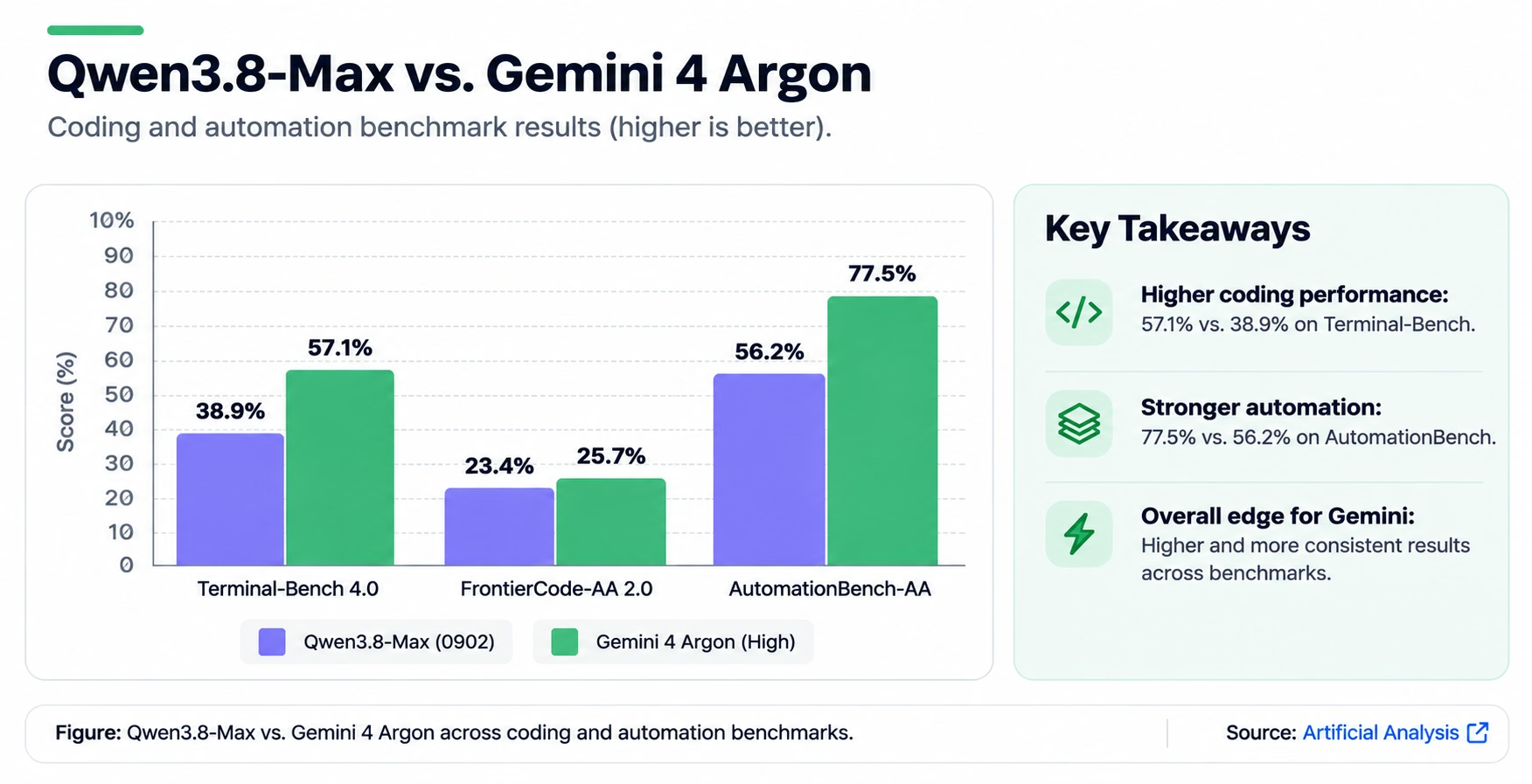
Qwen3.8-Max (0902) vs. Gemini 4 Argon (High) across coding and automation benchmarks. AI-generated visualization based on independently reported results from Artificial Analysis, November 12, 2026.
What Do These Results Mean?
Gemini leads the overall Intelligence Index by 16 points. Its higher Terminal-Bench 4.0 and FrontierCode-AA 2.0 scores indicate stronger performance across the coding tasks assessed by these independent evaluations. Its AutomationBench advantage also suggests greater reliability on tested software automation workflows.
Qwen performs better on two document-focused evaluations. AA-Briefcase assesses professional deliverables involving files, analysis, and presentation quality, while GDP.pdf tests answers grounded in lengthy PDF documents.
The GDP.pdf difference is only one percentage point, so it should not be interpreted as a decisive advantage.
These results suggest Gemini is the stronger general-purpose choice for demanding reasoning, coding, and automation. Qwen remains competitive for selected document-heavy workflows. Argon is one of several Google tiers, and our Gemini 4 Carbon vs Gemini 4 Argon comparison shows what the step up buys.
Vendor-reported benchmarks can provide additional context, but they should be assessed separately because testing environments and evaluation methods may differ.
Qwen vs. Gemini for Coding
Choosing an AI model for coding involves more than comparing benchmark scores. Developers should also consider how well each model integrates with their tools, handles complex workflows, and supports their preferred development environment.
Coding Performance
Gemini's advantage in independent coding evaluations makes it a stronger candidate for demanding development tasks. However, the results do not establish how either model will perform across every programming language, codebase, or development environment.
Gemini's advantage suggests it may be better suited to complex debugging, multi-file development, and coding workflows requiring several reasoning steps. However, benchmark performance does not guarantee identical results across every programming language or project.
Developer Tools and Integration
Alibaba offers Qwen Code, an open-source coding agent that supports AI-assisted development through terminal-based workflows.
Google offers Gemini Code Assist, which integrates AI assistance into supported development environments for tasks such as code generation, explanation, and debugging.
These tools should not be confused with the underlying models. Their capabilities and supported model versions may differ.
Qwen Code and Gemini Code Assist both come with their vendor's choices built in. If you want a coding agent that follows your own repo structure, test commands, and review steps, you can set one up with a coding agent builder.
Which Model Should You Choose for Coding?
Gemini 4 Argon is the stronger choice when independent coding performance is the main priority, particularly for demanding development and automation tasks.
Qwen3.8-Max remains an alternative for teams prioritizing Alibaba's API ecosystem or lower output-token pricing. Developers interested in self-hosting can also evaluate Alibaba's separate open-weight Qwen models.
For either family, testing against your actual codebase remains advisable before making a production decision. For a wider ranking beyond these two families, see our best AI models for coding guide.
Qwen vs. Gemini Pricing, Speed, and Access
Qwen3.8-Max has lower published API token prices than Gemini 4 Argon. However, pricing alone does not determine which model is more economical for a particular workload.
API Pricing Comparison
Published standard API rates in USD per million tokens, November 2026. Qwen prices reflect Alibaba Cloud's international/US pricing; rates may differ by deployment region. Gemini 4 Argon's introductory rates end November 30, 2026. Sources: Alibaba Cloud Model Studio and Google Gemini API pricing. *Qwen rates are current published prices, not guaranteed future prices.
At introductory rates, Qwen costs 40% less per million output tokens. From December 1, the difference increases if Alibaba's prices remain unchanged.
For how Argon's December increase and cached input are priced in full, see our Gemini 4 Argon pricing guide.
Cost per Completed Task
Artificial Analysis currently reports an evaluated task cost of $10.02 for Qwen3.8-Max versus $9.95 for Gemini 4 Argon (High), using its displayed pricing basis.
Qwen generates approximately 171,000 output tokens per evaluated task, compared with Gemini's 116,000. This helps explain why cheaper output tokens do not necessarily produce cheaper completed tasks.
These benchmark costs should not be treated as estimates for every business application.
Response Speed
Artificial Analysis performance measurements, November 12, 2026. Source: Artificial Analysis.
Qwen3.8-Max has a substantially lower measured time to first token, meaning users may see the response begin sooner. However, Gemini 4 Argon delivers higher measured output throughput and a shorter mean end-to-end response time in this comparison.
These results highlight an important distinction: faster initial responses do not necessarily translate into faster task completion. Actual latency will depend on the prompt, reasoning settings, output length, and API environment.
Open Weights, Privacy, and Data Residency
Qwen and Gemini offer different deployment options, but neither Qwen3.8-Max nor Gemini 4 Argon provides downloadable model weights.
Open-Weight Alternatives
Alibaba offers Qwen3.8-2.4T-A95B and Qwen3.8-27B as downloadable models. Google offers the separate Gemma family.
These models allow organizations to explore self-hosting and customization instead of relying exclusively on managed APIs. However, licenses differ between checkpoints, and large models can require substantial computing resources.
Open weights also do not automatically mean unrestricted commercial use. Businesses should review the specific model license before deployment.
Privacy and Data Retention
Alibaba Cloud Model Studio generally retains standard inference prompts and responses for no longer than 30 days, subject to legal and security exceptions. Eligible enterprise customers can apply for Zero Data Retention (ZDR) for supported API inference calls. ZDR must be enabled for the relevant workspace and does not cover every feature, such as application orchestration or knowledge bases.
Google's data-handling arrangements depend on the service and plan. Consumer Gemini, paid Gemini API services, and Google Cloud's enterprise offerings should not be treated as having identical privacy terms.
Data Residency
Alibaba Cloud provides regional endpoints and deployment scopes, including options for US and European processing. Google Cloud also provides regional controls for supported services.
For sensitive business data, compare the actual deployment region, inference location, retention settings, access controls, and contractual commitments before selecting a provider.
Neither model family should be considered automatically compliant with a particular industry's requirements.
Which Should You Choose? Qwen or Gemini by Use Case
The better AI model depends on your workload, budget, and deployment requirements. Gemini 4 Argon leads in overall intelligence and coding benchmarks, while Qwen3.8-Max offers lower output-token pricing and advantages in selected document-focused evaluations.
Workload-based recommendations informed by Artificial Analysis and official provider documentation. Recommendations are not guarantees of performance.
Conclusion: Qwen or Gemini?
Choosing between Qwen and Gemini requires looking beyond overall benchmark rankings. The right model depends on what you're building, how frequently you'll use it, and the costs involved.
For high-volume applications, lighter alternatives such as Qwen3.8-Flash and Gemini's Flash models may offer a more economical balance of performance and cost. For how Google's Flash tier behaves against its successor, see Gemini 4 Hydrogen vs Gemini 3.8 Flash. Businesses requiring self-hosting should evaluate the separate open-weight Qwen and Gemma families.
Ultimately, test models against your actual workload, including accuracy, latency, and total task cost, before committing to a provider.
If you want to build an application without writing code, Emergent is an app builder that lets you describe what you want to build in natural language and turn that description into a working application.
Describe it. Build it. Launch it.
- End-to-End Creation
- No Code Needed
- Live in Minutes
Most AI app builders stop at prototypes. Emergent creates production-ready apps you can actually launch.
- Production-ready apps
- Web & mobile apps
- Deploy in minutes