



TL;DR
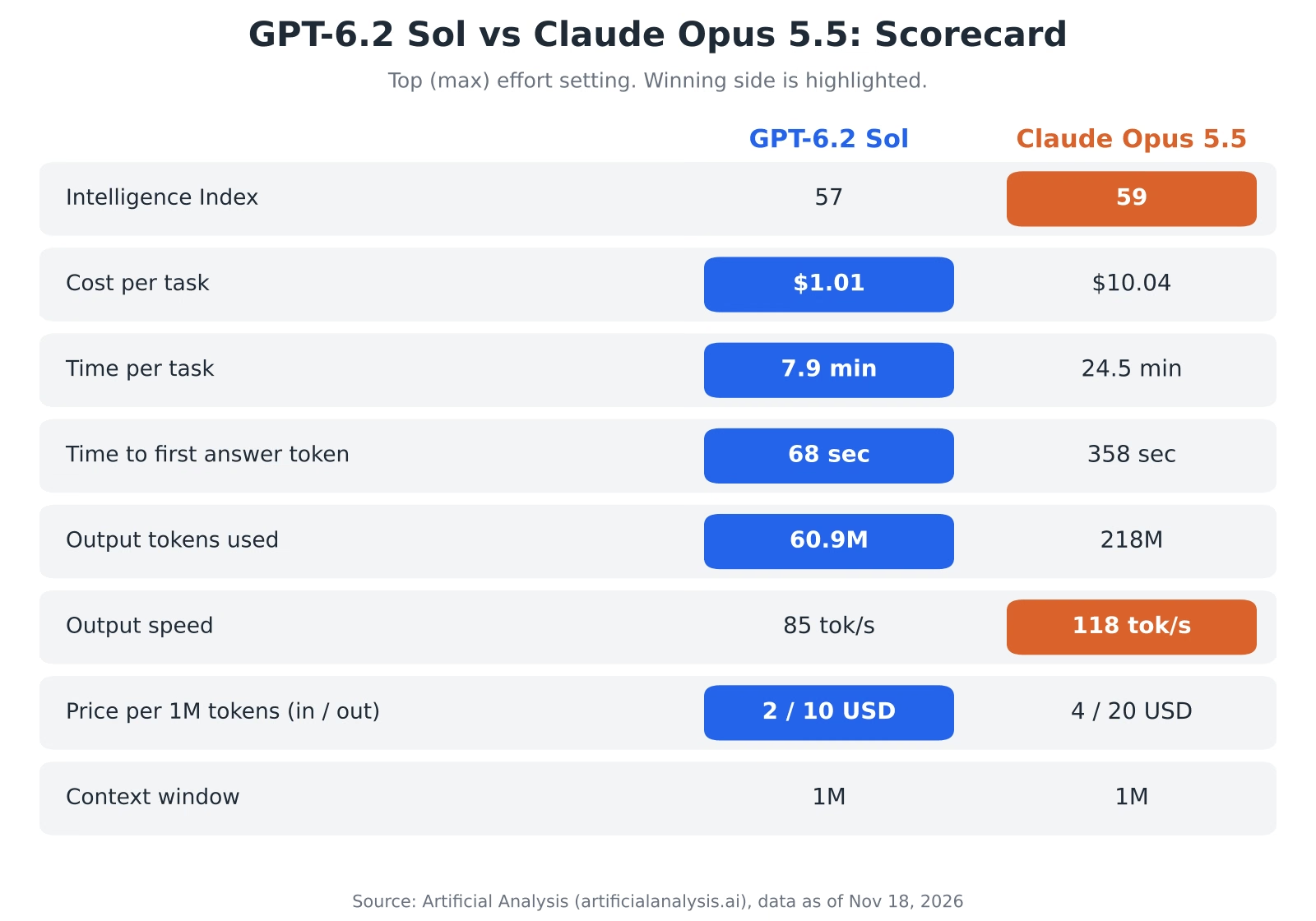
- GPT-6.2 Sol is the superior choice in terms of cost, speed, and token usage (57 vs 59); Claude Opus 5.5 scores higher.
- Sol costs $1.01 per Intelligence Index task. Opus costs $10.04.
- It takes Sol 8.5 minutes to complete a task. Opus takes 24.5 minutes.
- Both models have a 1M-token context window and accept text and image input.
- The times for “xhigh” (56) are close to “max” (59) for Sol, within approximately 5 minutes per task.
GPT-6.2 Sol is 10x cheaper per task and 3x faster than Claude Opus 5.5 (by 2 points), but that's just two points. Compare the two models by looking at scores, price, speed, and token usage.
Claude Opus 5.5 is two points more intelligent, but GPT-6.2 Sol is more economical, faster, and much less verbose. At their highest settings, both Opus 5.5 and Sol score 59 and 57 on the Artificial Analysis Intelligence Index. However, Opus costs 10 times more per task and is 3.5 times slower. This comparison of GPT-6.2 Sol vs Claude Opus 5.5 details intelligence, speed, pricing, token consumption, and context to help you choose the right model for your tasks.
GPT-6.2 Sol vs Claude Opus 5.5: Quick Comparison
Claude Opus 5.5 wins on raw intelligence, while GPT-6.2 Sol wins on nearly every other aspect. Each model's maximum setting is used, and a plain-language explanation is provided for each row in the table below.
| Metric | GPT-6.2 Sol (Max) | Claude Opus 5.5 (Max) | What it means |
|---|---|---|---|
| Intelligence Index | 57 | 59 | Opus scores two points higher on a combined test. |
| Rank (intelligence) | 13 of 92 | 10 of 92 | Both sit near the top. |
| Input price per 1M tokens | $2.00 | $4.00 | Sending text to Opus costs twice as much. |
| Output price per 1M tokens | $10.00 | $20.00 | Reading Opus’s answers costs twice as much. |
| Cost per Index task | $1.01 | $10.04 | A typical task costs about 10x more on Opus. |
| Time per Index task | 8.5 min | 24.5 min | Sol finishes work about 3x sooner. |
| Output speed | 79 tokens/sec | 118 tokens/sec | Opus writes faster once it starts. |
| Time to first answer token | 75.06 sec | 335.85 sec | Opus takes much longer to answer. |
| Output tokens used | 60.9M | 218M | Opus writes about 3.6x more text. |
| Context window | 1M tokens | 1M tokens | Both fit roughly 1,500 pages. |
| Released | Nov 17, 2026 | Sep 22, 2026 | Sol is the newer model. |
| API providers | 1 (OpenAI) | 4 | Opus has more places to run. |
What Are GPT-6.2 Sol and Claude Opus 5.5?
Both are the highest-level proprietary reasoning models on the market. GPT-6.2 Sol is an OpenAI product that was released on November 17, 2026. Claude is Anthropic's latest version, released on September 22, 2026.
Both models “think” before they answer. This extended reasoning helps with difficult problems. It also delays and increases expenses.
Both take in text and images and generate text. The number of parameters has not been revealed by either company, and neither model is open-weight.
All models also have five effort levels: max, xhigh, high, medium, and low. The more effort expended, the more reasoning, the higher the scores, and the higher the bill. It is not only a matter of which model you run, but which effort level you run.
Intelligence: Claude Opus 5.5 Leads by Two Points
Claude Opus 5.5 has a score of 59 on the Artificial Analysis Intelligence Index, which is outperforming GPT-6.2 Sol with a score of 57. That puts Opus at rank 10 of 92 and Sol at rank 13. Both models are well above average, since the median for similar models is 43.
The Index is the result of nine assessments. These include agentic knowledge work, SaaS workflows, coding, terminal use, scientific research, physics reasoning, professional documents and general knowledge. On a combined score, a 2-point difference isn't that big of a deal. You will not experience it with each task.
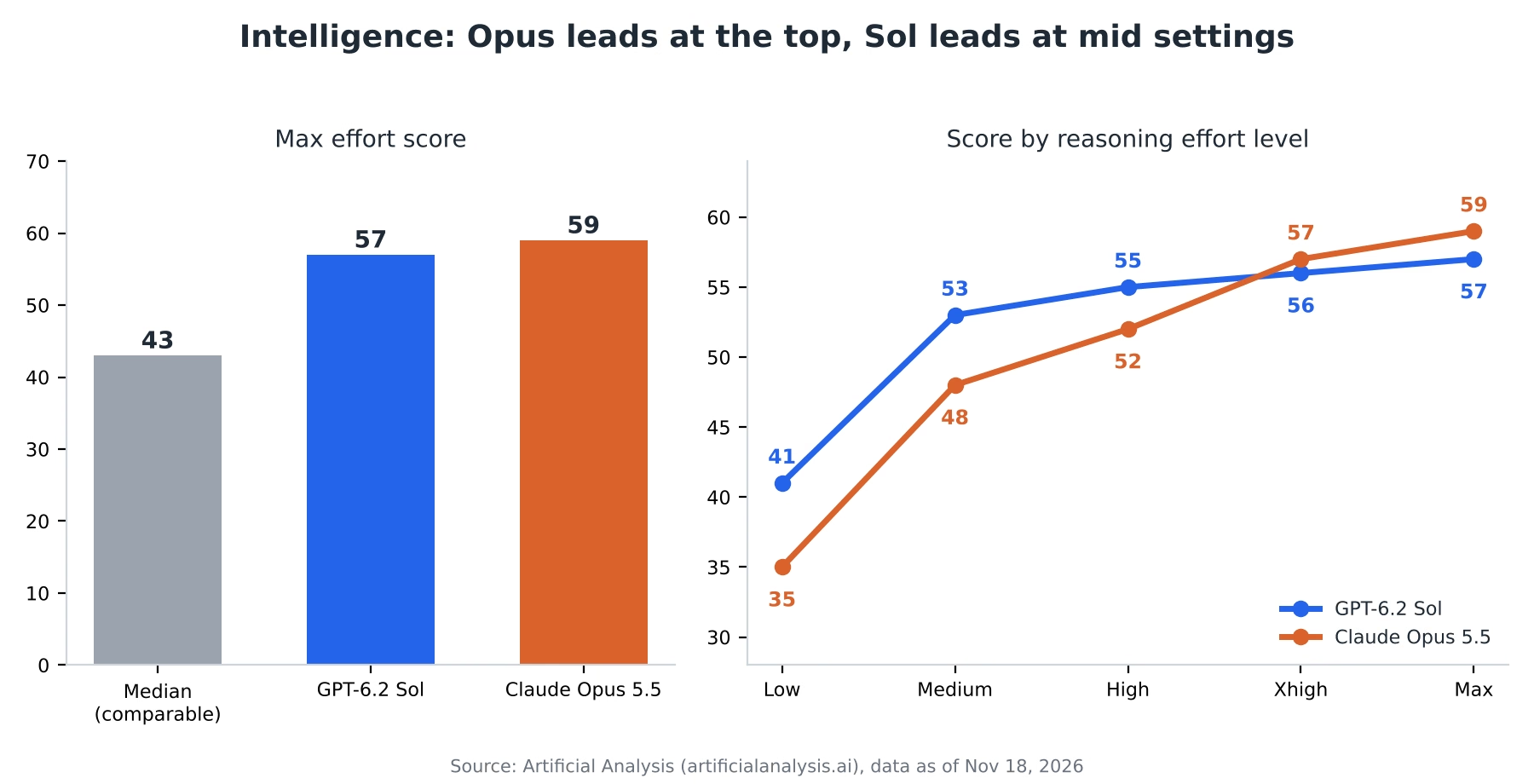
Sol's power is evident at less than full effort. Sol's score is 55, and Opus's score is 52 at “high.” At “medium,” Sol is rated at 53 while Opus is rated at 48. Sol's hold is better, as it is dialed down.
Also Read: GPT-6.2 Sol vs GPT-6.1 Sol for how the new model compares with the one it replaces
Reasoning Effort Levels: Sol Scores Higher at Mid Settings
GPT-6.2 Sol outperforms Claude Opus 5.5 on all but the greatest difficulty settings, “max” and “xhigh.” Time/Task and Intelligence Index scores are provided in the table below.
| Effort level | Sol score | Opus score | Sol time per task | Opus time per task |
|---|---|---|---|---|
| Max | 57 | 59 | 8.5 min | 24.5 min |
| Xhigh | 56 | 57 | 4.9 min | 15.6 min |
| High | 55 | 52 | 4.2 min | 9.3 min |
| Medium | 53 | 48 | 3.1 min | 6.8 min |
| Low | 41 | 35 | 1.4 min | 3.0 min |
Simply put, Sol is faster at all levels. It also has a higher score at high, medium, and low. Opus only overtakes at the highest two settings, and by one or two points.
So much so that one comparison sticks with me: the “max” score, 57, is the same for Sol as for Opus at “xhigh”. Sol takes 8.5 minutes to reach that score. Opus needs 15.6 minutes.
Also Read: Claude Opus 5.5 high vs low effort for how effort changes cost and results on Opus
Speed: Sol Finishes Tasks Faster, Opus Streams Faster
GPT-6.2 Sol will take 8.5 minutes to complete an Intelligence Index task, while Claude Opus 5.5 requires 24.5 minutes. The median of similar models is 11.5 minutes. Sol beats it. Opus's performance is noticeably slow.
The following speed picture is divided into two components. Opus compresses text at 118 tokens per second, while Sol is at 79 tokens per second. However, for each task, Opus generates significantly more text, and even so, it still comes in late overall.
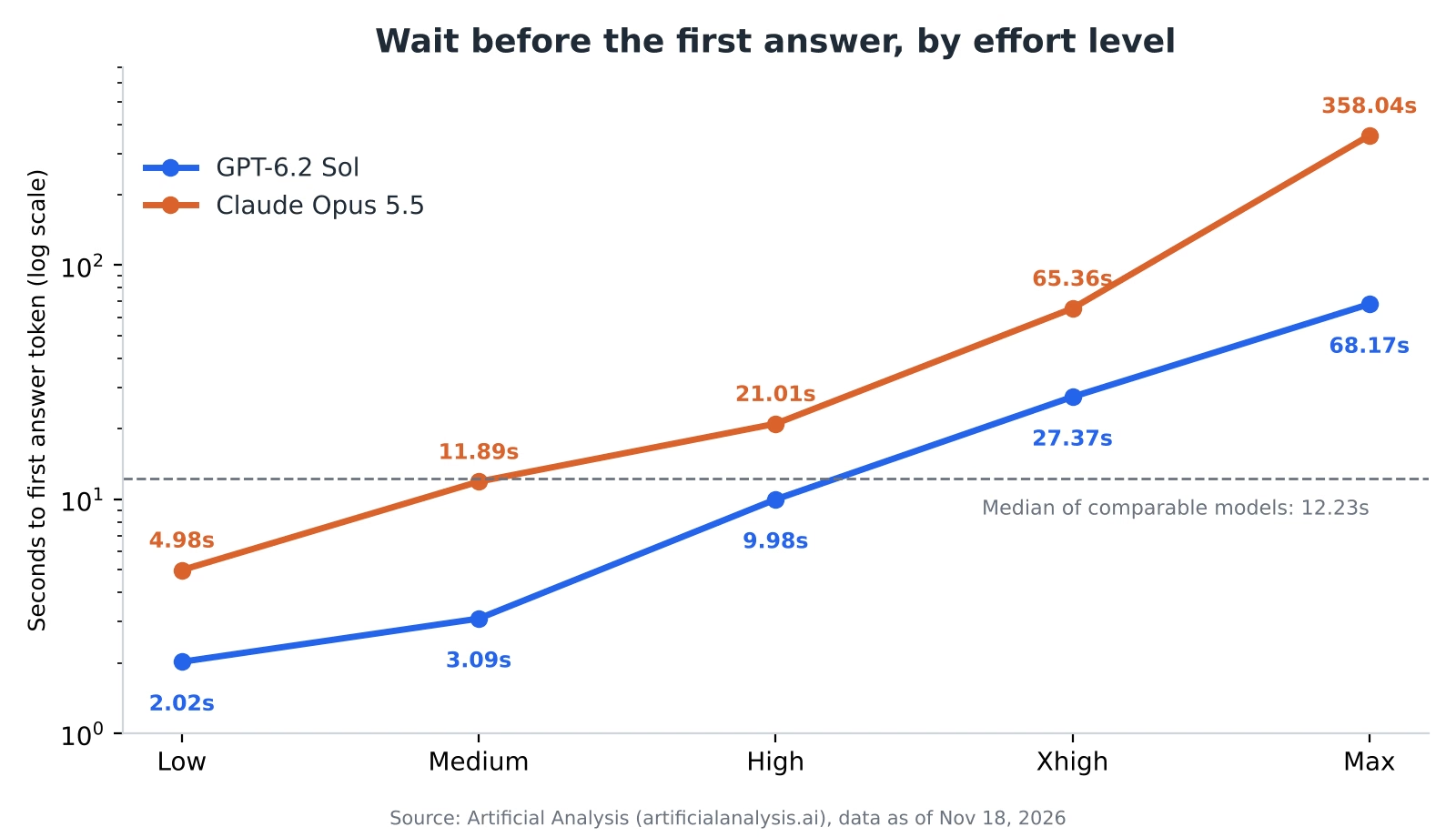
There is also variation in the delay between words. It takes Sol 75.06 seconds to get its first answer token at “max”. Opus requires 335.85 seconds, or almost 6 minutes. At this setting, both are slow, with a median of 12.23 seconds. This wait included thinking time.
Lower effort levels fix most of this:
| Effort level | Sol first answer token | Opus first answer token |
|---|---|---|
| Max | 75.06 sec | 335.85 sec |
| Xhigh | 27.37 sec | 65.36 sec |
| High | 9.98 sec | 21.01 sec |
| Medium | 3.09 sec | 11.89 sec |
| Low | 2.02 sec | 4.98 sec |
Use “high” or " low " on either model for chat or live tools. It takes Sol about 10 seconds to respond when the question is “high”. It responds at “medium” in approximately 3 seconds.
Cost: Sol Is About 10x Cheaper per Task
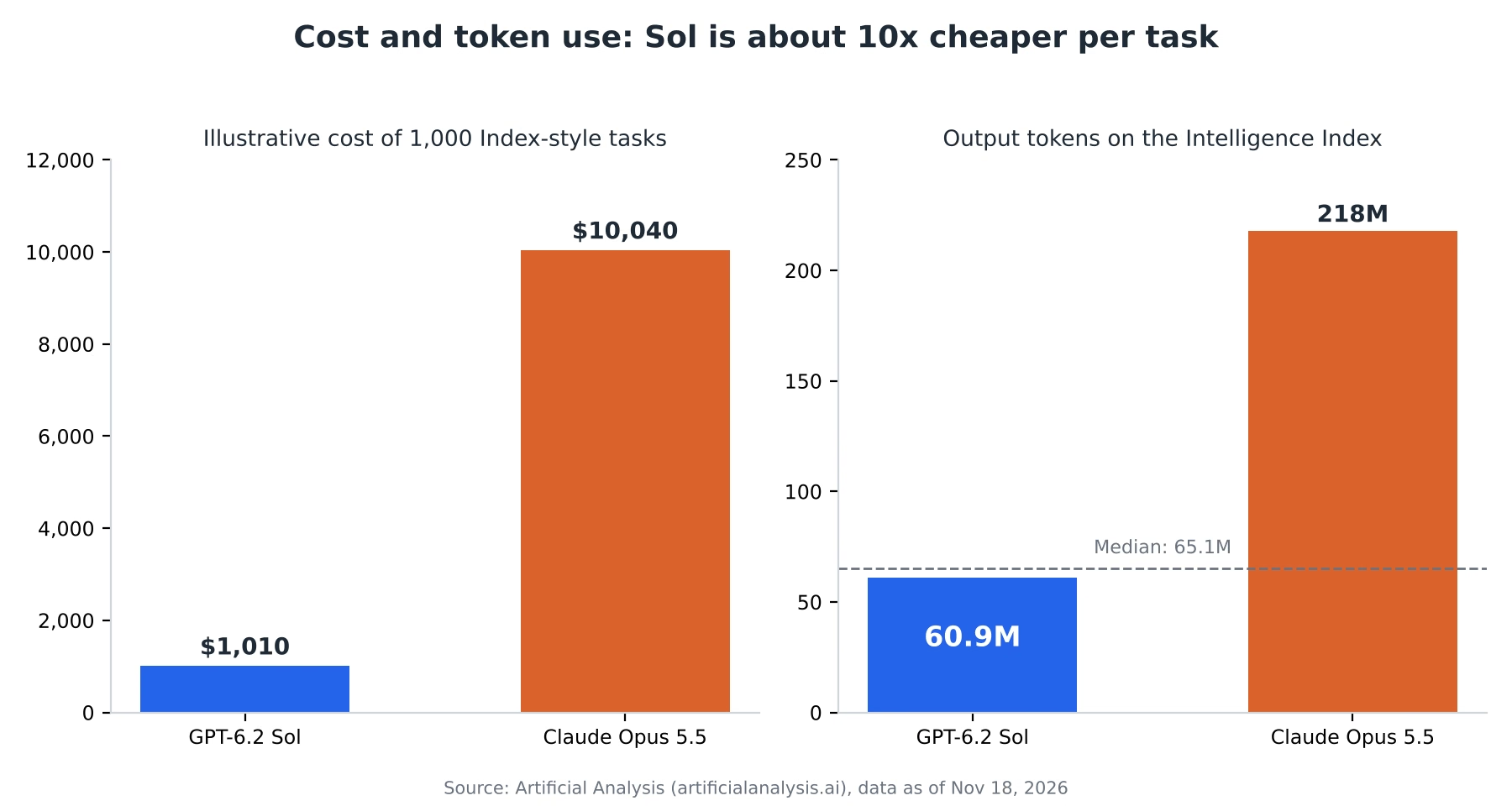
GPT-6.2 Sol costs $1.01 per Intelligence Index task, while Claude Opus 5.5 costs $10.04. That puts Opus at about 10 times the cost of running on the same benchmark. Sol ranks 26 of 95 on cost. Opus ranks 90 of 95.
Two forces fuel the gap. First, Opus costs twice as much per token. Second, Opus has many more tokens.
| Price item | GPT-6.2 Sol | Claude Opus 5.5 |
|---|---|---|
| Input per 1M tokens | $2.00 | $4.00 |
| Output per 1M tokens | $10.00 | $20.00 |
| Cache discount | 95% | 95% |
| Blended price per 1M tokens | $1.47 | $2.94 |
| Cost per Index task | $1.01 | $10.04 |
Sol's prices are equal to the median prices of similar models ($2.00 input, $10.00 output). On both, Opus is above average. Both models provide a 95% discount on cached inputs, meaning applications that call on long inputs get big savings on either model. For each side’s full rate card, see our Claude Opus 5.5 pricing and GPT-6.1 Sol pricing guides.
Let's take a simple example. Assume that you have 1,000 tasks similar to those in the Index. The total cost of Sol would be approximately $1,010. The total cost of Opus would be approximately $10,040. This is a sample using benchmark averages and is not a representation of your workload.
Token Use: Opus Writes About 3.6x More
Claude Opus 5.5's Intelligence Index output was 218M output tokens, compared to GPT-6.2 Sol's 60.9M output tokens. Similar models have a median of 65.1M. Sol is a bit shorter than average. Opus is extremely "verbose." Sol ranks 44 of 95 for verbosity, and Opus ranks 91 of 95.
There are two reasons for using tokens. All output tokens are paid for. You wait for all of the above as well.
Effort level changes token use sharply:
| Effort level | Sol output tokens | Opus output tokens |
|---|---|---|
| Max | 60.9M | 218M |
| Xhigh | 33.3M | 101M |
| High | 22.7M | 56.1M |
| Medium | 14.6M | 42.5M |
| Low | 7.21M | 21.1M |
Opus uses nearly as many tokens as Sol at “max” (60.9M tokens, score 57) and at “high” (56.1M tokens, score 52). Sol buys five more points for about the same token budget. Sol has a good efficiency result.
Context Window and Input Types: A Tie
Both models have a context size of 1M tokens, and both can accept text and images. About 1,500 pages of 12-point Arial text fit into a 1M-token window. This is sufficient for a large code base, long contracts or multiple reports at the same time.
Create only output text. It also doesn't create images, sounds or video. Either model is fine if you need an assistant to read screenshots, charts or scanned pages.
These two points will not be split up by context size. However, verbosity, speed and price will.
Availability: Opus Runs on Four Platforms
GPT-6.2 Sol is offered by one API provider, and Claude Opus 5.5 is offered by 4 API providers. Opus is available on Amazon Bedrock, Anthropic, Google and Microsoft Azure. Sol is available for use via OpenAI's API.
This is important for cloud teams. If your business already pays for its purchases at AWS, Google Cloud, or Azure, then Opus integrates into their billing and security framework. They will need an OpenAI account to use Sol.
Also record the model ages. This comparison was done one day before the Sol launch. It's early to say how many there will be. Availability, speed, and fees for providers might change as more teams adopt it.
Also Read: Claude Opus 5.5 vs GPT-6 Astra for how OpenAI’s flagship tier compares with Anthropic’s.
Which Model Should You Choose?
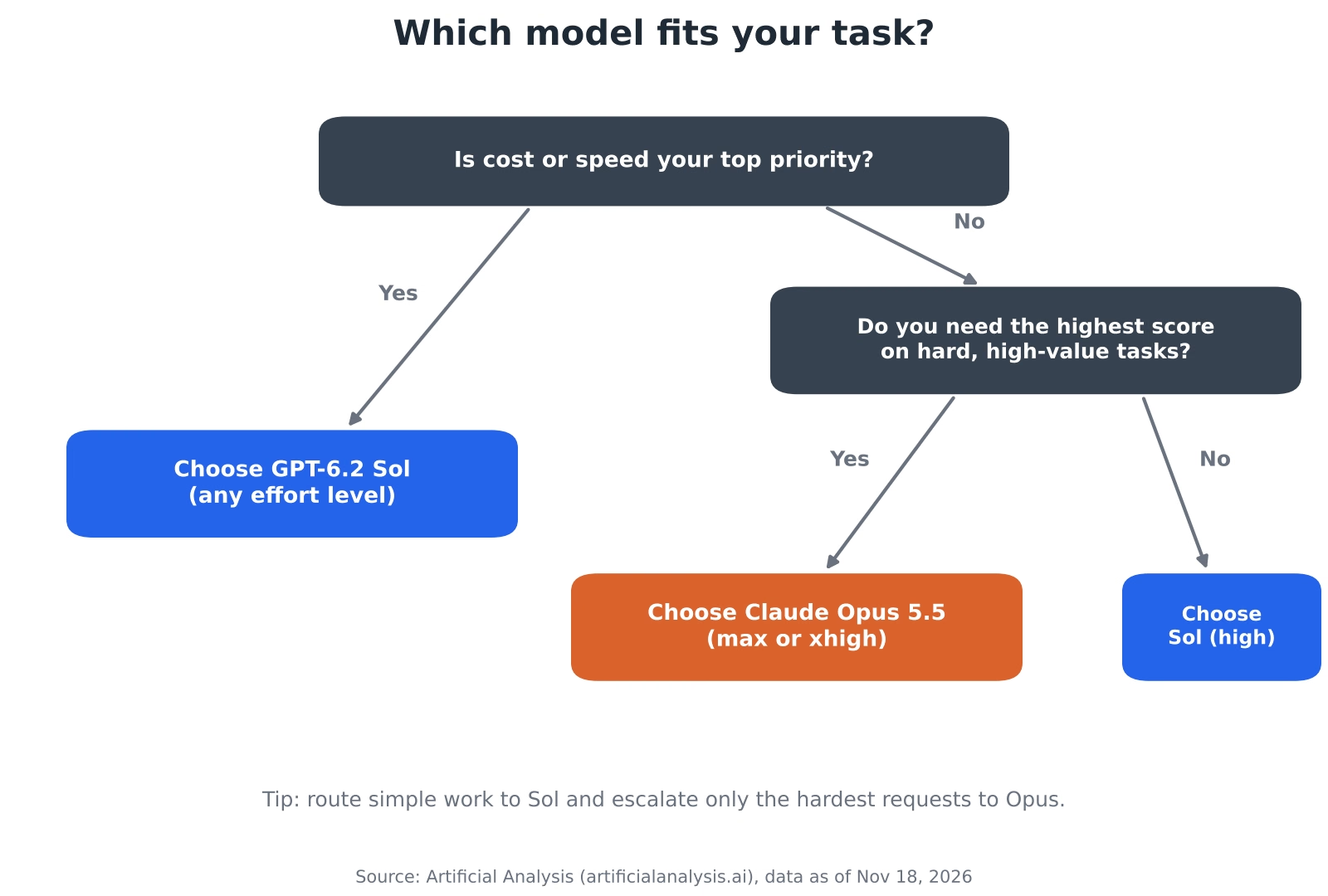
Use GPT-6.2 Sol if you want good results quickly and at a low price. If you want the highest score but are willing to pay more and accept slower responses, choose Claude Opus 5.5.
Select GPT-6.2 Sol when:
- You are running many tasks and costs come into play.
- Answers must be provided within seconds or a few minutes.
- You prefer good performance at “high” or “medium” effort.
- You want the answer to be brief.
Select Claude Opus 5.5 when:
- Two points are worth a valuable work.
- The answers are available after a longer time.
- You are purchasing AI from AWS, Google or Azure.
- Estimate around 10 times as much money for each task.
Use both when:
You prefer routing simple problems to Sol and hard problems to Opus.
Typically, there is a routing setup. For the most part, send to the more affordable, available one. Only escalate the very tough ones. This helps to maintain high quality and low cost.
To build that routing yourself, an AI agent builder lets you describe which tasks go to which model and where a person reviews.
Also Read: Claude Opus 5.5 low vs GPT-6.1 Sol low for how the two compare at the cheap end.
How We Compared These Models
The figures are all from the Independent benchmarking site Artificial Analysis. The scores are based on the average of nine evaluations, namely Intelligence Index v5.0.1. The cost, speed, and token data are provided by each company's API. Speed & latency are averages of the most recent runs.
Three limits apply. The Index is a general measure; your own tests may be different. The source page has “Max, Default Fallback” as the title for Opus figures. Sol is still a few days old, and its numbers could fluctuate.
Try each model with your own questions before making your choice.
Conclusion
GPT-6.2 Sol is two points behind Claude Opus 5.5. That results in a cost of around 10 times as much per task and roughly 3 times greater waiting time. In most cases, GPT-6.2 Sol offers a more balanced performance. Opus gets its price on the most difficult, high-ticket work.
The best approach is to match the model and effort to the task. Use Sol for volume. If enough points are added to the bill, use Opus.
Choose a model and use it. Emergent is an app builder that can help you turn your concept into a functioning application. Your software will look the way you envisioned. Your application will carry your essence, embodying your business idea every time you log in. Tell them what you want and begin building with Emergent today.
Describe it. Build it. Launch it.
- End-to-End Creation
- No Code Needed
- Live in Minutes

Most AI app builders stop at prototypes. Emergent creates production-ready apps you can actually launch.
- Production-ready apps
- Web & mobile apps
- Deploy in minutes





