




TL;DR
- Overall performance: GPT-6.2 Sol scores 55 on the Artificial Analysis Intelligence Index, compared with Gemini 4 Argon's 50 at High reasoning.
- Coding and automation: Sol leads in four of five selected benchmarks, while Argon performs better on AutomationBench-AA.
- Speed: Sol completes Intelligence Index tasks approximately 6.3× faster and delivers its first answer token around 4.5× faster.
- Pricing: Both models currently charge $2 per million input tokens and $10 per million output tokens, although Argon's rates are scheduled to increase in December 2026.
- Best use cases: GPT-6.2 Sol is worth considering for coding, complex reasoning, and latency-sensitive applications. Gemini 4 Argon is worth evaluating for SaaS automation and applications requiring native audio or video understanding.
With the recent launch of GPT-6.2 Sol, comparisons with other leading AI models, including Google's Gemini 4 Argon, are only natural. As AI models continue to evolve, developers and businesses face an increasingly important question: which model offers the right balance of intelligence, speed, capabilities, and cost?
Both models are capable of handling demanding AI workloads, but their strengths extend beyond benchmark scores. Differences in reasoning, coding, response speed, and multi-step execution can influence how well they perform in everyday business applications.
This comparison examines GPT-6.2 Sol and Gemini 4 Argon across their capabilities, independent benchmarks, speed, API pricing, coding performance, and practical use cases. It draws on published evaluations and official documentation to identify their respective strengths and limitations.
GPT-6.2 Sol vs. Gemini 4 Argon: At a Glance
GPT-6.2 Sol and Gemini 4 Argon serve overlapping but somewhat different requirements. OpenAI positions Sol as an efficient model for everyday work, coding, and AI agents at scale, while Google emphasizes Argon's capabilities in complex reasoning, software engineering, and long-running workflows.
The table below compares their specifications, supported capabilities, and standard API pricing as of November 19, 2026.
| Feature | GPT-6.2 Sol | Gemini 4 Argon |
|---|---|---|
| Developer | OpenAI | Google DeepMind |
| Release date | November 17, 2026 | September 30, 2026 (initial announcement) |
| Primary focus | Everyday work, coding, and AI agents | Advanced reasoning, coding, and complex workflows |
| Context window | 1,050,000 tokens | Up to 1M tokens, combined input and output |
| Maximum output | 128,000 tokens | 65,536 tokens per streaming segment; up to 1M with long-decode continuation |
| Input modalities | Text and images | Text, images, audio, and video |
| Output modality | Text | Text |
| Function calling | Supported | Supported through Gemini API |
| Standard API input price (per 1M tokens) | $2.00 | $2.00 (introductory) |
| Standard API output price (per 1M tokens) | $10.00 | $10.00 (introductory) |
| Scheduled pricing change | No announced change | $4 input / $20 output from December 1, 2026 |
GPT-6.2 Sol vs. Gemini 4 Argon: model specifications and API pricing as of November 19, 2026. Sources: OpenAI model documentation, OpenAI's GPT-6.2 announcement, Google Developer API Pricing, and Google's official Argon announcement. Pricing is in USD per million tokens and excludes applicable discounts or additional charges.
Both models currently have identical standard API input and output token rates. However, Gemini 4 Argon's introductory pricing is scheduled to end on November 30, 2026. This could make GPT-6.2 Sol more economical per token from December, assuming OpenAI's pricing remains unchanged.
The larger distinction lies in their intended workloads and supported modalities. Sol offers a substantial context window and integration with OpenAI's developer tools, while Argon supports additional input types and extended generation through Google's continuation mechanisms.
These specifications provide a useful starting point, but benchmark performance, latency, and cost per completed task are necessary to understand their practical differences.
What's New in GPT-6.2 Sol?
Launched on November 17, 2026, GPT-6.2 Sol builds on GPT-6.1 Sol with improvements in coding, code review, and agentic workflows. The latest iteration focuses on helping developers and businesses complete complex tasks more reliably while making efficient use of tokens and developer tools.
Improved Coding and Code Review
One of GPT-6.2 Sol's notable improvements is its ability to identify issues in existing code. According to GitHub's early testing, the model identified nearly twice as many genuine code-review issues as GPT-6.1 Sol while maintaining the accuracy of its findings.
This makes Sol particularly relevant for developers reviewing pull requests, debugging applications, and maintaining large codebases. However, these findings relate specifically to code review and should not be interpreted as an equivalent improvement across all coding tasks.
Greater Efficiency in Multi-Step Workflows
GPT-6.2 Sol is designed to support tasks involving multiple reasoning steps, tool interactions, and iterative execution. Improvements in token efficiency can be particularly valuable for applications that process complex instructions or perform repeated operations.
For businesses, this could mean fewer unnecessary iterations and more efficient execution of automated workflows. Actual performance and cost savings will depend on the task, configuration, and model usage.
Tool Integration and Agentic Capabilities
GPT-6.2 Sol supports function calling, structured outputs, and integration with developer tools through OpenAI's API ecosystem. These capabilities allow developers to build AI agents that retrieve information, process documents, execute supported operations, and return structured results.
While several of these capabilities were also available with GPT-6.1 Sol, the newer model aims to improve the quality and reliability of their execution.
GPT-6.2 Sol vs. Gemini 4 Argon: Benchmark Performance
Independent benchmarks help assess how GPT-6.2 Sol and Gemini 4 Argon perform across reasoning, coding, and agentic workflows. Artificial Analysis provides directly comparable results for both models using its Intelligence Index v5.0.1 and individual evaluations.
Intelligence and Reasoning Performance
The Artificial Analysis Intelligence Index combines nine evaluations covering reasoning, knowledge work, coding, and automation.
| Metric | GPT-6.2 Sol (High) | Gemini 4 Argon (High) |
|---|---|---|
| Intelligence Index | 55 | 50 |
| Finance & Accounting Index | 55 | 56 |
| Strategy & Operations Index | 58 | 57 |
| Legal Index | 51 | 55 |
| Healthcare & Medical Index | 51 | 51 |
GPT-6.2 Sol vs. Gemini 4 Argon: Artificial Analysis Intelligence Index v5.0.1 and capability scores, High reasoning settings. Source: Artificial Analysis. Accessed November 19, 2026.
GPT-6.2 Sol leads by five points on the overall Intelligence Index at High reasoning. However, the specialized capability scores reveal a more balanced picture. Argon performs slightly better in finance and accounting and has a stronger Legal Index score, while Sol leads narrowly in strategy and operations.
At its Max reasoning setting, Sol's Intelligence Index increases to 57. This demonstrates the importance of reasoning configuration when comparing models, as higher settings can affect latency and token consumption.
Coding and Agentic Performance
Coding and agentic benchmarks offer a more detailed view of how effectively each model handles software engineering, tool use, and automated workflows.
| Benchmark | GPT-6.2 Sol (High) | Gemini 4 Argon (High) |
|---|---|---|
| Terminal-Bench 4.0 | 58.6% | 57.1% |
| FrontierCode-AA 2.0 | 40.2% | 25.7% |
| AutomationBench-AA | 69.9% | 77.5% |
| CritPt v2 (Hard Subset) | 61.5% | 52.5% |
| Terminal-Bench-Science 0.1 | 67.6% | 52.9% |
Coding, automation, and reasoning benchmark results for GPT-6.2 Sol and Gemini 4 Argon at High reasoning settings. Source: Artificial Analysis, November 19, 2026.
Sol leads on four of the five evaluations, including FrontierCode-AA 2.0, where it achieves 40.2% compared with Argon's 25.7%. This suggests an advantage in the evaluated agentic software engineering tasks.
However, Argon leads on AutomationBench-AA, scoring 77.5% against Sol's 69.9%. This benchmark evaluates agentic SaaS workflows, making the result particularly relevant for applications involving connected business tools and automated operations.
A model that performs better on coding benchmarks may still fall behind on tasks involving business software and connected services.
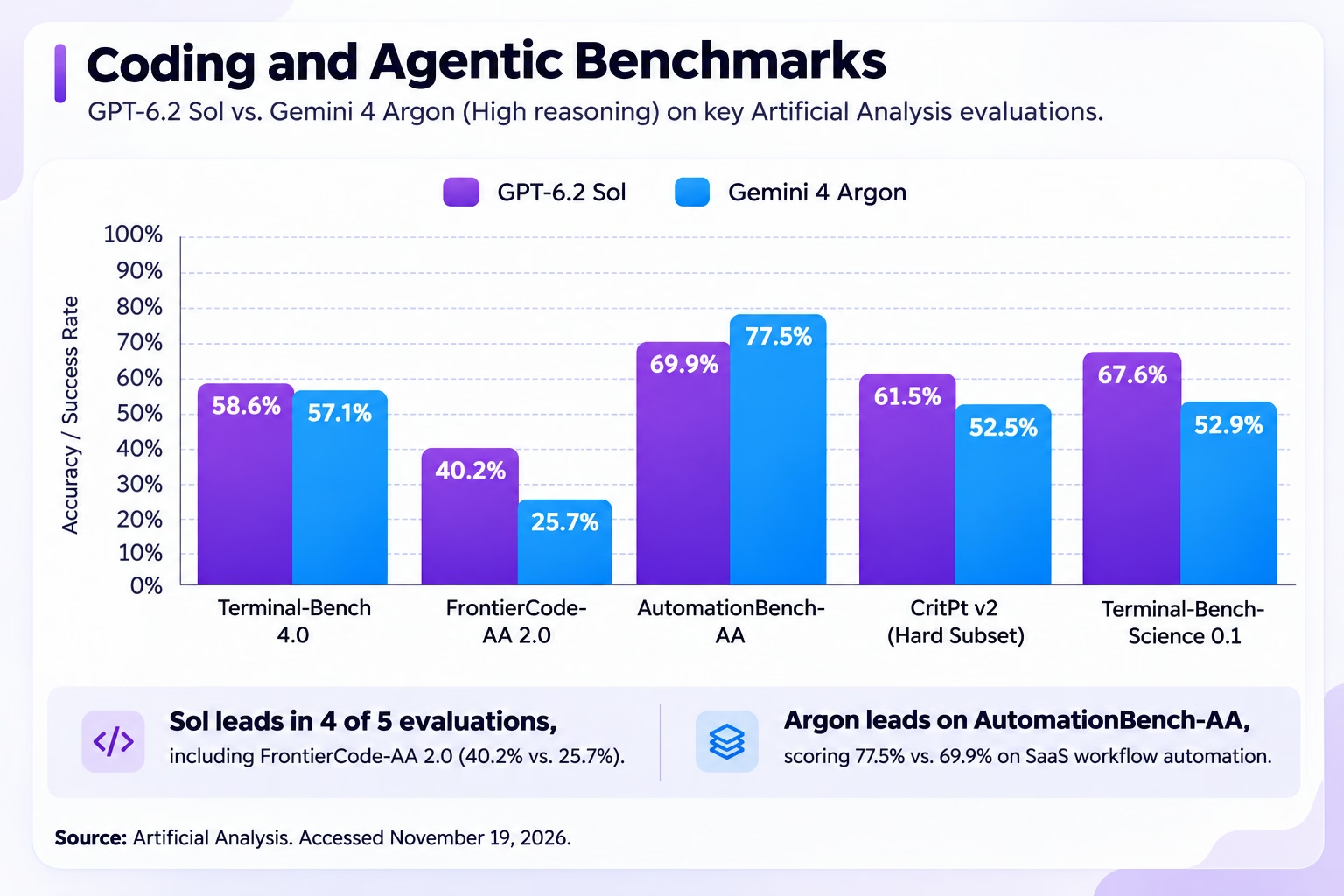
GPT-6.2 Sol vs. Gemini 4 Argon across five coding, reasoning, and agentic benchmarks. Sol leads in four evaluations, while Argon leads in AutomationBench-AA. Both models evaluated at High reasoning. Source: Artificial Analysis, accessed November 19, 2026.
What Do These Benchmark Results Mean in Practice?
GPT-6.2 Sol's stronger coding and reasoning scores make it worth considering for tasks involving software development, complex problem-solving, and AI-powered applications. Meanwhile, Gemini 4 Argon's advantage in AutomationBench-AA suggests potential strengths in automating workflows across connected business tools.
For businesses and individuals building AI-powered solutions, the better choice depends on the intended application. A model that excels at generating code may not necessarily perform better at automating business processes.
Ultimately, benchmark scores provide useful guidance, but real-world performance also depends on reliability, execution speed, and cost.
Also Read: Gemini 4 Carbon vs Gemini 4 Argon for how Google’s two frontier models differ.
GPT-6.2 Sol vs. Gemini 4 Argon: Speed, Latency, and Efficiency
Speed is an important consideration when choosing an AI model, particularly for applications involving customer interactions, document processing, and multi-step workflows. However, response latency and task completion speed measure different aspects of performance.
Artificial Analysis measurements indicate that GPT-6.2 Sol is considerably faster than Gemini 4 Argon across the two evaluated metrics at High reasoning settings.
How Fast Are GPT-6.2 Sol and Gemini 4 Argon?
| Performance metric | GPT-6.2 Sol (High) | Gemini 4 Argon (High) |
|---|---|---|
| Time per Intelligence Index task | 4.7 minutes | 29.7 minutes |
| Time to first answer token | 11.14 seconds | 49.73 seconds |
GPT-6.2 Sol vs. Gemini 4 Argon: independent performance measurements at High reasoning. Source: Artificial Analysis, accessed November 19, 2026.
GPT-6.2 Sol requires approximately 84% less time per Intelligence Index task than Gemini 4 Argon under these evaluation conditions. It also delivers its first answer token approximately 4.5 times faster.
These results suggest that Sol may offer a more responsive experience for applications requiring frequent interactions or complex task execution. However, benchmark measurements do not guarantee identical performance across every real-world workload.
Response Latency vs. Task Completion Speed
The two metrics highlight different aspects of model performance:
- Time to first answer token: Measures how long the model takes to begin delivering its answer. Lower latency is particularly valuable for conversational applications, customer support, and interactive AI tools.
- Time per Intelligence Index task: Measures the average time required to complete tasks in the Artificial Analysis Intelligence Index evaluation. It reflects the combined effects of reasoning, generation, and evaluation conditions.
For example, a customer-facing AI assistant benefits from faster initial responses, while an application analyzing financial documents or completing complex research may prioritize overall task completion time.
Why Token Efficiency Matters
Faster execution can improve the user experience, but it doesn't always reduce operating costs. Two reasoning models may consume different numbers of tokens to complete the same task, even when their API token rates are identical. A model that requires fewer tokens can therefore be more economical, although accuracy and task completion rates must also be considered.
For businesses, the most useful model is one that completes tasks accurately, quickly, and at a reasonable cost. Speed alone doesn't determine efficiency.
Also Read: GPT-6.1 Sol pricing for how OpenAI priced caching and long prompts on the previous Sol.
GPT-6.2 Sol vs. Gemini 4 Argon: Pricing and Cost Comparison
GPT-6.2 Sol and Gemini 4 Argon currently have identical standard API token prices. However, their actual operating costs can differ considerably depending on reasoning effort, token consumption, and task complexity.
For businesses building AI-powered applications, understanding these differences is essential when estimating costs and choosing a model for long-term use.
API Pricing: GPT-6.2 Sol vs. Gemini 4 Argon
| Pricing metric | GPT-6.2 Sol | Gemini 4 Argon |
|---|---|---|
| Input tokens (per 1M) | $2.00 | $2.00 |
| Output tokens (per 1M) | $10.00 | $10.00 |
| Cached input (per 1M) | $0.10 | $0.10 |
| Standard input price from Dec. 1, 2026 | $2.00* | $4.00 |
| Standard output price from Dec. 1, 2026 | $10.00* | $20.00 |
Standard API pricing in USD per million tokens, as of November 19, 2026. Rates shown apply to standard, short-context requests. OpenAI applies higher token rates to GPT-6.2 Sol requests exceeding 272,000 input tokens. Gemini 4 Argon's introductory rates apply through November 30, 2026, with higher standard rates effective December 1. Sources: OpenAI API Pricing and Google Gemini API Pricing.
Both models currently charge $2 per million input tokens and $10 per million output tokens. However, Google's introductory pricing for Argon is scheduled to end on November 30, 2026, after which its standard rates will double.
This makes the timing of deployment relevant for businesses estimating ongoing API expenses. For how Argon’s introductory rates, December increase, and cached input are priced, see our Gemini 4 Argon pricing guide.
How Much Would a Typical Workload Cost?
Consider an application processing 10 million input tokens and generating 2 million billable output tokens each month.
| Cost component | GPT-6.2 Sol | Gemini 4 Argon |
|---|---|---|
| 10M input tokens | $20 | $20 |
| 2M output tokens | $20 | $20 |
| Total monthly cost | $40 | $40 |
| Monthly cost from Dec. 1, 2026* | $40 | $80 |
Illustrative costs based on published standard rates and identical billable token volumes. Excludes caching discounts, additional tool charges, and variations in reasoning-token consumption. Sol's future cost assumes unchanged pricing.
At current rates, both models would cost $40 per month under these assumptions. However, Argon's scheduled pricing increase would raise its monthly cost to $80 for the same token volumes.
These calculations illustrate API expenditure rather than the actual cost of completing equivalent tasks. Models can consume different numbers of tokens even when processing identical requests.
Cost per Completed Task: What Does Artificial Analysis Show?
Artificial Analysis measures the weighted average cost of completing tasks in its Intelligence Index, accounting for token consumption and applicable pricing.
| Metric | GPT-6.2 Sol (High) | Gemini 4 Argon (High) |
|---|---|---|
| Cost per Intelligence Index task | $0.56 | $4.97 |
| Intelligence Index score | 55 | 50 |
Independent cost-per-task measurements using High reasoning settings. Source: Artificial Analysis, accessed November 19, 2026.
Under these evaluation conditions, Sol costs approximately 89% less per Intelligence Index task than Argon. This is a substantial difference despite their identical published token rates.
This illustrates why token pricing alone cannot determine which AI model is more economical. Reasoning-token usage, response length, and task execution patterns can significantly influence actual expenditure.
However, these figures represent Artificial Analysis evaluation workloads, not guaranteed costs for every business application.
Which Model Offers Better Value?
GPT-6.2 Sol currently offers a compelling combination of higher overall Intelligence Index performance, faster task execution, and lower measured cost per task.
Gemini 4 Argon remains worth evaluating for workloads where its specific capabilities provide an advantage, particularly SaaS workflow automation, where it leads in AutomationBench-AA.
For businesses and individuals developing AI-powered applications, the better approach is to compare task success, latency, and total expenditure rather than select a model solely on its advertised token prices.
GPT-6.2 Sol vs. Gemini 4 Argon: Context Window and Multimodal Capabilities
Both GPT-6.2 Sol and Gemini 4 Argon support extensive context windows, making them suitable for analyzing lengthy documents, processing large datasets, and working with complex information. However, they differ in supported input formats, output limits, and how they handle extended generation.
Context Window and Long-Document Processing
GPT-6.2 Sol supports a 1,050,000-token context window, with maximum input and output limits of 922,000 and 128,000 tokens, respectively. Gemini 4 Argon uses a unified input-output context window of approximately one million tokens. Unlike Sol's separate input and output limits, Argon's available output capacity decreases as input consumption increases. Generating more than its standard output segment limit requires supported long-decode mechanisms.
These capacities allow both models to process substantial amounts of information, including financial reports, research papers, and large codebases.
For example, a business could use either model to analyze multiple annual reports and extract financial insights without dividing every document into separate requests.
However, supporting a million tokens doesn't mean a model will interpret every detail equally well. When analyzing lengthy documents, its ability to locate relevant information, connect findings across sections, and avoid overlooking important details matters just as much as the advertised context limit.
Multimodal Capabilities: What Can Each Model Process?
| Capability | GPT-6.2 Sol | Gemini 4 Argon |
|---|---|---|
| Text input and output | Supported | Supported |
| Image understanding | Supported | Supported |
| Audio understanding | Not supported natively | Supported |
| Video understanding | Not supported natively | Supported |
| Maximum context | 1.05M tokens | 1M tokens, shared input/output |
| Maximum output | 128K tokens | Up to 65,536 tokens per streaming segment; extended generation up to 1M tokens through supported continuation mechanisms. |
| Function calling | Supported | Supported |
| Structured outputs | Supported | Supported through compatible API configurations |
GPT-6.2 Sol vs. Gemini 4 Argon: context limits, multimodal capabilities, and API features. Sources: OpenAI's GPT-6.2 Sol documentation and Google DeepMind's Gemini 4 Argon model card. Accessed November 19, 2026.
Gemini 4 Argon offers broader native input support, allowing applications to process audio and video alongside text and images. This can be particularly useful for analyzing recorded meetings, interpreting video content, or building multimodal research applications.
GPT-6.2 Sol supports text and image inputs, with integrations for tools such as web search, file search, and code execution through OpenAI's Responses API.
Tool Integration and AI-Powered Workflows
Both models support tool-enabled workflows through their respective APIs, allowing applications to retrieve information, process documents, and interact with external services.
For non-technical users, app builders can simplify these integrations by handling much of the underlying development work.
GPT-6.2 Sol vs. Gemini 4 Argon: Coding and AI Agent Performance
Both models support coding and AI agent development, but their benchmark results suggest different strengths. These differences matter to developers and businesses using AI-powered tools to build applications and automate workflows.
Coding Capabilities: Where Does Each Model Excel?
GPT-6.2 Sol demonstrates stronger performance on several independent coding evaluations, including FrontierCode-AA 2.0 and Terminal-Bench 4.0.
These results suggest that Sol is particularly worth evaluating for tasks involving code generation, debugging, and software maintenance.
For example, building an expense management application involves more than generating code. The application must accept user inputs, calculate totals, store records, and respond correctly to user actions.
Sol's coding performance makes it a promising candidate for such workflows. However, benchmark scores alone cannot establish whether an application will work correctly without testing its functionality.
Also Read: Best AI models for coding for how Sol and Argon rank against other coding models.
AI Agents and Business Workflow Automation
AI agents go beyond answering questions. They can interact with tools, retrieve information, execute predefined actions, and coordinate tasks across connected systems.
Here, Gemini 4 Argon demonstrates a notable advantage on AutomationBench-AA, suggesting stronger performance in the evaluated SaaS automation workflows.
For example, a business might use an AI agent to retrieve customer information, update records, and generate follow-up reports. Such workflows require reliable tool interactions and accurate execution across multiple steps.
Sol remains competitive in agentic tasks, particularly those involving software engineering. However, Argon's automation benchmark advantage illustrates why coding performance and business workflow automation should be evaluated separately. To build an agent around your own SaaS workflow, an AI agent builder lets you describe the steps and where a person reviews.
What About Non-Technical Users?
For users without programming experience, AI-powered application builders can make these capabilities more accessible. Instead of writing code manually, users can describe their requirements in natural language and use an application-building platform to generate and refine the software.
However, the underlying model is only one part of the process. Application quality also depends on the platform's development tools, integrations, testing, and deployment capabilities.
Whether building a customer management system, an internal dashboard, or a workflow automation tool, the priority should be a functional application that meets the user's requirements rather than the model with the highest benchmark score.
GPT-6.2 Sol vs. Gemini 4 Argon: Which Model Should You Choose?
The right model depends on what your application needs to accomplish. The recommendations below offer a starting point based on independent benchmarks, supported capabilities, and measured efficiency. For production applications, test both models against your own requirements before making a final decision.
| Use case | Recommended model | Primary reason |
|---|---|---|
| Coding and debugging | GPT-6.2 Sol | Stronger coding benchmark results |
| Complex reasoning | GPT-6.2 Sol | Higher overall Intelligence Index |
| SaaS workflow automation | Gemini 4 Argon | Higher AutomationBench-AA score |
| Time-sensitive applications | GPT-6.2 Sol | Lower measured latency |
| Audio and video analysis | Gemini 4 Argon | Native multimodal input support |
| Cost-sensitive AI applications | GPT-6.2 Sol | Lower measured cost per task |
Neither model is universally superior. Sol offers advantages in several coding, speed, and cost evaluations, while Argon remains competitive in automation and multimodal applications. The final choice should reflect the tasks an application needs to perform.
Conclusion: GPT-6.2 Sol vs. Gemini 4 Argon
GPT-6.2 Sol demonstrates advantages in coding benchmarks, response speed, and cost per completed task, making it a compelling choice for AI-powered applications. Gemini 4 Argon, meanwhile, offers strengths in SaaS workflow automation and native multimodal processing.
However, benchmark leadership does not guarantee better performance across every application. The right choice depends on task complexity, reliability, integration requirements, and operating costs.
For businesses and individuals looking to turn AI capabilities into functional software, platforms such as Emergent can simplify application development without requiring extensive coding knowledge.
The right choice comes down to which model delivers reliable results for your application without unnecessary complexity or cost.
Describe it. Build it. Launch it.
- End-to-End Creation
- No Code Needed
- Live in Minutes

Most AI app builders stop at prototypes. Emergent creates production-ready apps you can actually launch.
- Production-ready apps
- Web & mobile apps
- Deploy in minutes





