
To answer 'how long does it take to build a website?', I built the same four-page site three ways and found that building was rarely the slowest part. On an AI builder, four marketing pages came back before my coffee went cold, drafted from a single prompt in minutes.
I spent the next week finishing my own copy and photos after the tool had completed the pages.
To compare the methods, I built the same four-page content marketing service site using an AI builder, a DIY builder, and WordPress, with the same copy and images for each build. I timed only the building and editing work. Publishing the sites live wasn’t a part of my testing.
For the same four-page site, the build method changed the timeline. Here is how long it takes to build a website with each method, and how to pick the one that fits your deadline.
The Short Answer: It Depends on Your Build Method
How long it takes to build a website depends almost entirely on your build method.
A simple site can be built in minutes to a couple of hours with an AI builder. A DIY drag-and-drop build takes a weekend to a week or two. WordPress runs days to weeks, and a custom or professional build stretches from weeks for a standard professional site to several months, or a year or longer for a full custom app.
Once the initial pages were ready, content and scope took the most time. Writing the copy, gathering case study screenshots, and deciding what the site needs can add days after the initial pages are ready.
All of that comes back to your deadline. Pick the method that fits it, then protect the timeline by having your content ready before you start.
Here is the clock for each method, side by side.
The Website Build-Time Table, by Method
The "Best for" column is the part to read closely. Each method is fastest at a different job, so the right timeline depends on what you're building.
The Build Methods, From Fastest to Most Custom
There are four common ways to build a site, and the method you pick has the largest effect on the timeline. Across the three builds, the AI run took under an hour, the DIY run took a full weekend, and the WordPress run lost its first day to setup.
Method 1: AI Website Builders (Minutes to a Couple of Hours)
I gave the AI website builder a single prompt describing the site and let it run. The prompt was one paragraph, roughly this:
"Build a four-page marketing website for a small content-marketing service: a home page, a services page, a case studies page, and a contact page. Keep the design clean and professional, write benefit-led copy, make the site responsive, and include clear calls to action leading to the contact page.
Use placeholder images and sample case studies."

All four pages came back right away. The initial pages took minutes to generate. Once my content was ready, replacing the placeholder copy and images took less than an hour. Nothing about the structure needed fixing, so the whole job came down to editing what was already there.
The domain and hosting took a few minutes to wire in. Bundled setup made page generation much faster than preparing and replacing the content.
What it is: An AI builder generates a full draft site from a text prompt, then lets you edit it. The AI builder I tested bundled hosting and domain setup, so that part took almost no time.
How it works: You describe your site, the tool drafts the pages, and you swap copy and images. For a simple site, that's the whole job.
This was the fastest method I tested for a simple site. A tool like Emergent can produce a marketing-site draft the same afternoon, while Carrd and Google Sites are simpler options for a one-page portfolio.
Method 2: DIY Drag-and-Drop Builders (A Weekend to a Week or Two)
I rebuilt the same site over a weekend on a drag-and-drop builder, laying out the services page and case studies by hand this time. The template did the heavy lifting up front, so I hit something like 80% of a finished-looking site inside the first hour. Then the last 20% took over.
I spent most of Saturday nudging content blocks a few pixels at a time, lining up spacing the template got almost, but not quite, right. Setup was still near zero, no hosting or plugins to wire up, so every hour I spent went into polish instead of plumbing.
The first hour feels like you're nearly done, but the finishing pass can take the rest of the weekend.
What it is: A visual builder where you pick a template and drop content into it, no code required.
How it works: The template collapses the design phase, so you're editing a finished-looking site instead of building one from scratch.
An online website builder like Squarespace can get the structure close in an hour, but spacing and content edits can take the rest of the weekend.
This is the sweet spot for a small business site you want to own and control without code. A beginner can get a working site live in a weekend here. Expect the polish to be where your hours go. Setup barely figures in.
Method 3: WordPress and a Visual Builder (Days to Weeks)
WordPress gives you more room to grow, but its hosting, theme, and plugin setup took most of my first day before design began.

Where the drag-and-drop build wrapped in a weekend of roughly 10 to 20 hands-on hours, the same site on WordPress lands closer to the 20-to-40-hour range once you add the admin, the updates, and the moving parts you now own. The clock starts before design even begins.
What it is: WordPress is a content management system (CMS), the software that runs a huge share of the web. It's usually paired with a visual page builder like Elementor or Divi.
How it works: You set up hosting, install a theme and plugins, then build pages with the visual builder. The setup comes first, then a flexible build.
Pick this for a content-heavy or growing site, or a real blog. You get more power and more moving parts to manage. If you want to build a three-page site quickly, WordPress adds more setup than the job needs.
Method 4: Custom-Coded or Professional Builds (Weeks to a Year or Longer)
A custom build becomes relevant when a site needs functionality that standard builders cannot support, such as user accounts, stored data, or custom integrations. I did not build a custom-coded version of the four-page test site, so I compared this route using typical project timelines.
A custom build is what you reach for when the project hits a capability limit that weekend edits can't solve, and that limit often pushes a project toward custom development or an AI app builder.
What it is: A site built with custom code, by you or a professional, when a builder can't do what you need.
How it works: Someone designs, builds, and wires up the site from the ground up, including any custom functionality.
This is the long end of the range, and for good reason. A standard professional website often takes about 8 to 12 weeks, while more complex projects can stretch to five or six months. A custom app can take several months to a year or longer, depending on its scope and the work required before and after development.
The functionality drives that jump, well past the page count. A static site (fixed pages that look the same for everyone) is fast to build. A dynamic site (one that reacts to each user with logins and stored data) is a different project entirely.
The AI builder produced my four static marketing pages in under an hour. Projects that need user accounts, stored data, or custom logic fall into a different build category, where a custom developer or AI app builder becomes another option.
How Long It Takes by Site Type
The method sets the pace, but the type of site shifts the clock too. An eCommerce store requires more work than a one-page portfolio, even on the same builder.
An eCommerce build adds separate work for products, payment setup, taxes, and end-to-end checkout testing. Those steps can add days beyond the storefront design.
Website Timeline at a Glance
An eCommerce store on Shopify or WooCommerce can look done in a day and still take weeks to launch. The storefront goes up quickly, but products, payments, and checkout testing are where the clock runs.
The Phases of a Website Build (and How Long Each Takes)
Whatever method you pick, the process of building a website moves through the same phases. Knowing where the hours land helps you plan around the slow ones instead of being surprised by them.
The project included planning, content preparation, page building, and testing, although the same copy and images were reused across all three builds. Publishing wasn’t a part of this test. The surprise was how little time the build itself took next to the content.
- Domain and hosting setup: The fastest part. It's near zero on AI and DIY builders, and a few hours on WordPress.
- Planning and strategy: Hours to days, depending on how clear you are on what the site needs to do.
- Design and wireframes: Collapsed to hours by templates, or stretched to weeks if you're designing custom.
- Development and build: The longest phase on a custom build, and fast on a builder.
- Content: Often the true bottleneck. Writing and gathering it can take longer than design and build combined.
- Testing and final review: Hours for a simple site, and days for eCommerce once you factor in checkout testing.
What Slows You Down
My final copy and photos took longer than the page structure in all three tests, so content set the pace.
Once you know that, you can plan around it. These are six factors to plan for, including the content and setup delays I saw in my tests.
- Content readiness: This was the largest delay across my three builds. If your copy and images aren't ready, the build stalls with nothing to fill it. Have final content in hand before you touch a builder.
- Scope creep: The number two delay. "Just one more page" and "one more section" turned one weekend into two. Each added page or section creates another round of writing, design, and review.
- Site complexity and custom functionality: Logins, data and logic, and integrations each add days. Every one is a small project inside the project.
- eCommerce setup: Payments, shipping, taxes, and end-to-end checkout testing are fixed added days regardless of the tool. Budget for them separately.
- Design and feedback cycles: Each approval round adds days. When a committee weighs in, days become weeks.
- Setup overhead: WordPress adds hosting, theme, and plugin time up front. AI and DIY builders bundle it, so you skip that first day.
The fix for most of this is preparation, and a faster tool won't buy back the time. The next section covers the moves that shorten a build.
How to Build a Website Faster
I learned these the hard way first, by losing time, then cutting it on the next run. After testing each method, I found four ways to shorten the build.
- Start by building your website with AI or a template: It collapses the design phase from days to minutes, so you edit a finished-looking site instead of building from a blank page.
- Prepare your content before you build: Write the copy and gather the images first, so the build doesn't stall waiting on you.
- Keep the scope tight: Build the core pages first, then add extra pages after the first version is complete.
- Match the platform to the job: Don't put a three-page site on a custom stack, or a web app on a brochure builder.
With your content ready, an AI builder is the fastest option for a simple site.
Which Build Method Should You Choose?
Needing a custom feature that your website builder cannot support is the clearest signal to consider custom development or an AI app builder. Short of that, the right method comes down to your deadline and how much control you want.
Here's the quick decision rule for each situation.
Choose an AI builder if: You want a simple site live today and will refine the copy later.
Choose a DIY builder if: You want a small business site you fully control without code, built over a weekend.
Choose WordPress if: You need room to grow, a real blog, or plugin flexibility, and you can handle the setup day.
Choose custom development or an AI app builder if: You need real logins, data and logic, or app functionality a website builder can't support.
Most people choose more complexity than they need. A builder works faster for a site with only a few information pages, so choose a custom build only when the features require it.
Where Emergent Fits Once You Outgrow Builders
The methods above cover almost every simple site. They run out at the same place mine did, the moment you need real logins, stored data, or functionality a template can't fake. For years, the only answer was to hire a developer and wait several months to a year, or longer, for a full web app.
That gap is where Emergent fits. It handles app-level projects with logins, stored data, and custom logic that DIY builders cannot support. You give Emergent a plain-language brief, and its agents can generate the pages, stored data, and custom logic, then test the project.
Wix and Squarespace fit simple brochure sites, while Emergent targets projects that need custom logic, logins, or stored data.
For projects that need app-like functionality, an AI app builder is another option to compare with traditional custom development.
How Emergent Helps You Build a Website
- Skip the hiring cycle: You describe the site in plain language, and agents build its interface, logic, and data without requiring you to wait to book a developer.
- Logins and stored data handled for you: Built-in user accounts and a managed database cover the exact features (member areas, stored data) that push a project past what a template can do.
- Built and live in one step: Your site deploys automatically to managed hosting, with the option to connect a custom domain.
- Testing before it goes out: Emergent tests the finished build and fixes detected issues before deployment.
You can try it for free. The free tier comes with 10 credits a month to build on, enough to describe your site and watch how far the agents take it before you commit to a plan. Start building on Emergent.
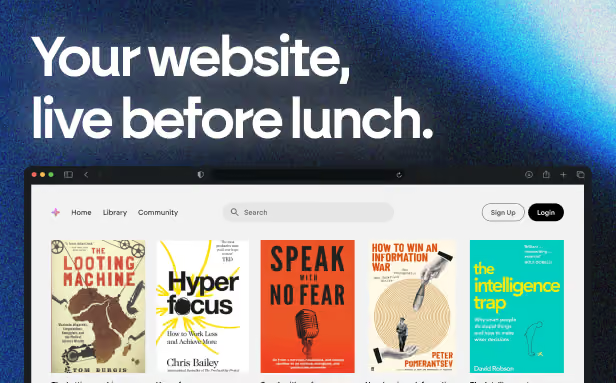
Emergent designs, writes, and publishes your whole site from one prompt. No templates, no drag-and-drop.
- Full site from one prompt
- Custom design, real pages
- Publish in minutes