TL;DR
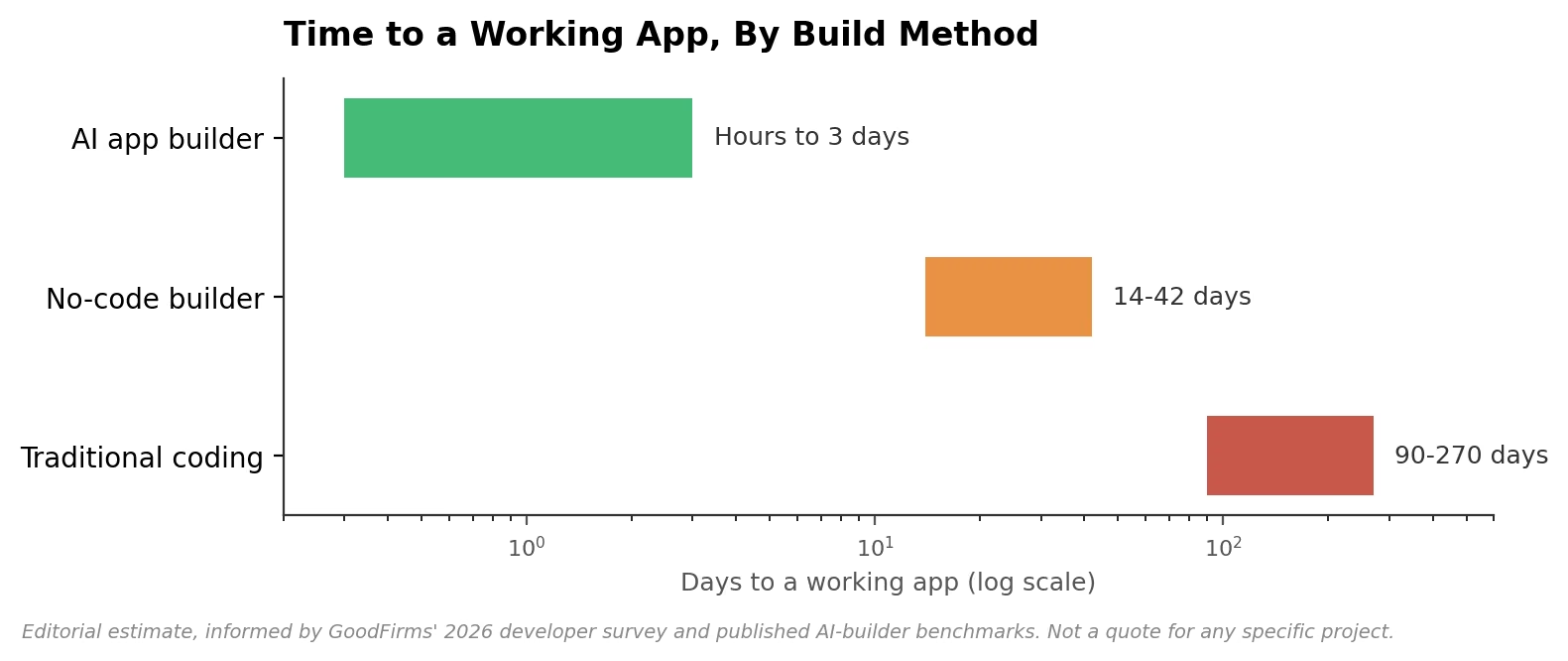
- Build time by method: An AI app builder can get a working app live in hours to a few days. A no-code builder takes about 2-6 weeks. Traditional coding takes 3-9 months for a simple to mid-sized app, and real programming skill.
- What's actually hard now: AI has taken most of the difficulty out of the technical build. The hard parts now are defining exactly what to build and getting people to open your app more than once, so budget your hardest effort there.
How hard it is to make an app depends less on whether you can code and more on which of three paths you take: traditional coding, a no-code builder, or an AI app builder, and each one carries its own time, cost, and skill requirement.
It also depends on which question you're really asking: are you asking how hard it is to build an app, or how hard it is to build one people actually keep using? Those are two different problems with two different difficulty curves, and confusing them is why so many first-time builders launch something nobody opens twice.
This guide draws on current cost and timeline surveys for traditional development, real build case studies for AI-assisted projects, and established product-validation research for the usage side.
It breaks down both: what determines difficulty, how the three build methods compare on time and cost, and where the difficulty has moved to now that AI has made the technical part easier.
What Actually Determines How Hard It Is to Build an App?
Four factors decide the difficulty of any app project, and they matter more than which tool you eventually pick.
- App complexity: A single-purpose tool (a calculator, a timer, a simple tracker) is a different project than something with user accounts, payments, and real-time data. Complexity is the biggest single driver of how hard the project is.
- Your technical starting point: Someone with zero technical background faces a steeper first month than someone who's written any code before, regardless of which build method they choose.
- Platform choice: A native app (built separately for iOS and Android) is more work than a cross-platform app, which is more work than a web app that runs in a browser with no app-store submission at all.
- Build method: Traditional coding, a no-code visual builder, or an AI app builder each carry a fundamentally different time and skill requirement for the same finished app, covered in detail below.
How Hard Is It to Make an App, By Method?
Of the four, the build method is the one you have the most control over, and it changes the difficulty equation more than any other decision you make.
| Method | Difficulty (1-10) | Time to a Working App | Best For |
|---|---|---|---|
| AI app builder | 2-3 | Hours to a few days | Validating an idea fast, business tools, apps with real logic |
| No-code builder | 4-5 | 2-6 weeks | Apps needing specific visual design control or a mature template library |
| Traditional coding | 8-9 | 3-9 months simple to mid-sized, up to 18+ for enterprise | High-performance apps, deep custom requirements, regulated industries |
Difficulty ratings above are our own editorial assessment, not a third-party benchmark. Timeline ranges are informed by GoodFirms' App Development Cost and Time Survey, which puts full custom timelines at 3 to 18-plus months depending on complexity.
The 5 Stages of Building an App, and Where Each One Gets Hard
Every app, regardless of build method, goes through the same five stages. The difficulty within each stage looks different depending on your path.
1. Idea and validation
The difficulty here is emotional. The real risk is building something nobody wanted. Talking to 10-15 people who match your target user before writing a single feature is the highest-leverage time you'll spend on the whole project.
2. Design (UX/UI)
Mapping how a user moves through the app (UX) and how it looks (UI) is where non-designers tend to underestimate the work. A confusing flow will sink an app faster than a missing feature ever will, and technical polish won't rescue a layout people can't figure out.
3. Development
This is traditionally the hardest, most technical stage, turning designs into working software, wiring up data storage and logic, handling the countless edge cases a shipped app runs into.
It's also the stage AI has changed the most concretely: indie developer Pieter Levels built a working 3D flight simulator, fly.pieter.com, in three hours using Cursor, despite having no prior game development experience, on February 22, 2025.

4. Testing
Testing across devices, screen sizes, and live user behavior catches the bugs that don't show up when you're the only person using the app. This stage is easy to rush and expensive to skip.
A buggy first impression is one of the fastest ways to lose a new user permanently.
5. Launch and maintenance
Getting into an app store is a process with its own rules and rejection risk. The work continues after launch: an app needs ongoing updates, bug fixes, and adjustments to new OS versions for as long as it exists.
Building an App vs. Making One People Actually Use
Everything above answers one question: how hard is it to build an app?
Making something people keep opening is a separate question, and first-time builders who treat the two as one problem set their expectations wrong.
Pieter Levels' fly.pieter.com is the clearest documented example of both sides of this at once. The three-hour build reached $1 million in annualized revenue within 17 days of launch, about $87,000 in its best month, driven by in-game sponsor slots and viral attention after a high-profile retweet.
That part is the build-difficulty story: a working, monetized product from a single prompt and an afternoon of iteration.
The usage-difficulty story arrived later: by mid-2026, the flight sim line in Levels' own public X bio read $0 per month.
The sponsor slots and one-time purchases weren't a recurring subscription base, and once the viral attention passed, the revenue left with it.
Meanwhile, his older product, Photo AI, built up gradually rather than overnight.
It was still generating roughly $100,000 a month as of mid-2026, down from a record $150,000 a month in September 2025, still durable in a way the flight sim never was.
The build difficulty curve has collapsed.
Whether a stranger comes back a second time is still decided by the same three things: a real problem, a first-run experience that doesn't confuse anyone, and enough ongoing value to earn a permanent place on someone's phone.
If you're choosing a build method partly to save time, spend the time you save on talking to users and refining what happens in someone's first 60 seconds with your app, not on adding more features before you've confirmed anyone wants the first version.
Is It Hard to Make an App If You're Not a Programmer?
No, if you use an AI app builder or a vibe coding platform like Emergent rather than traditional coding. For a non-programmer, the hard parts have always been translating how an app should function into concrete steps and having the patience to debug it. An AI builder now does most of that translation for you when you describe what you want in plain language.
What still requires effort regardless of technical background: defining exactly what your app should do, making design decisions a tool can't fully make for you, and testing the result with actual users. Those are judgment calls, and no build method removes them entirely.
How Much Does It Actually Cost to Make an App?
Cost splits sharply by build method, more than by anything else, and blending them into one number is where a lot of cost estimates go wrong. For a fuller breakdown, see how much it costs to create an app.
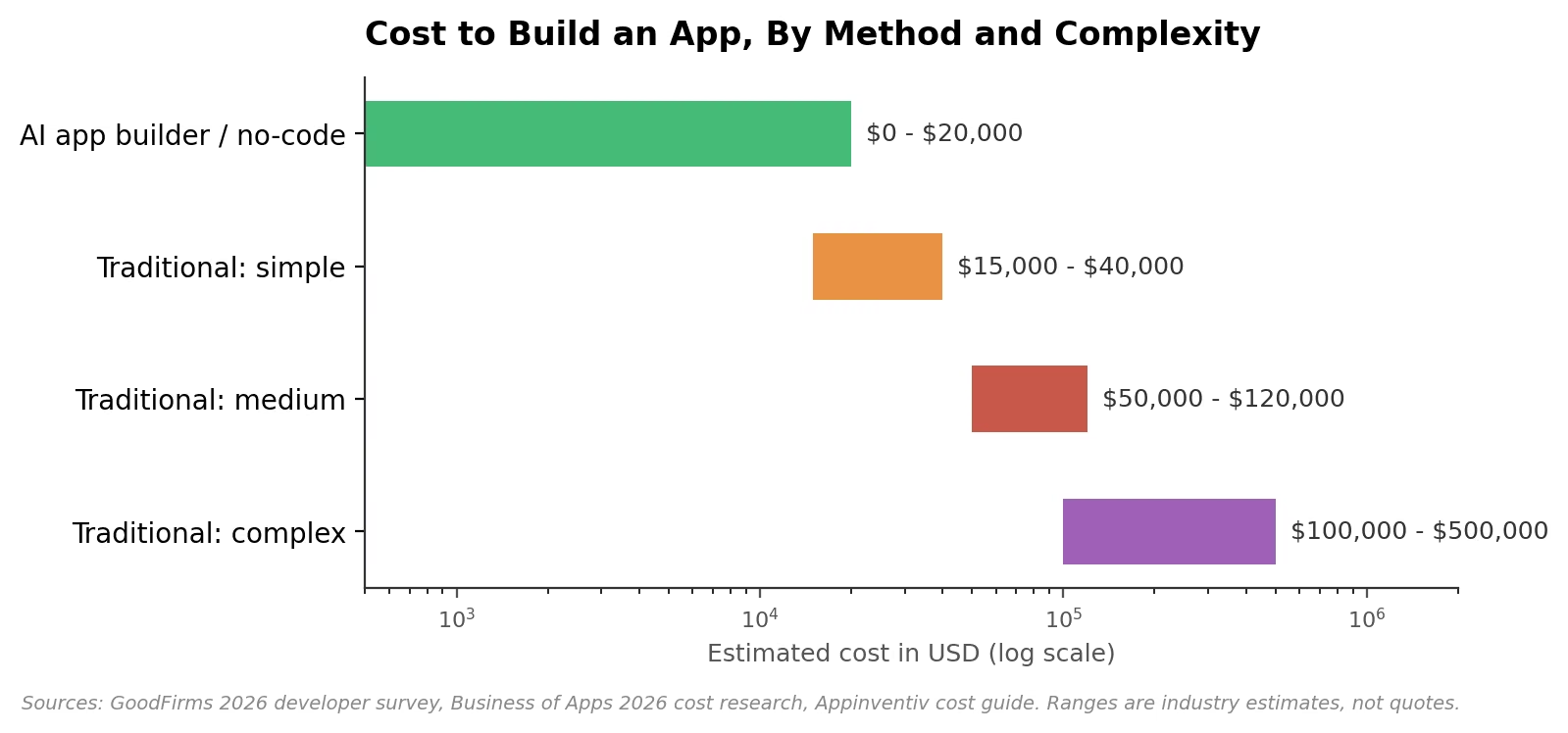
Building with an AI app builder or no-code tool: free to a few hundred dollars a year on subscription pricing for most projects, rising with usage rather than with engineering hours.
Hiring traditional development, simple app: roughly $15,000 to $40,000, per GoodFirms' 2026 developer survey, though estimates vary by source.
Hiring traditional development, medium complexity: roughly $50,000 to $120,000, per Business of Apps' 2026 cost research.
Hiring traditional development, enterprise-scale app: commonly $250,000 to $500,000 or more for a fully custom build with a dedicated team, real-time data, and enterprise-grade security, per industry cost surveys.
For a closer look at how this plays out for a specific type of build, see how much it costs to build an MVP, or how the same cost logic applies to a website build if your project is browser-based rather than a native app.
How Does an App Actually Make Money?
Building the app is only half the difficulty question. The other half is whether it can pay for itself, and that depends on which revenue model fits how people use it.
- Subscriptions: A recurring fee for ongoing access, the model behind Pieter Levels' durable $100,000-a-month Photo AI, and the one most SaaS-style tools default to.
- In-app purchases: One-time or repeatable purchases inside a free app, the model that carried fly.pieter.com's early revenue through cosmetic plane upgrades and ad slots.
- Freemium: A free tier with paid upgrades, useful for building an audience before asking anyone to pay.
- Advertising: Revenue from impressions or clicks, which usually needs a large, active user base to add up to anything.
- One-time purchase: A single upfront price, simple, but it puts all the pressure on that first purchase decision.
Which one fits depends on what the app does and how often people come back to it. For a fuller breakdown of each model and how to pick between them, see how apps make money.
Making an App with Emergent
Emergent is built specifically for the part of this equation that's changed the most: describe the app you need, and it builds a working version, including the logic, data handling, and hosting, without you needing to know how any of that works underneath.
That matters most at the harder end of the complexity scale covered above. A simple to-do list is easy on any AI builder; an app with custom scoring rules, conditional workflows, or multi-step approval processes needs a tool that can hold the rules together. Emergent builds workflows with conditions, triggers, and actions, approvals, notifications, and background processes, from the same conversation you used to describe the app. Notifications through services like Slack or SendGrid work once you connect your own webhook or API key.
Two parts of app-building stay with you either way: defining what your app should do, and figuring out whether people want it.
If you want the full build process end to end, see how to build an app without coding.
So, how hard is it to make an app? With an AI app builder, it's hours of describing what you want; with traditional coding, it's months of real programming work.
See current plans on the Emergent pricing page. There's a free tier with 10 credits a month, and the Standard plan is $20/month ($17 billed annually) for 100 credits. Worth knowing: keeping one app deployed uses 50 credits a month on its own.
Ready to create your app? Describe it to Emergent’s AI app builder and get a working first version back in minutes, free.
Most AI app builders stop at prototypes. Emergent creates production-ready apps you can actually launch.
- Production-ready apps
- Web & mobile apps
- Deploy in minutes