TL;DR
- A SaaS pricing model is the structure you bill under, separate from the specific price on your plan. The six SaaS pricing models covered here are flat-rate, tiered, per-seat, usage-based, freemium, and hybrid, and none of them is universally the right one.
- A pricing model (the structure) and a pricing strategy (how you land on the actual number) are two separate decisions.
- A lot of SaaS products drift toward a hybrid model (a predictable base fee plus a usage or seat layer on top) within a few years, because a single clean model rarely survives contact with customers.
A common shortcut is to copy a competitor's SaaS price and change the number slightly. It's fast, and it hands the decision to a competitor.
To see what works instead, I spent seven days working through the live pricing pages behind each of the six models below, checking how each company defines a seat, a task, or an included allowance.
One mistake sat under almost all of them: founders pick a price for being easy or familiar instead of one that matches how the product creates value. Copying a competitor's number is the fast way to make that mistake. A flat plan bleeding money on its heaviest users is the slow way to make it.
Here's the menu of SaaS pricing models, plus the difference between a pricing model and a pricing strategy. By the end, you'll know which structure fits your product, how to set a number inside it, which mistakes to avoid, and when it's time to change the model.
What Are SaaS Pricing Models? The 30-Second Answer
SaaS pricing models are the structural frameworks you use to charge customers for ongoing access to your product. A model is the shape of the bill: flat, tiered, per seat, metered by usage, free-to-start, or some blend of those. The specific number on the bill is a different question.
Confuse a model with a number, and you end up negotiating a price before you've settled on the structure that price has to fit inside.
Pricing Model vs. Pricing Strategy: Two Different Decisions
Search around long enough, and you'll run into two different-sounding answers. Some pages list four pricing models and treat freemium and hybrid as separate add-ons.
Others list seven pricing strategies, bundling in extra tactics like penetration pricing and price skimming alongside the three fundamentals. Both are right, because they're answering different questions.
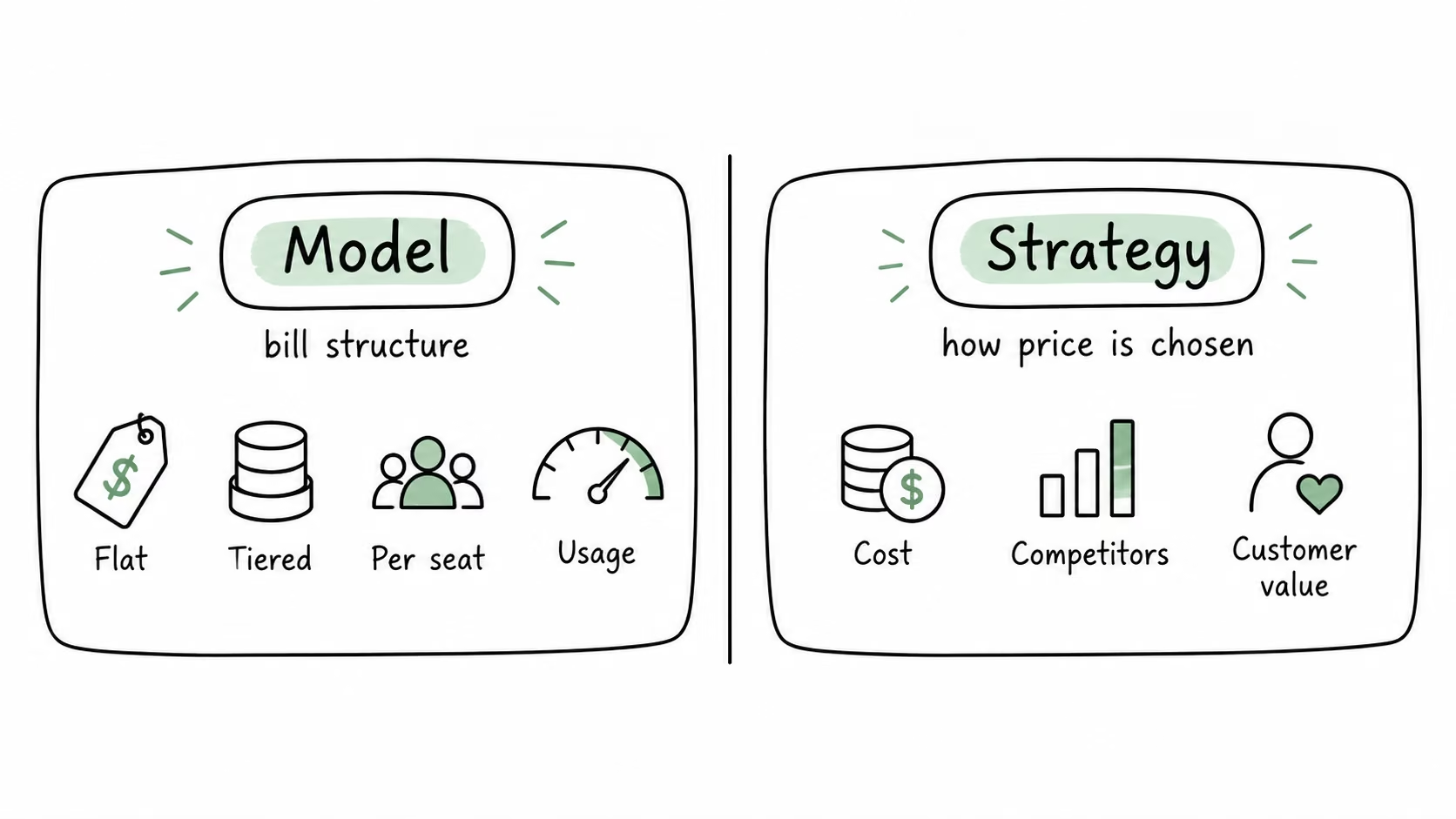
A pricing model is the billing structure. It's flat-rate, tiered, per-seat, usage-based, freemium, or hybrid, and it answers one question: What does the bill look like?
A pricing strategy sets the actual number inside that structure, using cost-plus, competitor-based, or value-based reasoning. It answers a different question: How did you land on $49 instead of $29 or $99?
You need both. Tiered pricing tells a customer how they'll pay, but it says nothing about whether $49 is the right price for your tier. That second question is a strategy decision.
Model vs. strategy, side by side:
| Pricing Model | Pricing Strategy | |
|---|---|---|
| What it answers | What does the bill look like? | How did you land on this specific number? |
| The options | Flat-rate, tiered, per-seat, usage-based, freemium, hybrid | Cost-plus, competitor-based, value-based |
| When you decide it | Early, usually locked in before launch | Ongoing, revisited as you gather usage and customer data |
| Who owns the call | Product and engineering, since it changes what you build and bill | Whoever owns pricing and go-to-market, since it changes what you charge |
The Six SaaS Pricing Models, and How Each One Works
Six models, each one anchored to a live example. Calendly earns two entries because its free tier and its paid seats are two different models sitting inside one product.
Flat-Rate Pricing
Flat-rate pricing charges one fixed price per plan, with no usage meter attached. The price for a given plan doesn't move based on team size or how heavily a team uses the product within it.
Basecamp builds its entire pitch around this idea. There are no per-seat fees on any tier. From Studio up, users are unlimited, and the price doesn't move as the team grows; the Free and Freelancer plans cap headcount at five and 20 people, which forces an upgrade rather than a per-seat charge.
Its two team plans run $59/month (Studio) and $99/month (Pro), and neither offers an annual-billing discount. Both stay month-to-month only. A separate Unlimited Edition tier runs $299/month, billed annually, with 1 TB of storage plus unlimited projects and users. Basecamp's plans scale by project count and storage, independent of headcount.
Flat-rate pricing is straightforward to sell and easy for a buyer to budget around. There's one number, and nobody has to do math to figure out what growing the team will cost.
That simplicity shifts the cost risk to your side of the business: A light user and a heavy user pay exactly the same amount. If your underlying cost scales with usage (service requests, compute, storage), your heaviest customers can cost far more to serve than they pay you.
Tiered Pricing (Good-Better-Best)
Multiple packaged plans at different price points, usually three, each adding more features, higher limits, or both as you move up.
Netflix is a clean example. It's a consumer subscription, unlike the usual B2B SaaS company, but the mechanic underneath is identical. Standard with ads, Standard, and Premium all sell the same core product, streaming video, though the ad-supported tier locks part of the catalog.
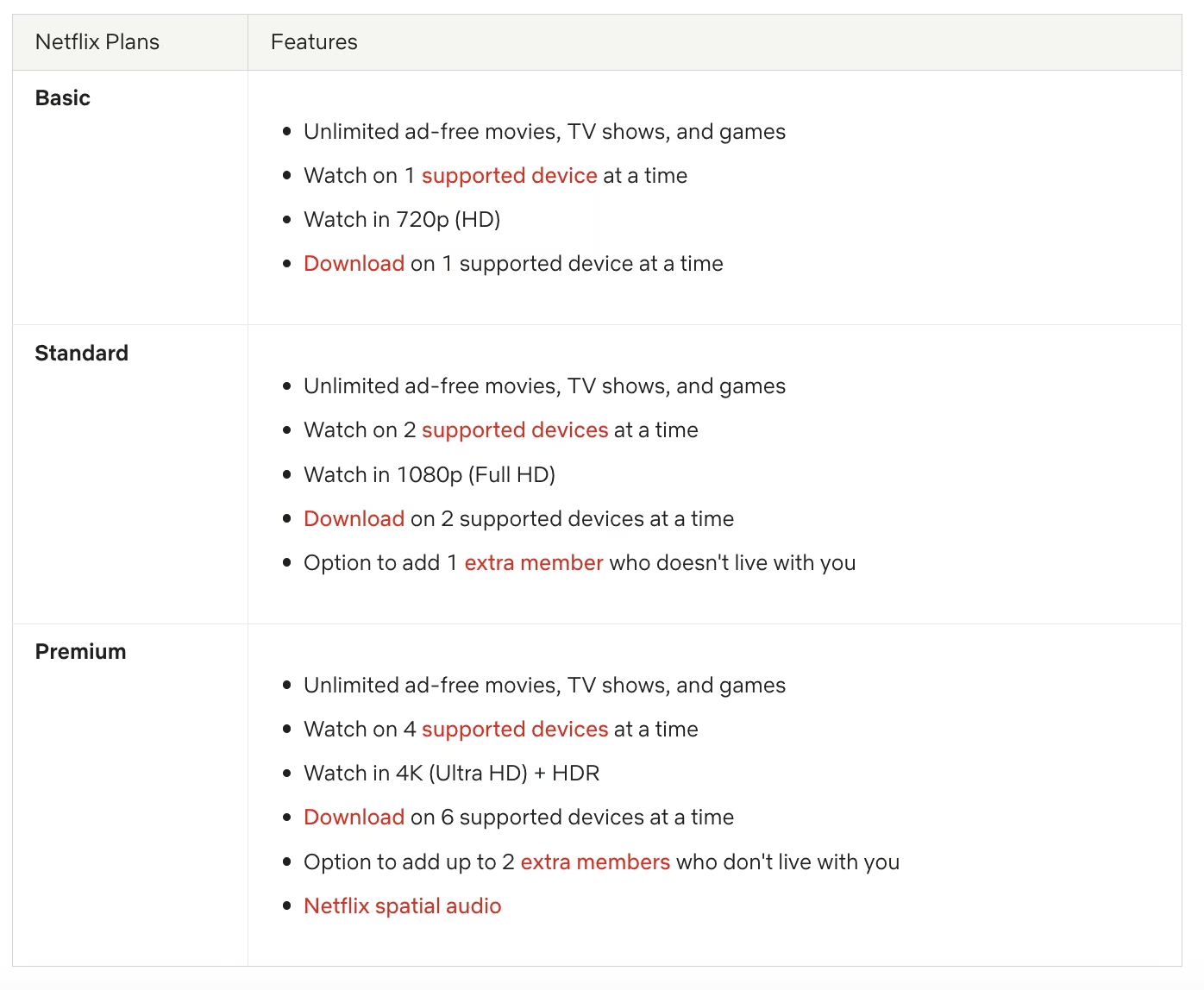
Ads, simultaneous streams, resolution, and download limits set the tiers apart. None of that is metered by usage. Netflix does sell extra member slots on top of Standard and Premium ($7.99/month with ads, $9.99/month without), a small seat layer bolted onto a tiered base.
Feature-based pricing often sits inside a tiered model. Each price point adds specific capabilities as the price climbs. A CRM's cheap tier might cap you at basic contact records, while the top tier adds custom reporting and programmatic access. Tiered and feature-based pricing frequently overlap.
Tiered pricing gives customers a natural upgrade path. It also lets you serve a solo user and an enterprise team from the same product. Push tiering too far, though, and it backfires. Add too many tiers, or tiers that don't map cleanly to how customers use the product, and buyers freeze on the pricing page, unable to pick a plan.
Per-Seat (Per-User) Pricing
One price per person who gets access. Add a teammate, and the bill goes up. It's the model most SaaS buyers already understand, because it maps to something concrete: headcount.
Calendly runs this way for its paid tiers. Standard costs $12/month ($10/month, billed annually) per seat. Teams costs $20/month ($16/month, billed annually) per seat.
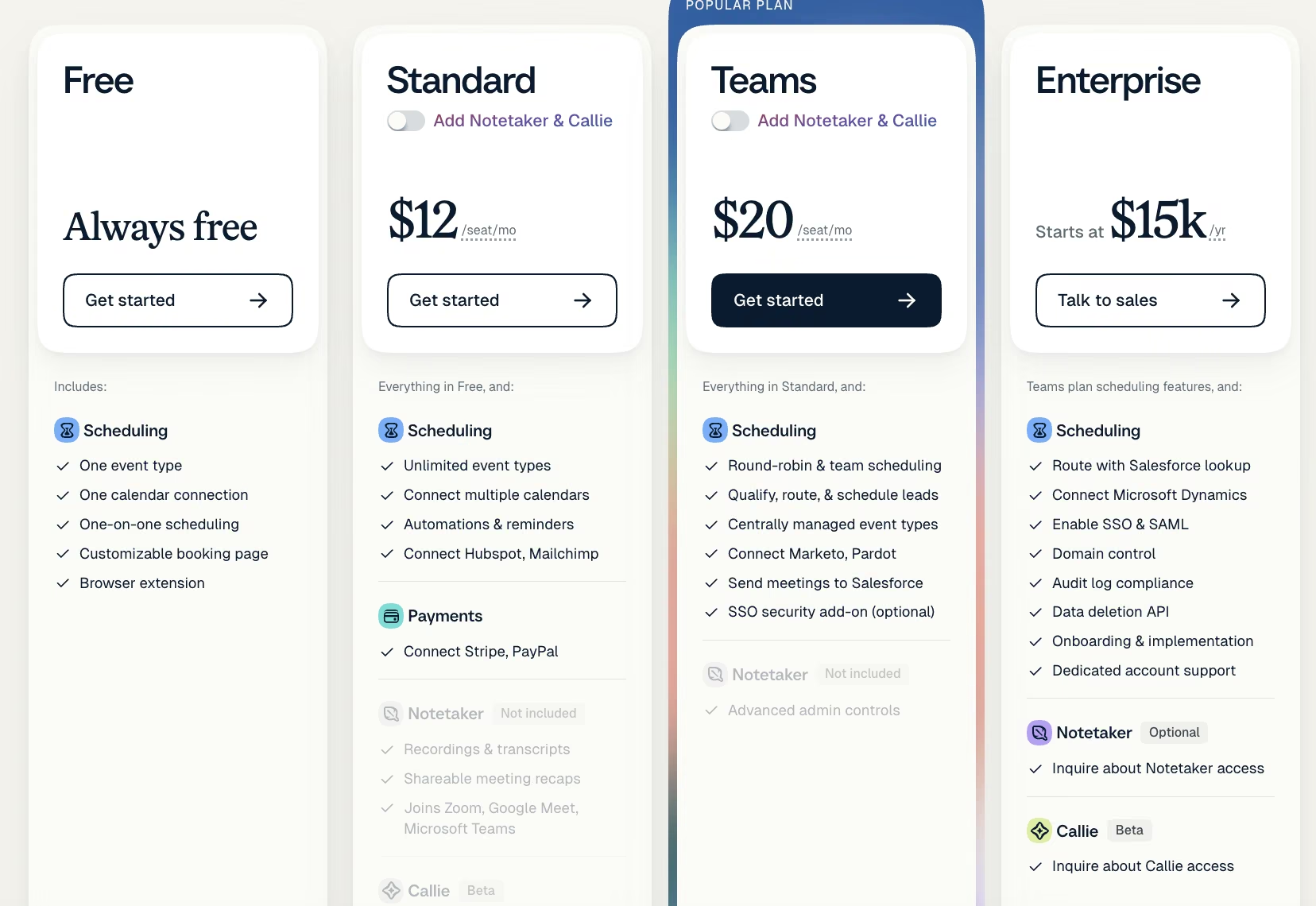
Calendly draws a specific line around what counts as a seat: The people who connect calendars and host meetings need one. The people who book time on someone else's calendar don't.
Per-seat pricing is predictable and easy to forecast for both the buyer and the seller. That predictability is part of the appeal.
But it has a blind spot. A team that gets more efficient with your product needs fewer people to do the same work. Fewer people means fewer seats, which caps how much that account can grow, right when your product is working best.
Per-seat pricing also has no good answer for an AI agent doing a chunk of what used to take a human. Is an automated workflow a seat? Most pricing pages haven't decided yet, and the customers running those workflows have noticed.
Usage-Based (Metered) Pricing
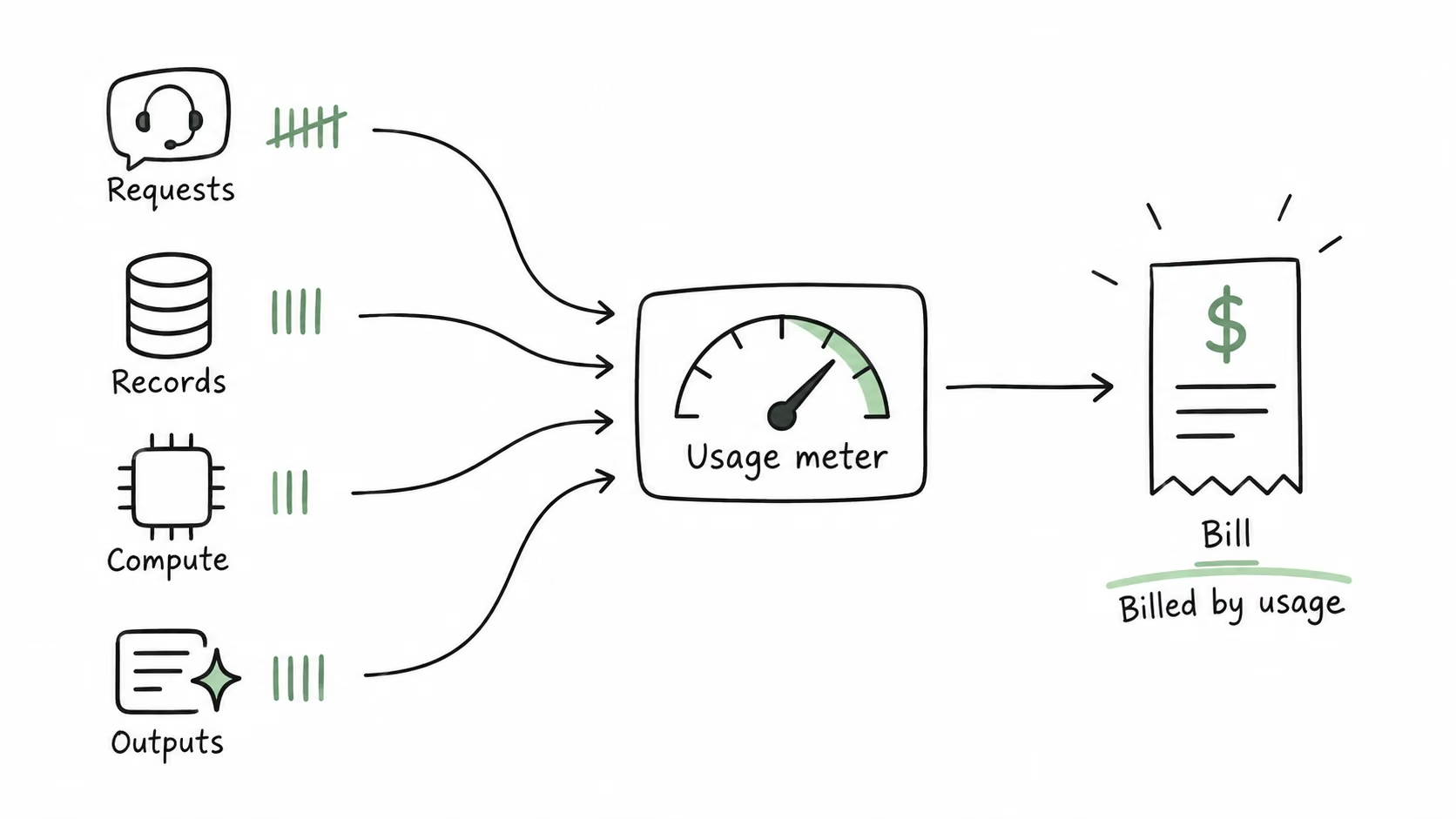
You pay for what you use, metered against whatever unit ties directly to the value delivered. Common usage units include:
- Service requests
- Records processed
- Compute time
- Generated outputs
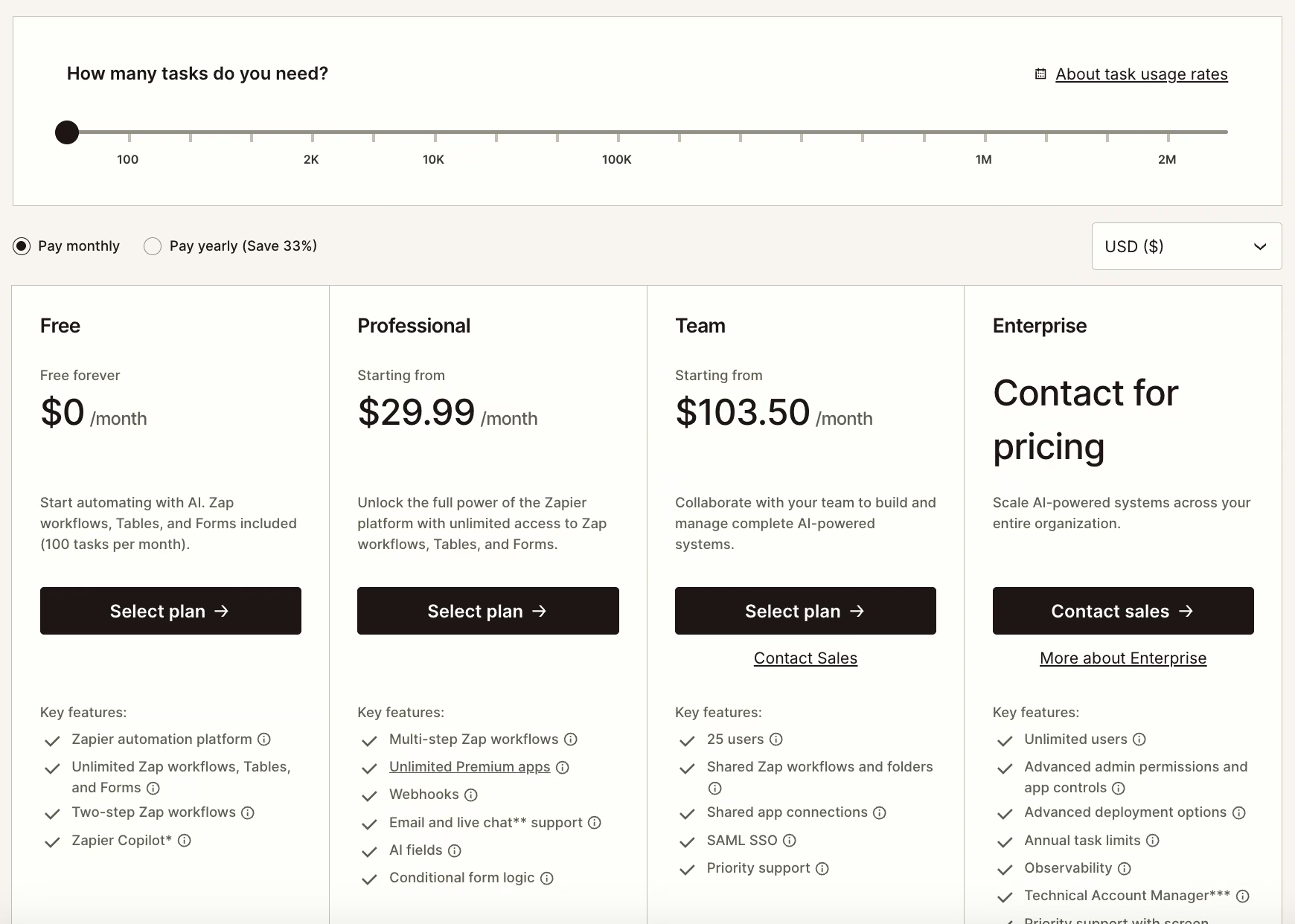
Zapier pricing uses task-based billing across much of its automation platform. AI steps and code actions both meter against tasks, though the rate varies by action. SDK actions, however, are free while the Zapier SDK is in open beta.
Usage-based pricing ties the bill to consumption. A light user pays less, a heavy user pays more, and neither one subsidizes the other's cost to serve.
The catch is psychological as much as financial. A bill that moves every month is harder to forecast. Metered actions can feel like a penalty for using the product at all, even when the billing logic is sound. A document the product generates (billed whether or not it was good enough to use) creates precisely that friction.
A lot of what gets marketed as credit-based pricing is usage-based pricing wearing friendlier packaging. A block of prepaid credits removes the sting of a live, per-action meter, even though the underlying math is identical.
Freemium Pricing
A free tier that never expires sits alongside paid tiers that add more. That's structurally different from a time-boxed trial.
Calendly's free plan is the example already on the table. It's free forever, with one calendar connection and one event type, a combination that covers plenty of individual use cases without ever needing to upgrade. The paid tiers exist for people who need more than one calendar, a team, or automation.
Freemium lowers the barrier to trying a product to zero. That's powerful for word of mouth, and for building a funnel you'd otherwise have to buy with ad spend.
It also means you're supporting a large base of people who never pay you a cent. If the free tier is too generous, or the paid tier's value isn't obvious, conversion can stall while free users continue to create support and infrastructure costs.
Hybrid Pricing
A predictable base fee, usually a subscription or per-seat charge, with a usage layer added on top.
HubSpot's Marketing Hub is a current example of this stack. It combines tiered base plans (Free, Starter, Professional, Enterprise) with a per-seat add-on for additional "Core Seats" beyond what's included.
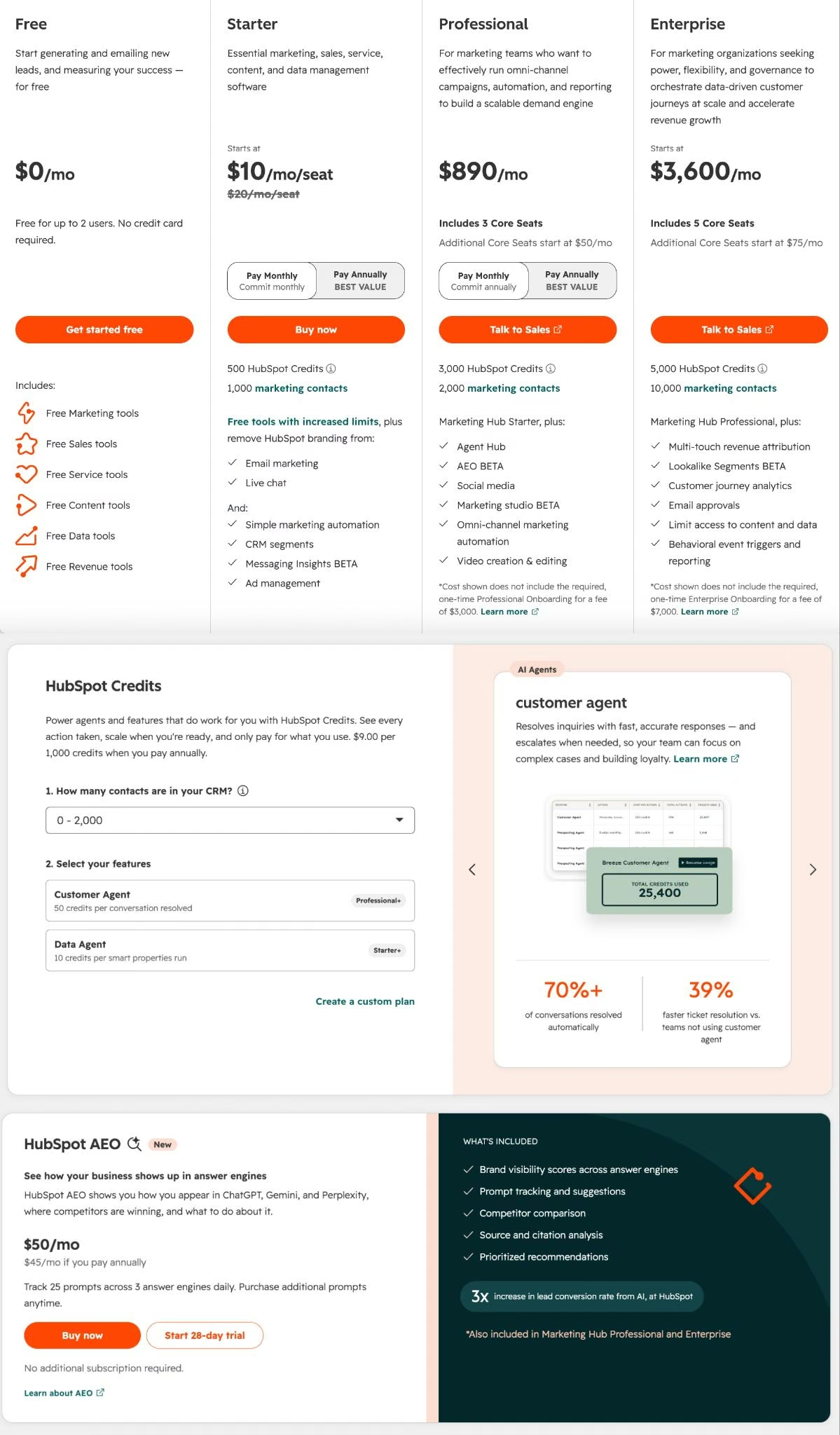
On top of both sits a metered "HubSpot Credits" layer that powers AI agent features, with a monthly credit allowance included on each paid plan and more available to buy.
Hybrid pricing can address problems that appear when a simpler model stops fitting the product, including the per-seat-versus-AI-agent tension. The seat or subscription base preserves the predictability customers like. The usage layer on top captures extra value from customers who consume more, without punishing the ones who don't.
The cost is complexity. There's more to build, price, explain, and bill correctly.
SaaS Pricing Models Compared: Which One Fits Your Product?
How the six models compare: Revenue predictability, setup complexity, and fit.
| Model | Revenue predictability | Setup complexity | Best fit |
|---|---|---|---|
| Flat-rate | High | Low | A simple product with roughly uniform usage across customers |
| Tiered | High | Medium | A product serving distinctly different buyer segments |
| Per-seat | High | Low | Collaboration tools where value scales with headcount |
| Usage-based | Low to medium | Medium to high | Infrastructure or AI products with variable, metered cost |
| Freemium | Low early, higher later | Medium | A product that benefits from viral or word-of-mouth adoption |
| Hybrid | Medium to high | High | A maturing product outgrowing a single, simpler model |
Read the table against your own product before you compare it to anyone else's. Find the row that already sounds like your customers, and start there.
How SaaS Pricing Differs by Business Type
The right model shifts again once you factor in who's buying it. A consumer app, a mid-market B2B tool, and enterprise software sell to buyers with different expectations around price, complexity, and how a sale even happens.
This case study of a toxicologist who built two subscription apps gives you both sides of that split: one product is consumer-facing, while the other is sold to enterprise clients.
B2C SaaS Pricing
Consumer-facing SaaS runs on low friction. A shopper who has to talk to a salesperson before using your product is a shopper you risk losing. Self-serve signup, a visible price on the page, and a free trial or freemium tier do more work here than a sophisticated pricing model ever will.
Keep the number of plans low and make the difference between them obvious at a glance. Monthly churn tends to run higher in B2C than in B2B, so the pricing has to stay out of the way between checkout and a first useful moment.
B2B SaaS Pricing
B2B buyers tolerate more complexity because they're weighing the product against a real business outcome, a slower calculation than a consumer's impulse buy. Tiered pricing with clear feature differentiation is the default here for a reason. It lets a small team and a much larger one buy the same product at a price that matches what each gets from it.
Value-based reasoning carries real weight in B2B, because the buyer can usually put a number on what the problem currently costs them. A support ticket deflected, or a manual reconciliation process removed, translates into a defensible price a B2C impulse buyer would never sit still for.
Enterprise SaaS Pricing
Enterprise pricing mostly stops being self-serve. The "Contact us" prompt on the page (with no number attached) comes from how these deals close. A standard tiered plan can struggle to account for multi-year contracts, negotiated volume discounts, security reviews, and implementation work.
Enterprise pricing is still built on the same underlying model, most often tiered or hybrid, with the final numbers and terms negotiated per account even when a vendor publishes a starting price. Your pricing page has to convince a buying committee more than any single user.
How to Choose and Set Your SaaS Price
A founder makes plenty of decisions on the way to starting a SaaS business, and setting a price is one of them. Picking a model only gets you halfway. The model is the structure, and the strategy puts a number inside it. This guide focuses on three pricing strategies.
Cost-plus pricing starts with what it costs you to deliver the product and adds a margin on top. It's fast and can help keep your price above your delivery costs. But it ignores what the product is worth to the customer, so it tends to leave money on the table for anything valuable to them.
Competitor-based pricing takes its cue from what similar products charge and positions your number relative to theirs. Unlike the copy-and-tweak shortcut from the opening, this is deliberate.
It's a reasonable starting anchor when you have zero data of your own. You're still borrowing someone else's guess, though. It can pull an entire category into a race to the bottom if everyone's anchoring off everyone else.
Value-based pricing hinges on the outcome your product produces, whether that's time saved, revenue generated, or a cost avoided. It prices against that outcome, apart from your cost or a competitor's number. It takes work.
You have to talk to customers, understand what a specific outcome is worth to them, and test that against what they'll pay.
When Value-Based Pricing Is Worth the Extra Work
Reach for it once your product produces a measurable outcome bigger than what it costs to deliver. You also need enough customers to put real research behind willingness to pay.
Say a tool demonstrably saves a team 10 hours a week, or generates a specific amount of new revenue. That tool has room to be priced against that outcome, well beyond what it costs to run.
How to Set Your SaaS Price in Six Steps
- Know what you're building: Pricing decisions usually start forming around the same time you're figuring out your minimum viable product (MVP). That's the smallest version of the product that gets you feedback. Lock in a pricing structure only after you know what you're shipping.
If you're still deciding how to build it, take a look at visual SaaS tools before you commit to a build path.
- Ask customers what they'd pay: Don't copy a competitor's sticker price and call it research. A short round of conversations with people who'd use the product surfaces who controls the budget. It also shows what the outcome is worth to them, something a public pricing page never tells you.
- Match a model to how customers get value: If value scales with headcount, per-seat makes sense. If it scales with consumption, usage-based does. If usage is roughly uniform across your customer base, flat-rate is often simpler than it looks.
- Set a floor and a ceiling: Use cost-plus to estimate the floor below which you'd lose money. Use value-based reasoning to find the number the outcome can support. Your price lives somewhere inside that range.
- Build the tiers and the billing logic: Someone has to wire up the plans, the payment processing, and the usage tracking to turn a model on paper into a working product, and a lot of early pricing plans stall right there. Visual builders for SaaS that handle payments can get tiered or usage-based billing live without pulling engineering off other work.
- Ship it and set a date to revisit it: Launch pricing is a first guess made with the least data you'll ever have on this product, so put that review on the calendar now instead of waiting for a customer to force it.
Pricing is one part of a wider SaaS product launch, where billing tests, early users, and post-launch iteration all affect how that first price performs.
Common SaaS Pricing Mistakes That Cost Founders Revenue
Every mistake below traces back to the same root cause. A model, or a number, got picked for being easy or familiar. It rarely got picked because it matched the product.
Pricing too low to win volume: A cheap entry price can win signups, but it doesn't guarantee retention. Check whether the customers it attracts stick around long enough to get value from the product and give you useful feedback.
Flat pricing with no usage ceiling: An unlimited-usage plan is easy to pitch, but it puts you on the hook for every unit a customer burns through. AI features can make that exposure visible because they carry metered per-request costs. The invoice is identical either way, so the account that costs you the most to serve is often the one paying you the least per unit of work.
Charging for every unit of raw usage with no floor: A margin-protection argument backs metering every single action. Customers still read a fluctuating bill as being nickel-and-dimed. A bundled allotment (a plan, a credit block, or another reasonable included amount) can make the bill easier to predict than billing every action individually.
Copying a competitor's price without checking who pays it: The same sticker price can be a rounding error for one buyer and a budget fight for another. That gap widens fast when the person using the product isn't the person paying for it.
SaaS Pricing Best Practices for After You Launch
A few habits keep pricing from going stale after launch:
- Revisit pricing on a set cadence: A launch price is often set with limited information about your customers. Come back to it deliberately, before something forces the issue.
- Don't grandfather old customers forever: A short grandfather period is fair. An indefinite one means running two products' worth of pricing logic, and it can cost you money on your longest-tenured customers.
- Communicate price changes directly and early: A price increase that first appears on a renewal invoice gives customers no time to weigh it. Send the change (and the reasoning behind it) weeks in advance.
- Be careful with steep early discounting: A generous early-customer discount is easy to hand out and hard to take back. Treat it as an ongoing cost for as long as that price stays in place.
When to Change Your SaaS Pricing Model
One clear signal is usage outgrowing the structure you started with. Per-seat pricing that made sense for a five-person team starts breaking the moment that team automates work with AI agents. That's the same growth ceiling covered earlier, arriving at the worst possible moment.
The same shift is showing up from the cost side, too. AI features carry variable compute costs per prompt or automation run, which can strain a flat monthly fee or fixed per-seat price when usage varies widely. That cost pressure can also push companies toward usage or hybrid pricing.
PricingSaaS, a firm that sells pricing-intelligence software, tracked the top 500 SaaS and AI companies with public pricing through 2025, and its co-founder published the results in January 2026.
It found more than 1,800 individual pricing changes across that group in a single year, an average of 3.6 changes per company. Credit-based pricing specifically went from 35 of those 500 companies to 79 in the same year, more than double.
Put a pricing review on the calendar now, so that pace of change reaches you on a date you picked.
One way to change a pricing model is to keep the existing seat or subscription plan and charge separately for usage on top of it. That's a move toward the hybrid model.
The Bottom Line on Choosing a SaaS Pricing Model
These six SaaS pricing models don't have a default winner. Base the model on where the value lands for your customers.
Flat-rate or a basic tiered structure is easy to explain at launch and a fine place to start, though it may not be the model you're still running a couple of years from now.
Start with whatever model you can explain clearly and bill correctly from day one. Expect to add a usage or hybrid layer once the product outgrows it. That's an ordinary stage for a growing product, and reaching it means the first model did its job.
How Emergent Helps You Build (and Rebuild) Your Pricing Logic

A model and a strategy only settle what the bill should look like on paper. Your engineering team then needs to translate that decision into billing code that invoices customers correctly, and that work usually competes for the same sprint capacity as every other roadmap item.
Emergent's AI SaaS builder lets you describe your plan structure in a sentence, say a free tier, three paid tiers, and a usage meter on top, and it hands back a working app with that billing logic built directly into the product.
It comes Stripe-integrated and ready to charge for whichever tier a customer picks. That's the difference between booking an engineering sprint to wire up billing and having it wired up the moment the app exists, without writing code.
Rebuilding that structure later is where the cost shows up. A shift from flat-rate to tiered, or a new usage layer added onto an existing seat plan, changes the product's underlying logic, well beyond a marketing page update.
Plenty of those pricing changes need billing logic rewritten behind them, and a rebuild shouldn't be the reason a good pricing decision doesn't happen. When your turn comes, try describing the new structure to Emergent before you scope a separate engineering project for it.

Most AI app builders stop at prototypes. Emergent creates production-ready apps you can actually launch.
- Production-ready apps
- Web & mobile apps
- Deploy in minutes

Most AI app builders stop at prototypes. Emergent creates production-ready apps you can actually launch.
- Production-ready apps
- Web & mobile apps
- Deploy in minutes