

Build a Culture Survey That Tests Your Values
Build a culture survey that scores each value by what employees see at work, with every answer in a database you own.
Build a culture survey that scores each company value by what employees see day to day.
Trusted by Builders Worldwide
Active Builders Worldwide
Apps Successfully Created
Countries Globally Reached



How Each Value Gets Measured
One prompt with your values and teams gives your employee culture survey each piece below.
Behavior statements for every value
Emergent writes two or three statements per value about things people can watch happen. Ownership becomes: I can fix a problem outside my team without asking for permission first.
Agreement scored by value and team
Each statement is scored as the share of people who agree or strongly agree. Statements roll up to the value they test, and the dashboard can split every value by department or site.
A reporting minimum you choose
Pick the smallest group allowed to see results, such as five people. A team below it shows no scores or comments on any dashboard, though its answers still count in the total.
Open answers grouped by theme
Add an open question, for example the three words that describe working here. The survey sorts the answers into themes, counts them, and keeps each original reply under its theme.
Alerts when a team drops below a floor
Set a floor for any statement. When one team falls under it, the survey emails that team's owner or messages them in Slack with the score, the answer count, and the comments.
Code you can take with you
The survey, its response tables, and its dashboards are ordinary code. Export them to your GitHub repository on paid plans, host them yourself, or keep changing them by prompt.
Four Culture Survey Examples
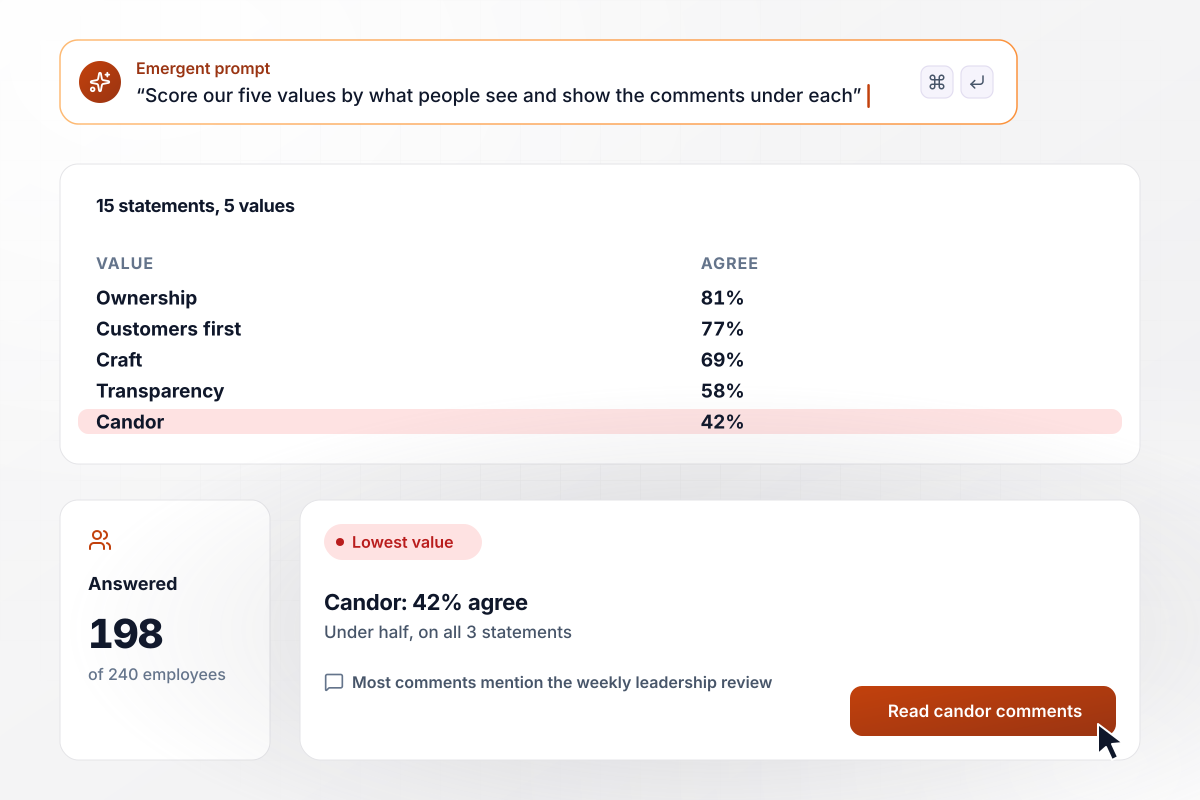
Of five values, candor comes last
A 240-person software company turns its five values into 15 statements about everyday behavior, and 198 people answer. Candor scores lowest: fewer than half agree with its three statements. Most of the comments under it mention the same weekly leadership review.
window.awbMockup = { companyValues: "Build a culture survey for my 240-person software company. Turn our five values into three statements each about behavior people can see, rated from strongly disagree to strongly agree. Score each value as the share who agree, split it by department, and list the comments under each value. Hide any team with fewer than five answers.", plantSafetyCulture: "Build a safety culture survey for operators and supervisors on the five lines at my plant. People answer on a shared tablet at shift change and give no names. Ask whether they can report a near miss and not be blamed for it. If agreement on any line is under 60%, email our plant safety manager with that line's results and comments.", afterAnAcquisition: "My company, Halden Logistics, bought Brightwater Labs six months ago. Build a culture survey for both. Ask staff at each company the same 16 statements about decisions, meetings, and how plans change. Give each company its own column, rank the statements by the gap between them, and send the biggest gap to our integration lead.", oneOpenQuestion: "I run a 300-person agency. Build a one-question culture survey that asks everyone which three words describe working here. Group the words into themes such as fast or siloed, count each theme, and keep every original answer under it. Post the ranked themes to our people team's Slack channel when the survey closes." };
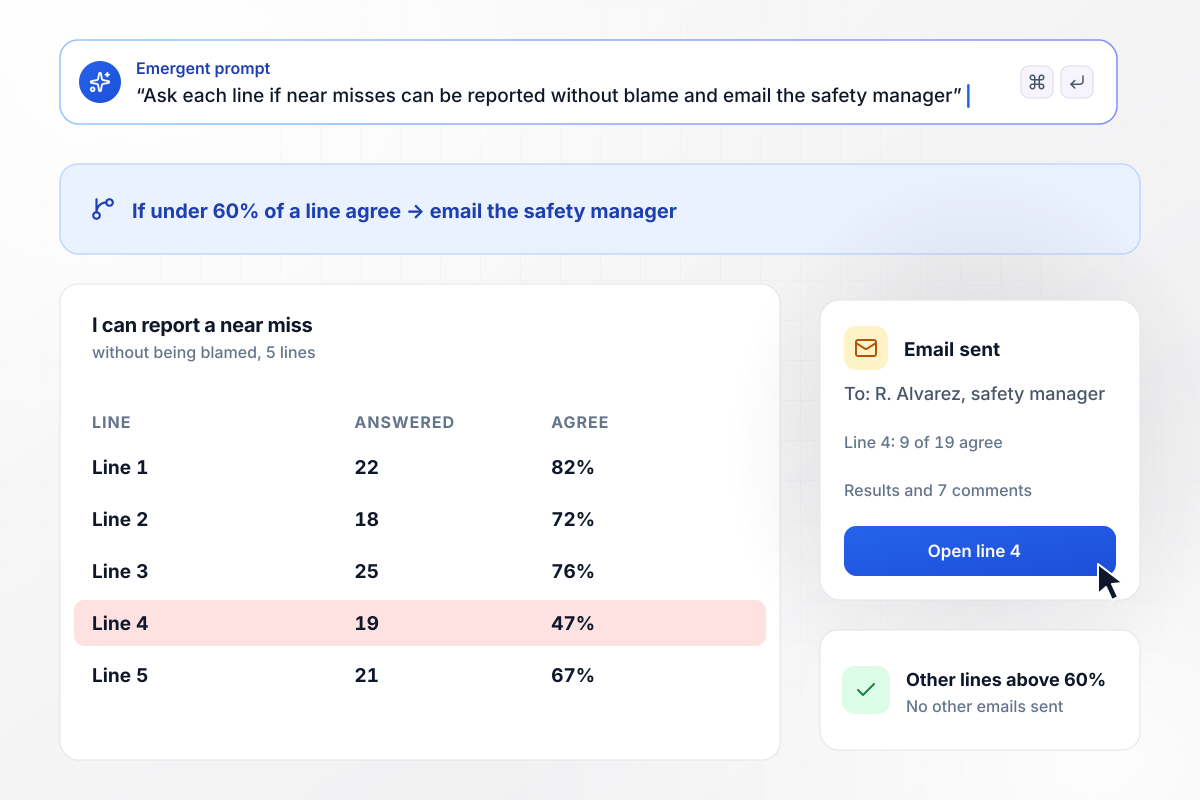
Line 4 doubts it can report a near miss
Operators and supervisors on five production lines answer a safety culture survey on a shared tablet at shift change. One statement reads: I can report a near miss without being blamed. When under 60% of a line agree, the plant safety manager gets an email with that line's results and comments.
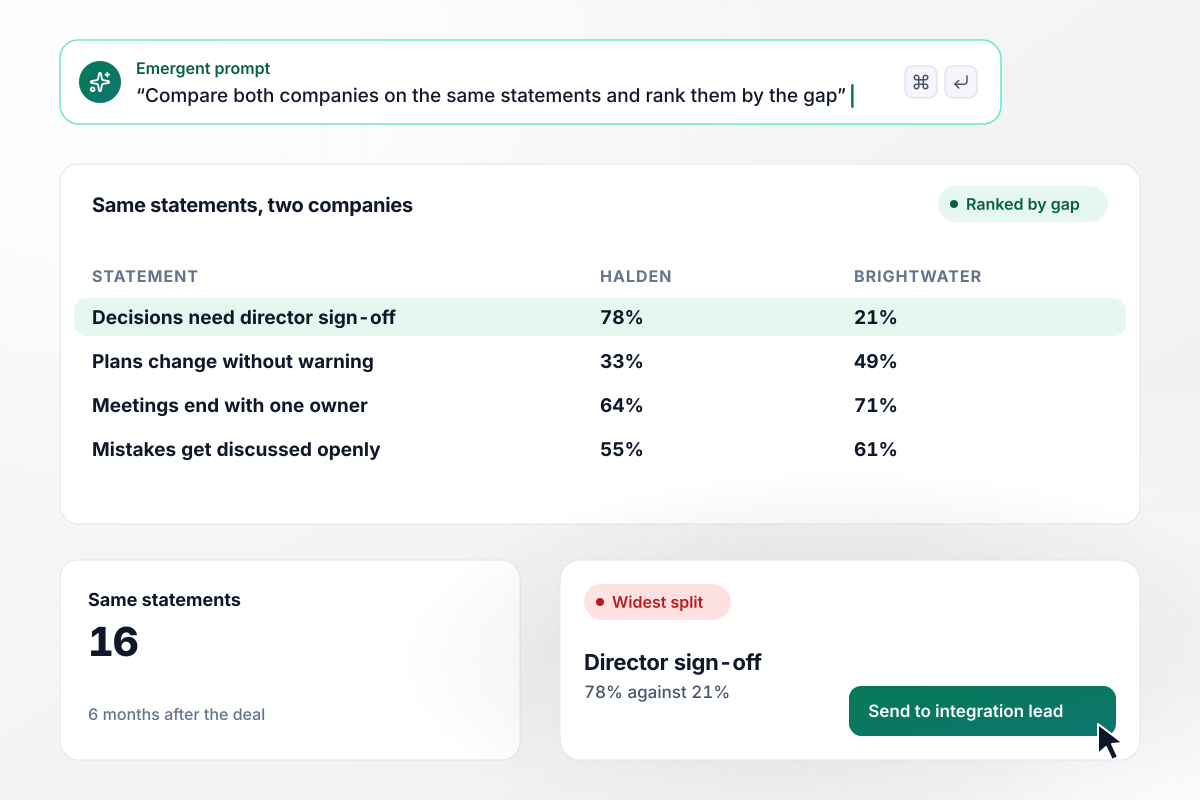
Two companies split on who signs off
Six months after Halden Logistics buys Brightwater Labs, both staffs answer the same 16 statements about how work gets done, and each company gets its own column. The widest split is sign-off: most Halden staff say decisions wait for a director, while few at Brightwater do. That gap goes to the integration lead.
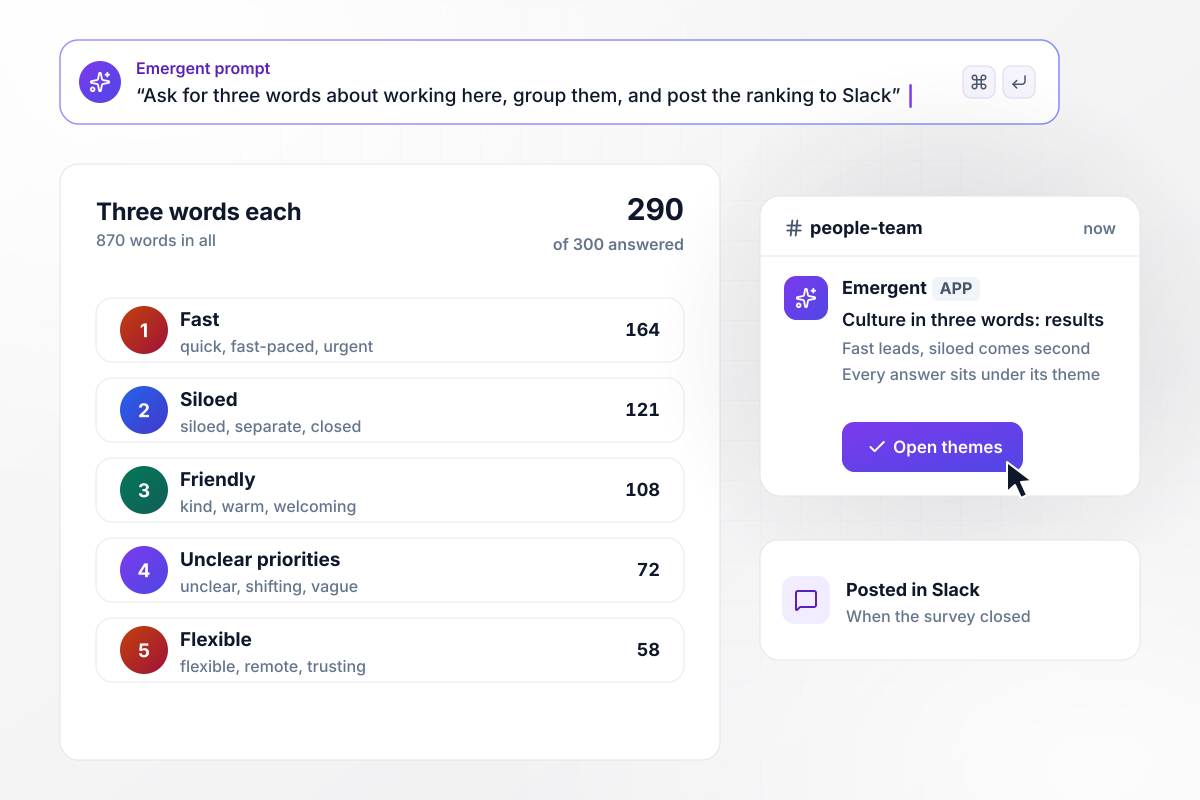
Three words each from 290 people
Every employee at a 300-person agency gets one open question: which three words describe working here? The 290 people who answer give 870 words, and the survey groups them into themes. Fast leads and siloed comes second. The people team gets the ranked list in Slack, with the answers behind each theme.






How to Build a Culture Survey
Seven steps to build a culture survey that checks each value against daily behavior and names one change per gap.
Take your values word for word from the handbook or careers page. Add habits leaders talk about, such as written decisions or no-meeting Fridays. Leave out anything nobody has promised. The survey tests claims, not hopes.
Write your culture survey questions as statements about something a person could witness, not something they should believe. Candor becomes: people here say so when they disagree with a plan. Keep one idea per statement and avoid leading wording.
A confidential survey ties answers to a roster, which lets reminders and team splits work. An anonymous one stores no identity at all. Choose one, set a reporting minimum of at least five, and state both on the first screen.
Starting from a culture survey template means editing someone else's values. Write a short brief instead: who answers, your statements, the groups to compare, and any alert rules. Emergent builds the survey, its database, and the dashboards from it.
Send the draft to about 10 people from different teams and ask which statements they read two ways. Rewrite those before launch. A statement people read two ways gives you a score nobody can act on.
Sort values by agreement and start with the lowest. Then compare groups, since a value that scores well overall can still fail in one department or among newer staff. Read the comments before you decide what a number means.
Share company results within a few weeks of closing. For the weakest value, name one behavior leadership will change and who owns that change. A year later, ask the identical statements again so the two scores line up.
Why Run Culture Surveys on Emergent?
These tools price by headcount or seat and keep answers on their servers. Emergent builds the survey as an app you own.

|
Culture Amp | Qualtrics EmployeeXM | SurveyMonkey | |
|---|---|---|---|---|
| What you get | Pulse and annual surveys, confidential reporting, and manager dashboards, as code you own | Engagement, pulse, onboarding, and exit surveys with analytics | Employee listening inside the Qualtrics XM platform | Survey builder with templates, including employee engagement |
| Pricing model | Credits, no response caps or per-response fees | Quote-based, per employee by module, billed annually | Quote-based, priced by employee count | Per-user team plans with a seat minimum, billed annually |
| Where responses live | A database table you own, plus any integration | Culture Amp platform | Qualtrics platform | SurveyMonkey account |
| Code ownership | Full code export to GitHub on paid plans | None | None | None |

Pick the Pricing Plan That Works for You
Choose the plan that fits your building ambitions. From weekend projects to enterprise applications, we've got you covered.




Find the right survey, quiz, or poll
for your team
Frequently Asked Questions
Your Questions, Answered
Don't change this element unless you know what you are doing
More things you can build
with Emergent









on Emergent today


