

Build a Manager Feedback Survey for Teams and Their Managers
Build a manager feedback survey that gives each manager a private report and pools small teams so no one stands out.
Build a manager feedback survey for my software company where every team rates its manager twice a year.
Trusted by Builders Worldwide
Active Builders Worldwide
Apps Successfully Created
Countries Globally Reached



What Each Manager's Survey Comes With
A manager feedback survey asks direct reports to rate the person they report to, then gives that manager a private report.
Statements about the person you report to
Emergent writes each statement about one manager, such as "My manager keeps our 1:1s as planned." Ask for changes by prompt until the wording sounds like your own teams.
A private report for each manager
Each manager opens a report on their own team only, with the lowest-scoring statement at the top and the written comments under it. No other manager can open that report.
A minimum count before any team shows
Set the smallest team a report may show, such as 3 answers. A team under that line still counts toward the director's rollup and the company total, but never shows alone.
Reminders that stop after an answer
People who have not answered get an email reminder before the survey closes, and HR gets a Slack list of teams still under the minimum. Anyone finished gets no more email.
One statement per screen on a phone
Staff in a clinic or on a warehouse floor answer one statement per screen from a link on their phone. Emergent puts no cap on responses, so 40 teams run on the same build.
Your code on GitHub, answers in your tables
Export the full code to your GitHub repository on paid plans. Every answer already sits in a database you own, so next spring's round compares against this year's scores.
How Four Teams Run Manager Feedback
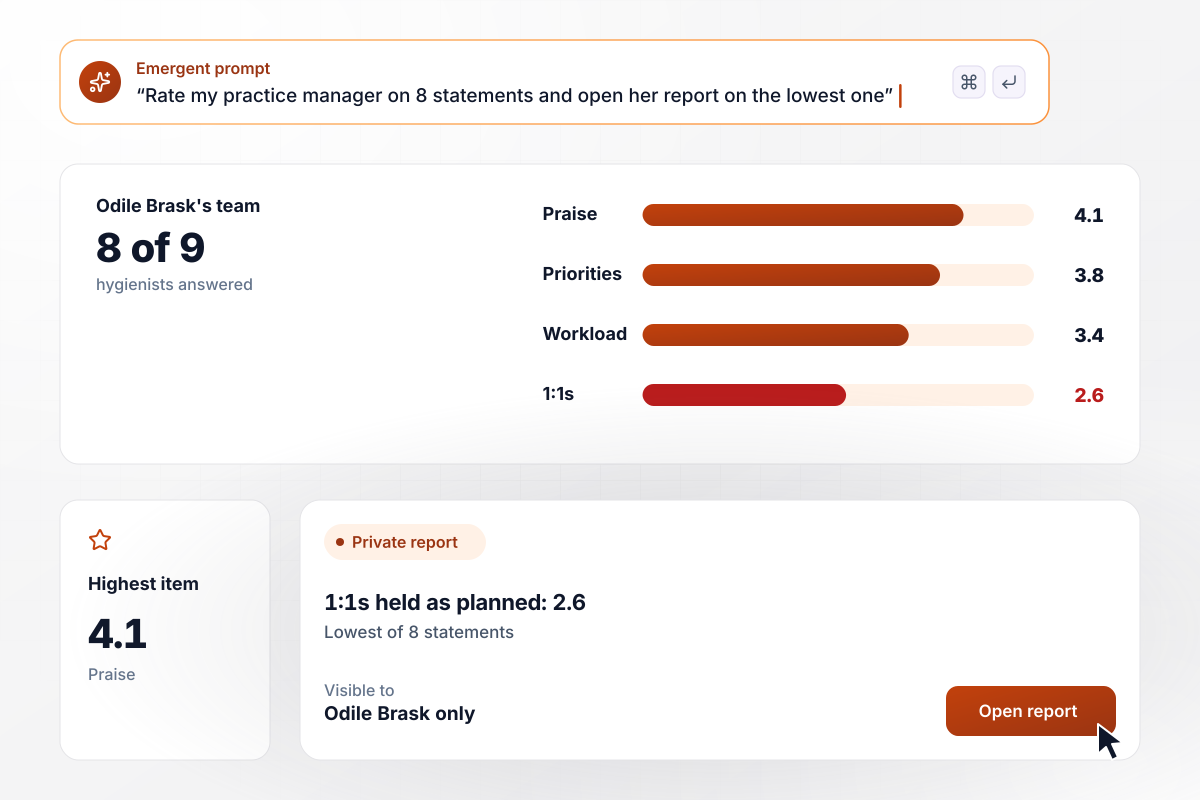
Her report opens on 1:1s, the lowest item
Halvorsen Dental's 9 hygienists rate practice manager Odile Brask on 8 statements, and 8 of 9 answered this round. Her private report opens on the lowest item, 1:1s held as planned, at 2.6. Praise for good work scored highest, at 4.1. She moved her 1:1s to Tuesday mornings and told the team why at the next huddle.
window.awbMockup = { teamRatings: "Build a manager feedback survey for my dental practice. The 9 hygienists rate their practice manager on 8 statements from 1 to 5, including 1:1s held as planned and praise for good work. Give the manager a private report that opens on her lowest-scoring statement, with the written comments below it. Show the answer count, such as 8 of 9.", skipLevelRollup: "Build a skip-level view for a director over 6 warehouse managers. Show one row per team with its answer count and average score across every statement. Pool any team with fewer than 3 answers into one combined row so no small team can be read alone. Highlight the team with the lowest average.", sixWeekRecheck: "Six weeks after my spring manager feedback round, send my 7 reports 2 statements by email about the change I made, meeting-free Wednesdays. Show this round's agreement next to the spring result for the same statement, such as 2 of 7 then and the new count now.", newHireCheckIn: "Build a day-45 check-in that each manager at my clinics fills in about a new hire. Ask 5 questions, including whether the hire is ready to work shifts alone, with Yes, Not yet, or Too early to say. When a manager picks Not yet, email our HR partner with the manager's comment. Count the hires each month." };
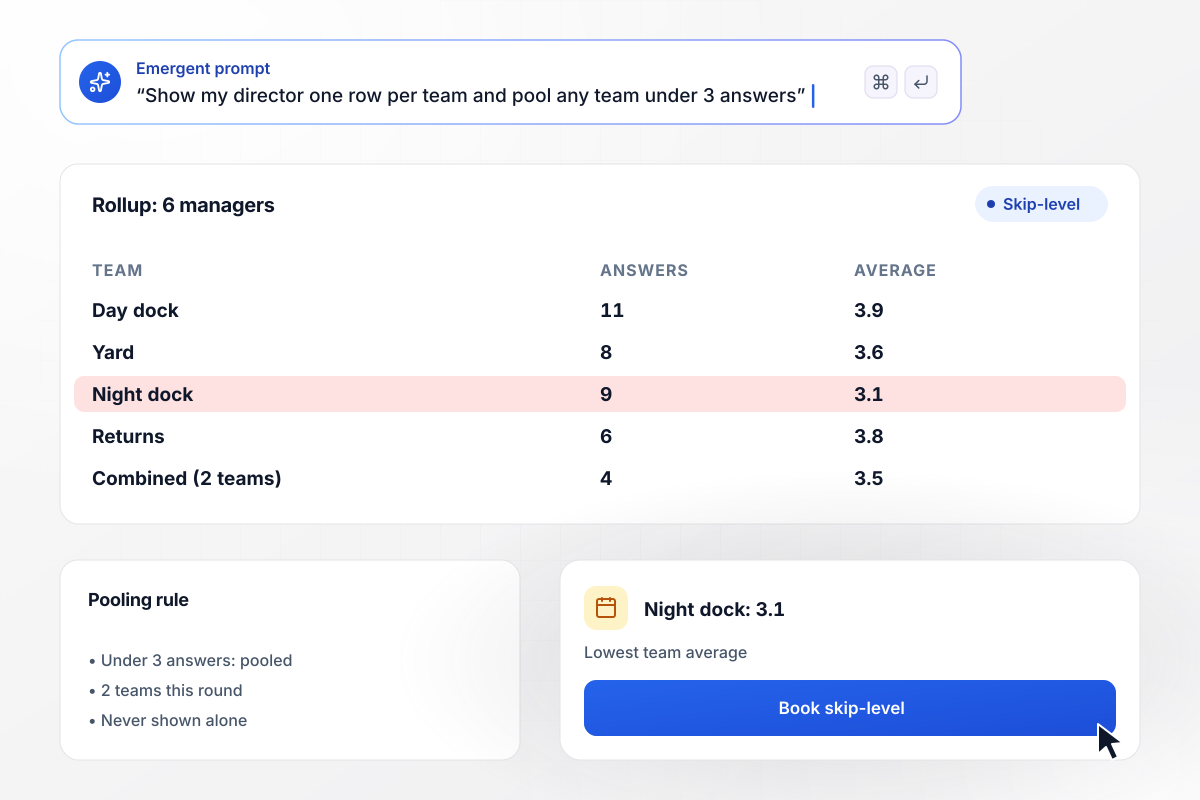
Two small teams fold into a combined row
Sela Marquand directs 6 warehouse managers at Marlpit Logistics, and her rollup shows each team's answer count and average. The 2 teams with fewer than 3 answers share one combined row, and neither can be read alone. Night dock has the lowest average, at 3.1, and Sela booked a skip-level meeting there.
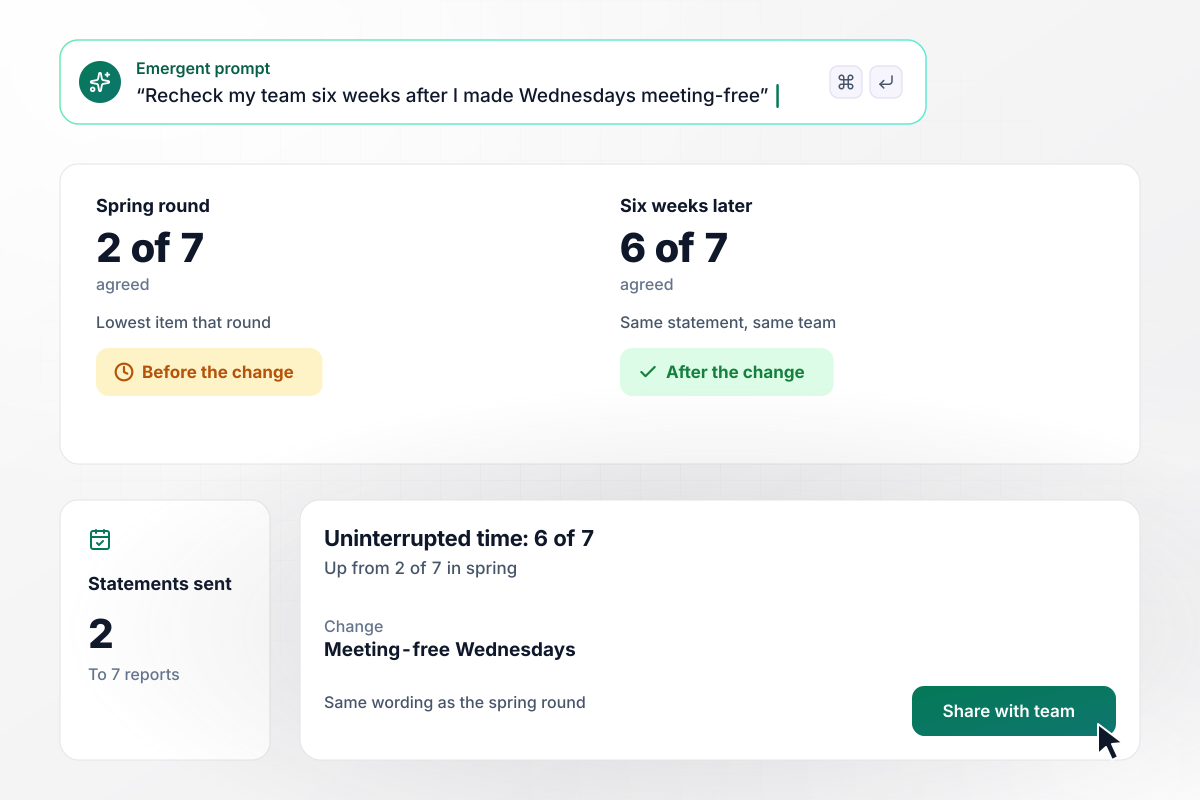
Six weeks after his promise, 6 of 7 agree
Rui Okafor's team at Tessaly Software rated focus time lowest in the spring round, and he made Wednesdays meeting-free. Six weeks later, the app sent his 7 reports 2 statements. On "I get uninterrupted time for deep work," 6 of 7 agreed, up from 2 of 7 in spring.
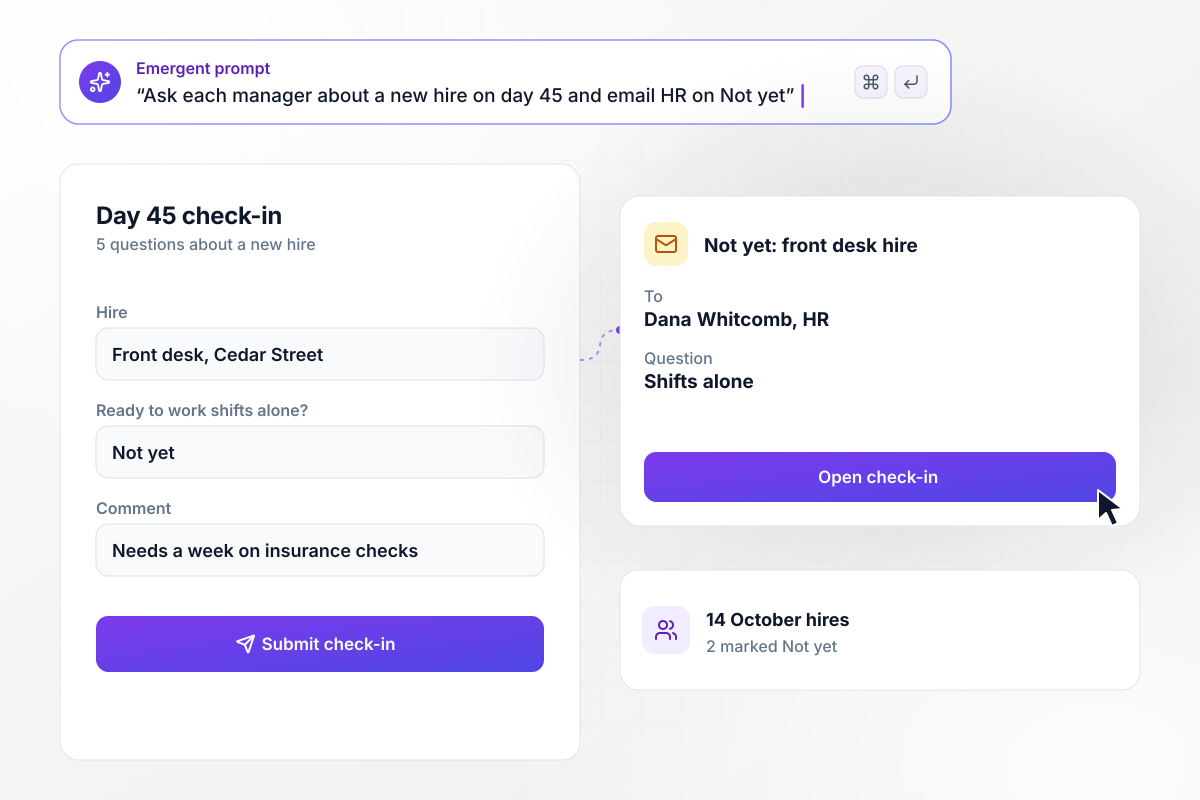
Any Not yet on a new hire emails HR
On day 45, every manager at Brightfern Clinics answers 5 questions about each new hire. One asks whether the hire is ready to work shifts alone: Yes, Not yet, or Too early to say. A Not yet emails HR partner Dana Whitcomb with the manager's comment. Of 14 October hires, 2 drew a Not yet.






How to Run a Manager Feedback Survey
Seven steps to run a manager feedback survey that each manager reads in private and acts on, then build it with Emergent.
Write down who sees what before anything goes out. One split that works: each manager reads their own team's report, a director sees the rollup, and HR sees everything. Put that split in the invitation in one plain sentence.
Choose the answer count below which a team's results never appear on their own, such as 3. Teams under it fold into the director's rollup. Check the build applies the line to comments and exports before anyone answers.
Write 8 to 12 statements about actions a direct report can see, like holding 1:1s, explaining priorities, and giving credit. Skip traits such as "is a good leader." Describe the list in your prompt, and Emergent drafts the statements.
Ask what the manager should keep doing and what they should change. These two comments give a low score its reason. Keep them optional, since a small team can sometimes guess who wrote a distinctive answer.
Avoid the weeks around performance reviews, when people may trade a rating for a rating. Leave the survey open for about 10 working days, with one reminder near the end for anyone who has not answered.
Release reports to managers a few days before the director's rollup meeting. Ask each manager to pick one statement to work on and tell the team which one it is at their next meeting. Saying it aloud turns a private score into a promise the team can check.
Six weeks later, resend the statement or two the manager chose, worded exactly as before. Identical wording is what makes the two scores comparable, and the team sees that what it wrote in the first round led somewhere.
Why Build It With Emergent?
SurveyMonkey sells per-user team plans. Emergent builds the survey and every manager's report as one app, on a database you own.

|
SurveyMonkey | Microsoft Forms | SurveyHero | |
|---|---|---|---|---|
| What you get | Survey, logic, and response database, as code you own | Survey builder with templates, including employee engagement | Surveys, quizzes, and polls with response summaries | Survey builder with templates, including employee satisfaction |
| Pricing model | Credits, no response caps or per-response fees | Per-user team plans with a seat minimum, billed annually | Free with a Microsoft account; included in Microsoft work and school subscriptions | Free plan, then per-account plans with unlimited responses |
| Where responses live | A database table you own, plus any integration | SurveyMonkey account | Microsoft Forms, with export to Excel | SurveyHero account, EU data centers |
| Code ownership | Full code export to GitHub on paid plans | None | None | None |

Pick the Pricing Plan That Works for You
Choose the plan that fits your building ambitions. From weekend projects to enterprise applications, we've got you covered.




Find the right survey, quiz, or poll
for your team
Frequently Asked Questions
Your Questions, Answered
Don't change this element unless you know what you are doing
More things you can build
with Emergent









on Emergent today


