

Build a Brand Questionnaire That Drafts the Strategy
Build a brand questionnaire that saves every client's answers and turns them into a first draft of the strategy.
Create a brand questionnaire for new clients, with every answer saved to a database
Trusted by Builders Worldwide
Active Builders Worldwide
Apps Successfully Created
Countries Globally Reached



What Each Section of the Questionnaire Produces
Every question should feed a piece of the strategy. These six carry a client's answers into documents a strategist can work from.
Positioning answers in statement form
Ask four questions that map to the parts of a positioning statement: customer, category, benefit, and proof. The answers arrive as a draft statement to rework line by line.
Competitor rows with a required difference
List each rival on its own row next to the promise it makes. Require a reply on how the client differs, or mark any blank row as an open question to settle in the workshop.
Value pickers instead of blank boxes
Show a list of candidate values and cap the picks at three. A short list forces a choice, and the order the client ranks them in shows which value should lead the voice guide.
Voice pairs in the client's own words
Have the client write this-not-that pairs about how the brand should sound. Each pair lands in the draft voice guide with the original wording intact, ready for a writer to refine.
Deliverables checked against the launch
Let the client tick the deliverables it wants and name a launch date. The app adds up the weeks each piece takes and flags any plan that runs past the date the client gave.
The questionnaire's code in your repo
Export the full codebase to your GitHub on paid plans whenever you want it. Past answers stay in the database you own, and a developer can add a client portal on top of it.
Four Brand Projects, Four Drafts
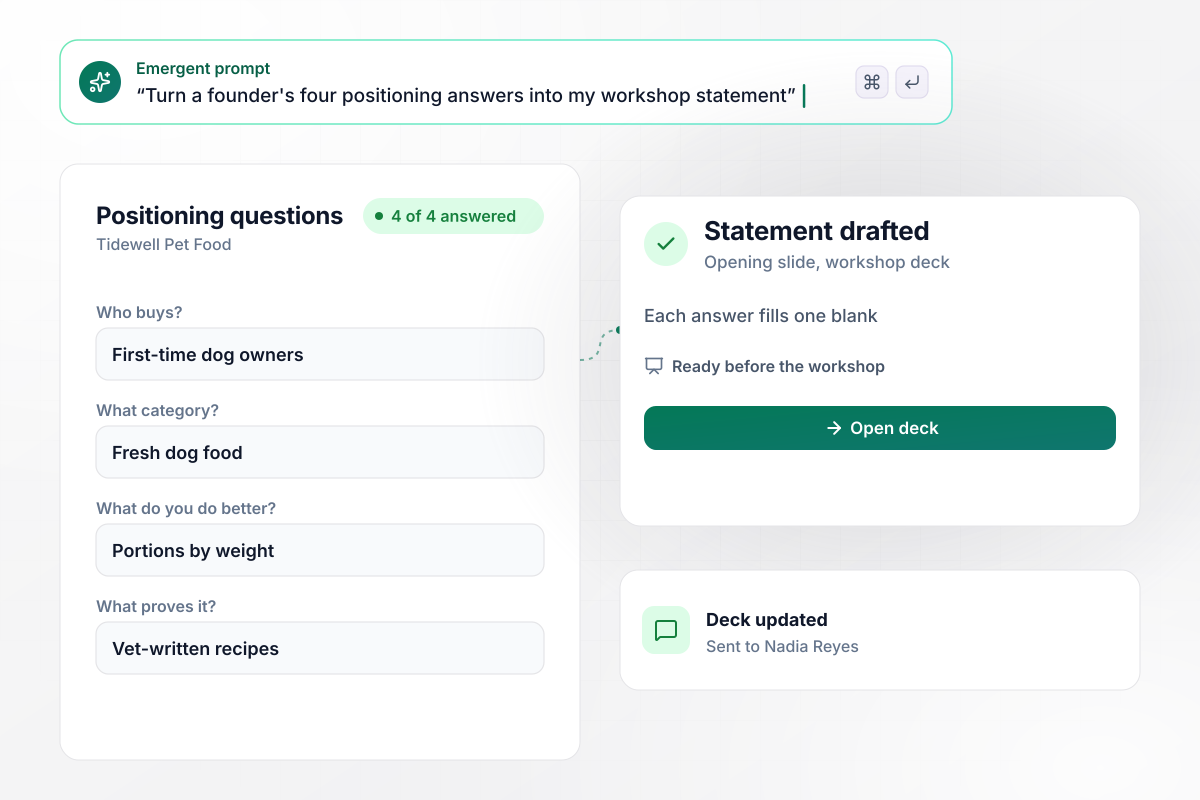
A positioning statement written by four answers
Nadia Reyes writes brand strategy for startups, and her questionnaire asks founders four positioning questions. Tidewell Pet Food's founder answers first-time dog owners, fresh dog food, portions by weight, and vet-written recipes. Each answer fills one blank of the statement on the opening slide of the workshop deck.
window.awbMockup = { brandPositioning: "I run brand positioning workshops for consumer startups. Build a questionnaire for the founder with four questions: who buys, what category they shop in, what the product does better, and what proves it. Put each answer into one blank of a positioning statement on the opening slide of my workshop deck, and message me when all four are in.", competitorAudits: "My studio repositions credit unions and small banks. Build a questionnaire that asks the client for three competitors, the promise each one makes and how the client differs from it. Show the answers as a competitor table, and when the difference for any competitor is left blank, add that competitor to the top of the workshop agenda.", voiceAndValues: "I write voice guides for outdoor and travel brands. Build a questionnaire where the marketing lead picks three values from a list of 12 and writes five this-not-that voice pairs, like expert, not preachy. Turn the values and the five pairs into page one of a draft voice guide I can edit before the kickoff call.", rebrandScoping: "My studio scopes rebrands from the client's answers. Build a questionnaire where the client ticks deliverables like discovery, naming, visual identity and brand guidelines, and gives a launch date. Add up the weeks each deliverable takes, and if the plan runs past the launch date, flag the gap to me before I write the proposal." };
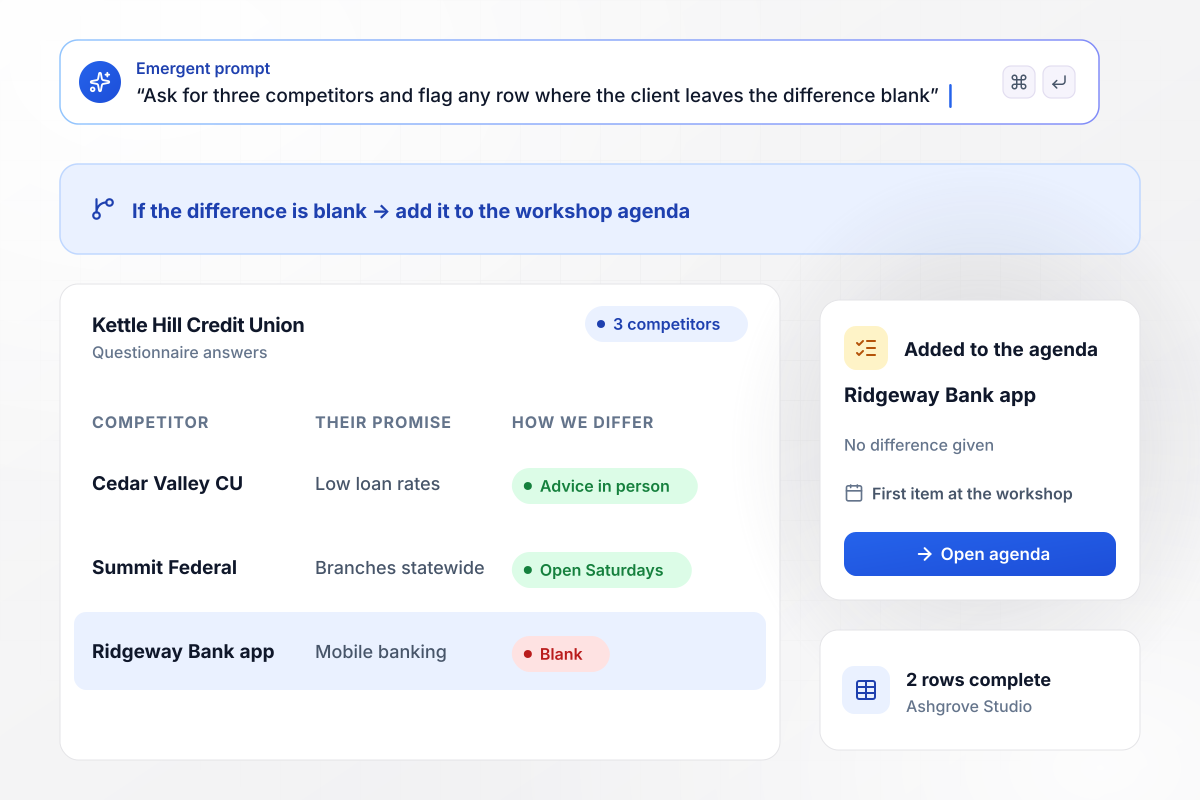
Where the client cannot say how it differs
Ashgrove Studio is repositioning Kettle Hill Credit Union, and its questionnaire asks for three competitors and how Kettle Hill differs from each. Two rows come back complete. The row for the Ridgeway Bank app leaves the difference blank. Any blank difference goes on the workshop agenda, and this one opens it.
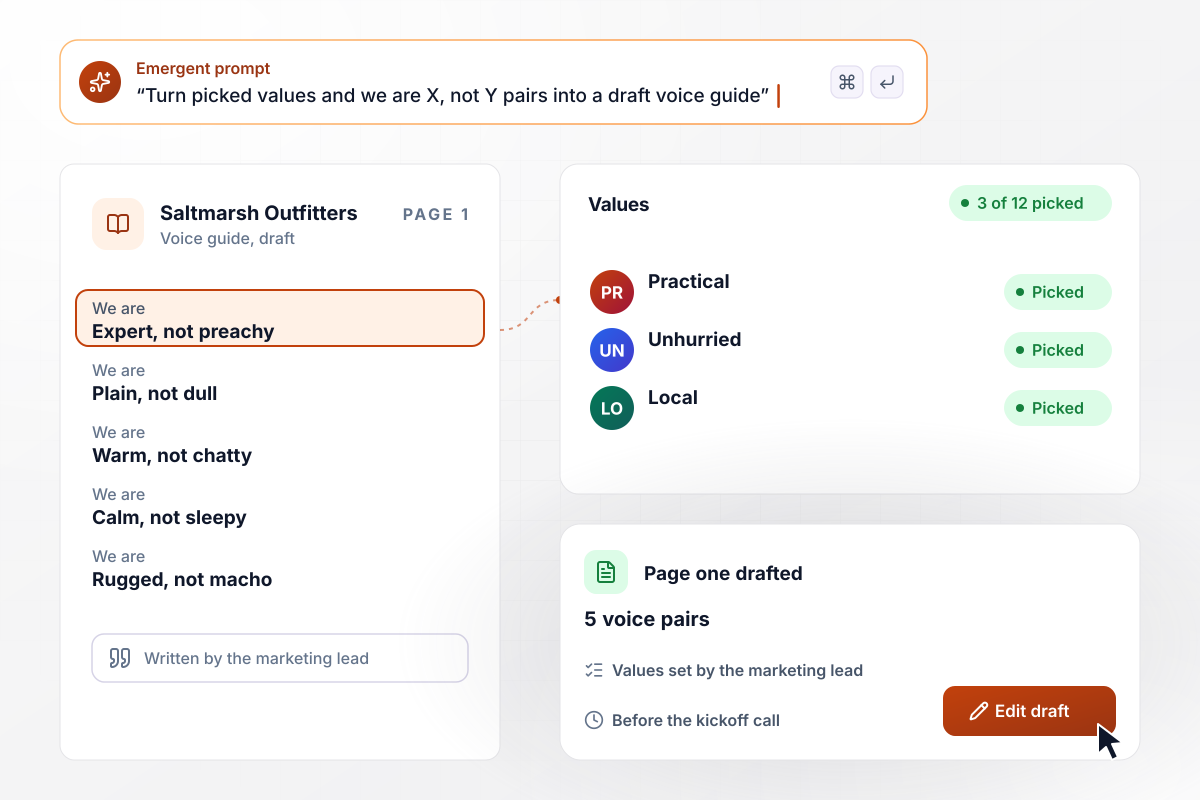
Five voice pairs become page one of the guide
Saltmarsh Outfitters asked its marketing lead to pick three values from a list of 12 and write five this-not-that voice pairs. She chose practical, unhurried and local, and wrote pairs such as expert, not preachy. Her answers became page one of the draft voice guide before the kickoff call.
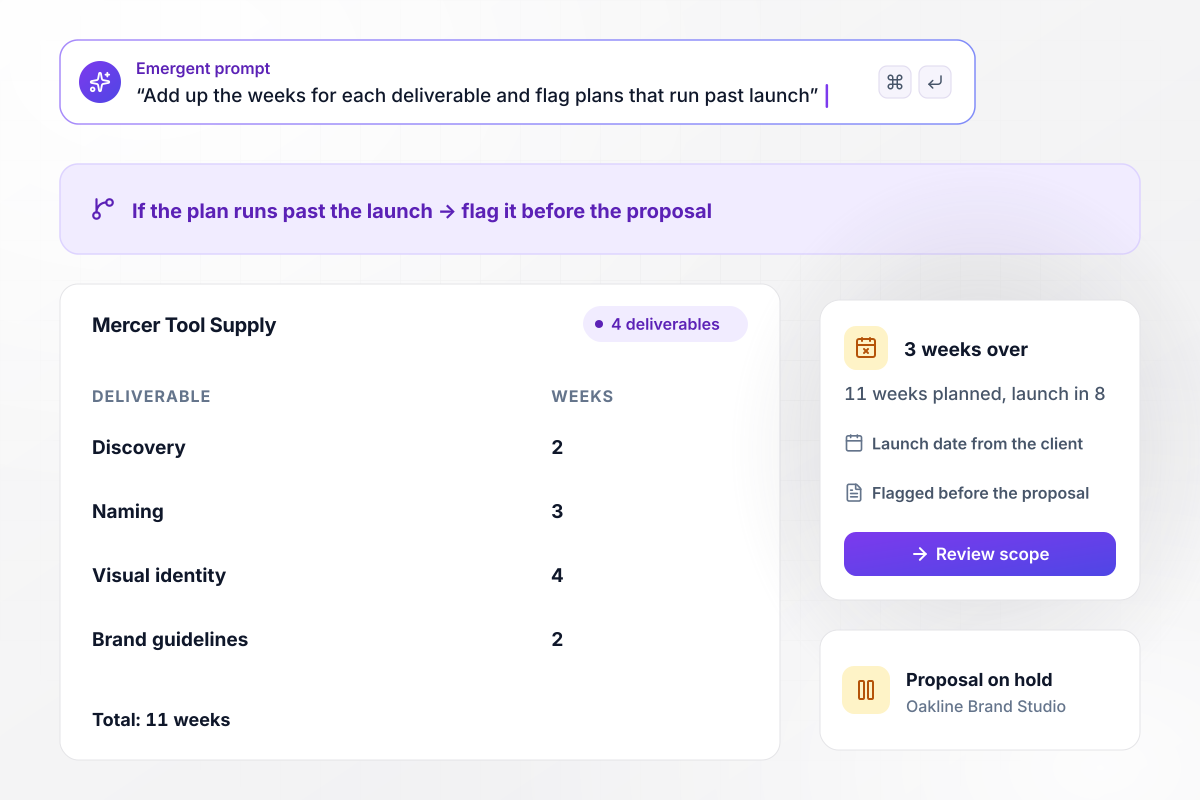
Eight weeks to launch, 11 weeks of rebrand work
On its rebrand questionnaire, Mercer Tool Supply ticks four deliverables: discovery at two weeks, naming at three, identity at four, and guidelines at two. That adds up to 11 weeks, and its launch is eight weeks out. Because the plan runs past the launch, Oakline Brand Studio sees the three-week gap before the proposal.






How to Write a Brand Questionnaire
These seven steps give you a brand questionnaire whose answers fill the strategy documents, not a folder of notes.
List what the questionnaire has to produce: a positioning statement, a competitor table, a values shortlist, a voice draft, and a scope. Every question should feed one of them. A question that feeds nothing belongs in the workshop, where you can follow up on the reply.
Give each output its own section, in the order the strategy gets built: business and audience first, competitors next, then values and voice, with scope at the end. A client who can see why a section exists tends to answer it with more care.
When the client says its product is better, ask what shows it: a test result, a review or a count of repeat customers. A claim without proof becomes a workshop question instead of a line in the positioning statement the founder signs off on.
Values and voice are hard to describe from nothing. Give the client a list of candidate values to pick from and a sentence frame for voice pairs. Leave one open box under each list for anything the options missed, and keep it optional.
Send the same link to each person who signs off on the brand. Their answers stay apart, which shows where the founder and the head of sales describe the customer differently. You learn that before the workshop instead of halfway through it.
End with the deliverables the client wants and the date the new brand has to launch. Asked last, these come after the client has thought through what the brand needs. Check the weeks of work against that date before you quote anything.
Have a colleague answer as a busy founder would, skipping every optional question. Check that the statement draft and the competitor table still fill in. Then send it to the client with a return date two working days ahead of the workshop.
Why Build Brand Questionnaires With Emergent?
Template questionnaires stop at the submit button. Emergent builds what follows: drafts and checks filled from the client's answers.

|
Typeform | Jotform | Google Forms | |
|---|---|---|---|---|
| How you build | Describe it in plain English | Templates, editor, AI assist | Templates, editor, AI generator | Editor, with Gemini drafting on some Workspace plans |
| Response limits | No response caps | Monthly response caps by plan; the form closes at the cap | Monthly submission caps by plan; the form stops at the cap | No limit |
| Where responses live | A database table you own, plus any integration | Typeform account | Jotform account | Google Sheets |
| File uploads | Files saved to storage you own, no sign-in | Paid plans only | Included; files count toward plan storage | Respondents must sign in to Google; files fill your Drive |
| Code ownership | Full code export to GitHub on paid plans | None | None | None |

Pick the Pricing Plan That Works for You
Choose the plan that fits your building ambitions. From weekend projects to enterprise applications, we've got you covered.




Find the right form
for whatever you're collecting
Frequently Asked Questions
Your Questions, Answered
Don't change this element unless you know what you are doing
More things you can build
with Emergent









on Emergent today


