

Build a Speaker Application Form That Fills Your Agenda
Build a speaker application form that collects talk proposals and puts each one in front of the right reviewer.
Build a speaker application form for my tech conference that asks for a talk title, format, and track, and sends each proposal to its track chair.
Trusted by Builders Worldwide
Active Builders Worldwide
Apps Successfully Created
Countries Globally Reached



What Reviewers Need From Every Proposal
A speaker application form decides which talks reach the stage. This one also runs the review and the reply each speaker gets back.
Questions that change with the format
Pick a workshop and the form asks for the seat limit and what attendees should bring. Pick a talk and it asks for the length, so nobody fills in a field that does not apply.
Proposals sent to the right chair
Give each track an owner, and the app emails every proposal to the chair of the track it names. A proposal with no track goes to the program lead, so none sits unread.
Scores with the speaker's name hidden
Reviewers read the title and abstract, score it on your scale, and add a note. Names stay hidden until every score is in, and the app averages them into one ranked list.
Recording consent signed on the form
Ask speakers to agree that their session may be recorded and posted, and capture the signature with the proposal. The video crew finds consent in the same record as the talk.
A proposal table with no response caps
Each proposal is saved as a row in a database you own, however many arrive before the deadline. Sort by track or average score, and mark each talk accepted or declined.
The code, exported to your GitHub
On paid plans, export the full codebase of the form and its review screen to your GitHub repository. Run it beside your event site, or keep building on it for next year.
Four Events That Call for Speakers
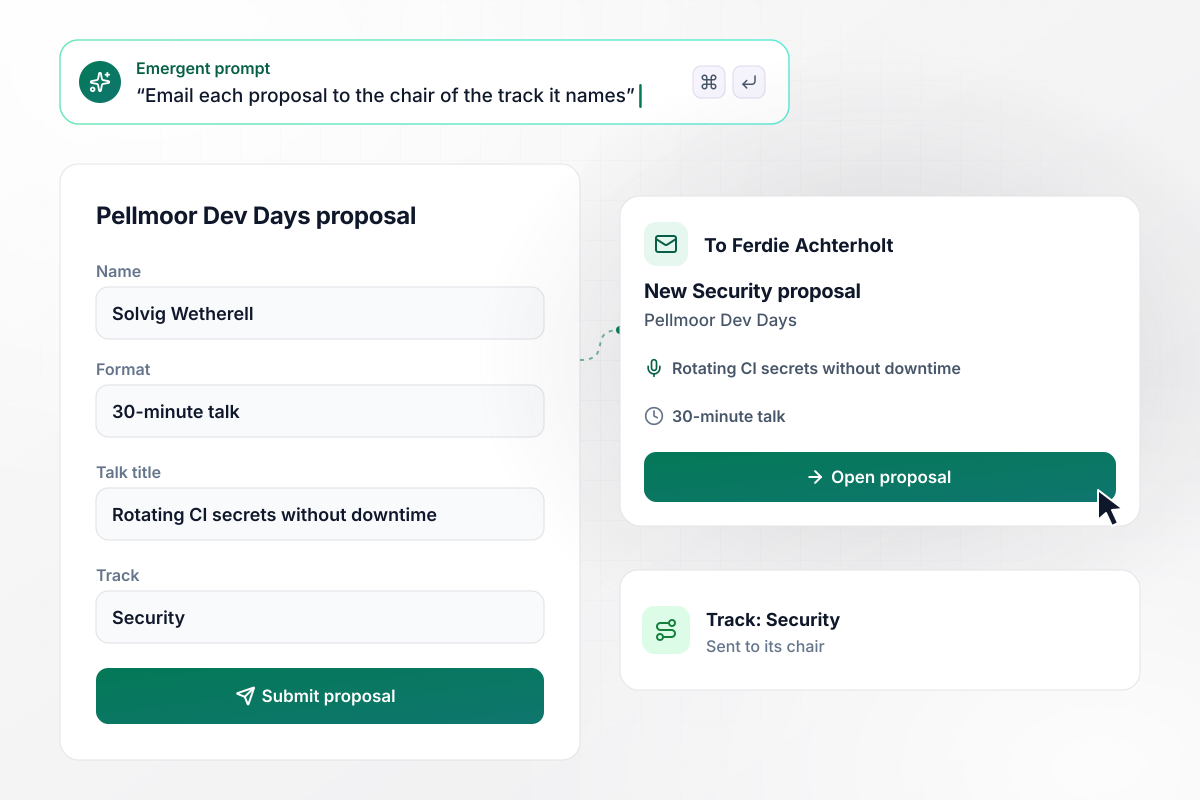
Solvig's Security talk goes straight to its chair
Pellmoor Dev Days gives every track its own chair. Its form asks for name, talk title, format, and track. Solvig Wetherell proposes Rotating CI secrets without downtime as a 30-minute talk in the Security track. The form then emails it to Ferdie Achterholt, the Security chair.
window.awbMockup = { developerConferences: "Build a speaker application form for my developer conference. Ask for name, talk title, format, and track. Email each proposal to the chair of the track it names, and save every proposal to a table I can sort by track.", communityMeetups: "Build a speaker application form for my monthly data meetup. Ask for name, talk title, and the month the speaker wants. Each month has 3 lightning-talk slots of 5 minutes. When a month's slots are taken, offer the first open slot in the next month and hold the talk for that night.", industrySummits: "Build a speaker application form for my freight industry summit. Ask for name, company, home city, and whether the speaker needs travel covered. Flag every yes for my program lead before reviewers see the proposal, and show a weekly count of new applications and travel requests.", designConferences: "Build a speaker application form for my UX conference with blind review. Ask for name, talk title, and abstract. Hide the speaker's name from 3 reviewers, who each score the proposal from 1 to 5. Average the scores, and put any proposal averaging 4 or higher on my shortlist." };
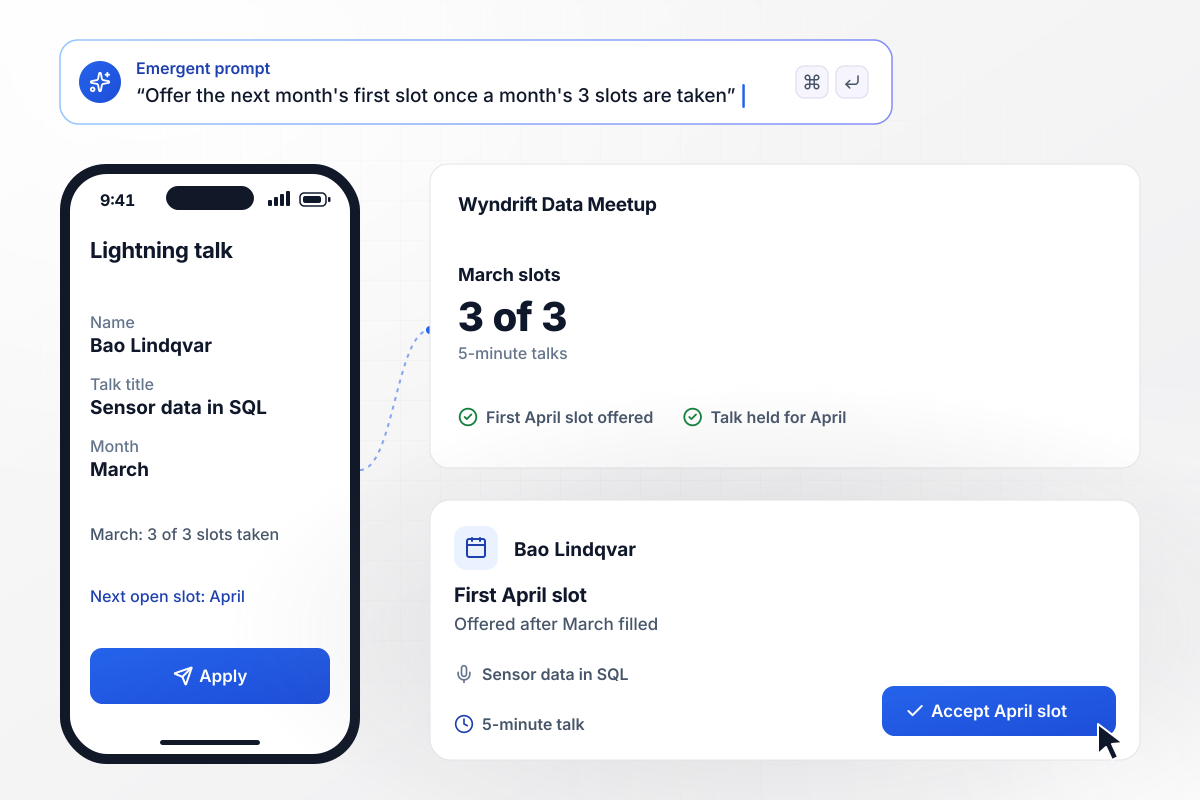
Bao asks for March after all 3 slots are gone
The Wyndrift Data Meetup meets once a month and holds 3 lightning-talk slots of 5 minutes each. Speakers give their name, a talk title, and the month they want. Bao Lindqvar picks March after every March slot is taken. The form offers him the first April slot instead and holds his talk for that night.
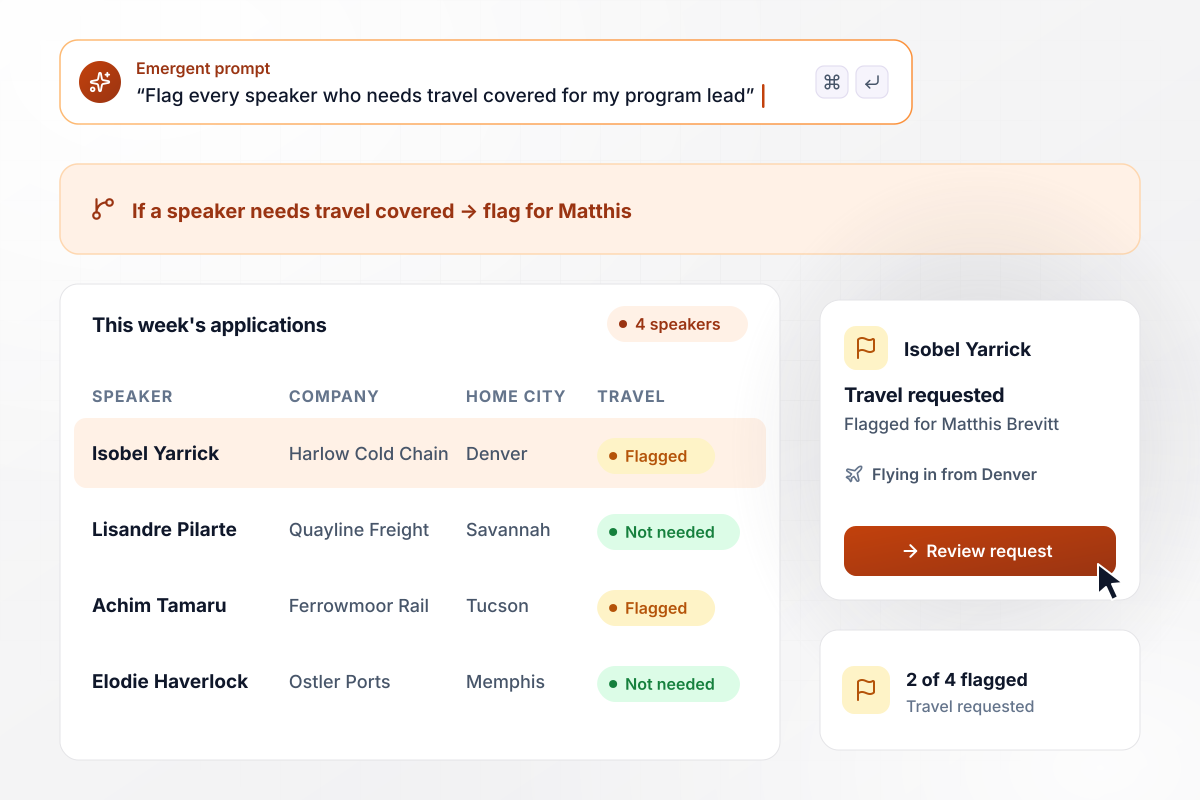
Matthis gets each travel request ahead of review
Matthis Brevitt runs the Corrowmere Freight Summit program on a fixed travel budget. Its form asks for name, company, home city, and whether travel needs covering. Any yes is flagged for Matthis before review. This week 4 speakers applied and 2 asked, Isobel Yarrick from Denver among them.
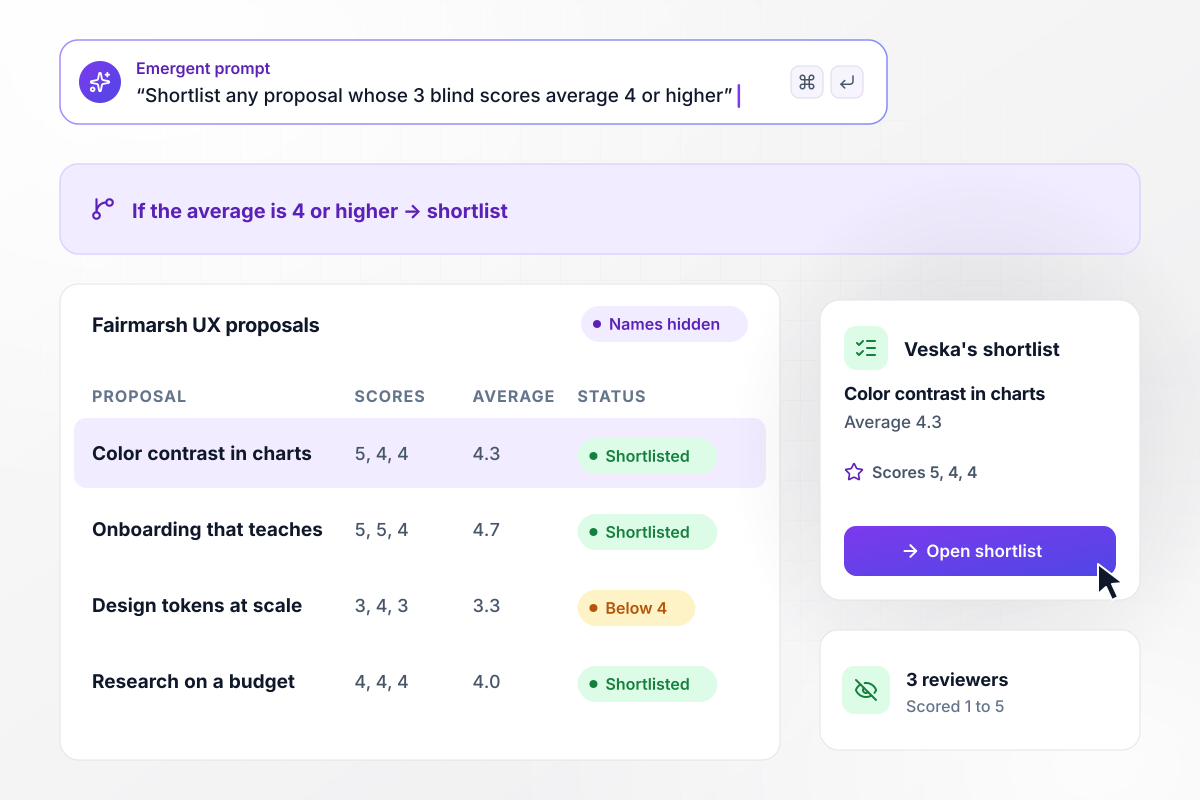
With 3 blind scores in, a design talk makes the shortlist
Veska Lauwers chairs the program at the Fairmarsh UX Conference. Three reviewers score each proposal from 1 to 5 without seeing the speaker's name, and an average of 4 or higher makes the shortlist. Color contrast in charts scores 5, 4, and 4, an average of 4.3, and goes onto Veska's shortlist.






How to Create a Speaker Application Form
Follow these 7 steps to build a speaker application form that brings in proposals and gets every one scored before the agenda is set.
Write down the session types you accept, such as 30-minute talks and 90-minute workshops. Then name your tracks and give each one a chair, since every proposal will be routed by the track the speaker picks.
Collect the talk title, a short abstract, and the format. Cap the abstract at 250 words. Ask for a link to a past talk, and make it optional for anyone who has never spoken at an event.
Decide how many people score each proposal and on what scale, such as 3 reviewers scoring 1 to 5. Hide names until scoring ends. Then set the shortlist bar on that same scale, for example 4 or higher.
Choose the day the call for speakers closes and count the slots in each track or month. Decide what a proposal gets once its slot is full: a waitlist place or an offer of the next open date.
Describe the questions and the review rule in plain English. Emergent builds the speaker application form and the screen reviewers score on. Change a question later by asking.
Email each track chair when a proposal names their track, and send the program lead a weekly count. Every speaker gets a confirmation that says when decisions go out.
Submit one talk and one workshop from a spare email address. Check that each reaches the right chair, that the workshop asks for a seat limit, and that both rows appear in the table with no score yet.
Why Build Speaker Applications With Emergent?
Tell Emergent your tracks and your review rule in plain English, and it builds the speaker form along with the screen your reviewers score on.

|
Jotform | Google Forms | Typeform | |
|---|---|---|---|---|
| How you build | Describe it in plain English | Templates, editor, AI generator | Editor, with Gemini drafting on some Workspace plans | Templates, editor, AI assist |
| Where responses live | A database table you own, plus any integration | Jotform account | Google Sheets | Typeform account |
| Response limits | No response caps | Monthly submission caps by plan; the form stops at the cap | No limit | Monthly response caps by plan; the form closes at the cap |
| Code ownership | Full code export to GitHub on paid plans | None | None | None |

Pick the Pricing Plan That Works for You
Choose the plan that fits your building ambitions. From weekend projects to enterprise applications, we've got you covered.




Find the right form
for whatever you're collecting

Frequently Asked Questions
Your Questions, Answered
Don't change this element unless you know what you are doing
More things you can build
with Emergent









on Emergent today


