

Build a Vendor Application for Your Market or Event
Get a vendor application that reads insurance dates off each certificate and saves every vendor to a database you own.
Build a vendor application that saves every response to a database I own.
Trusted by Builders Worldwide
Active Builders Worldwide
Apps Successfully Created
Countries Globally Reached



What the Application Checks Before You Do
What Emergent builds into a vendor application, and what you keep when the season ends.
An application drafted from your event
Describe your market and what you screen vendors for. Emergent builds the application and the screen your reviewers use to score it. Change any question with a follow-up prompt.
Questions that match each vendor type
Food vendors get the permit and insurance questions, and a jeweler gets a photo upload instead. Each applicant answers only what their category needs, in a form that stays short.
Certificates read into fields
Vendors upload a certificate of insurance or a permit, and the app reads the insured name and policy dates into fields. A date it cannot read with confidence goes to a person.
Scores and notes on the vendor's row
Reviewers score each application and leave notes. Each score sits in a database you own, beside the vendor's answers and uploads. Sort by category to fill the booths you have.
Status emails and a nudge for the manager
Each status change sends its own email: accepted, waitlisted, or missing a document. Vendors missing a file get reminders, and the manager gets a Slack alert when a decision is due.
Your web address, your code
Run the application at your event's own web address; custom domains are included and use credits. Paid plans add full code export to your GitHub repository, yours after the season.
How Four Organizers Screen Their Vendors
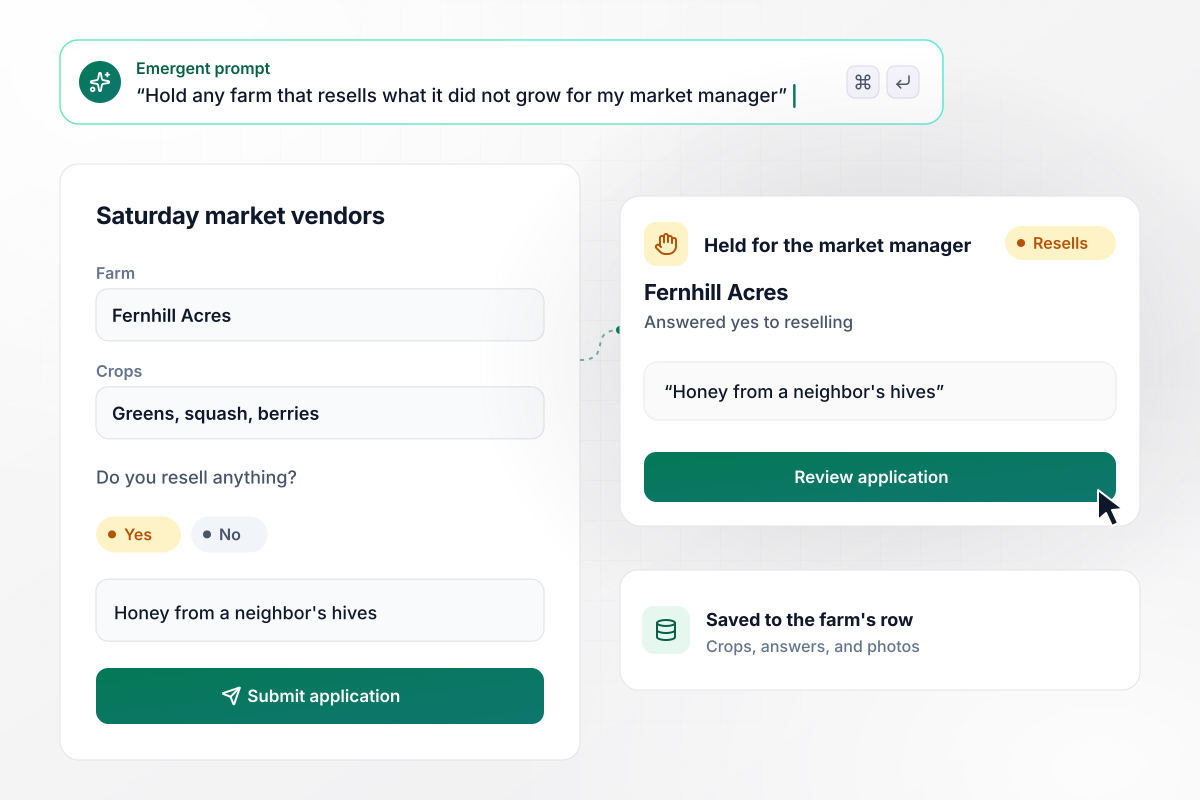
Honey from next door waits for the manager
Every vendor at a producer-only Saturday market sells what their own farm grows. The application asks each farm for its crops and whether it resells anything. A yes holds the application for the market manager, with the answer quoted in full. Fernhill Acres answered yes: honey from a neighbor's hives.
window.awbMockup = { farmersMarket: "Build a vendor application for my producer-only Saturday farmers market. Ask each farm for its name, its crops, and photos of its fields, then ask whether it resells anything it did not grow and what. Approve the rest as they come in, but hold any application that answers yes for my market manager, with the answer quoted, and save every farm to its own row.", craftFairJury: "Build a juried vendor application for my craft fair. Each applicant picks a category and uploads five photos of their work. Let three jurors score every applicant out of 5, average the scores, and rank each category. Jewelry has 8 booths: accept the top 8 and send every applicant an accepted or not accepted email once I confirm the list.", foodVendors: "Build a food vendor application for my July 18 street festival. Ask for the menu, the truck or tent size, and the health permit, and have each vendor upload a certificate of insurance. Read the policy start and end dates off the certificate. If the policy ends before the festival, put the application on hold and email the owner for a renewed certificate.", holidayMarket: "Build a vendor application with a booth waitlist for my holiday market. Keep a waitlist for each category in the order people applied. When a vendor cancels, email the first person on that category's waitlist an offer that stays open for 48 hours, then move to the next name if it lapses. Update the booth map when someone accepts." };
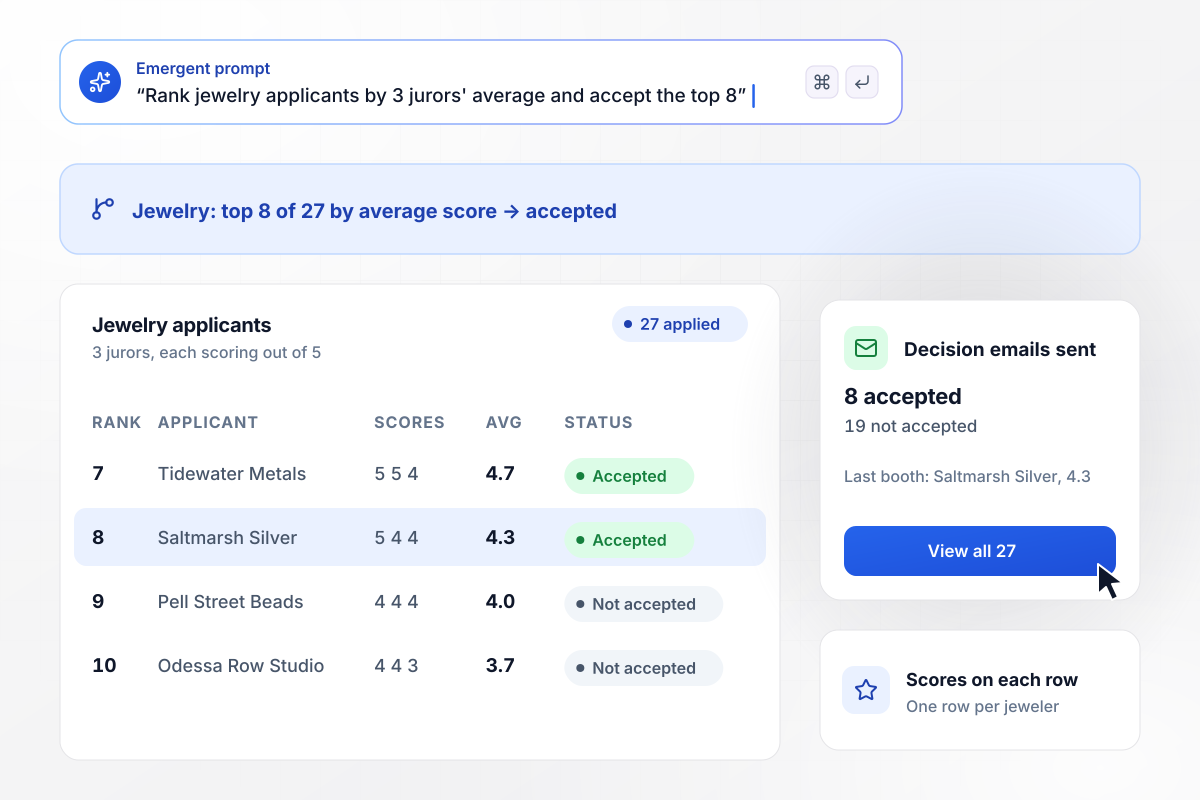
Three jurors, one ranked list of jewelers
Jewelers sent 27 applications for 8 booths at a juried craft fair. Three jurors score each applicant's photos out of 5, and the app ranks the averages. The top 8 are accepted. Saltmarsh Silver took the last booth with a 4.3, and the decision emails went out as 8 accepted and 19 not accepted.
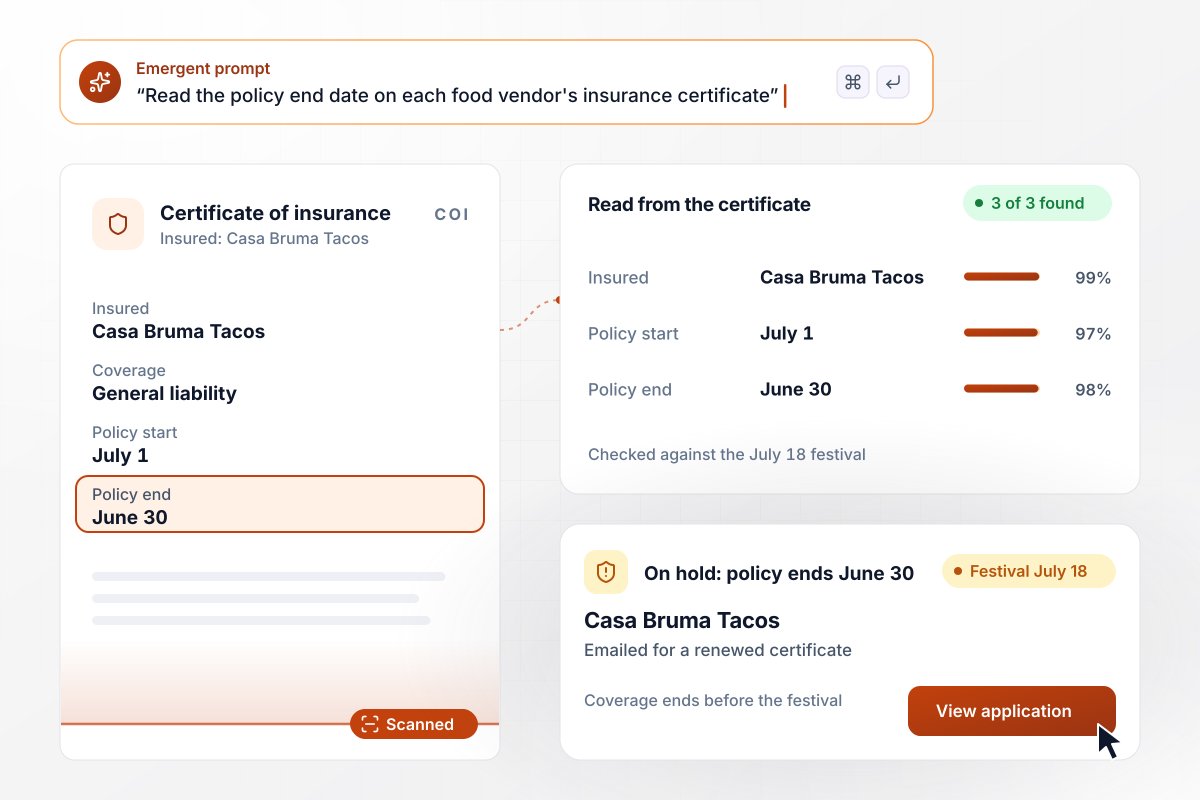
Each certificate read for its end date
Food vendors at a July 18 street festival upload a certificate of insurance with the application. The app reads the policy start and end dates off each one. Casa Bruma Tacos sent a certificate whose policy ends June 30. Its application is on hold, and the owner has an email asking for a renewed certificate.
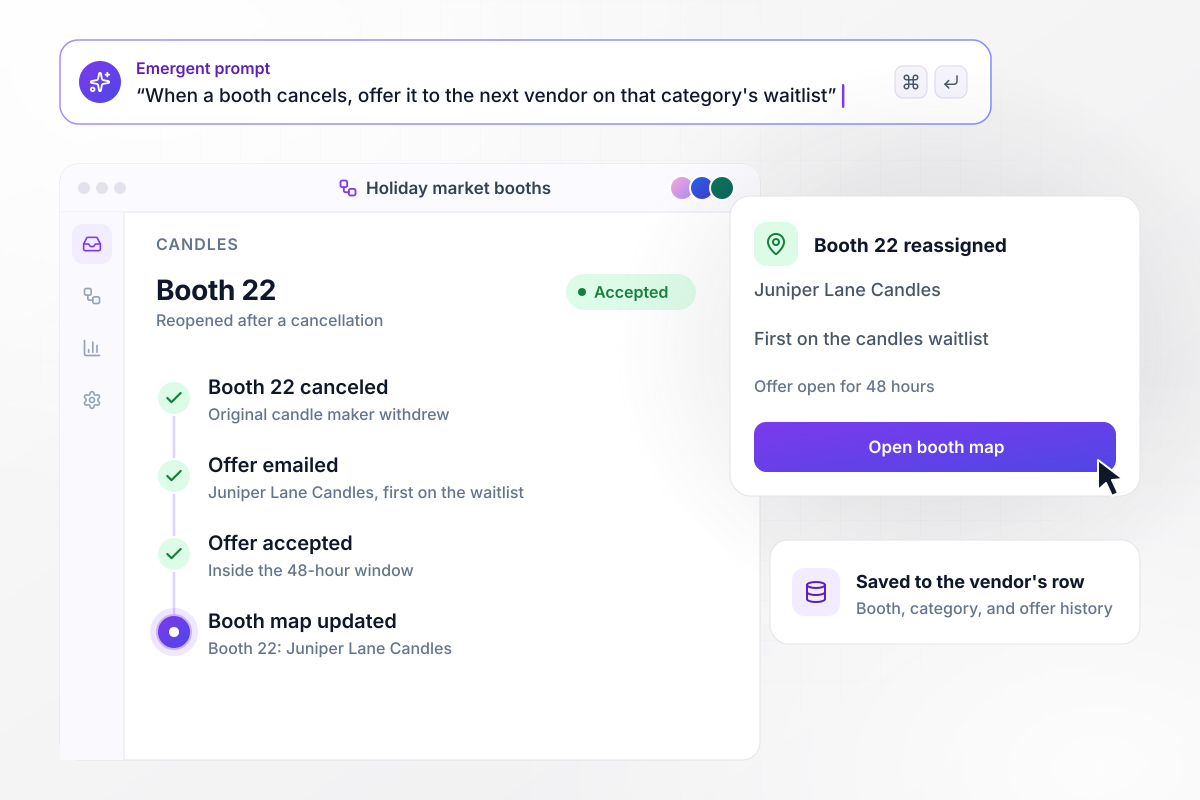
One cancellation, one offer, 48 hours to answer
A candle maker cancels booth 22 at a holiday market. The app emails the first candle maker on the waitlist, Juniper Lane Candles, an offer that stays open for 48 hours. An offer that lapses moves to the next name in line. Juniper Lane accepted, and the booth map now shows it in booth 22.






How to Create a Vendor Application
Seven steps to create a vendor application that asks only what you need to pick vendors, then sends each decision.
Write down the booth count per category and anything that rules an applicant out, such as reselling at a producer-only market. Every question on the form should help you apply one of those rules, and any question that does not can go.
Open with the business name, then the person and the email address that should get your decision. Ask for a sales tax permit number only if your event requires one, and use the field's help text to say why you need it.
Ask for a short product list, a price range, and 3 to 5 photos of the work and of a past booth. Photos let a jury compare applicants side by side, and the price range shows whether a vendor fits the shoppers you draw.
Place uploads after the questions, once a vendor has invested time in the answers. A certificate of insurance is only evidence of coverage in effect when it was issued. Find the policy end date on each one and compare it with your event date.
Offer booth size and power as fixed choices, never free text, and add a corner checkbox if you charge extra for corners. These answers drive the booth map, and a 10x10 with power is far easier to place than a paragraph.
Submit one application that should pass and one that should be held, such as a certificate that ends before the event. Check that each lands on its own row with the right status, and that each fake vendor gets the email it should.
Post the link on your event's site with a firm deadline. When reviews are done, send every decision email from the same table, and keep this season's rows so next year's invitations go to vendors you already know.
Why Build a Vendor Application With Emergent?
Applications never hit a response cap before your deadline, and every answer stays in a database you own.

|
Jotform | Square | Google Forms | |
|---|---|---|---|---|
| How you build | Describe it in plain English | Templates, editor, AI generator | Printable template, then Card on File in Square | Editor, with Gemini drafting on some Workspace plans |
| Where responses live | A database table you own, plus any integration | Jotform account | Square Customer Directory | Google Sheets |
| Response limits | No response caps | Monthly submission caps by plan; the form stops at the cap | Paper form, fees charged per payment | No limit |
| Code ownership | Full code export to GitHub on paid plans | None | None | None |

Pick the Pricing Plan That Works for You
Choose the plan that fits your building ambitions. From weekend projects to enterprise applications, we've got you covered.




Find the right form
for whatever you're collecting
Frequently Asked Questions
Your Questions, Answered
Don't change this element unless you know what you are doing
More things you can build
with Emergent









on Emergent today


