

Build a Podcast Listener Survey Your Show Can Act On
Build a podcast listener survey that listeners open from your show notes, with every answer saved in a database you own.
Build a podcast listener survey for my weekly history show that asks how fans listen and what they share.
Trusted by Builders Worldwide
Active Builders Worldwide
Apps Successfully Created
Countries Globally Reached



Inside a Listener Survey Built by Emergent
Tell Emergent about your show and what you want to learn. It builds the podcast listener survey, and you change it by prompting.
Questions written around your segments
Name your show, its recurring segments, and the decision you are weighing. Emergent writes the questions to match, and a follow-up prompt rewords, cuts, or adds any of them.
Every answer tied to an episode
Each answer is saved as a row in a database you own, with the episode number you ask it to record. Sort by episode to see which ones listeners rated highest and lowest.
One question per screen on a phone
Listeners who tap the link inside a podcast app land on a phone screen that shows one question at a time, with large answer buttons. Nobody has to zoom through a long form.
A results view for each segment and vote
Emergent builds a results view with the survey: the average for each segment, the count for each choice, and the open comments underneath. Add a chart with another prompt.
Opted-in listeners added to your email list
Send listeners who opt in to your email list or CRM through its API, with their answers attached. The next newsletter can then go only to people who asked for more on a topic.
Your own short link, and code you keep
Custom domains are included in Emergent and use credits, so the survey link read out on air can be short and yours. On paid plans, export the full code to your GitHub repository.
Listener Surveys on Four Podcasts
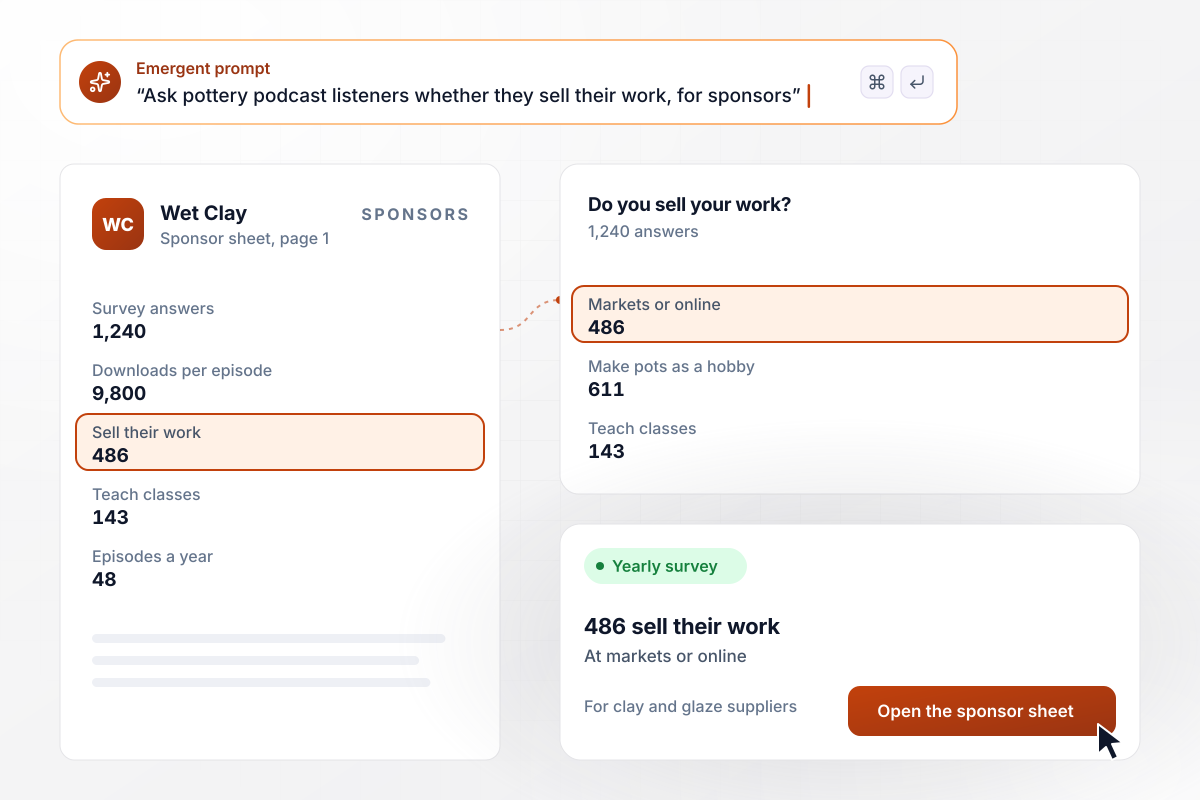
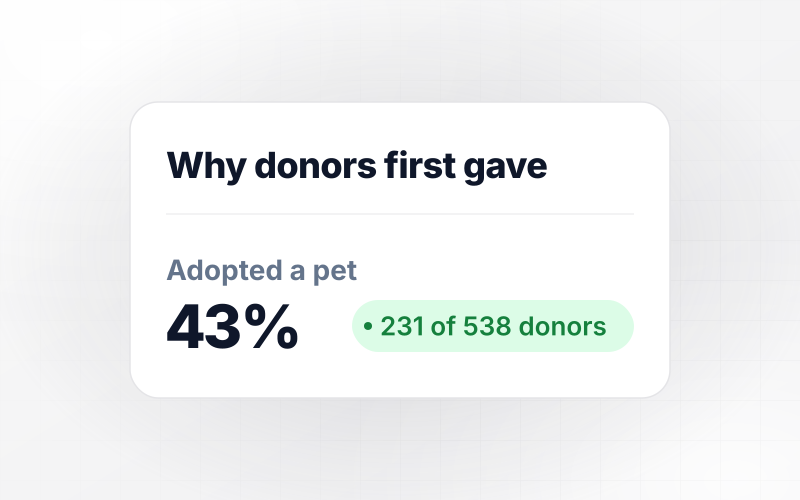
The sponsor sheet leads with 486 pottery sellers
Every spring, Wet Clay asks the listeners of its pottery podcast who they are and whether they sell their work. Of 1,240 answers, 486 sell at markets or online, 611 make pots as a hobby, and 143 teach classes. The 486 goes on page 1 of the show's sponsor sheet, where clay and glaze suppliers read it first.
window.awbMockup = { sponsorProfile: "Build a yearly listener survey for my pottery podcast. Ask who listens and whether they sell their work, with choices for selling at markets or online, making pots as a hobby, and teaching classes. Show the count for each answer so I can add it to my sponsor sheet.", segmentRatings: "Build a rating survey I can link in each episode's show notes for my history podcast. Ask listeners to score each of the 4 segments out of 5 and save the episode number with every answer. Show the average for each segment over the last 6 episodes.", seasonVote: "Build an end-of-season vote for my podcast for small business founders, one question per screen: which theme should season 5 cover? Give 4 choices: hiring a first employee, pricing, finding customers, and leaving a day job. Show the vote count for each.", episodeLength: "Build a survey for my parenting podcast that asks listeners how long an episode should be, with choices for under 30 minutes, 30 to 45 minutes, and over 45 minutes. Show the number of answers for each choice and the share that picked under 30 minutes." };
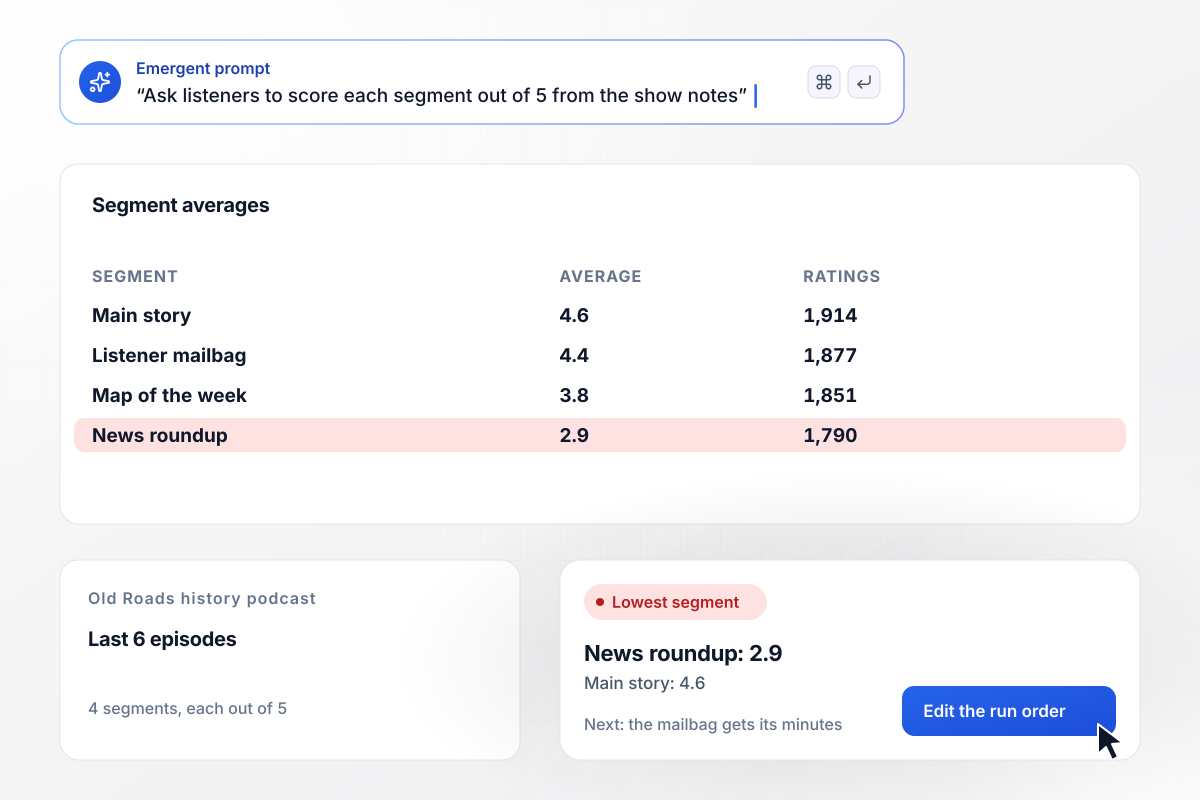
The news roundup averages 2.9 and leaves the show
Old Roads, a history podcast, puts a rating link in each episode's show notes and asks listeners to score its 4 segments out of 5. Over 6 episodes, the main story averages 4.6 and the listener mailbag 4.4, while the news roundup sits at 2.9. The roundup is dropped, and the mailbag gets its minutes.
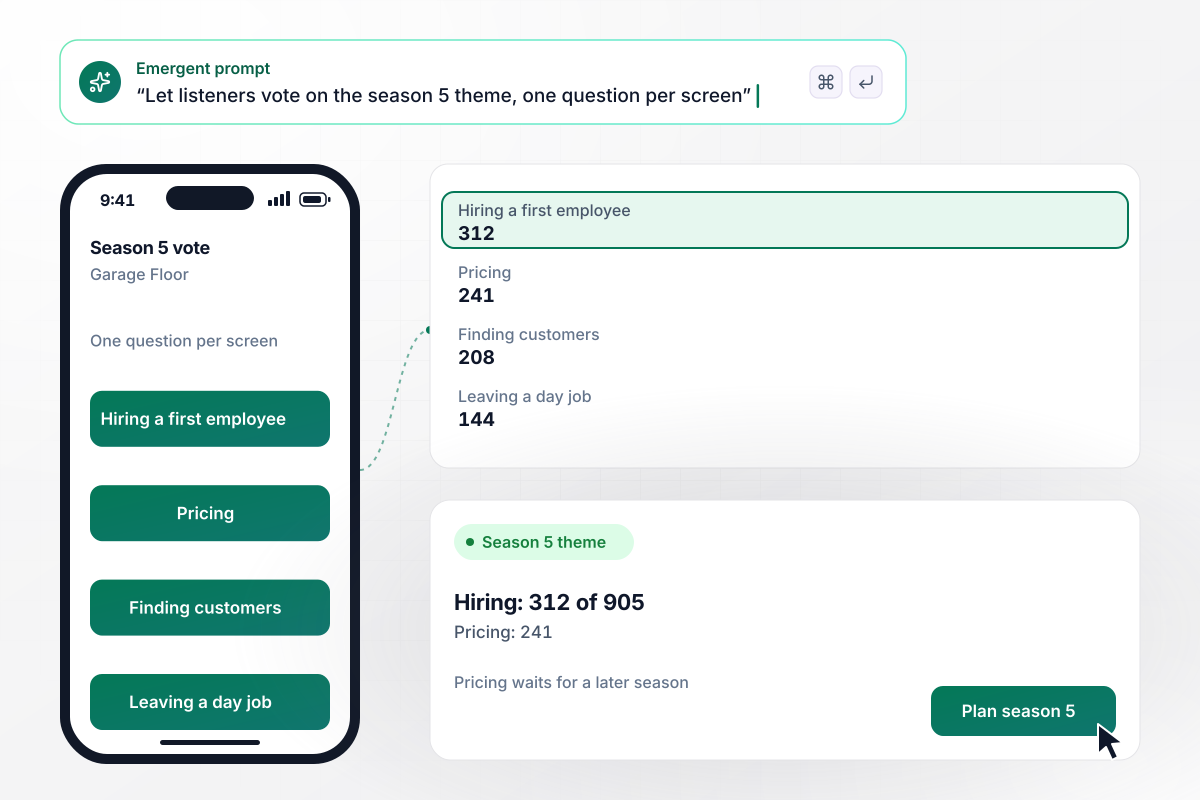
Listeners vote hiring in as the season 5 theme
Garage Floor, a podcast for small business founders, closes its season with a vote shown one question per screen: which theme should season 5 cover? Of 905 votes, 312 go to hiring a first employee, ahead of pricing at 241. The hosts plan season 5 around hiring and keep pricing for a later season.
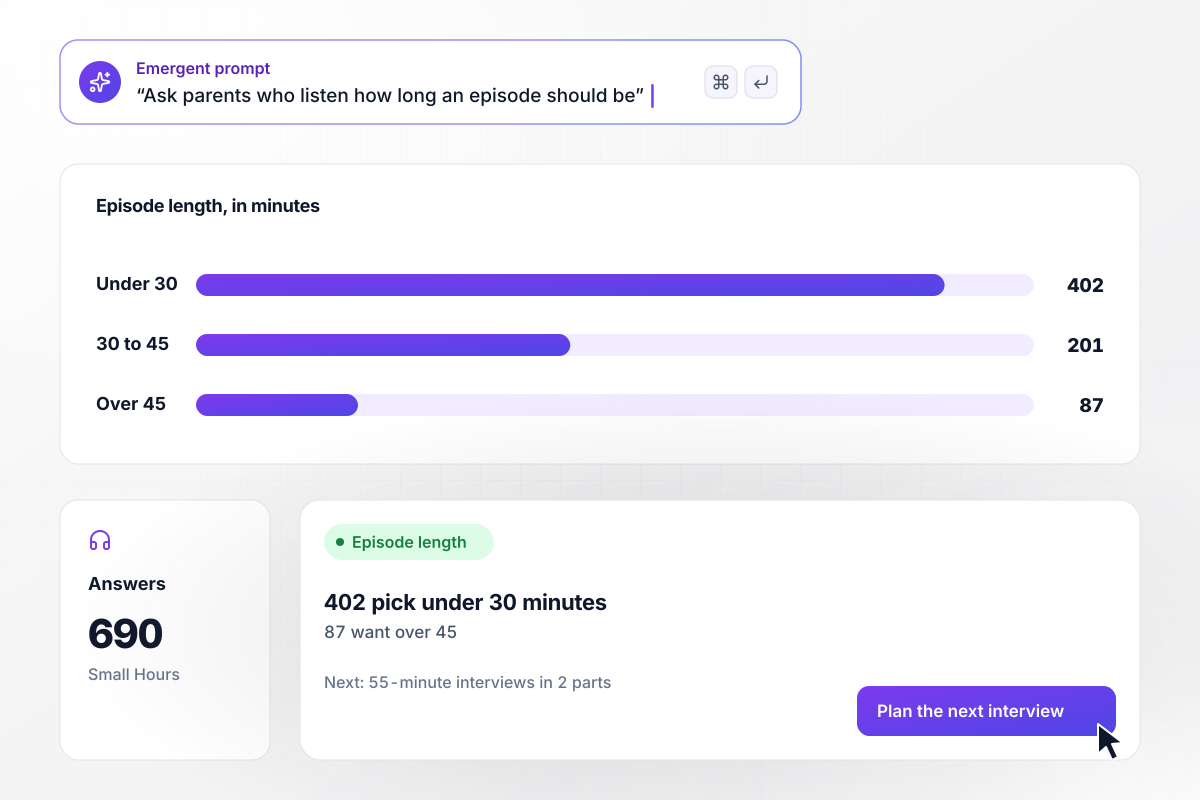
Small Hours splits its interviews after 402 of 690 answers
Small Hours, a parenting podcast, asks listeners how long an episode should be. Of 690 answers, 402 pick under 30 minutes, and only 87 want more than 45. The show now cuts each 55-minute guest interview into two parts.






How to Create a Podcast Listener Survey
Follow these seven steps to build a podcast listener survey, share it on air, and turn the answers into a change to your show.
Write down the one choice the survey should settle, such as which segment to drop or what next season covers. Put it at the top of your prompt, and cut any question whose answer cannot change that choice.
Refer to each segment by the name listeners hear on the show, not a working title from your notes. A listener who has never seen your run sheet should know which part of the episode each question means.
Score every segment on the same scale, such as 1 to 5, and keep the wording fixed between rounds. A segment rated out of 5 one month and out of 10 the next cannot be compared. Settle the scale before the first link goes out.
Choose a short link with no numbers or hyphens. A host can read it on air once and listeners can spell it. Put the same link at the top of the show notes for anyone who would rather tap than type.
Send the survey to 3 listeners who have written in before and ask them to answer on their phones. Note any question they read twice, then fix the wording with a follow-up prompt before launch.
Mention the survey near the start of the episode and again at the end, with the link both times. Say how many questions it has before you read the link, and keep that number small enough to say without wincing.
Once the answers are in, say on air what you are changing because of them, such as dropping a segment or picking next season's theme. That is how the people who answered learn their time counted, and it sets up the next survey.
Why Emergent for Podcast Listener Surveys?
Emergent builds the listener survey as an app you keep. There are no response caps, however many listeners an episode sends to the link.

|
SurveyMonkey | Microsoft Forms | SurveyHero | |
|---|---|---|---|---|
| What you get | Survey, logic, and response database, as code you own | Survey builder with templates, including employee engagement | Surveys, quizzes, and polls with response summaries | Survey builder with templates, including employee satisfaction |
| Pricing model | Credits, no response caps or per-response fees | Per-user team plans with a seat minimum, billed annually | Free with a Microsoft account; included in Microsoft work and school subscriptions | Free plan, then per-account plans with unlimited responses |
| Where responses live | A database table you own, plus any integration | SurveyMonkey account | Microsoft Forms, with export to Excel | SurveyHero account, EU data centers |
| Code ownership | Full code export to GitHub on paid plans | None | None | None |

Pick the Pricing Plan That Works for You
Choose the plan that fits your building ambitions. From weekend projects to enterprise applications, we've got you covered.




Find the right survey, quiz, or poll
for your team
Frequently Asked Questions
Your Questions, Answered
Don't change this element unless you know what you are doing
More things you can build
with Emergent






on Emergent today


