

Build Hotel Automation Around Your Front Desk and Back Office
Build hotel automation that checks guests in before they arrive and flags card charges with no matching settlement.
Build hotel automation that runs on its own and logs every step.
Trusted by Builders Worldwide
Active Builders Worldwide
Apps Successfully Created
Countries Globally Reached



What Emergent Builds Into a Hotel App
Hotel automation hands the repeat steps of a stay to software and sends each exception to the person who owns it.
Rules written the way you brief staff
Describe each rule in plain English, such as which room is cleaned first when an early guest waits. Emergent builds the app, its database, and the logic, and a prompt changes it.
Connects to the systems the desk runs
The app connects to any tool with an API, so reservations come in from your property management system and updates go back out. QuickBooks and Stripe connect in the same way.
Supplier invoices read into fields
Upload a linen or food supplier's invoice, and AI reads the vendor, the amount, and the due date into fields. A value the AI is unsure of goes to a person before the record is saved.
A named owner for every exception
An unmatched charge or a low guest rating goes to one person by email or in the app, and a reminder follows if nobody acts. Slack alerts work the same way, set for each rule.
No task cap in a sold-out week
Automations keep running with no task cap, so a full house with 60 arrivals runs the same rules as a quiet Tuesday. Guest, stay, and charge records sit in a database you own.
The code goes to your GitHub
Export the full code of the app to your GitHub repository on paid plans. A developer the hotel trusts can read every rule before the app touches a guest folio or a card settlement.
Four Hotel Automations to Run This Month
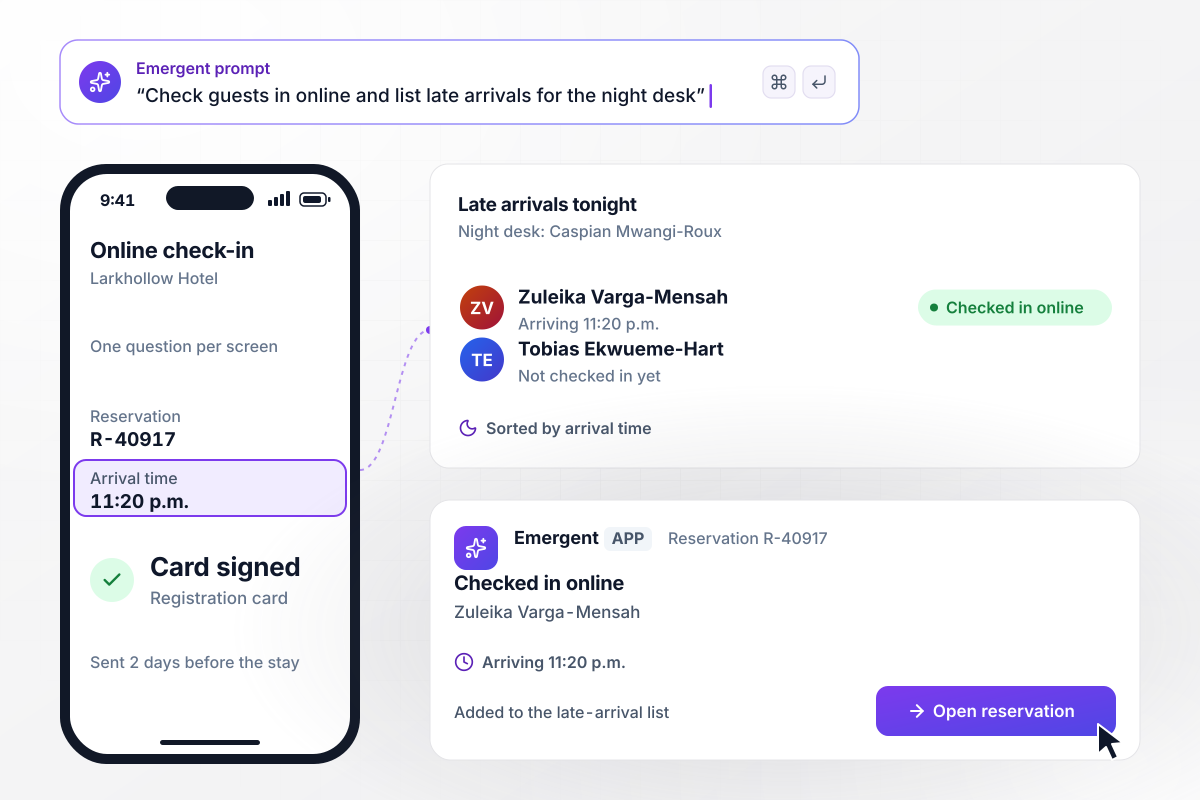
A late arrival checks in before she leaves home
Two days before her Larkhollow Hotel stay, Zuleika Varga-Mensah gets a check-in link with one question per screen. She gives an arrival time of 11:20 p.m. and signs the registration card. The app marks reservation R-40917 Checked in online and adds her to Caspian Mwangi-Roux's late-arrival list at the night desk.
window.awbMockup = { onlineCheckIn: "Send each guest a check-in link 2 days before arrival that asks one question per screen: arrival time, then a signature on the registration card. Mark the reservation Checked in online when they finish. If the arrival time is after 10:00 p.m., add the guest to the late-arrival list for the night desk.", roomTurnover: "When a room checks out, add it to the housekeeping cleaning list. If the next guest for that room asked to check in early, move the room to the top of the list. When housekeeping marks the room Clean, email the waiting guest that their room is ready.", chargeMatching: "Every night at 3:00 a.m., match the day's folio charges against the card settlement report. Sync the matched total to QuickBooks. For any charge with no settlement, send the controller a direct message in Slack with the room number, the amount, and a Review button.", postStaySurveys: "Two days after checkout, email each guest a one-question survey that asks them to rate their stay from 1 to 5, with a comment box. Send guests who rate 4 or 5 a $40 direct-booking offer. Leave lower ratings off the offer and email their comments to the general manager." };
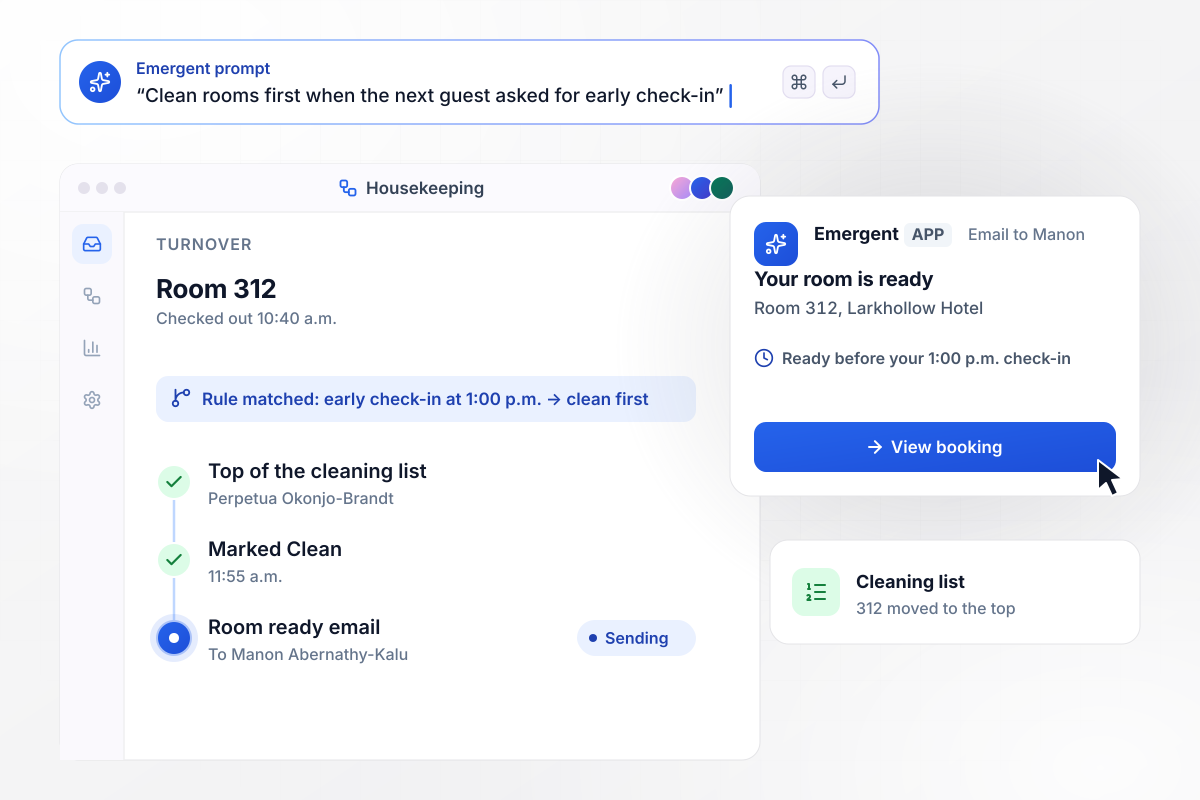
Room 312 goes first for a 1:00 p.m. guest
Room 312 checks out at 10:40 a.m. Manon Abernathy-Kalu asked to check in at 1:00 p.m. The app moves 312 to the top of the cleaning list for Perpetua Okonjo-Brandt in housekeeping. Perpetua marks the room Clean at 11:55 a.m., and the app emails Manon that her room is ready.
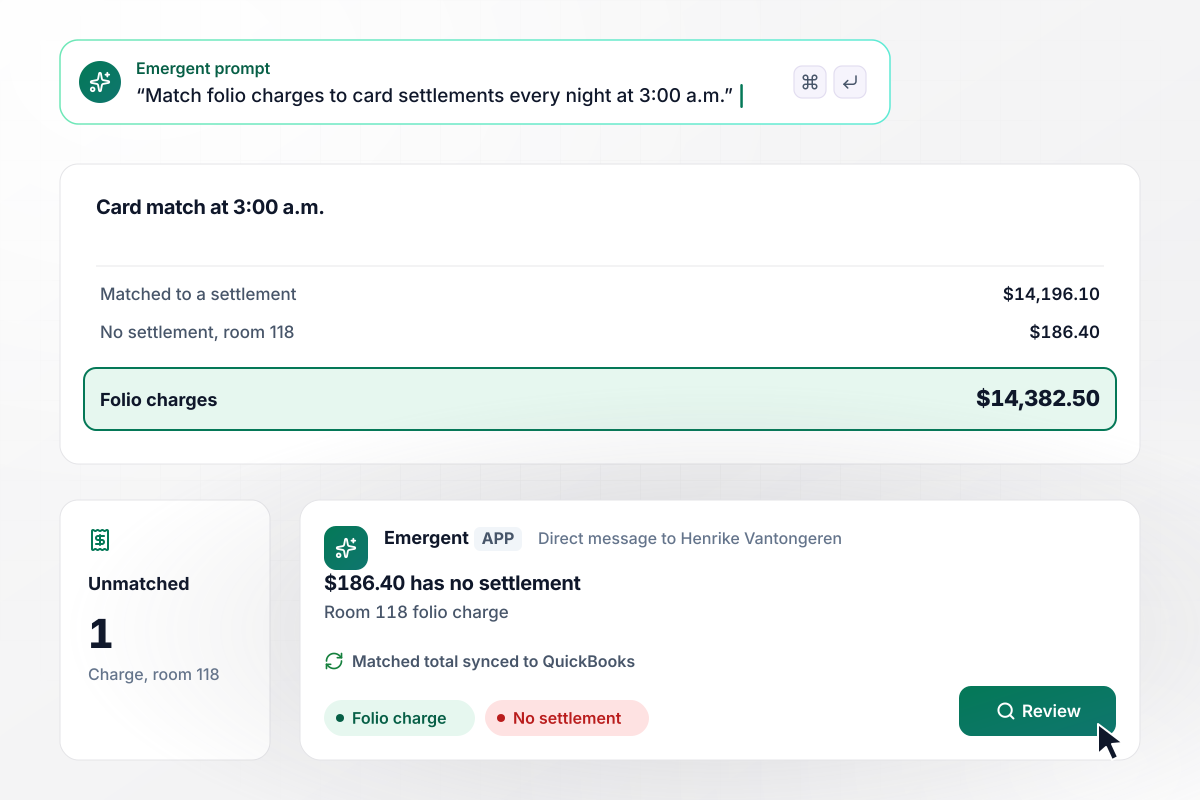
A $186.40 charge with no settlement reaches the controller
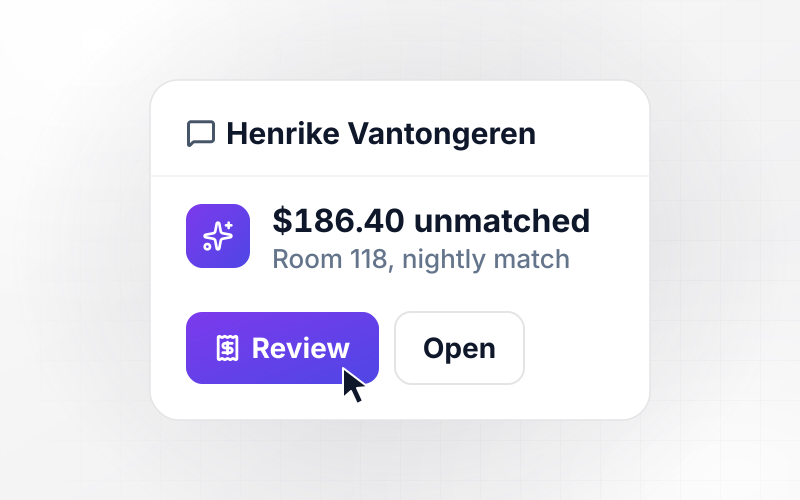
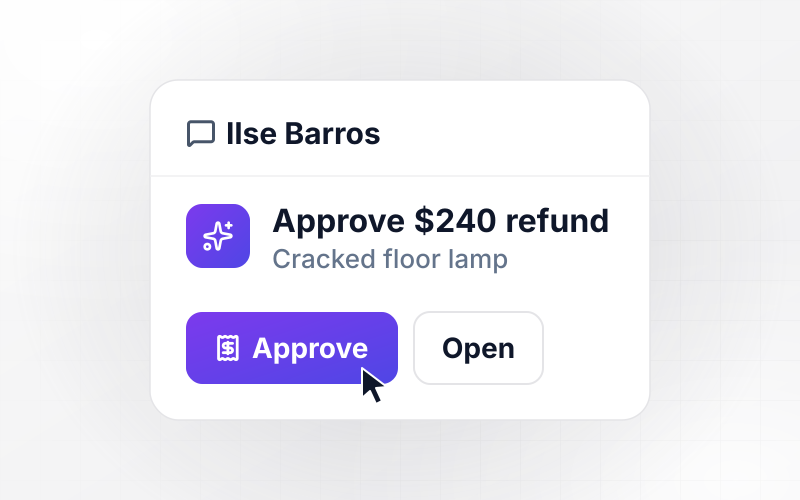
At 3:00 a.m., the app sets the day's $14,382.50 in folio charges against the card settlement report. Of that, $14,196.10 matches. One $186.40 charge on room 118 has no settlement. Henrike Vantongeren, the controller, gets a Slack direct message with a Review button, and the matched total syncs to QuickBooks.
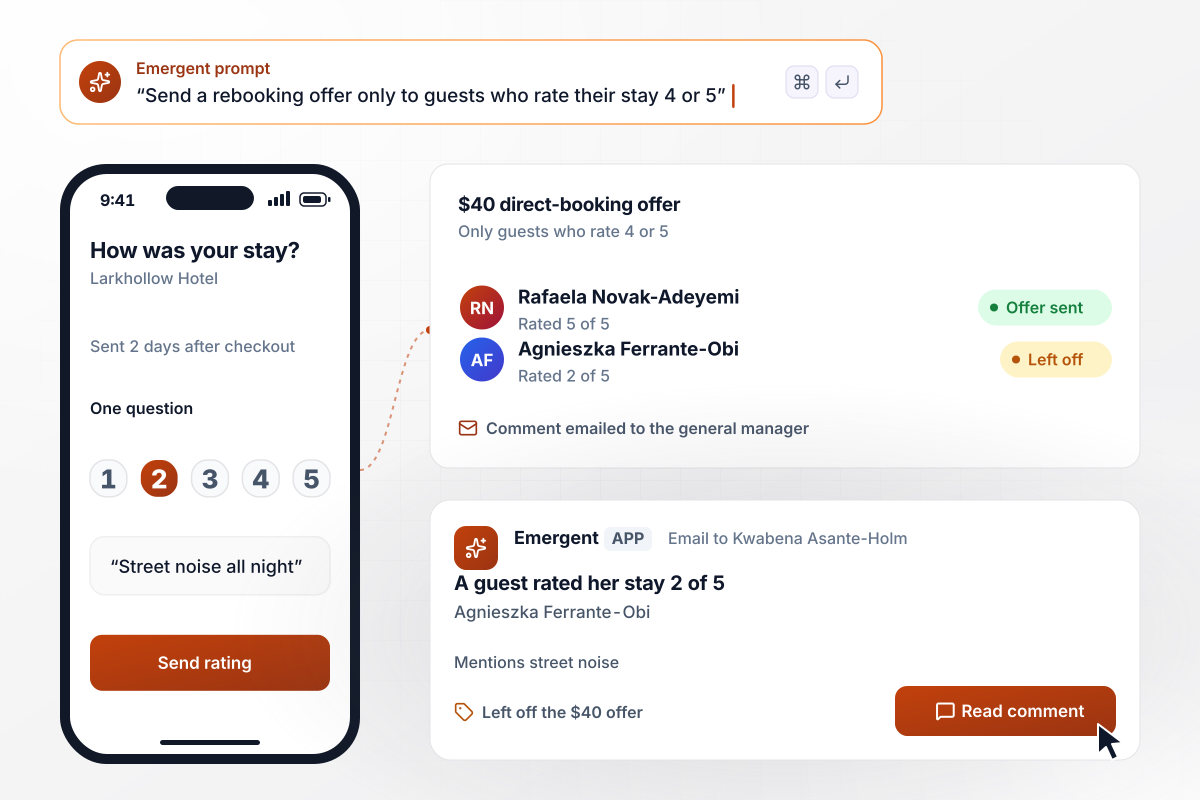
Only guests who rate 4 or 5 get the rebooking offer
Two days after checkout, the app emails Agnieszka Ferrante-Obi a one-question survey. She rates her stay 2 of 5 and mentions street noise. The app leaves her off the $40 direct-booking offer, which only guests who rate 4 or 5 get, and emails her comment to Kwabena Asante-Holm, the general manager.






How to Build Hotel Automation
Seven steps to plan hotel automation around a real booking and switch it on one flow at a time with Emergent.
Pick one booking from last week and list each step a person did by hand for it: the check-in email, the room assignment, the card match, and the review request. Mark the steps that follow a fixed rule, and start with those.
Write down where each fact lives at your hotel: reservations in the property management system, settlements in the card processor's reports, revenue in the ledger. Connect each one through its API. Every automation should read a fact from the system that owns it.
Write each rule the way you would explain it to a new front desk hire. Send a parking pass link to guests who booked a space, and flag any group block with no rooming list 7 days before arrival. Emergent builds the app and its logic from those sentences.
Decide who hears about each exception before it happens: the controller for an unmatched charge, the general manager for a low rating, the night auditor for a no-show. Name a person rather than a channel, and set a reminder for when nobody acts.
Run last month's reservations and settlements through the app before it emails a single guest. Compare every flagged charge with what the controller found by hand, and check the order housekeeping would have cleaned in. Fix a rule by prompting, then run the same month again.
Turn on charge matching first, because it never reaches a guest. Read every flagged charge for two weeks. Add online check-in next, then room turnover, and leave post-stay surveys for last, once the guest records are clean.
Once a month, read everything a person had to fix by hand: charges matched manually, rooms cleaned out of order, ratings that missed the offer. Change the rule behind each repeat with a prompt, and check whether the list shrinks the next month.
Why Build Hotel Automation With Emergent?
Emergent builds the automation and the screens the front desk works in, on a database you own, with no task cap as bookings grow.

|
Zapier | Make (Integromat) | n8n | |
|---|---|---|---|---|
| How you build | Prompt for the workflow and the app around it | Templates and editor, AI copilot | Visual canvas | Visual canvas, self-hosted or cloud |
| What you get | Workflow + trigger form + database + dashboard, as code you own | Zaps, plus Tables and Interfaces inside Zapier | Scenarios inside Make | Workflows inside n8n |
| Behavior at cap | Keeps running, no task cap | Overage billed at up to 1.25× the base rate | Runs pause | Cloud workflows stop until the reset or an upgrade |
| AI and agent steps | Native, share the same credit pool | Priced by model tier, drawn from the task pool | AI modules cost variable credits | Bring your own model API key, billed by the provider |
| Code ownership | Full code export to GitHub on paid plans | None | None | Yes on Community Edition |


Pick the Pricing Plan That Works for You
Choose the plan that fits your building ambitions. From weekend projects to enterprise applications, we've got you covered.




Find the right workflow automation
for you and your business
Frequently Asked Questions
Your Questions, Answered
Don't change this element unless you know what you are doing
More things you can build
with Emergent
on Emergent today




