

Build an Interview Evaluation Form That Scores Every Round
Build an interview evaluation form that rates each criterion on one shared scale and keeps every interviewer's scores together.
Build an interview evaluation form my panel fills in after each interview.
Trusted by Builders Worldwide
Active Builders Worldwide
Apps Successfully Created
Countries Globally Reached



What Goes on the Scorecard
Emergent builds each part of an interview evaluation form into one app, from the header to the closing hire call.
A header that names the round
Each scorecard opens with the candidate, the role, the round and the interviewer, with the date filled in. A phone screen and a final panel stay separate entries for one person.
Five levels, each with an anchor
Every point on the 1-5 scale gets a description the panel agrees on before the first interview. A 2 on communication then means the same thing whichever interviewer wrote it down.
Criteria written for the job
The form lists the skills the role depends on, each paired with the question that tests it. A support lead is scored on calming an angry caller; a controller on closing the month.
An evidence line under each score
No score saves until the interviewer writes what the candidate said or did. "Walked through the vendor dispute step by step" holds up in a debrief, and "seemed sharp" does not.
One recommendation, one reason
The form closes with four choices (strong hire, hire, no hire, strong no hire) and the main reason in a sentence. With no neutral middle, each interviewer has to take a side.
Source code in your GitHub
On paid plans, Emergent exports the app's full code to your GitHub repository. A developer can host it anywhere or connect it to the applicant tracking system recruiters use.
Scorecards for Four Kinds of Interview
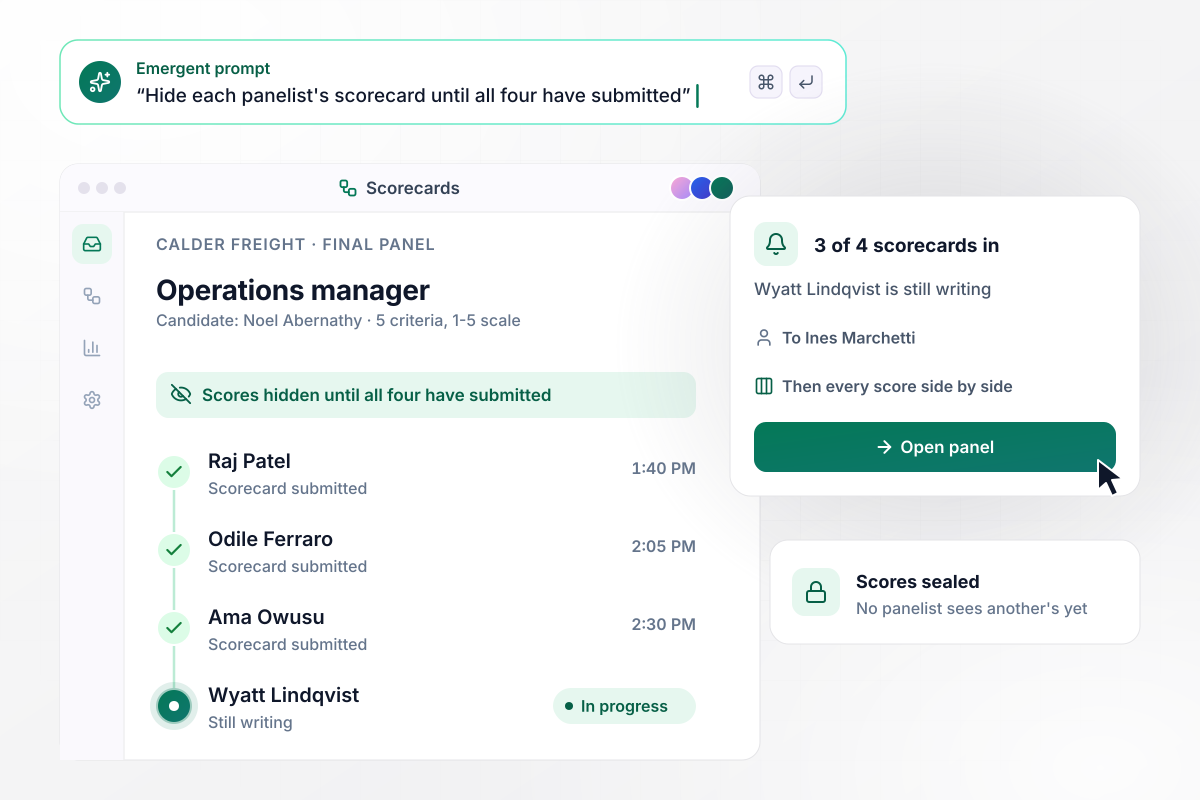
Nobody reads a scorecard until all four are in
Calder Freight runs a four-person final panel for an operations manager role, and no panelist sees another's scorecard until all four have submitted. With 3 of 4 in, hiring manager Ines Marchetti gets an alert that Wyatt Lindqvist is still writing. The debrief opens with every score side by side.
window.awbMockup = { panelInterviews: "Build an interview evaluation form for my four-person panel hiring an operations manager. Each panelist rates five criteria on a 1-5 scale with an evidence note under every score. Hide each person's scorecard from the other panelists until all four have submitted. Alert me, as hiring manager, when 3 of 4 are in and name who is still writing, then open the debrief with every score side by side.", engineeringRounds: "Create a scorecard for my team's backend live-coding round. Count problem solving twice and code quality and communication once each, and print the reason for the weights at the top. Interviewers rate each skill out of 5. Calculate the weighted score for every candidate and move anyone at 3.5 or higher to the onsite stage.", programAdmissions: "My radiography program interviews applicants for the next class. Two faculty members score every applicant out of 25. If their two totals are 5 or more points apart, assign a third faculty member to score that applicant before ranking. Give the program director a ranked list built from the settled totals.", mockInterviews: "I run mock interviews at a college career center. After each session the evaluator rates six criteria on a 1-5 scale with a short note. Email the student every score within the hour so they can read it on a phone, and name the two lowest criteria as what to practice before they book the next mock." };
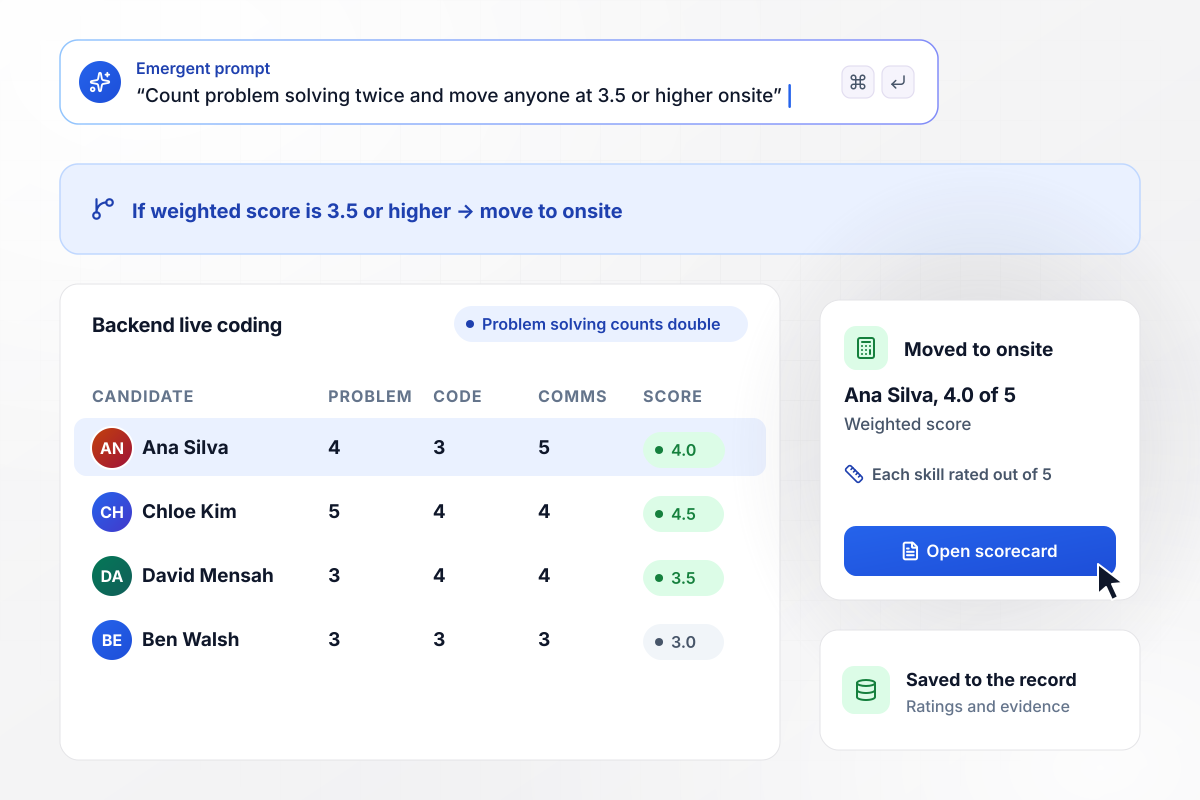
Problem solving counts double in each candidate's score
A backend team weights its live-coding round: problem solving counts twice, code quality and communication once, and the form prints the reason. Interviewers rate each skill out of 5, and the app works out a weighted score. Anyone at 3.5 or higher moves to the onsite.
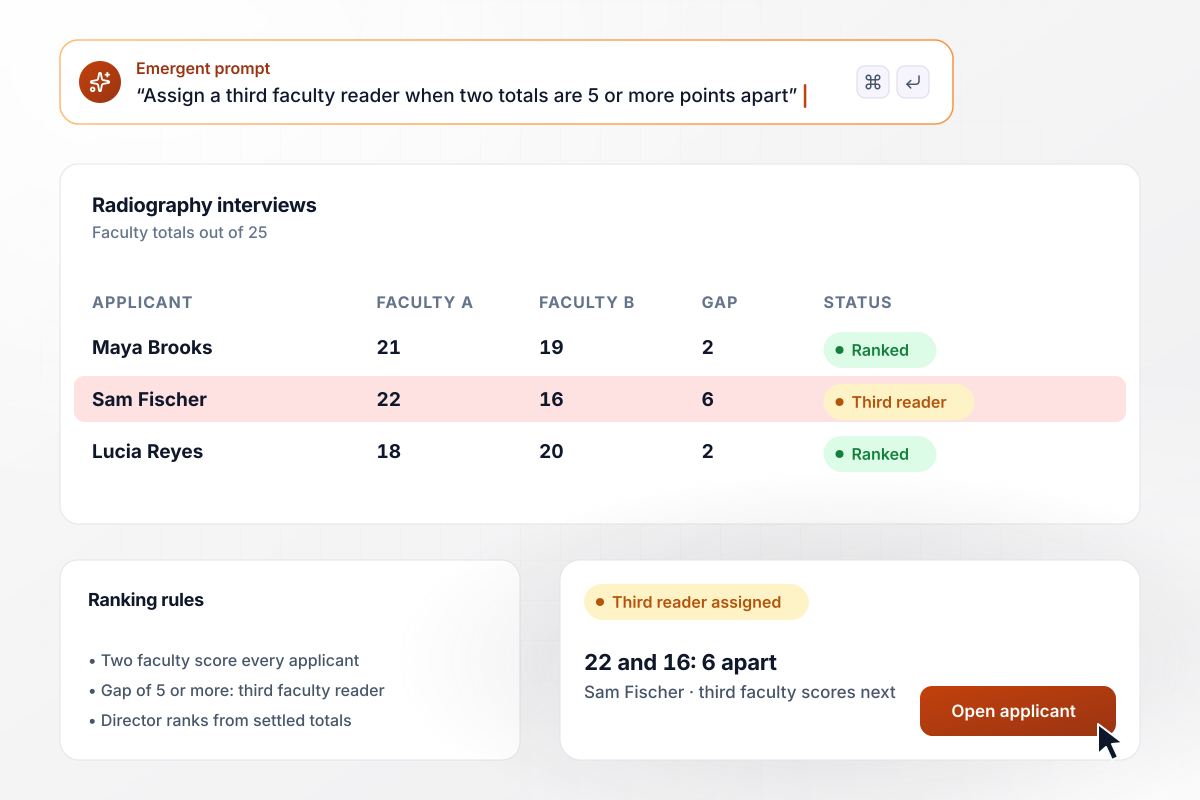
When two faculty totals split by 5, a third reads
A radiography program interviews every applicant for its next class with two faculty members, who each score out of 25. When their totals sit 5 or more points apart, the app assigns a third faculty member before that applicant is ranked. The program director ranks the class from the settled totals.
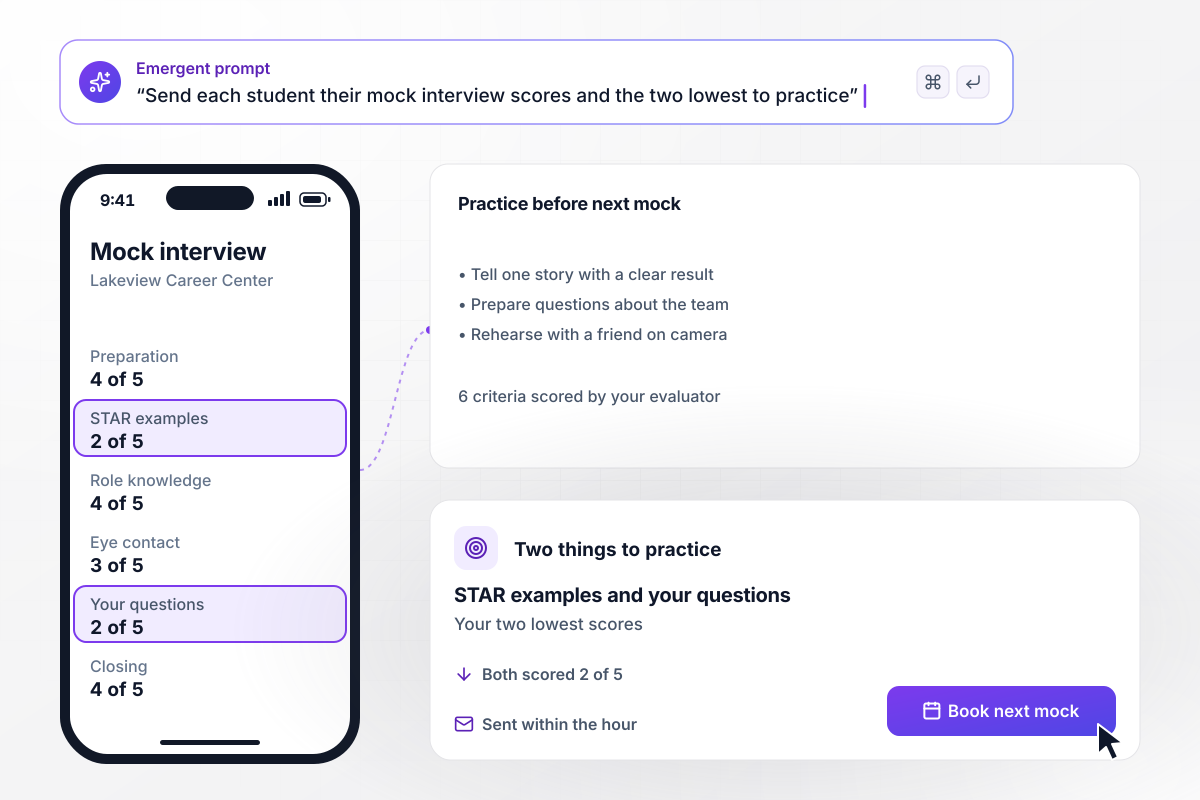
The student leaves with two things to practice
Lakeview Career Center runs mock interviews for students. The evaluator rates six criteria at the end of each session, and within the hour the student gets an email with every score. It names the two lowest criteria as the work to do before booking the next mock.






How to Create an Interview Evaluation Form
Seven steps to create an interview evaluation form that every interviewer fills in and scores the same way.
Ask the people who do the work which skills separate a strong hire from a weak one, and keep four to six. Leave out anything you cannot tie to a task in the job description, like hobbies or where someone grew up.
Write the question that tests each criterion and ask it of every candidate in the same order. The US Office of Personnel Management (OPM) describes structured interviews as using a standardized questioning and scoring process for all candidates. A follow-up question is fine; a new topic is not.
Decide how many levels the scale has, then describe what a low, a middle, and a top answer sound like for each criterion. OPM's advice for a custom scale is to write behavioral or situational examples for each level. One interviewer's 4 then matches another's.
Score each criterion equally unless you can write down why one matters more. OPM recommends equal weights for each competency and a documented justification for anything else. Print that reason on the form, where every panelist reads it before scoring.
Ask each interviewer to submit within a day and before any discussion, and keep each panelist's scores hidden until everyone is done. Then meet, start with the criteria where ratings differ most, and agree on one final rating.
End the form with a hire decision and one sentence of reasoning. The reason should point back to an evidence note written under a score, such as the vendor dispute story, not to a general impression of the person.
Store each scorecard with the candidate's record, including candidates you did not hire. A later question about the decision then has the notes behind it. Ask HR or legal counsel how long to keep hiring records.
Why Build Interview Scorecards With Emergent?
Every interviewer's scores land in a database you own, with no cap on how many scorecards a panel submits.

|
Jotform | Google Forms | Typeform | |
|---|---|---|---|---|
| How you build | Describe it in plain English | Templates, editor, AI generator | Editor, with Gemini drafting on some Workspace plans | Templates, editor, AI assist |
| Where responses live | A database table you own, plus any integration | Jotform account | Google Sheets | Typeform account |
| Response limits | No response caps | Monthly submission caps by plan; the form stops at the cap | No limit | Monthly response caps by plan; the form closes at the cap |
| Code ownership | Full code export to GitHub on paid plans | None | None | None |

Pick the Pricing Plan That Works for You
Choose the plan that fits your building ambitions. From weekend projects to enterprise applications, we've got you covered.




Find the right form
for whatever you're collecting
Frequently Asked Questions
Your Questions, Answered
Don't change this element unless you know what you are doing
More things you can build
with Emergent




on Emergent today


