

Build a Speech Therapy Intake Form for Every Age and Language
Build a speech therapy intake form that splits child and adult questions and saves each case history to a database you own.
Build a speech therapy intake form for my outpatient clinic that asks about the main concern, home languages, and past hearing tests.
Trusted by Builders Worldwide
Active Builders Worldwide
Apps Successfully Created
Countries Globally Reached



The Case History, Collected Before the Visit
Emergent builds a speech therapy intake form around the case history: the concern, when it began, hearing, and home languages.
A concern list in plain words
Offer the concerns a speech clinic sees as choices: speech sounds, stuttering, understanding words, voice, and swallowing. Add one open box for the family to describe it.
Questions worded for whoever answers
Ask who is completing the form first. A parent answering for a child, a spouse answering for an adult, and an adult answering alone each see questions written for them.
Milestones asked as ages, not essays
For a child, ask the age of first words and of first two-word phrases as numbers. The therapist reads two clean values on the record instead of a paragraph of memories.
Hearing and languages side by side
Ask for the date and result of the last hearing test, then the languages used at home, with the main one marked. Both answers sit side by side on the record the therapist opens.
Alerts that carry no answers
When a family submits, the therapist gets an email or Slack alert with a link to the record. The answers stay in the app, saved to a database you own, never in the message.
Your code, in your own repository
On paid plans, export the full code to your GitHub repository and host the form on the clinic's own site. A developer can add the screens the front desk asks for next year.
How Four Speech Clinics Use the Intake
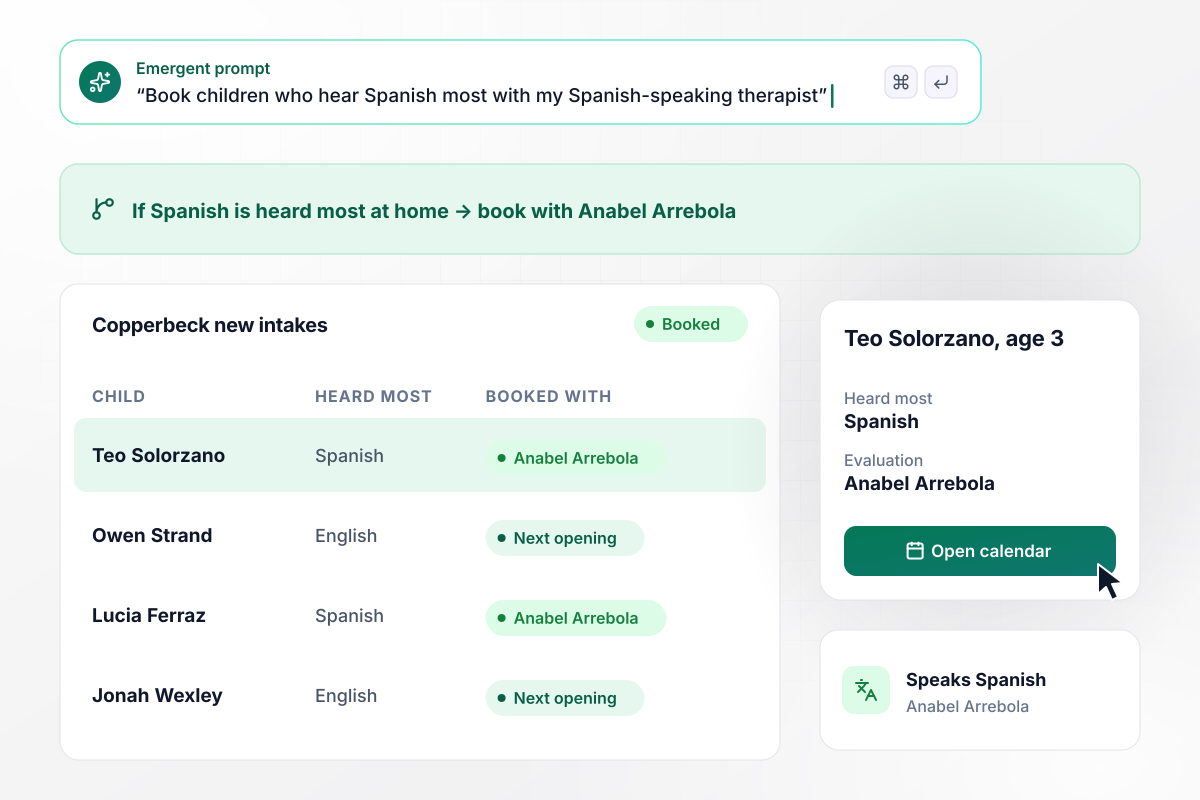
Anabel takes every child who hears Spanish most
Copperbeck Speech and Language asks what languages a family uses at home and which one the child hears most. Yaretzi Solorzano answers Spanish and English for her son Teo, 3, with Spanish heard most. Any child who hears Spanish most is booked with Anabel Arrebola, the clinic's Spanish-speaking therapist.
window.awbMockup = { bilingualFamilies: "I run Copperbeck Speech and Language. Build an intake that asks which languages are spoken at home and which one the child hears most. When Spanish is heard most, book the evaluation with Anabel Arrebola, my Spanish-speaking therapist. Show each new intake with the language heard most and the therapist it was booked with.", adultCaregivers: "My practice, Thornhaven Adult Speech Therapy, sees adults. Start the intake by asking who is completing the form. If a spouse or caregiver is, ask for their relationship, a phone number for scheduling, and an upload of the hospital discharge papers. When it is sent, email the therapist that a new intake is ready, with no answers in the email.", teletherapy: "My clinic, Larchgate Speech Therapy, offers sessions by video. Build an intake that asks for the device, whether there is a quiet room, the child's age, and, for a child under 8, whether an adult can sit in. If no adult can, send the intake to Jory Rountree at the front desk so he can book the child in the clinic.", waitlist: "I keep a waitlist at Saddlebrook Speech Clinic. Ask each family on the intake which weekday afternoons the child is free. When a session slot opens, list the families free at that time, oldest intake first, with the date each intake came in. Show the list to Lisette Sauvageau at the front desk so she knows who to call first." };
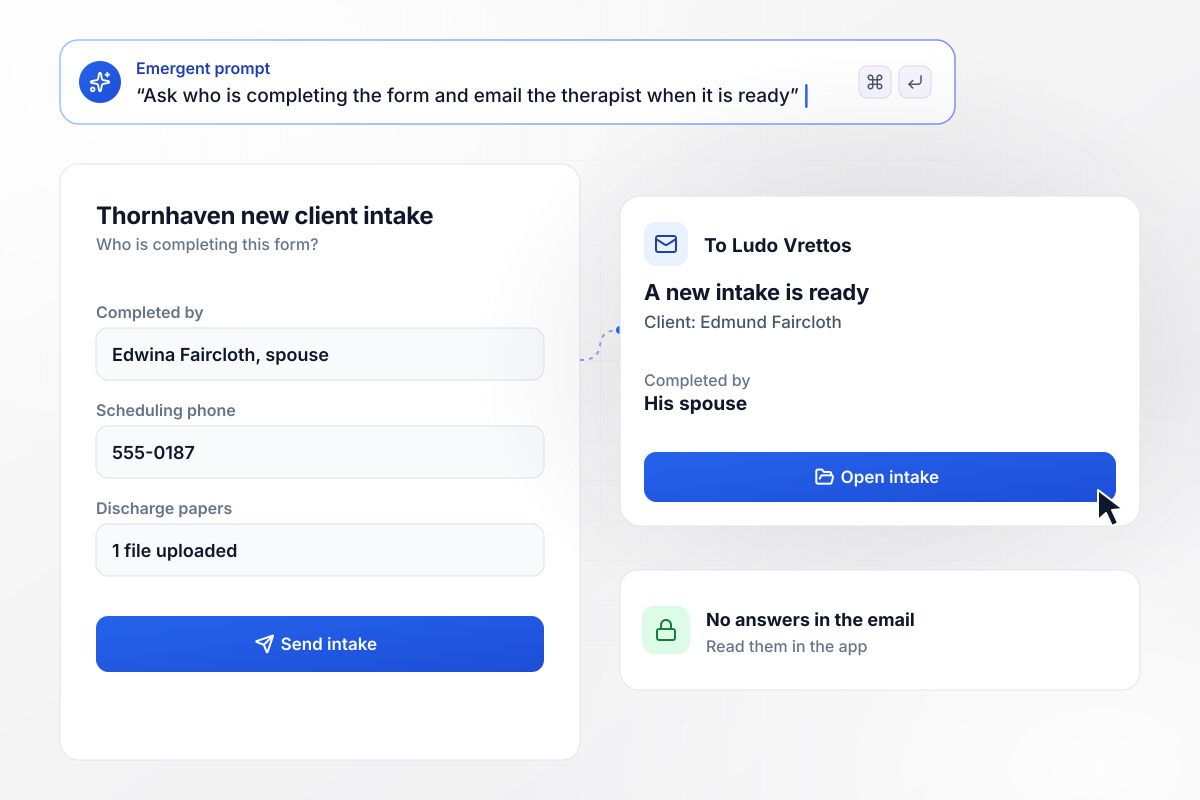
His spouse fills it in, and Ludo is told it is ready
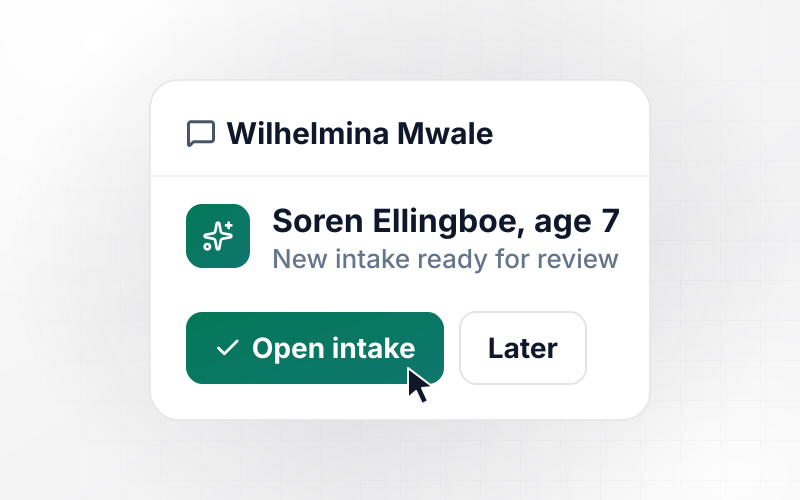
Thornhaven Adult Speech Therapy opens its intake by asking who is completing the form. Edwina Faircloth picks spouse for her husband, Edmund, adds a scheduling phone, and uploads his hospital discharge papers. When she sends it, therapist Ludo Vrettos gets an email that a new intake is ready, with no answers in it.
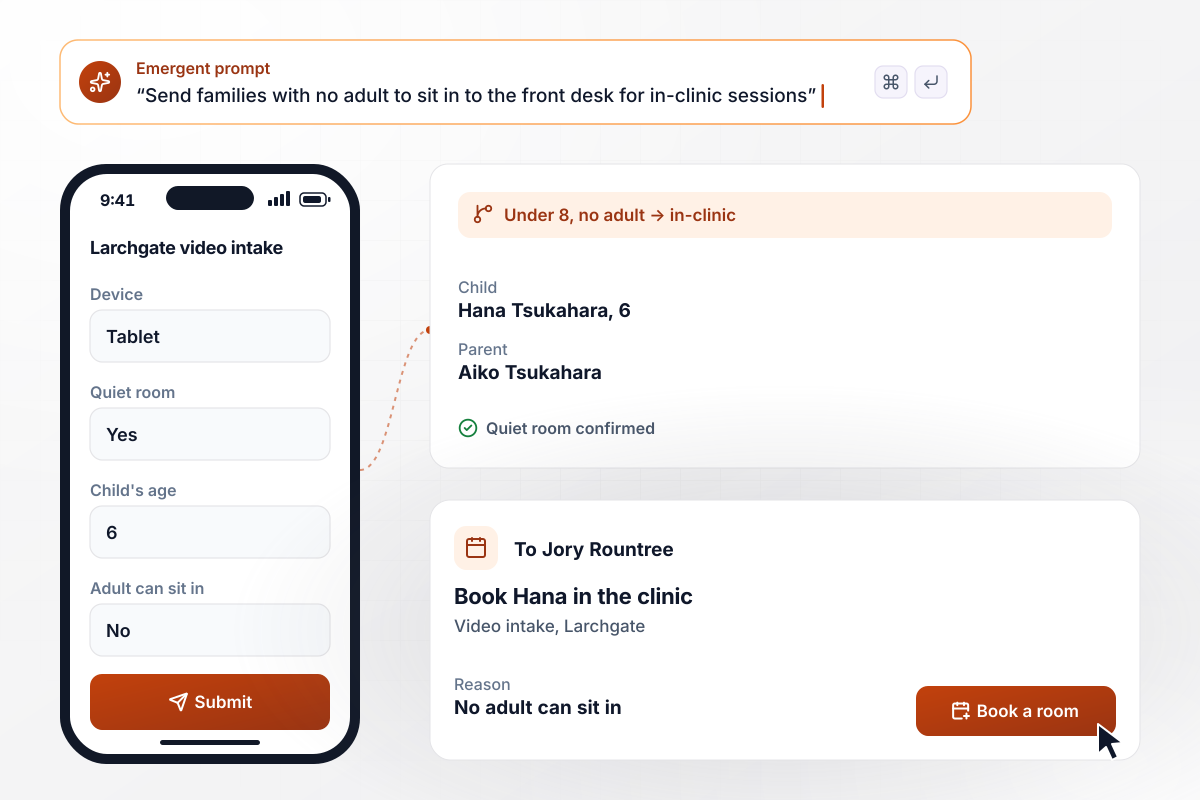
No adult can sit in, so Hana comes to the clinic
Larchgate Speech Therapy offers sessions by video. The intake asks for the device, a quiet room, and, for a child under 8, whether an adult can sit in. Aiko Tsukahara books Hana, 6, on a tablet, but no adult is home on weekday afternoons. Front desk lead Jory Rountree gets the intake and books Hana in the clinic.
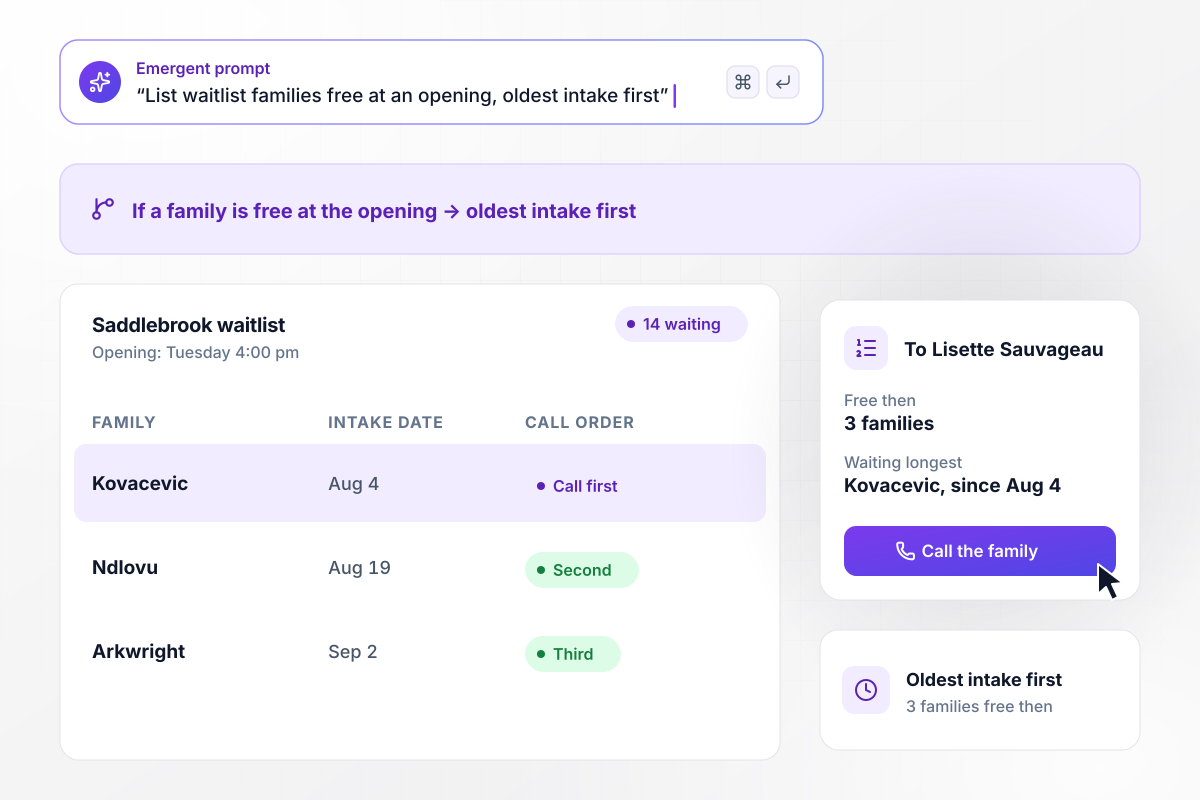
Of 14 waiting families, 3 fit the Tuesday opening
Saddlebrook Speech Clinic has 14 families on its waitlist, and each intake asks which weekday afternoons the child is free. When the Tuesday 4:00 pm slot opens, the app lists the 3 families free then, oldest intake first. Lisette Sauvageau calls the Kovacevic family, waiting since Aug 4, first.






How to Create a Speech Therapy Intake Form
Seven steps to plan a speech therapy intake form around the first evaluation, then build it with Emergent and send it to new families.
Sit with the therapists and write down what they ask in the first ten minutes of an evaluation, such as when the concern began and any past therapy. Each question on the form should trace back to that list. Anything nobody reads before the visit comes out.
Ask who the therapy is for before anything else. A child's path covers milestones and school, while an adult's path covers what changed and any recent hospital stay. Neither group scrolls past questions written for the other, and each path stays shorter.
Write "Does your child repeat sounds or get stuck on words?" instead of naming the diagnosis you suspect. Offer short choices where they fit, and test each question on someone outside the clinic before it goes in.
Add a question about the weekdays and times the client can attend, plus whether video sessions work at home. The front desk then books the evaluation from the intake itself, without a round of calls to find a time.
Put the questions, both paths, and the alert rules into one prompt. Emergent builds the form, the database behind it, and the screen the front desk works from. Ask for changes in plain English, such as a new question for adults.
Fill it in as a parent of a 4-year-old, as an adult client, and as a spouse answering for one. Check that each path shows only its own questions and that every alert reaches the person it names, with no answers inside.
Once the link is live, open the first 10 submissions with a therapist. Look for questions families skipped, misread, or answered the same way every time, and rewrite or cut them. Keep the form only as long as the evaluation needs.
Why Build Speech Therapy Intake With Emergent?
A paper case history reaches the therapist when the family walks in. An online intake is on the record the day it is sent.

|
Jotform | Google Forms | Typeform | |
|---|---|---|---|---|
| How you build | Describe it in plain English | Templates, editor, AI generator | Editor, with Gemini drafting on some Workspace plans | Templates, editor, AI assist |
| Where responses live | A database table you own, plus any integration | Jotform account | Google Sheets | Typeform account |
| Response limits | No response caps | Monthly submission caps by plan; the form stops at the cap | No limit | Monthly response caps by plan; the form closes at the cap |
| Code ownership | Full code export to GitHub on paid plans | None | None | None |



Pick the Pricing Plan That Works for You
Choose the plan that fits your building ambitions. From weekend projects to enterprise applications, we've got you covered.




Find the right form
for whatever you're collecting

Frequently Asked Questions
Your Questions, Answered
Don't change this element unless you know what you are doing
More things you can build
with Emergent





on Emergent today


