

Build an Automated Loan Processing System on Your Checklist
Build an automated loan processing system that reads borrower documents and sends complete files to underwriting.
Build an automated loan processing system that reads borrower pay stubs and bank statements and tracks the conditions on each file.
Trusted by Builders Worldwide
Active Builders Worldwide
Apps Successfully Created
Countries Globally Reached



What a Loan File Needs Before Underwriting
Five of these parts take over steps processors now do by hand. The credit decision stays with your underwriter.
Borrower documents read into fields
Pay stubs, W-2s, and bank statements are read into employer, pay dates, gross pay, and balances as borrowers upload them. A field read with low confidence waits for a processor.
A conditions list on every loan file
Each loan file carries the underwriter's conditions as a checklist. A condition clears when its document arrives and a processor accepts it, and the file shows what is still open.
Upload links and reminders for borrowers
Borrowers get a link that lists only the documents still missing from their file. Reminders go out by email on the schedule you set and stop once the last upload arrives.
Income and debt math, line by line
Income and debt figures are calculated from the documents themselves, and each number links back to its page. Underwriters see the debt-to-income ratio and every input behind it.
Routing by loan type and amount
Complete files land in the right underwriting queue by product and size, with a Slack or email alert. An incomplete application stays with its processor until the last gap is closed.
Your loan app, in your GitHub
The source code exports to your GitHub repository on paid plans. When credit policy adds a field or a second product launches, an engineer edits it there, or you prompt Emergent.
Where Lenders Start Automating
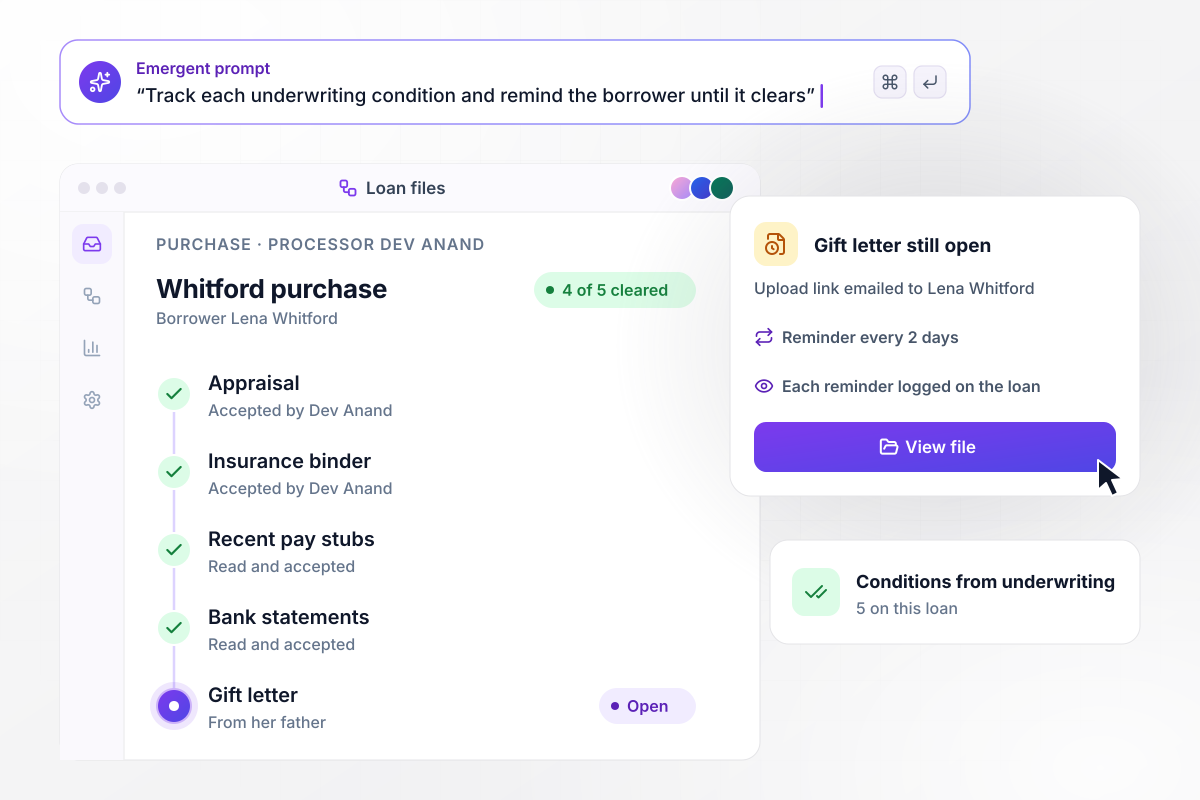
Four of five conditions cleared, one chased every 2 days
The Whitford purchase came back from underwriting with five conditions, and four cleared as Lena Whitford uploaded her documents. The gift letter from her father is still open. Until it arrives, she gets an upload link by email every 2 days, and processor Dev Anand sees each reminder on the loan record.
window.awbMockup = { mortgageFiles: "Build a conditions tracker for my mortgage processors. When underwriting returns a file with conditions, list each one on the file and send the borrower an upload link for the open items. Email a reminder every 2 days until each document arrives, show every reminder on the file, and mark a condition cleared once a processor accepts the upload.", personalLoans: "Build intake for my personal loan applications. Read each uploaded pay stub into employer, pay schedule, and gross pay, turn that into gross monthly income, and divide the monthly debts the applicant listed by it to get a debt-to-income ratio. Send the complete file to the underwriting queue with every input shown next to the ratio.", businessLoans: "Build a bank statement reader for my small business loans. When an applicant uploads four months of business statements, total the deposits for each month and show the monthly average. Flag any month that comes in below half the average and send it to the assigned underwriter with that statement attached.", autoLoanFunding: "Build a funding check for my auto loans. When a dealer sends a signed contract, compare the amount financed with the amount my team approved. Fund the deals that match, hold any deal where the two differ, and message the dealer to send a corrected contract or ask for a new approval." };
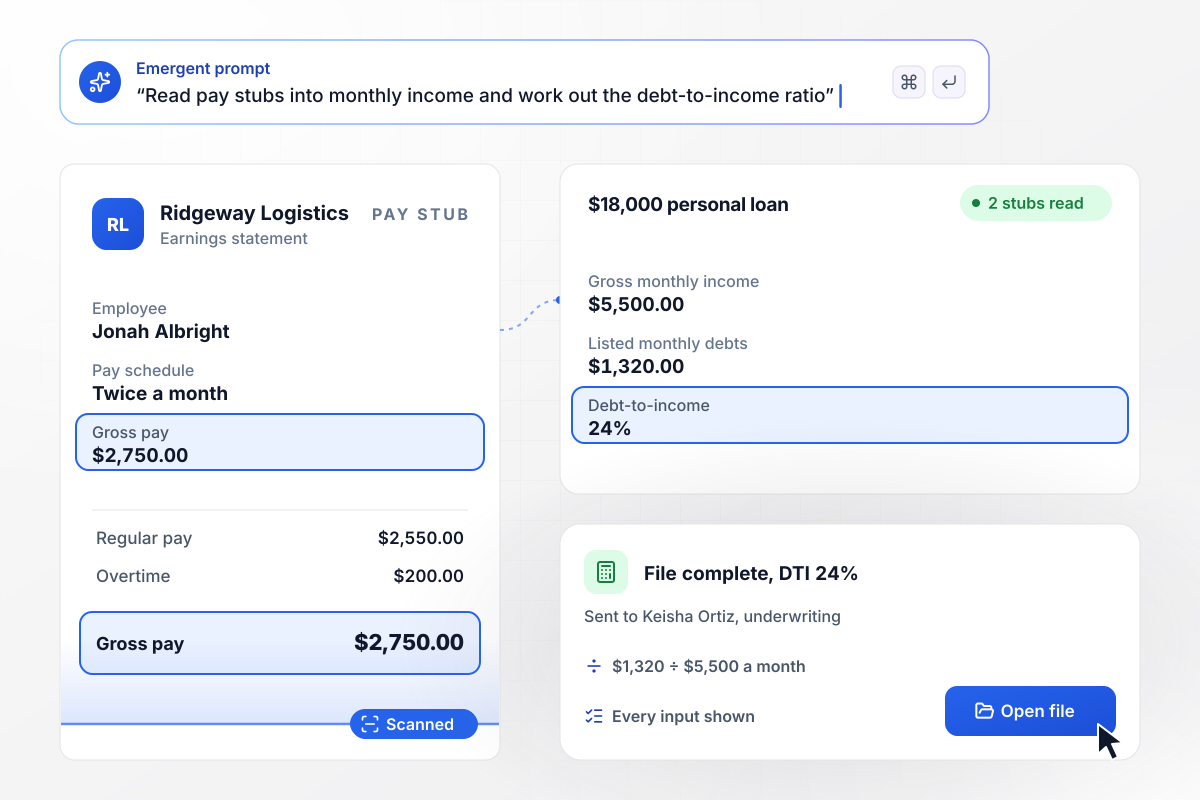
Pay stubs in, a ratio out for underwriting
Jonah Albright applies for an $18,000 personal loan and uploads two pay stubs. Each shows $2,750 in gross pay, twice a month, which the app records as $5,500 of gross monthly income. It divides his listed monthly debts of $1,320 by that figure and sends the result to Keisha Ortiz with every input shown.
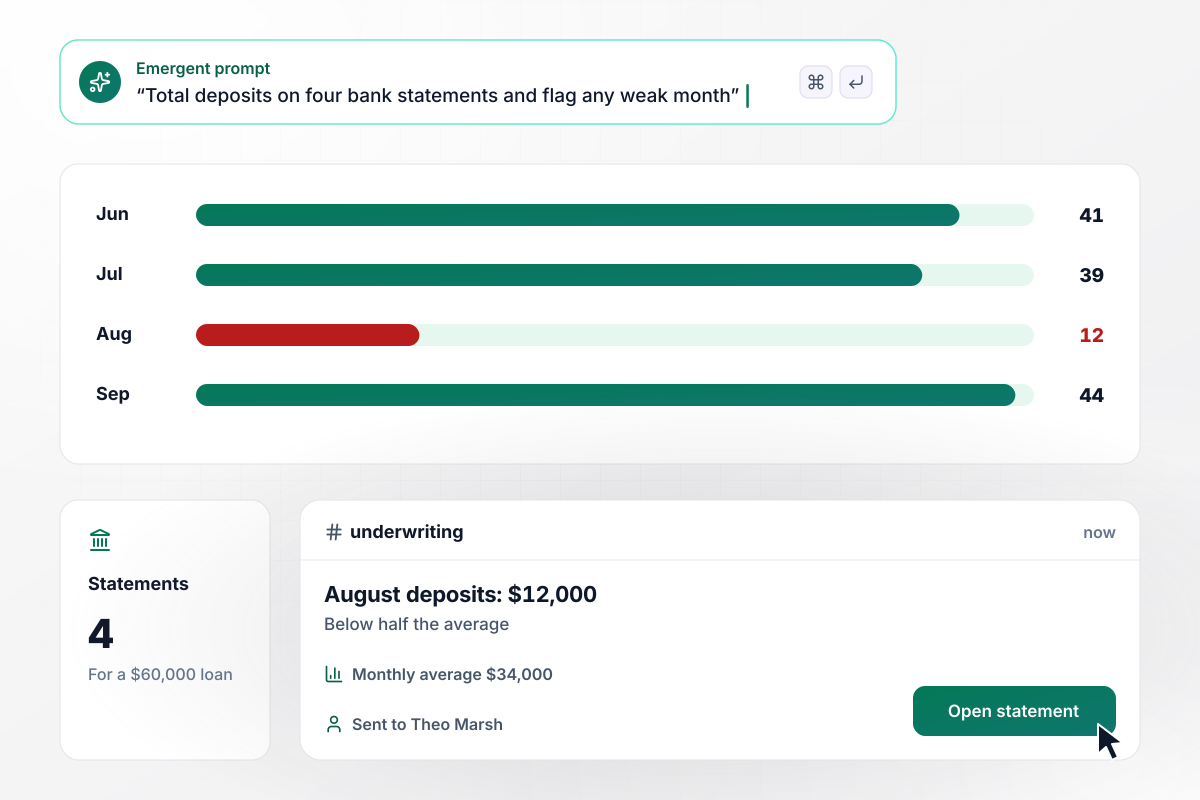
One weak month flagged out of four statements
Harbor Lane Bakery wants a $60,000 equipment loan and uploads four months of business bank statements. The app totals deposits month by month for an average of $34,000. August came in at $12,000, below half the average. That month goes to underwriter Theo Marsh with the statement attached.
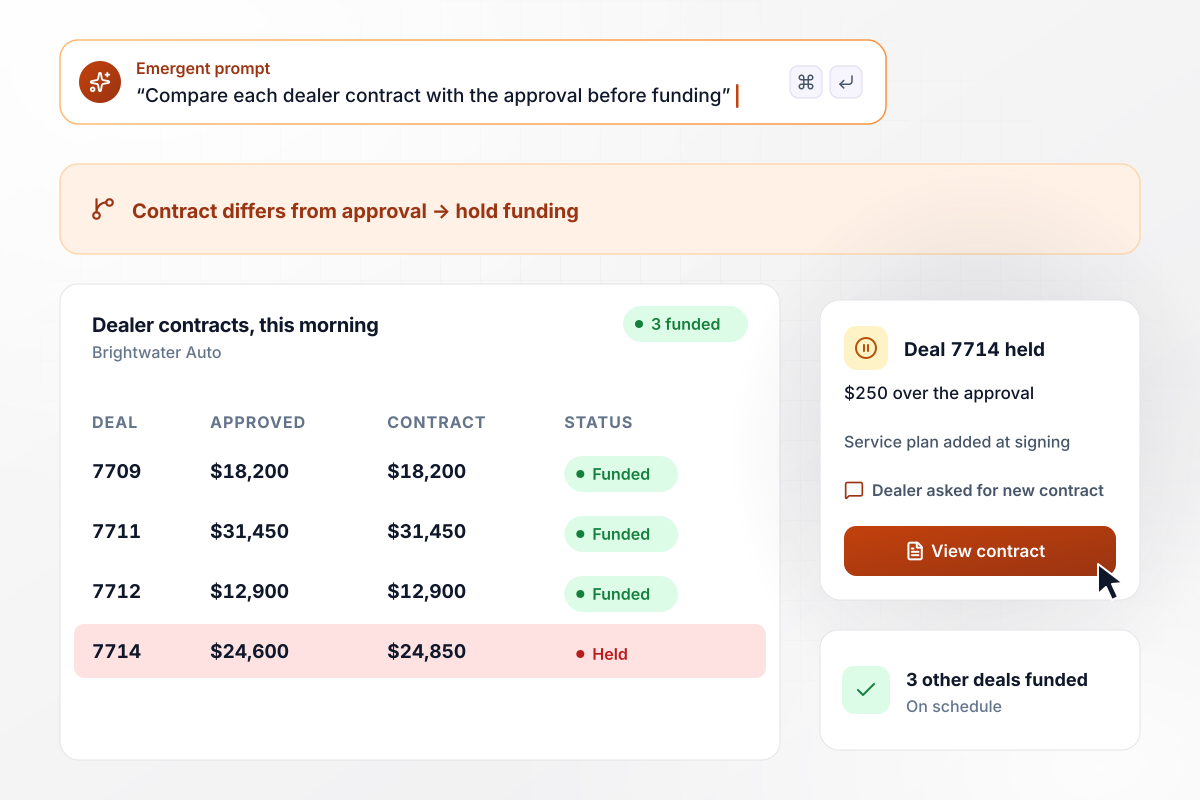
Funding holds when the contract and approval disagree
Brightwater Auto sends the signed contract for deal 7714. The approval was $24,600, and the contract reads $24,850 after a $250 service plan was added at signing. Funding holds on that deal alone while the dealer is asked for a new contract. Three other deals from the same morning fund on schedule.






How to Build Loan Processing Automation
Seven steps to build an automated loan processing system that collects borrower documents and gives underwriters complete files.
Pick one loan product and list every document and check a processor runs before a file reaches underwriting. Include the awkward cases, like a borrower paid in tips or a bank statement with a page missing. That list becomes the first version of the app.
Tell Emergent what a finished loan file holds: borrower details, documents, conditions, and the numbers underwriting reads first. Name the fields a processor must confirm by hand, such as any income figure read from a phone photo of a pay stub.
Ask for a page where borrowers see only the documents their file still needs. Set the reminder schedule, for example an email every three days, and decide which loan officer is copied when a borrower stops replying for a week.
Connect the loan origination system, CRM, or core banking platform your team already works in through its API. Emergent builds the sync: a new application opens a record in the app, and the underwriter's decision is written back to your system of record.
Write the rules in plain English. Personal loans over $50,000 go to a senior underwriter, and any deposit over $10,000 that is not payroll needs a note from the borrower. The app applies each rule to every file in the same way.
Run ten files your team closed last quarter through the app and compare its numbers with what your processors recorded. Fix any field it misreads by prompting Emergent, then run the same ten again until both sets of numbers agree.
Switch on one loan product for new applications while older files finish the way they started. After a month of clean files, add the next product, beginning with the one your processors spend the most hours on today.
Why Build Loan Processing With Emergent?
Workflow tools move data between apps. Emergent builds the loan app itself, with the upload page, conditions list, queues, and database.

|
Zapier | Make (Integromat) | n8n | |
|---|---|---|---|---|
| How you build | Prompt for the workflow and the app around it | Templates and editor, AI copilot | Visual canvas | Visual canvas, self-hosted or cloud |
| What you get | Workflow + trigger form + database + dashboard, as code you own | Zaps, plus Tables and Interfaces inside Zapier | Scenarios inside Make | Workflows inside n8n |
| Behavior at cap | Keeps running, no task cap | Overage billed at up to 1.25× the base rate | Runs pause | Cloud workflows stop until the reset or an upgrade |
| AI and agent steps | Native, share the same credit pool | Priced by model tier, drawn from the task pool | AI modules cost variable credits | Bring your own model API key, billed by the provider |
| Code ownership | Full code export to GitHub on paid plans | None | None | Yes on Community Edition |

Pick the Pricing Plan That Works for You
Choose the plan that fits your building ambitions. From weekend projects to enterprise applications, we've got you covered.




Find the right workflow automation
for you and your business
Frequently Asked Questions
Your Questions, Answered
Don't change this element unless you know what you are doing
More things you can build
with Emergent








on Emergent today




