

Build a KYC Workflow With a Case File for Every Customer
Build a KYC workflow that opens a case for each new customer, sends every check to a named reviewer, and logs each decision.
Build a KYC workflow for my credit union that reads each new member's ID, screens their name, and sends any mismatch to an analyst.
Trusted by Builders Worldwide
Active Builders Worldwide
Apps Successfully Created
Countries Globally Reached



Six Parts of a KYC Workflow Emergent Builds
Each new customer gets one case that fills in as checks come back and reviewers decide.
One form, one case per new customer
Emergent builds the intake form and the case database from your prompt. Each new customer's answers and uploads become one case, saved in a database you own and can query.
ID documents read into fields
The app reads the name, birth date, and ID number from an uploaded license or passport. A field it is unsure of goes to a person, and each one is compared with what was typed.
Your screening service, connected
Emergent connects the app to the verification or screening service you already use, through its API. Each result lands on the case, and a possible match keeps the account on hold.
Risk ratings from rules you write
Write the factors your compliance team rates on, such as account type or expected monthly volume, and the app scores each case. A high rating goes to a senior reviewer.
Alerts that name the case and the check
Reviewers get a Slack or email alert that opens the case and says which check failed. Documents and birth dates stay in the database, and overdue cases go to a manager.
The KYC app's code, in your GitHub
Export the full code to your GitHub repository on paid plans. Anyone on your team can trace each screening and routing rule to the exact lines of code that run it in production.
Where a KYC Case Stops for a Person
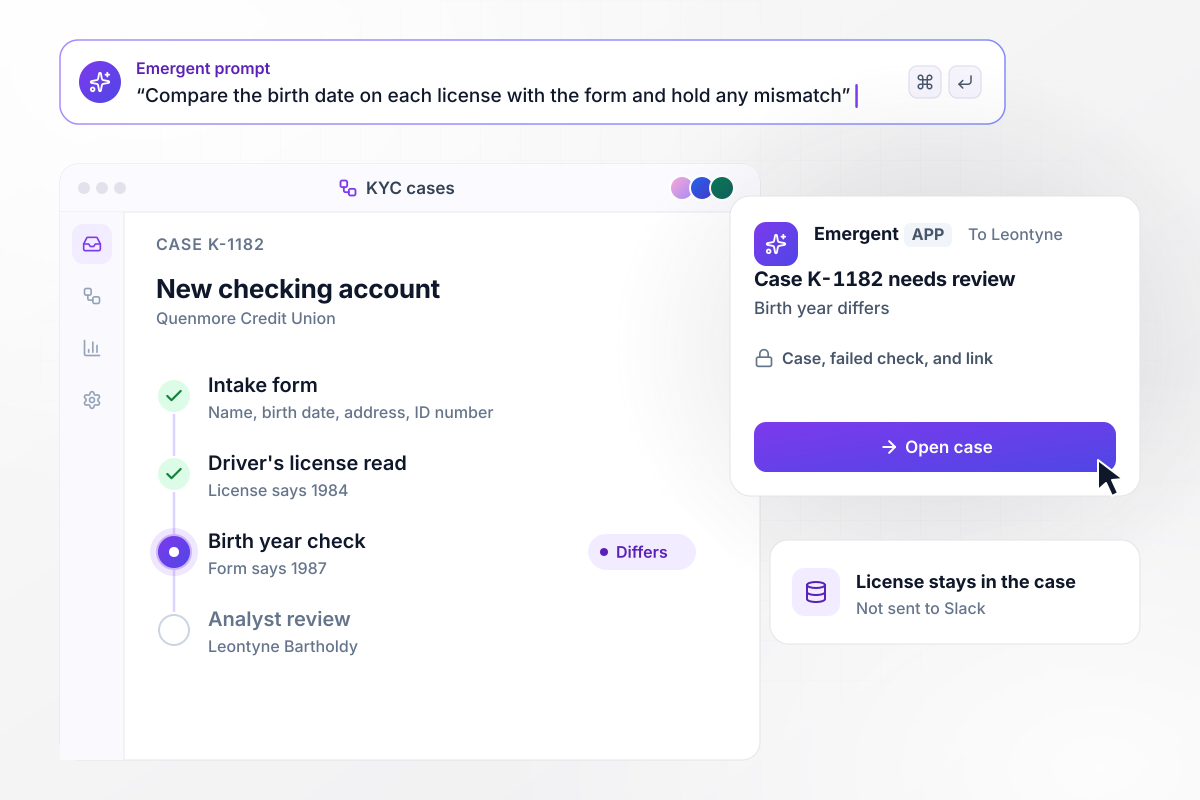
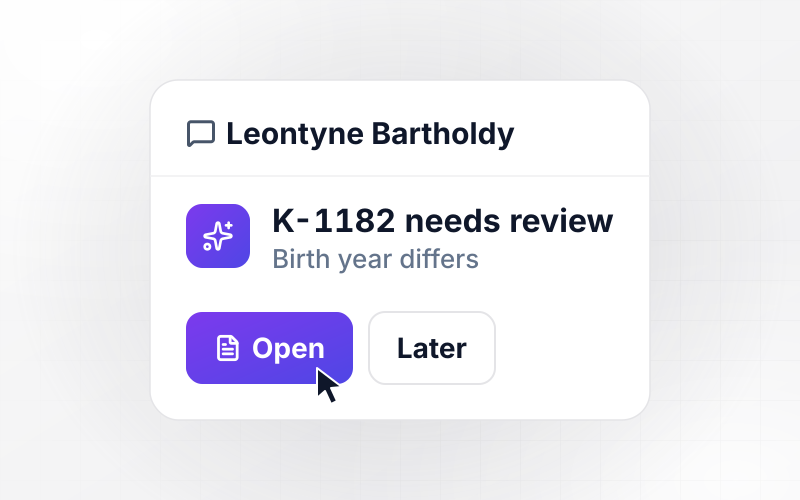
With a mismatched birth year, case K-1182 waits for Leontyne
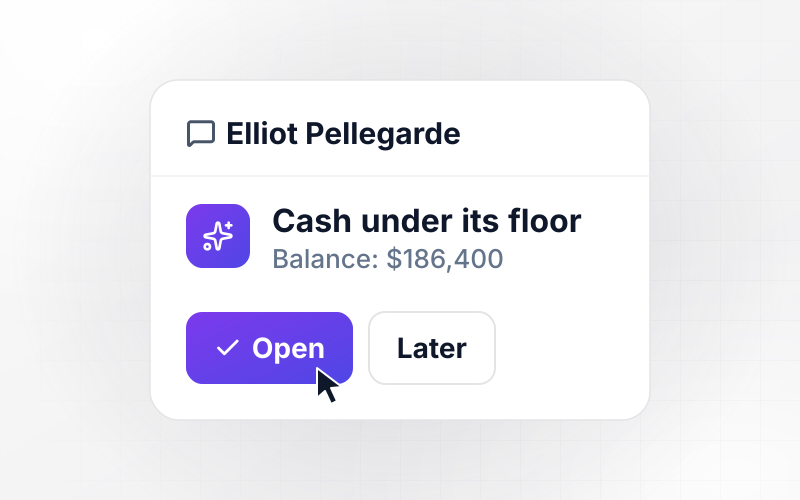
Quenmore Credit Union asks each new member for a name, birth date, address, and ID number, plus a driver's license photo. On case K-1182 the app reads 1984 from the license, but the form says 1987. The case waits for analyst Leontyne Bartholdy, whose alert names the case and the failed check, with a link.
window.awbMockup = { individualAccounts: "Build a KYC intake for my credit union. Each new member enters a name, birth date, address, and ID number and uploads a driver's license. Read the birth date from the license and compare it with the form. If they differ, hold the case and send our analyst a Slack alert with only the case number, the failed check, and a link.", businessOwners: "Build a business account intake for my community bank. Ask each business to list its owners and each owner's share. Email an ID upload link to every owner at 25 percent or more, and record smaller owners without one. Keep the account pending until every requested ID is in.", watchlistScreening: "Build watchlist screening for new client accounts at my wealth management firm. Send each client's name and birth date to our screening service through its API. If it returns a possible match, hold the account and show a reviewer the client's details next to the listed person's, with buttons to clear or escalate and a required note.", periodicReviews: "Build periodic KYC reviews for my payments company. Rate each customer high, medium, or low risk, and schedule reviews every 12, 24, or 36 months. Email each customer due for review a link to confirm their address and occupation. After 14 days with no answer, put the case in our analyst's queue." };
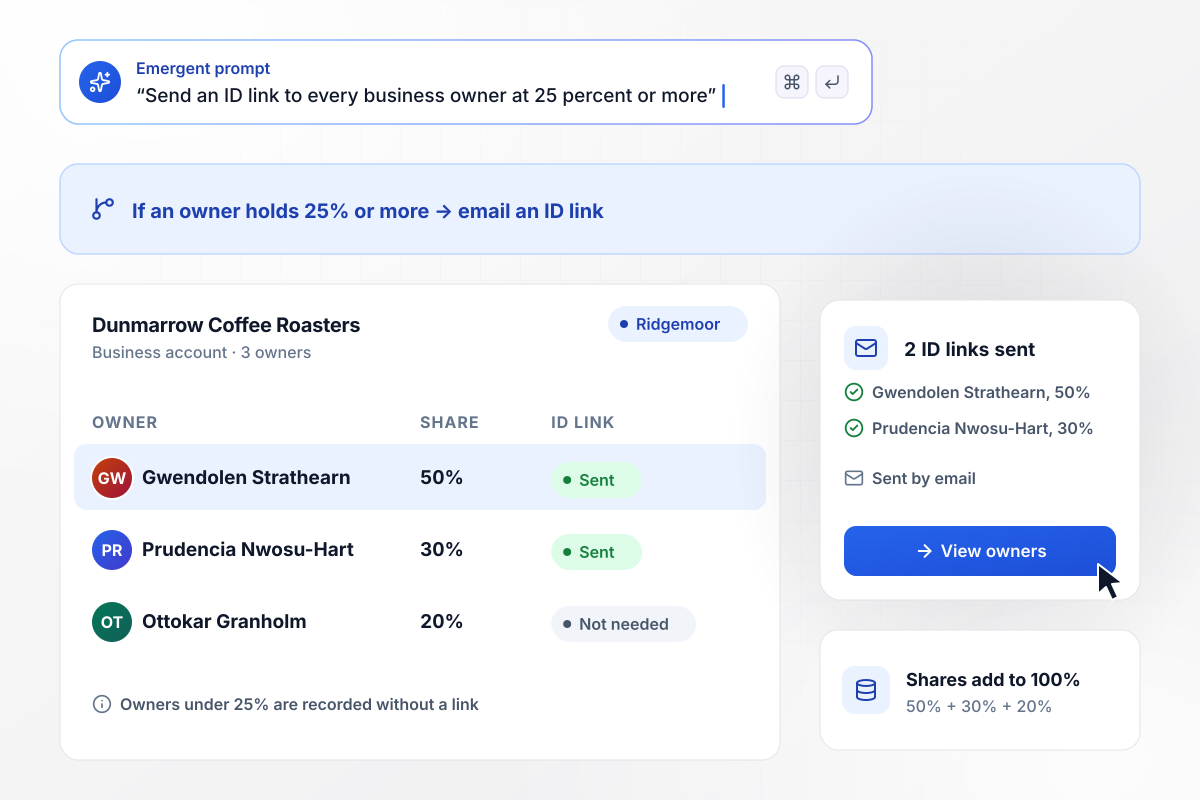
Owners with at least 25 percent each get an ID link
Ridgemoor Community Bank opens a business account for Dunmarrow Coffee Roasters, which lists three owners. The bank wants an ID from anyone owning at least 25 percent, so Gwendolen Strathearn and Prudencia Nwosu-Hart each get an ID link by email. Ottokar Granholm owns less and is recorded without one.
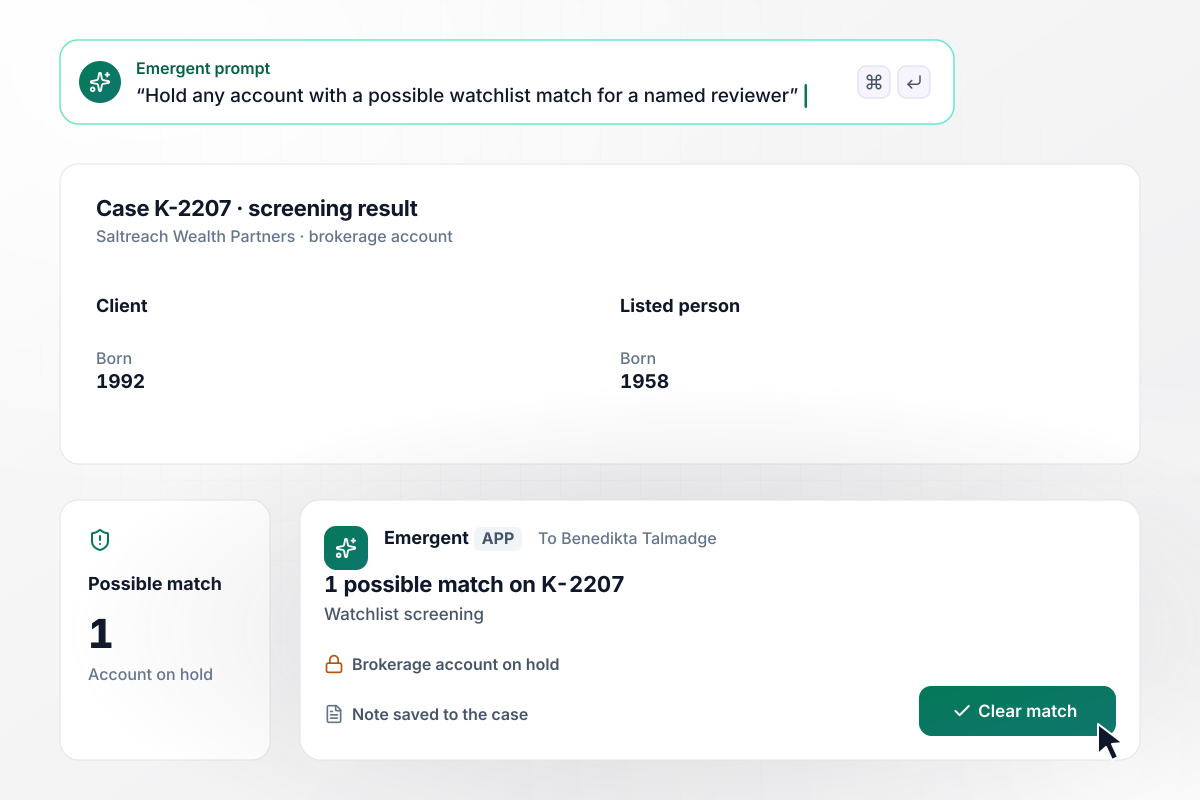
Benedikta Talmadge clears one possible match by birth year
A Saltreach Wealth Partners client opens a brokerage account, and the connected screening service returns 1 possible match on case K-2207. The account stays on hold. Reviewer Benedikta Talmadge sees the listed person was born in 1958 and the client in 1992. She clears the match and saves her note to the case.
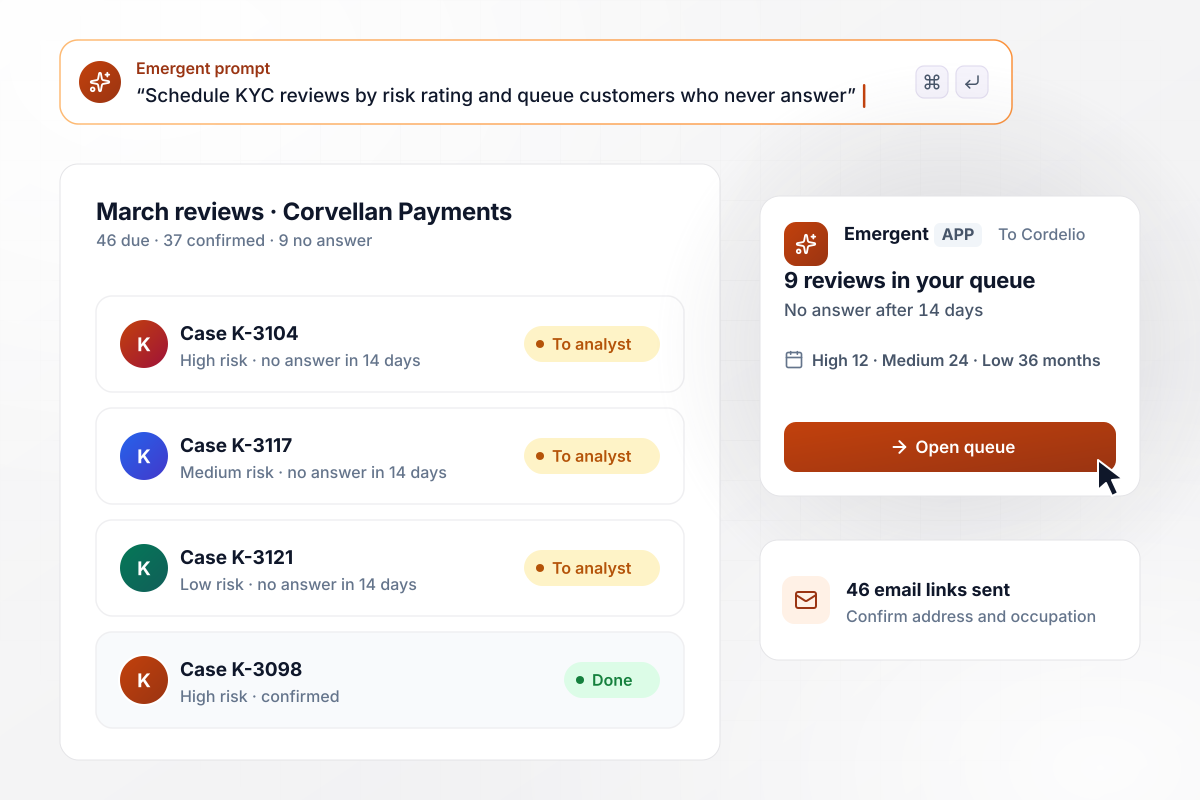
Nine customers who never answered go to Cordelio
Corvellan Payments reviews high-risk customers every 12 months, medium every 24, and low every 36. In March, 46 come due, and each customer gets an email link to confirm their address and occupation. Within 14 days, 37 confirm. The other 9 go to the queue of analyst Cordelio Achebe-Lowe.






How to Build a KYC Workflow
Seven steps to plan the checks in a KYC workflow and who reviews each case, then build and test it with Emergent.
Write down the fields and uploads for individuals and for companies. Mark which must be in before an account opens and which can follow. Your compliance team owns this list, and every item becomes a field or an upload on the intake form.
Choose the ID documents you accept, such as a driver's license or a passport, and the fields to read from each. Decide who checks a field the app reads with low confidence before the case moves on.
Name the identity verification and screening services you already use. Emergent connects the app to each one through its API, so every result lands on the case. Decide which results hold an account and which only add a note.
Describe each risk factor, such as expected monthly volume or the customer's country, and the rating each combination earns. Plain sentences in the prompt mean anyone on the team can read the rules the app applies to every case.
Give mismatches to an analyst and high ratings or possible matches to a senior reviewer. Pick how many days a case can sit before it moves to a manager, and require a note on every clear or escalate decision.
Choose how often each rating gets a periodic review and what customers confirm in it. Then pick how many days to wait for an answer before the case lands in an analyst's queue.
Before real customers see it, run 20 sample cases: clean ones, mismatches, a business with several owners, and a possible match. Have your compliance team check each decision and case record, and change the rules by prompting until they agree.
Why Build a KYC Workflow on Emergent?
Emergent builds the case database and every reviewer queue as one app from a prompt, and the workflow has no task cap.

|
Zapier | Make (Integromat) | n8n | |
|---|---|---|---|---|
| How you build | Prompt for the workflow and the app around it | Templates and editor, AI copilot | Visual canvas | Visual canvas, self-hosted or cloud |
| What you get | Workflow + trigger form + database + dashboard, as code you own | Zaps, plus Tables and Interfaces inside Zapier | Scenarios inside Make | Workflows inside n8n |
| Behavior at cap | Keeps running, no task cap | Overage billed at up to 1.25× the base rate | Runs pause | Cloud workflows stop until the reset or an upgrade |
| AI and agent steps | Native, share the same credit pool | Priced by model tier, drawn from the task pool | AI modules cost variable credits | Bring your own model API key, billed by the provider |
| Code ownership | Full code export to GitHub on paid plans | None | None | Yes on Community Edition |


Pick the Pricing Plan That Works for You
Choose the plan that fits your building ambitions. From weekend projects to enterprise applications, we've got you covered.




Find the right workflow automation
for you and your business
Frequently Asked Questions
Your Questions, Answered
Don't change this element unless you know what you are doing
More things you can build
with Emergent

on Emergent today


