

Build an Accounting Client Intake Form for Every Service Line
Build an accounting client intake form that shows each client only the questions for their services and prices the work.
Build an accounting client intake form that saves every response to a database I own.
Trusted by Builders Worldwide
Active Builders Worldwide
Apps Successfully Created
Countries Globally Reached



What the Form Settles Before Work Starts
Every answer a client gives once is a call you skip and a document you never have to ask for twice.
Sections that match the services bought
Show payroll questions only to clients who chose payroll, and sales tax questions only to businesses that sell goods. A client buying one personal return sees a short form.
Document requests from the answers
Turn answers into named upload requests. A client who sold shares is asked for a 1099-B, and a partner in a partnership is asked for each Schedule K-1 they received that year.
Quotes priced from the intake
Price each engagement from what the client tells you, with a base fee plus a set amount per K-1 or per added state. A partner can review any quote before the client sees it.
The engagement letter on the last screen
Fill the letter with the quoted fee and the services the client picked, then collect a typed or drawn signature. The signed letter lands in that client's record with a timestamp.
New clients assigned by service
Send each finished intake to whoever owns that work. Payroll setups can reach your payroll lead in Slack, while bookkeeping clients go to the bookkeeper with the fewest accounts.
Code your firm can take with it
Export the full code of the form and its client database to GitHub on paid plans. A developer can later connect it to the client portal or practice software your firm already runs.
Intake for Four Kinds of Accounting Work
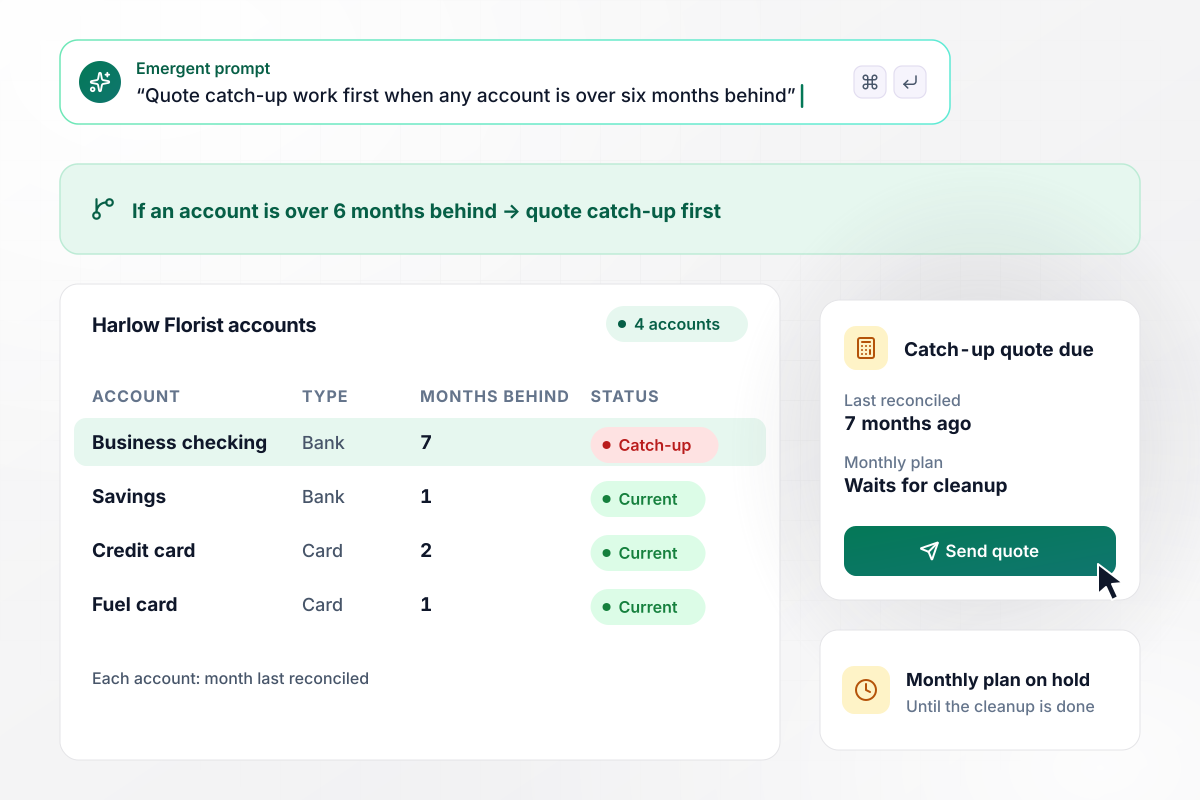
Any books six months behind get a catch-up quote
Ledgerline Bookkeeping asks each new client to list every bank and card account with the month it was last reconciled. Harlow Florist lists four. Its business checking was reconciled seven months ago. Any account more than six months behind gets a catch-up quote, and the monthly plan waits until the cleanup is done.
window.awbMockup = { bookkeeping: "I run a bookkeeping firm and need an intake form for new clients. Ask them to list every bank and card account and when each was last reconciled. If any account is more than six months behind, send me a catch-up quote to approve, and hold the monthly plan until the cleanup is finished.", personalTax: "My tax practice needs an intake form for individual clients. Ask what changed this year, like a new job or shares sold, and build each client's document list from those answers, with a 1099-B for any shares sold. Show which documents have arrived and email a reminder if anything is missing after a week.", businessTax: "I need an intake form for business tax clients that quotes our fee. A partnership return starts at $1,200, with $75 more per partner K-1 and $150 for each additional state return. Put the quote into our engagement letter on the final screen and collect the client's signature.", payroll: "My payroll company needs an intake form for new employers. Ask for their pay schedule and which state each employee works in. If staff work in more than one state, message Lena Brooks, our payroll lead, in Slack with the headcount per state. Put single-state employers in the specialist queue." };
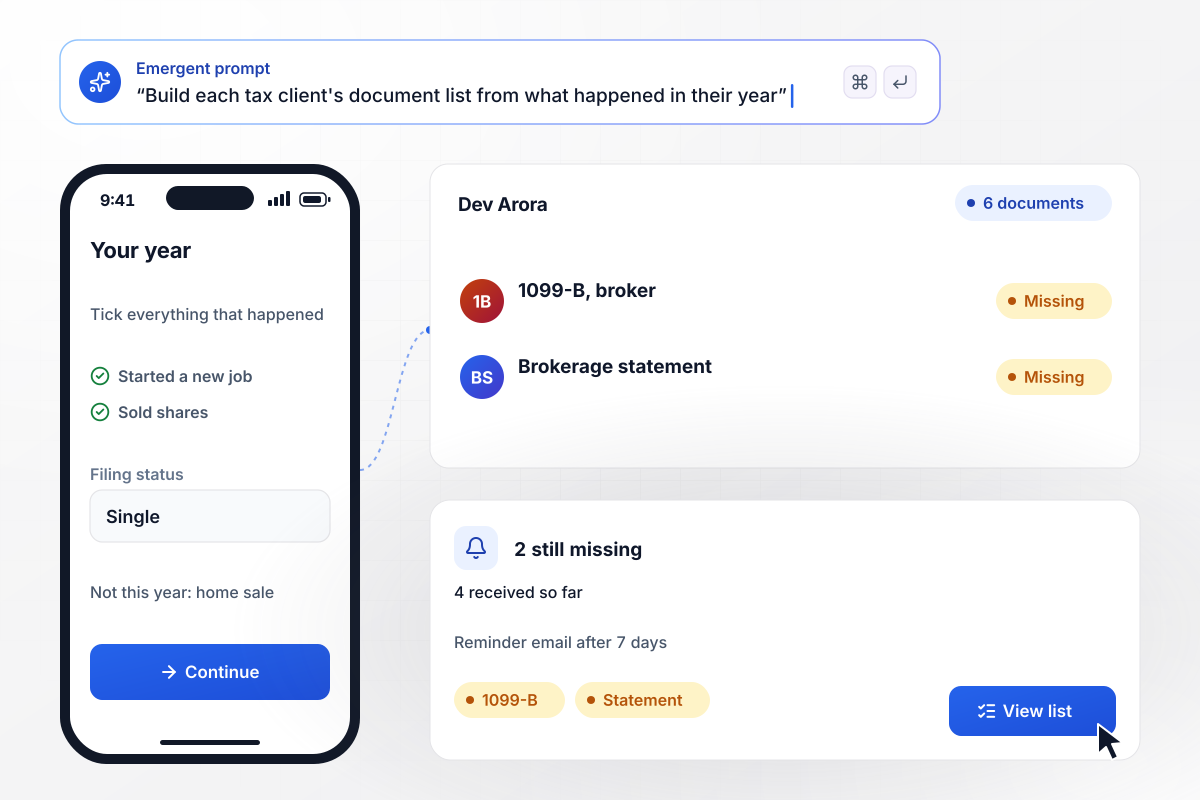
Each client's document list comes from their own year
The intake asks individual clients about their year, not about tax forms. Dev Arora ticks a new job and shares sold. The form builds his list of six documents, a 1099-B for the shares among them. Four have arrived. If two are still missing after seven days, he gets a reminder email.
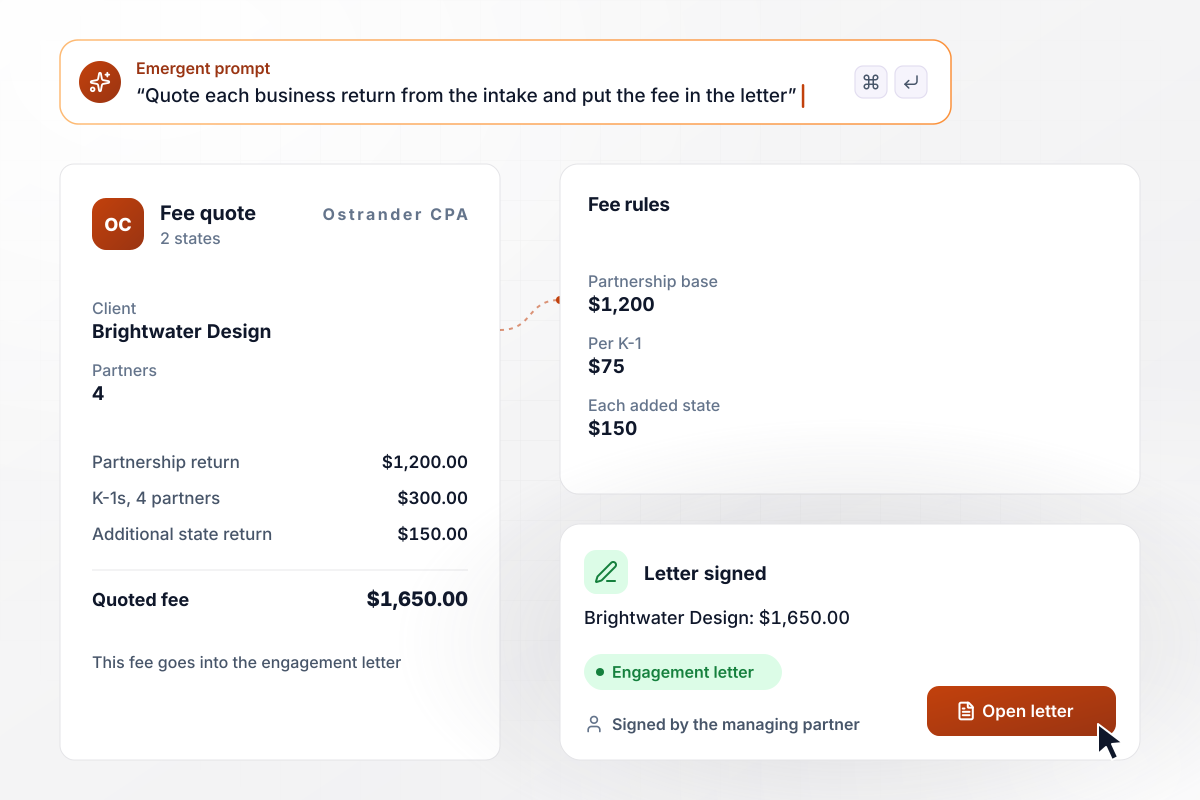
The fee is on the engagement letter before work starts
Ostrander CPA prices business returns from the intake. A partnership return starts at $1,200. Each partner's K-1 adds $75, and each added state return adds $150. Brightwater Design has four partners and files in two states, for a quote of $1,650. The managing partner signs the engagement letter with that fee in it.
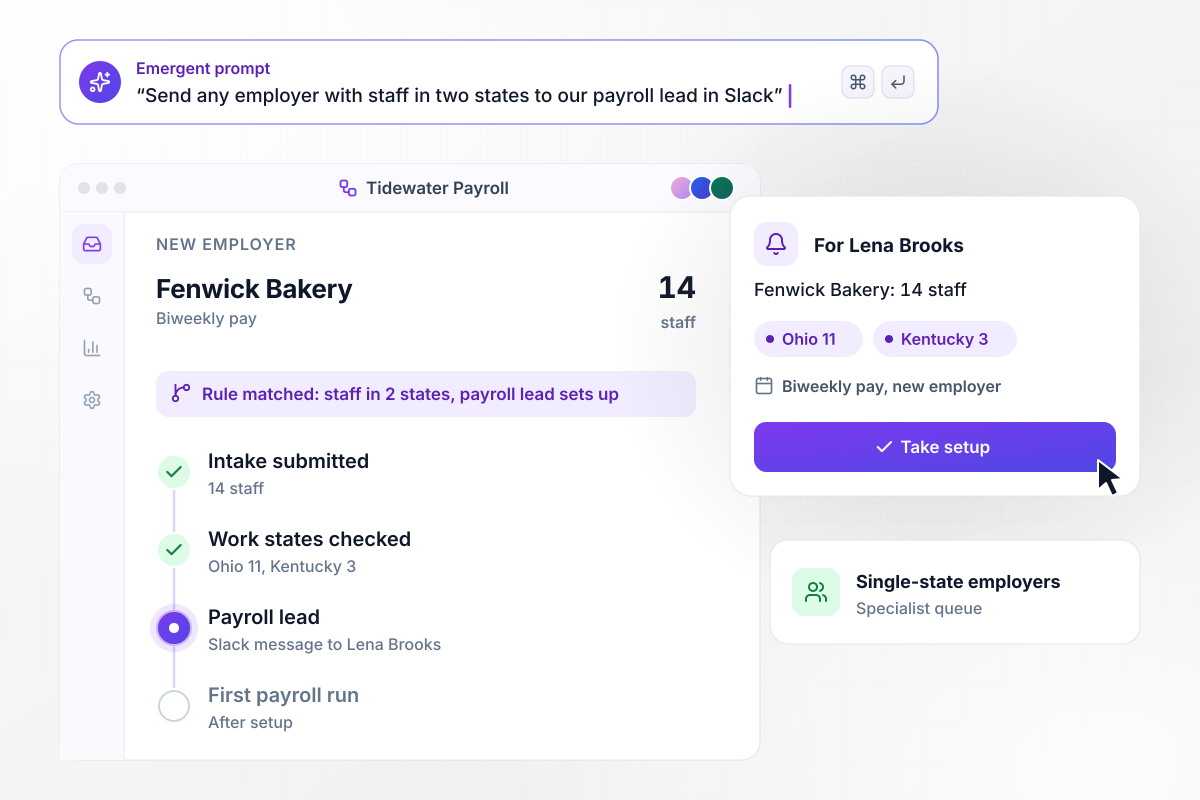
When staff work in two states, the payroll lead steps in
Tidewater Payroll's intake asks a new employer for its pay schedule and the state each employee works in. Fenwick Bakery reports 14 staff: 11 in Ohio and three in Kentucky. A second work state sends the setup to Lena Brooks, the payroll lead, as a Slack message. Single-state employers join the specialist queue.






How to Build an Accounting Intake Form
These seven steps turn your service list and fee sheet into an accounting client intake form that quotes each new client.
Write down each service a new client can buy, such as monthly bookkeeping or a personal return. Beside each, note the base fee and what raises it. Partnerships cost more per partner, and books that are months behind need catch-up work priced on its own.
Open every intake with the client's legal name and contact details. A business also gives its EIN, the federal tax ID the IRS assigns. After that comes one section per service, shown only to clients who chose that service.
For every answer, name the document it calls for. Shares sold means a 1099-B from the broker. A stake in a partnership means a Schedule K-1 from it. Clients then upload against a list built from their own answers.
Write each price as a rule the form can apply: a base amount, plus what each K-1 or added state costs. Decide which quotes a partner reviews first, and set a fallback for any work your rules do not cover.
Paste your services and fee rules into one plain-English prompt. Emergent builds the form with its pricing logic, plus the client database behind it. When a fee changes in January, prompt the new amount and the live form updates.
Place your engagement letter after the final question with the quote filled in, and add a signature field below it. The letter should spell out the scope of services and the fee. Have your counsel review the wording once.
Fill the form as a single filer, then as a partnership in two states. Check that each sees only its own sections and that every quote matches your fee sheet. Send the live link the day a client agrees to work with you.
Why Use Emergent for Accounting Intake?
A PDF lists questions and waits in an inbox. Emergent builds the form that asks them and prices the work as the answers arrive.

|
Jotform | Google Forms | Typeform | |
|---|---|---|---|---|
| How you build | Describe it in plain English | Templates, editor, AI generator | Editor, with Gemini drafting on some Workspace plans | Templates, editor, AI assist |
| Where responses live | A database table you own, plus any integration | Jotform account | Google Sheets | Typeform account |
| Response limits | No response caps | Monthly submission caps by plan; the form stops at the cap | No limit | Monthly response caps by plan; the form closes at the cap |
| Code ownership | Full code export to GitHub on paid plans | None | None | None |



Pick the Pricing Plan That Works for You
Choose the plan that fits your building ambitions. From weekend projects to enterprise applications, we've got you covered.




Find the right form
for whatever you're collecting

Frequently Asked Questions
Your Questions, Answered
Don't change this element unless you know what you are doing
More things you can build
with Emergent









on Emergent today


