

Build an Audition Form for Every Role You Cast
Build an audition form that books each performer into an open slot and saves their headshot and conflicts to your database.
Build an audition form for a community theater's spring musical that books each actor a 5-minute slot.
Trusted by Builders Worldwide
Active Builders Worldwide
Apps Successfully Created
Countries Globally Reached



What the Panel Gets From the Form
Emergent builds an audition form around the roles and rehearsal dates you list, and every sign-up lands as a row the panel can score.
Questions that change with the role
An actor who picks Ensemble skips the sides. A singer who picks a lead is asked for vocal range and the title of a 32-bar song cut. Each person answers only what the role needs.
Headshots and resumes on every record
Each performer uploads a headshot and a resume with the form. The panel opens both files from each sign-up, and they stay on that person's row in a database you own.
Rehearsal dates as checkboxes
List the actual rehearsal and performance dates, and performers tick the ones they cannot make. Conflicts come in as dates the app counts per person, not a paragraph of notes.
An email after sign-up and after casting
The app emails each performer a confirmation with their audition time once they submit. When casting is done, it emails each callback or decision to one person by name.
One scoring sheet for the whole panel
Judges score each audition on their own screens against the criteria you set, such as pitch and stage presence. The app averages the panel's scores and ranks every performer.
The code goes with the production
Export the full code of the audition form and its database to your GitHub repository on paid plans. A developer can then reuse it for next season's auditions or a second venue.
Audition Forms for Four Kinds of Production
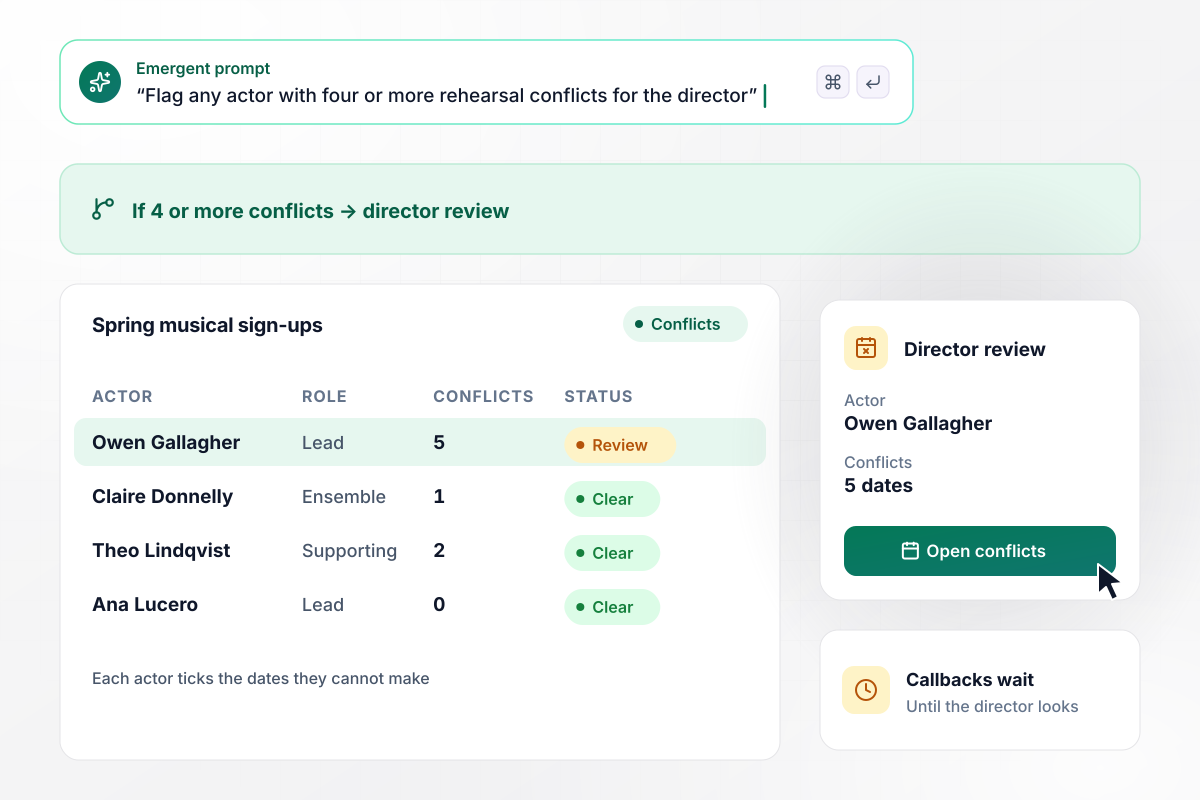
Four conflicts or more and the director sees it
Ostrowe Street Players is casting its spring musical. Every actor ticks the rehearsal dates they cannot make, and the form counts them. Owen Gallagher, reading for a lead, marks five. Anyone with four conflicts or more goes on the director's review list before callbacks are sent.
window.awbMockup = { communityTheater: "I run a community theater and need an audition form for our spring musical. Each actor picks the roles they want and ticks every rehearsal date they cannot make from our calendar. Count the conflicts per actor, and put anyone with four or more on a review list for the director before we send callbacks.", schoolDramaClub: "My high school drama club needs an audition sign-up for the fall play. Students book one 5-minute slot on Tuesday after school from their phones, and a booked time disappears for everyone else. Ask for a parent email, and send the confirmation with the slot time to the student and the parent.", youthOrchestra: "Our youth orchestra takes recorded auditions. Give each player an audition number and hide names from the panel. Three judges score each recording from 1 to 10 on their own screens. Average the three scores, rank the players, and put everyone at 8 or higher on a callback list we can email.", filmCastingCall: "I'm casting a short film with two speaking roles. Build a casting call form where actors pick a role and paste a link to their self-tape. Show the tapes on a board grouped by role, and let me pick an actor and email them a callback with the date, time, and scene to prepare." };
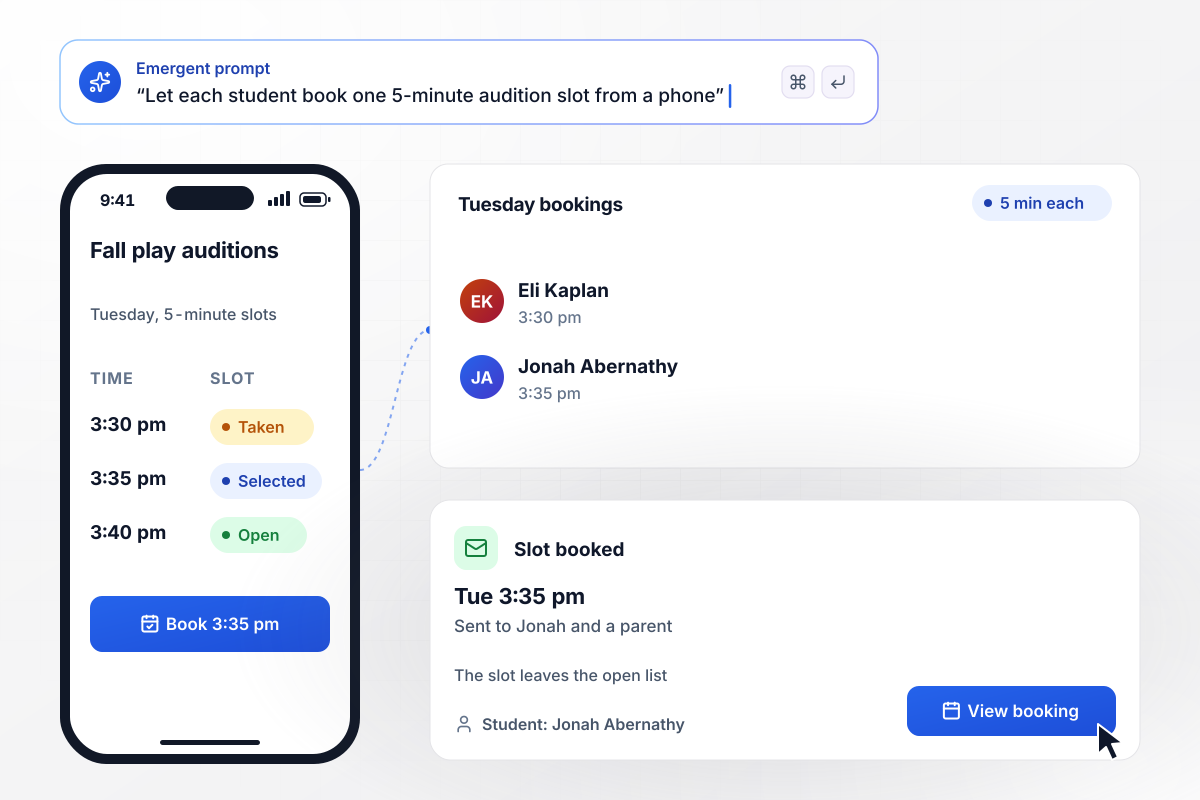
No slot gets booked twice in a 5-minute schedule
Linden Bluff High's drama club holds fall play auditions in 5-minute slots after school on Tuesday. Each student books one slot from a phone, and a taken time drops off the list for everyone else. Jonah Abernathy books 3:35 pm, and the confirmation goes to him and to the parent email on his form.
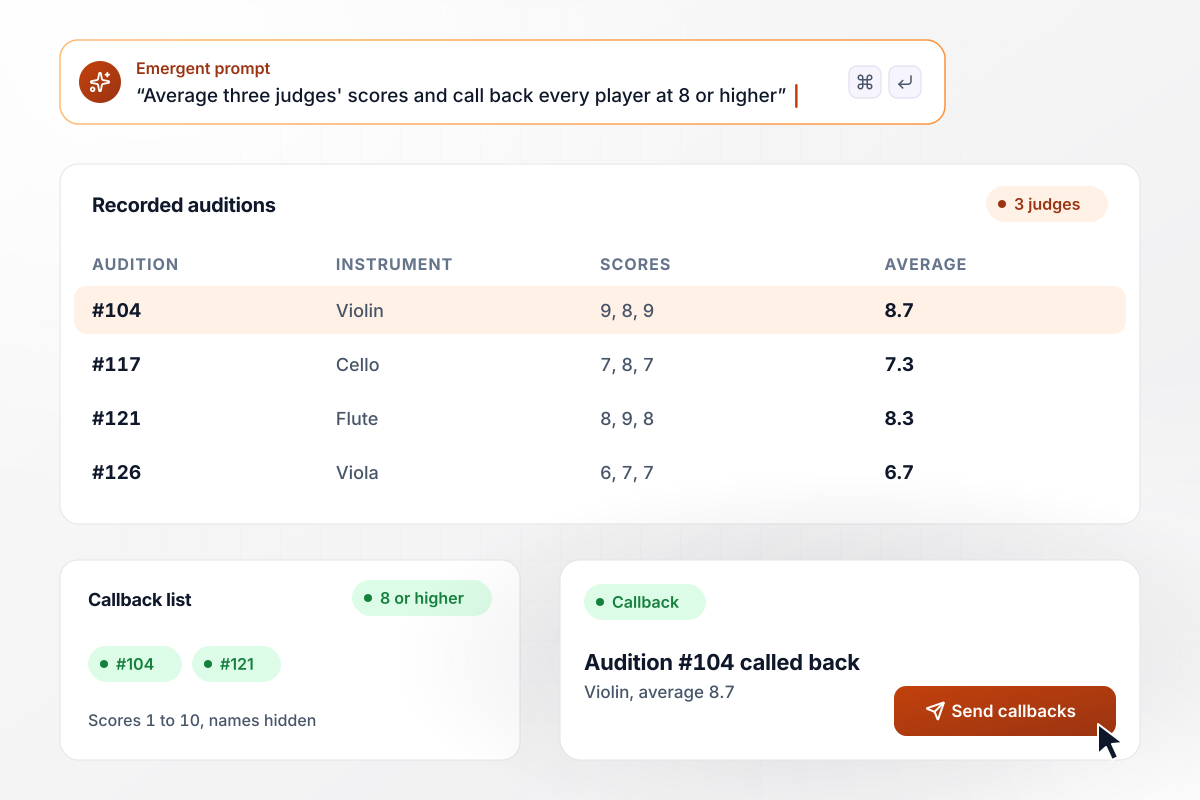
With three judges, the average decides the callback
Kestrel Valley Youth Orchestra takes recorded auditions, and the panel never sees a name. Three judges score each recording from 1 to 10 under an audition number. The app averages the scores, and any player at 8 or higher goes on the callback list. Audition #104, a violin player, averages 8.7.
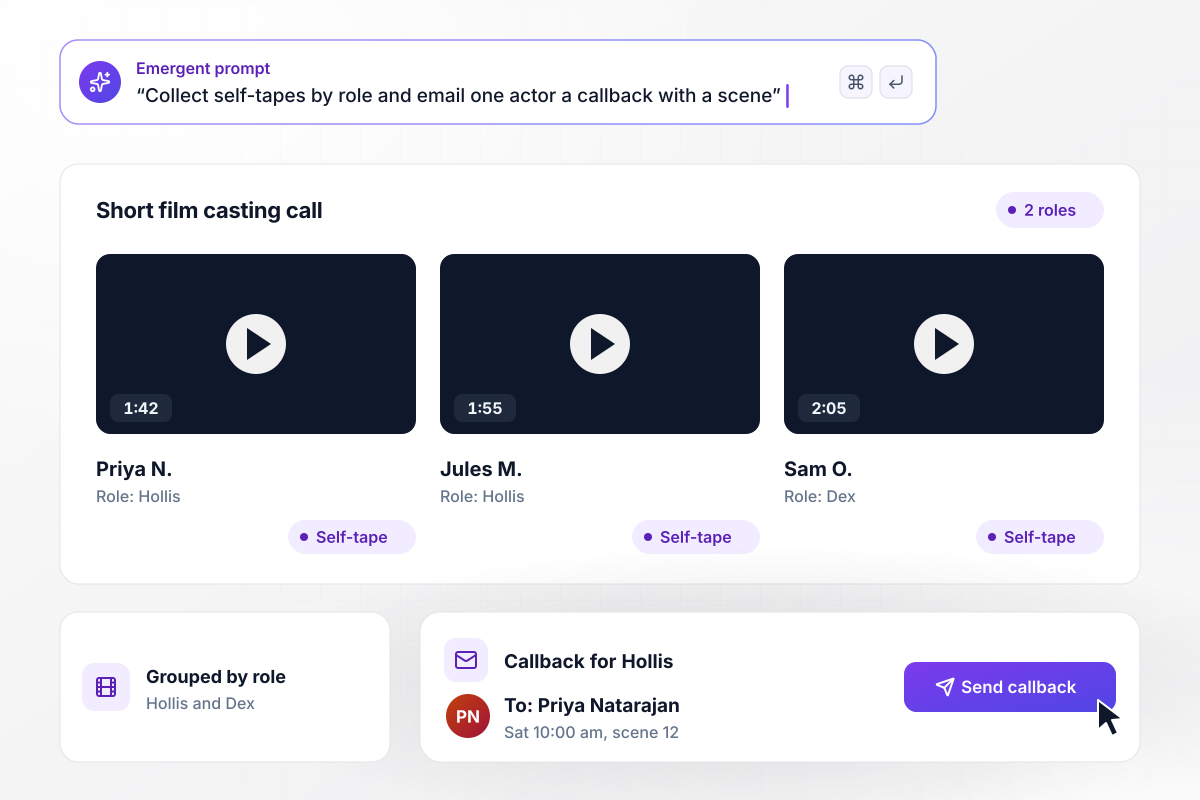
Self-tapes come in by role, and one becomes a callback
Paper Kite Films posted a casting call for a short film with two speaking roles. Each actor picks a role and pastes a link to a self-tape, and the board groups the tapes by role. The casting director picks Priya Natarajan to play Hollis, and the app emails Priya a callback for Saturday at 10:00 am with scene 12 to prepare.






How to Make an Audition Form
Seven steps to turn your roles and rehearsal calendar into an audition form that books slots and builds a callback list.
Write down every role you are casting and what each one asks of a performer: a song, a monologue, a dance combination, or a cold read. Note which roles share scenes, because those actors may need to read together at callbacks.
Collect every rehearsal and performance date before you build. Then decide how many missed dates you can work around for a lead and for the ensemble. That number becomes the flag the director sees on each sign-up.
Ask for a headshot and a resume for acting roles, and a link to a recording when people audition remotely. Leave out any file the panel will not open. Every extra upload is another step for someone filling in the form on a phone.
Choose the day and the slot length, such as 5 minutes per singer. Leave a 10-minute gap every hour for the panel to catch up. Decide now whether a performer may book more than one slot.
Write one prompt that holds the decisions from the first four steps. Emergent builds the form and its database, along with a scoring screen for the panel. Change anything later by prompting again, such as adding a vocal range question.
Send the link to two people from last season before it goes public. Ask one to book a slot from a phone and the other to upload a headshot and tick a few conflicts. Check that both entries land on the right record.
Publish the form and put its link in the audition notice. Close it at the deadline you announced. Judges then score each audition on the same records the sign-ups created, and callbacks go out from there.
Why Build Your Audition Form With Emergent?
A printed audition form sits on a clipboard until someone types it up. Emergent builds one that books slots and ranks every performer.

|
Typeform | Jotform | Google Forms | |
|---|---|---|---|---|
| How you build | Describe it in plain English | Templates, editor, AI assist | Templates, editor, AI generator | Editor, with Gemini drafting on some Workspace plans |
| Where responses live | A database table you own, plus any integration | Typeform account | Jotform account | Google Sheets |
| Response limits | No response caps | Monthly response caps by plan; the form closes at the cap | Monthly submission caps by plan; the form stops at the cap | No limit |
| Code ownership | Full code export to GitHub on paid plans | None | None | None |

Pick the Pricing Plan That Works for You
Choose the plan that fits your building ambitions. From weekend projects to enterprise applications, we've got you covered.




Find the right form
for whatever you're collecting
Frequently Asked Questions
Your Questions, Answered
Don't change this element unless you know what you are doing
More things you can build
with Emergent









on Emergent today


