

Build a Financial Planning Intake Form for the Discovery Meeting
Build a financial planning intake form that collects goals, income, and account statements before the first client meeting.
Build a financial planning intake form my new clients fill in before their discovery meeting, covering household, income, accounts, and debts.
Trusted by Builders Worldwide
Active Builders Worldwide
Apps Successfully Created
Countries Globally Reached



What the Planner Knows Before the First Meeting
A financial planning intake form that asks for goals, accounts, and statements in the order the first meeting uses them.
Goals with a target year and an amount
Clients enter each goal with the year they want it and what it costs, such as college in 2034. The planner opens the first meeting to dated goals, not a line that says retire early.
Statements read into account balances
Clients upload a 401(k), IRA, or brokerage statement, and the app reads the balance and its date into fields. A value it reads with low confidence goes to a person to confirm.
Questions that follow the household
Answer yes to children and the form asks each child's birth year. Answer yes to a business and it asks for the entity type and revenue. A single renter sees neither section.
Each household reaches the right planner
Set an asset threshold, and households above it go to a senior planner by email while the rest go to an associate. Either planner can also get a Slack alert when an intake arrives.
Every intake kept in a database you own
Each intake is saved as a row in a database the practice owns, with no cap on responses. Last year's answers stay next to this year's, ready to compare at the annual review.
The intake's code, in your own repository
On paid plans, export the full codebase to your GitHub repository and run the intake next to the practice's own website. A developer can keep extending it from that repo.
Where the Intake Fits in a Planning Practice
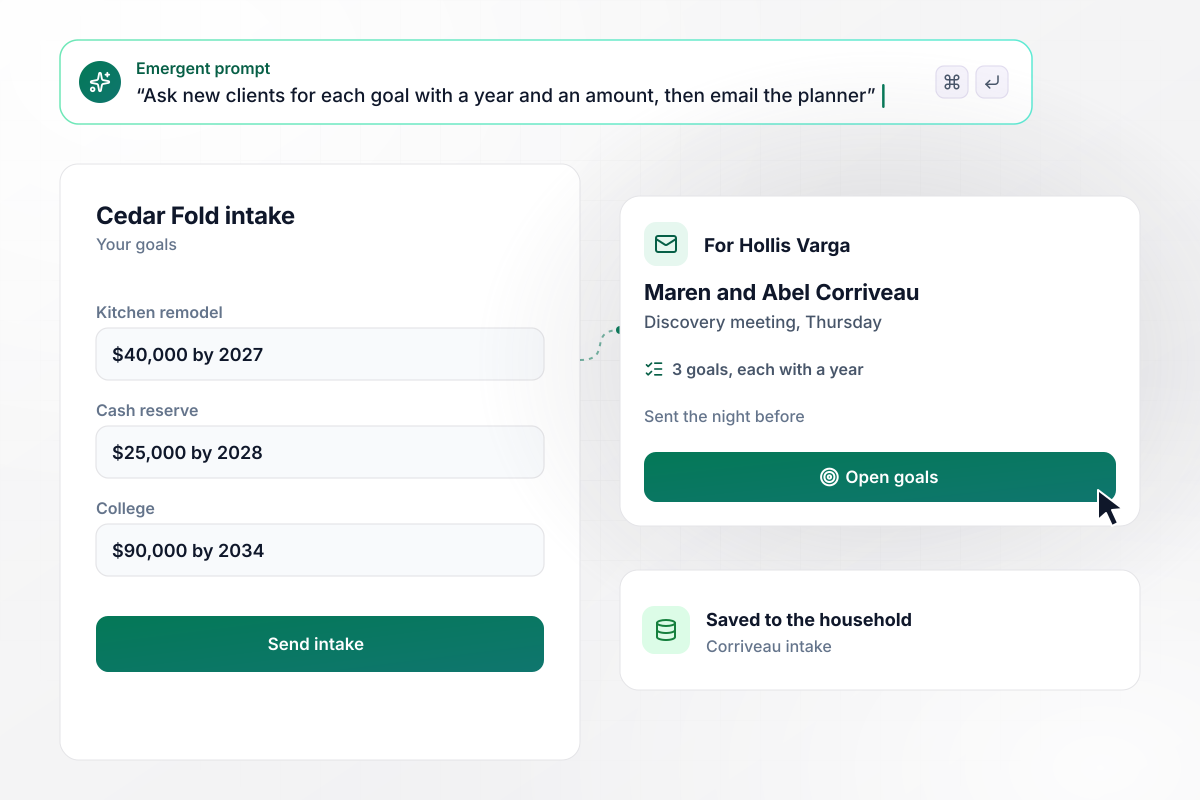
By Thursday, three goals with a year and a price
Cedar Fold Planning sends its intake with each discovery booking. Maren and Abel Corriveau list three goals, each with a year and a price: a $40,000 kitchen in 2027, a $25,000 cash reserve by 2028, and $90,000 for college by 2034. Hollis Varga, their planner, gets the list by email the night before Thursday's meeting.
window.awbMockup = { discoveryMeetings: "I run Cedar Fold Planning. Build a financial planning intake form that goes out when a client books a discovery meeting. Ask for household members, income, accounts, and debts, then ask for each goal with a target year and an amount. Email the planner the goals list the night before the meeting.", statementUploads: "Build an intake for Pell Harbor Advisory where clients upload their account statements from a phone. Read the balance from each 401(k), IRA, and brokerage statement into fields and add them up. If a statement reads with low confidence, send it back to the client to confirm before the planner sees it.", plannerRouting: "My firm is Marlow Crest Financial. Ask each household on the intake for its investable assets, the total of the savings and investment accounts it lists. Email any household over $500,000 to Odette Lindqvist, my senior planner, and send the rest to Jasper Oduya.", annualReviews: "Build a yearly update for Osterly Planning Group. Three weeks before each annual review, send clients last year's intake answers to update. Show the planner a table of last year's and this year's answers, with every changed answer marked, such as a new salary or a new dependent." };
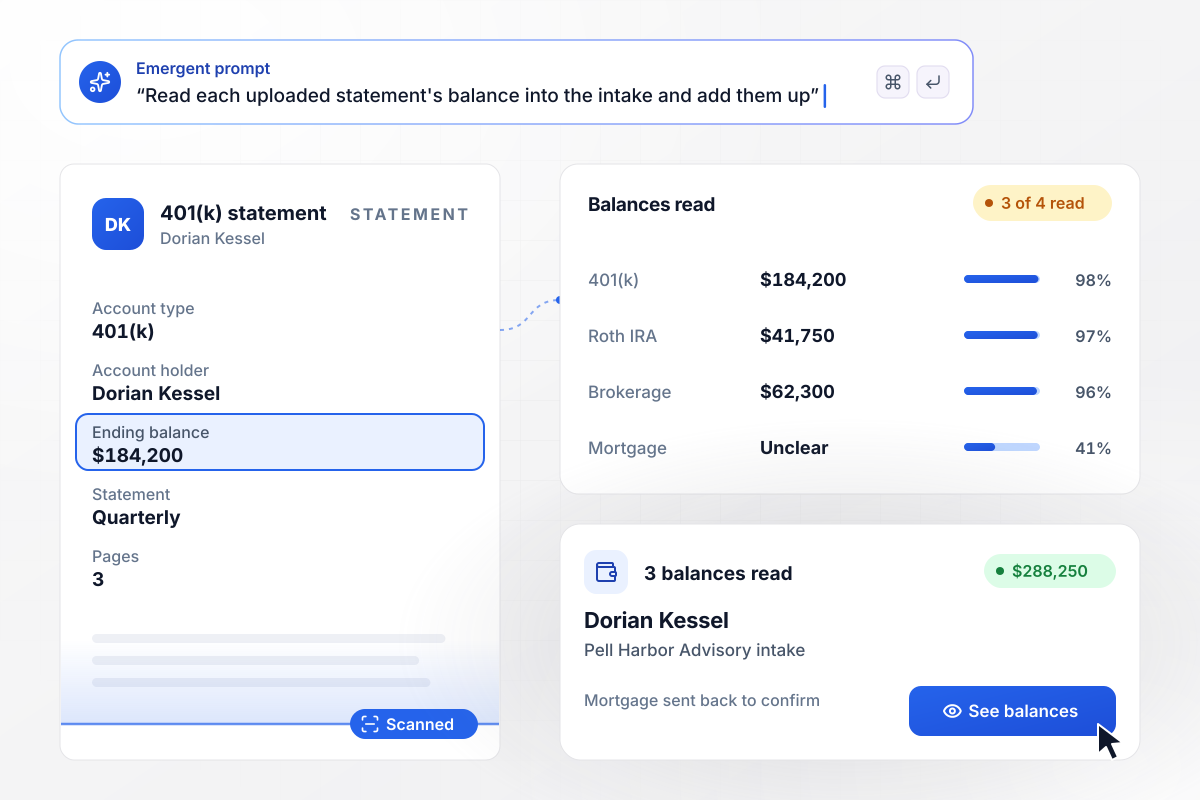
Statements in, balances out, one photo sent back
Dorian Kessel uploads four statements to the Pell Harbor Advisory intake. The app reads three balances: $184,200 in a 401(k), $41,750 in a Roth IRA, and $62,300 at a brokerage, $288,250 in all. The fourth is a mortgage statement shot at an angle. It reads with low confidence and goes back to Dorian to confirm.
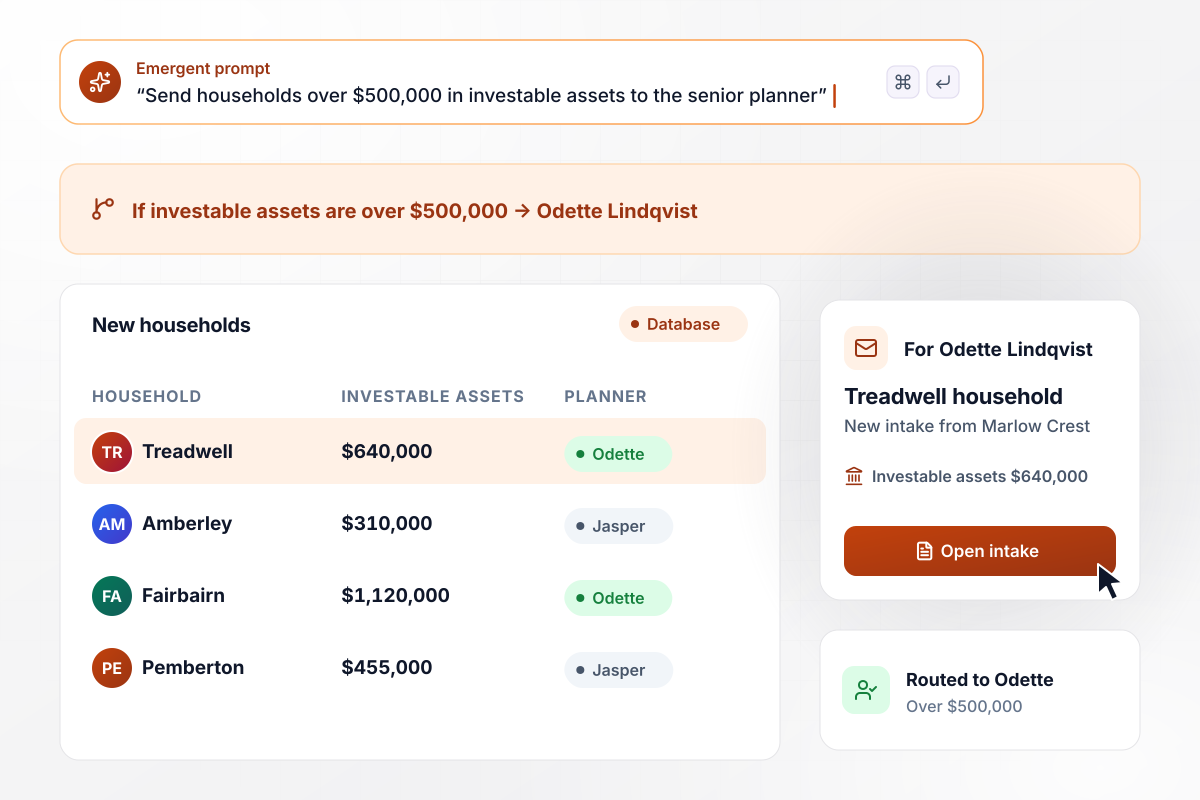
Households over $500,000 are Odette's from day one
Marlow Crest Financial asks each household for its investable assets: the total of the savings and investment accounts it lists. Any household over $500,000 goes to Odette Lindqvist, the senior planner, by email. The rest go to Jasper Oduya. The Treadwell household reports $640,000 and lands with Odette.
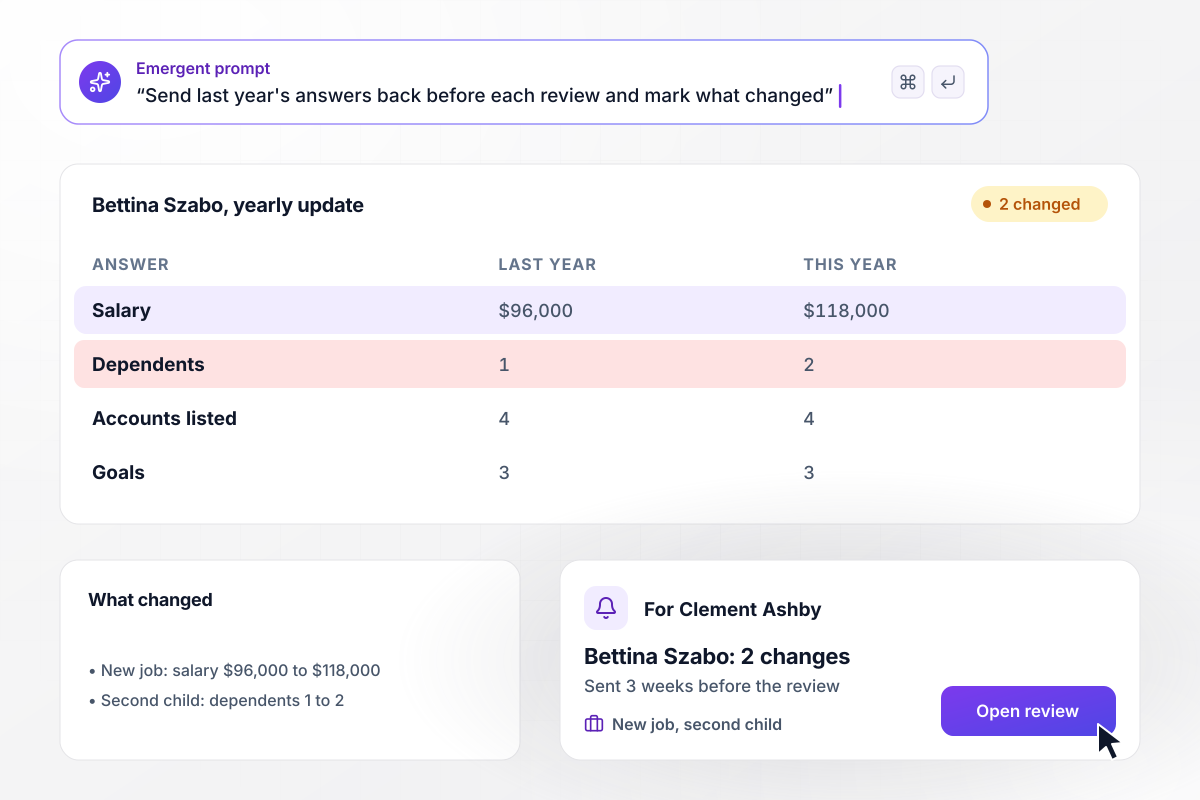
In a year, a new job and a second child
Three weeks before each annual review, Osterly Planning Group sends clients last year's answers to update. Bettina Szabo changes two. A new job took her salary from $96,000 to $118,000, and a second child took her dependents from 1 to 2. Clement Ashby, her planner, sees both marked beside last year's answers.






How to Build a Financial Planning Intake Form
Seven steps to design a financial planning intake form that has the first meeting ready, then build and test it with Emergent.
List the questions you ask in a discovery meeting today and the numbers you look up before it. Each question on the intake should answer one of them. Anything you would not read before the meeting comes off the form.
Replace an open goals box with rows the client fills in: what the goal is, the year it happens, and roughly what it costs. Let them add as many rows as they need, then rank the rows so the first meeting starts at the top.
Ask for each account's type, institution, and last four digits, plus the balance if the client knows it. Keep full account numbers, passwords, and logins off the intake. Statements carry the detail the planner needs for the first meeting.
Put an upload under each account so the client can photograph a recent statement instead of copying figures. Ask for the most recent statement, not a full year. Have the app read the balance and send anything unclear back to the client.
Choose the answer that sets the planner, such as investable assets or the service the client picked. Write the threshold down as a number. Then name who gets the intake by email above it, who gets it below, and who covers when either is out.
Write one paragraph that covers the sections, the goal rows and uploads, and the routing rule from step 5. Emergent builds the form and its database from it, along with the planner emails. Change a question later by describing the change in plain English.
Fill in the intake as a fictional couple with two children, three goals, and a blurry statement. Check that the right planner gets the email, the balances add up, and the blurry statement goes back. Fix what breaks before a real client sees it.
Why Build a Planning Intake With Emergent?
Describe the intake in a sentence. Emergent builds the questions and the routing to each planner as one app.

|
Jotform | Google Forms | Typeform | |
|---|---|---|---|---|
| How you build | Describe it in plain English | Templates, editor, AI generator | Editor, with Gemini drafting on some Workspace plans | Templates, editor, AI assist |
| Where responses live | A database table you own, plus any integration | Jotform account | Google Sheets | Typeform account |
| Response limits | No response caps | Monthly submission caps by plan; the form stops at the cap | No limit | Monthly response caps by plan; the form closes at the cap |
| Code ownership | Full code export to GitHub on paid plans | None | None | None |



Pick the Pricing Plan That Works for You
Choose the plan that fits your building ambitions. From weekend projects to enterprise applications, we've got you covered.




Find the right form
for whatever you're collecting

Frequently Asked Questions
Your Questions, Answered
Don't change this element unless you know what you are doing
More things you can build
with Emergent








on Emergent today


