

Build a Service Request Form With Routing and Tracking
Build a service request form that sends each request to the team that does the work and gives the requester a number to track.
Build a service request form that saves every response to a database I own.
Trusted by Builders Worldwide
Active Builders Worldwide
Apps Successfully Created
Countries Globally Reached



What Happens After Someone Hits Submit
Requesters only see the questions and the confirmation email. Everything else is what happens behind the form once a request lands.
Questions that change by request type
A heating request asks how old the furnace is; a streetlight report asks for the cross street. Each request type shows only its own questions, and each answer is its own field.
Routing to the queue that owns the request
The request type or the address a requester gives decides which queue gets the request. Each team then sees only its own requests, with the details and photos already attached.
An alert to one person for urgent answers
You name the answers that make a request urgent, such as no heat or water on the floor. Those requests skip the queue and go to the person on call as an email or Slack alert.
A request number the requester can quote
Every submission gets its own number, emailed to the requester with a copy of the answers. When the status changes, the requester gets another email that carries the same number.
A dashboard of open requests by age
The dashboard lists every open request with its owner and the number of days it has waited. Filter it by team or by location to see which queue is falling behind this week.
Code export to your own GitHub
On paid plans, Emergent exports the full code of the form and its dashboard to your own GitHub repository. Every part of the app can then be read and changed outside Emergent.
Where Service Requests Come In
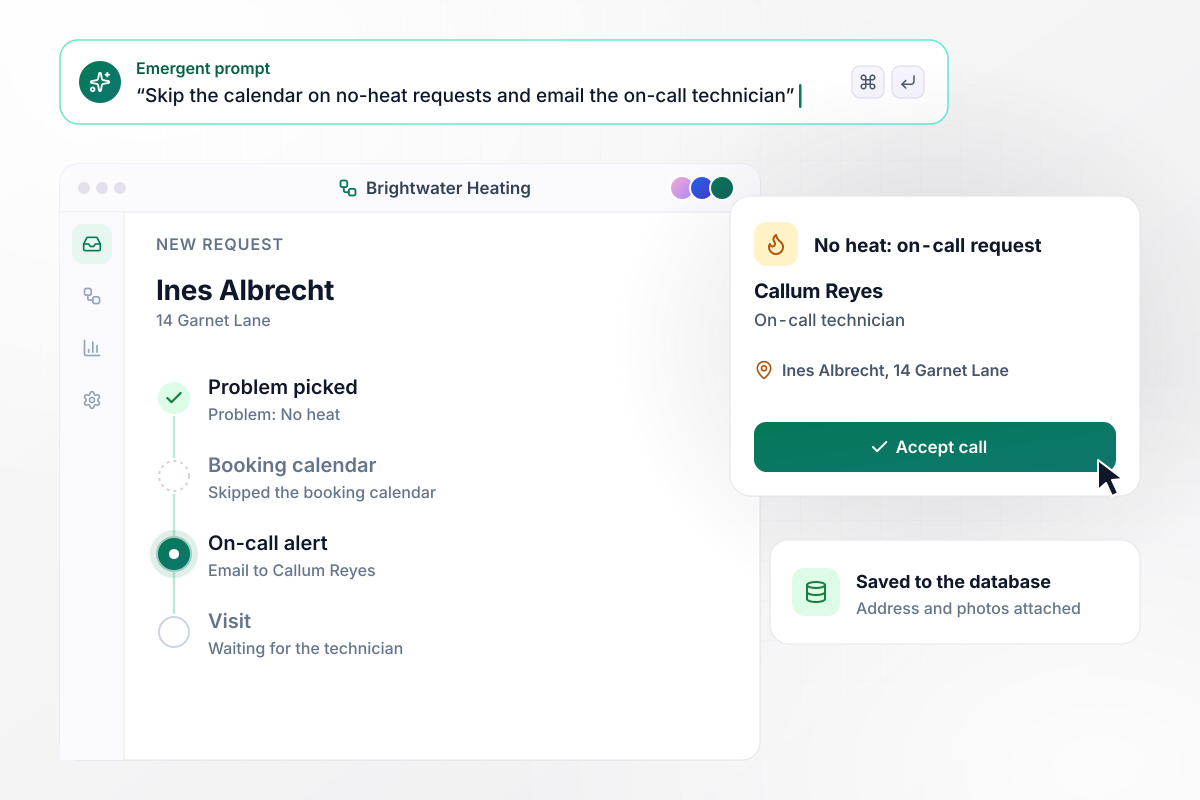
No heat means the on-call tech hears first
Brightwater Heating's form asks what is wrong first. Ines Albrecht picks No heat, and her request skips the booking calendar and alerts on-call technician Callum Reyes by email. Any other problem opens the calendar to book a visit. Each request saves as a row in Brightwater's database with its address and photos.
window.awbMockup = { heatingRepairs: "Build a service request form for my heating company. Customers pick the problem first, then give their address and add photos. If they pick No heat, skip the booking calendar and email the on-call technician right away. For every other problem, show a calendar so they can book a visit window. Save each request with the address and photos.", publicWorks: "My county public works department needs a form for residents to report problems. They pick a request type, such as Streetlight out, enter the location, and attach a photo. Give each report a request number, email it to the resident, and put the report in the queue for the crew that handles that type. Email the resident again when the crew closes it.", warrantyRepairs: "Build a warranty repair request form for my kitchen appliance company. Customers enter the serial number and purchase date for their mixer. If the mixer is under 24 months old, send the request to the free repair queue. If it is older, send the customer a repair quote by email before any work starts.", serviceDesk: "My company needs one internal service request form for all staff. Each person picks a category: IT, facilities, or HR. Send each request to that team's queue and post facilities requests to our facilities Slack channel with the floor and desk number. Show me how many requests each team got today." };
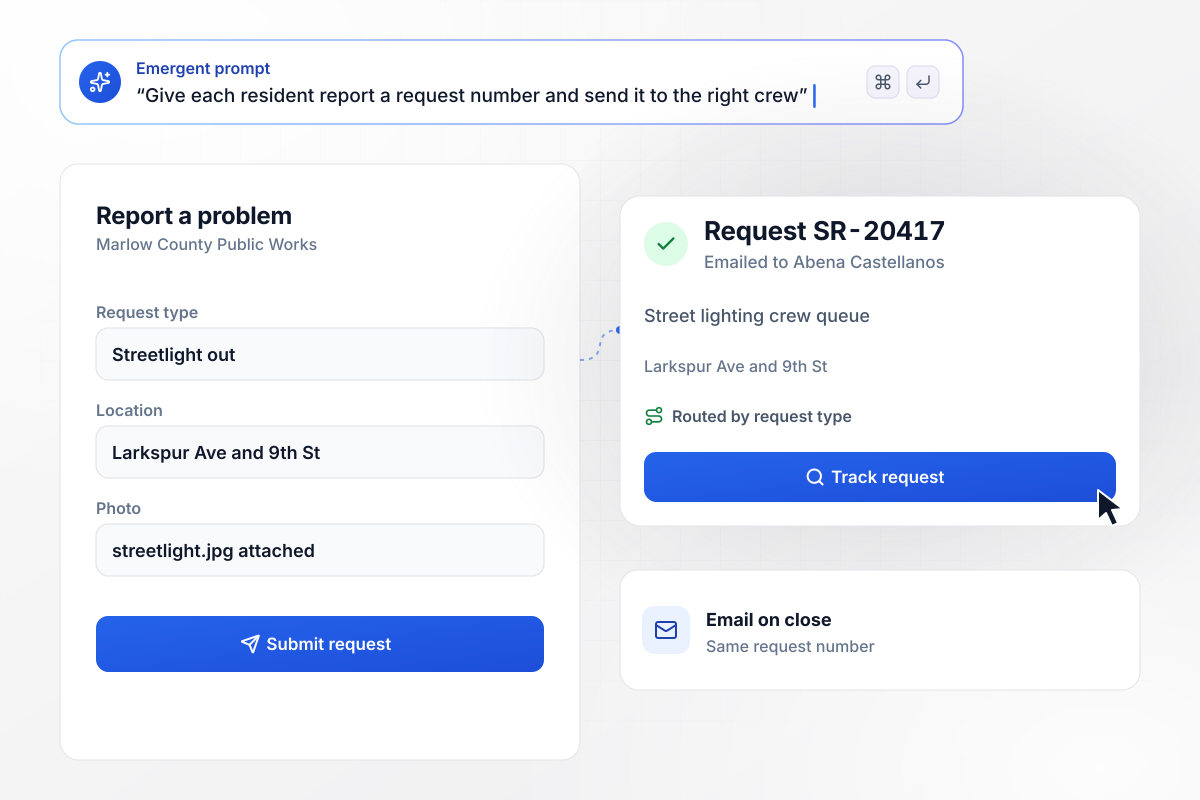
Streetlight reports come back with a number
Marlow County residents use one form to reach Public Works. Abena Castellanos picks Streetlight out, enters Larkspur Ave and 9th St, and adds a photo. The app emails her request number SR-20417 and queues the report for the street lighting crew. When the crew closes it, another email follows with the same number.
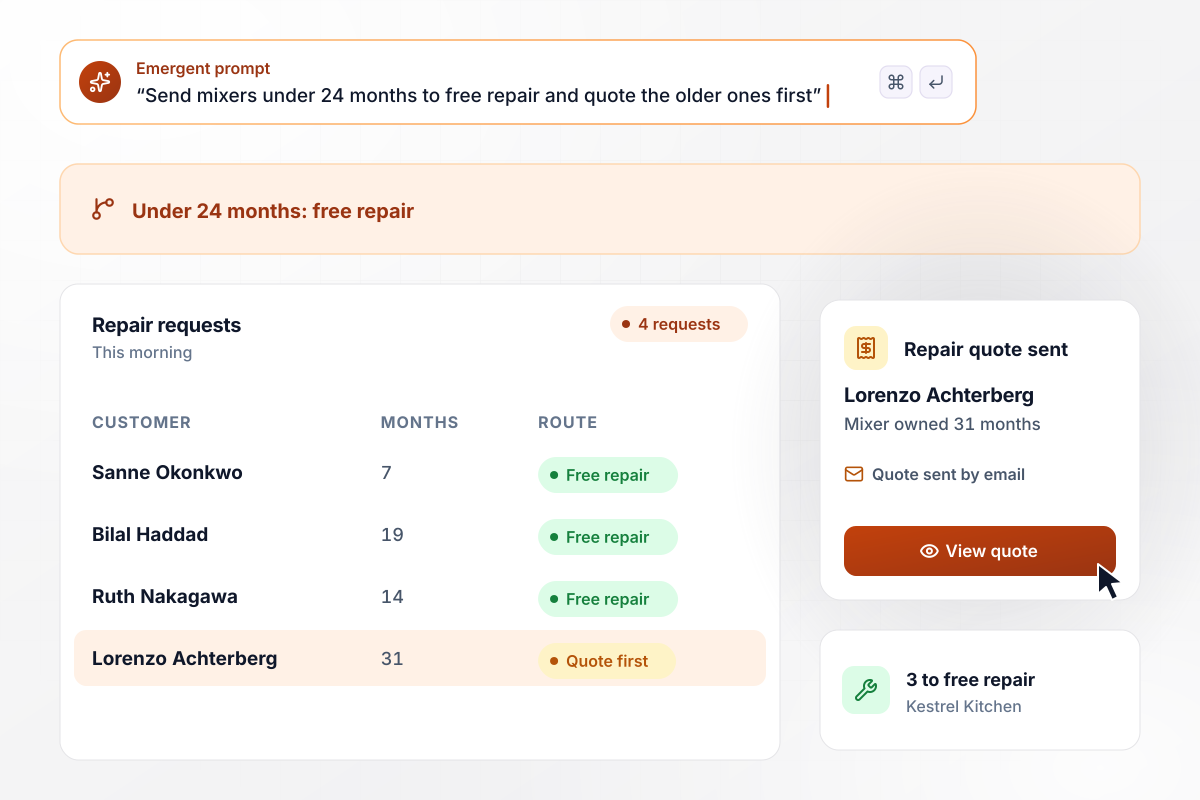
Every mixer under 24 months gets a free repair
Kestrel Kitchen's warranty desk asks for the serial number and purchase date first. A mixer under 24 months old goes to the free repair queue, and anything older gets a repair quote first. Of this morning's 4 requests, 3 went to free repair. Lorenzo Achterberg's mixer is 31 months old, and he gets the quote by email.
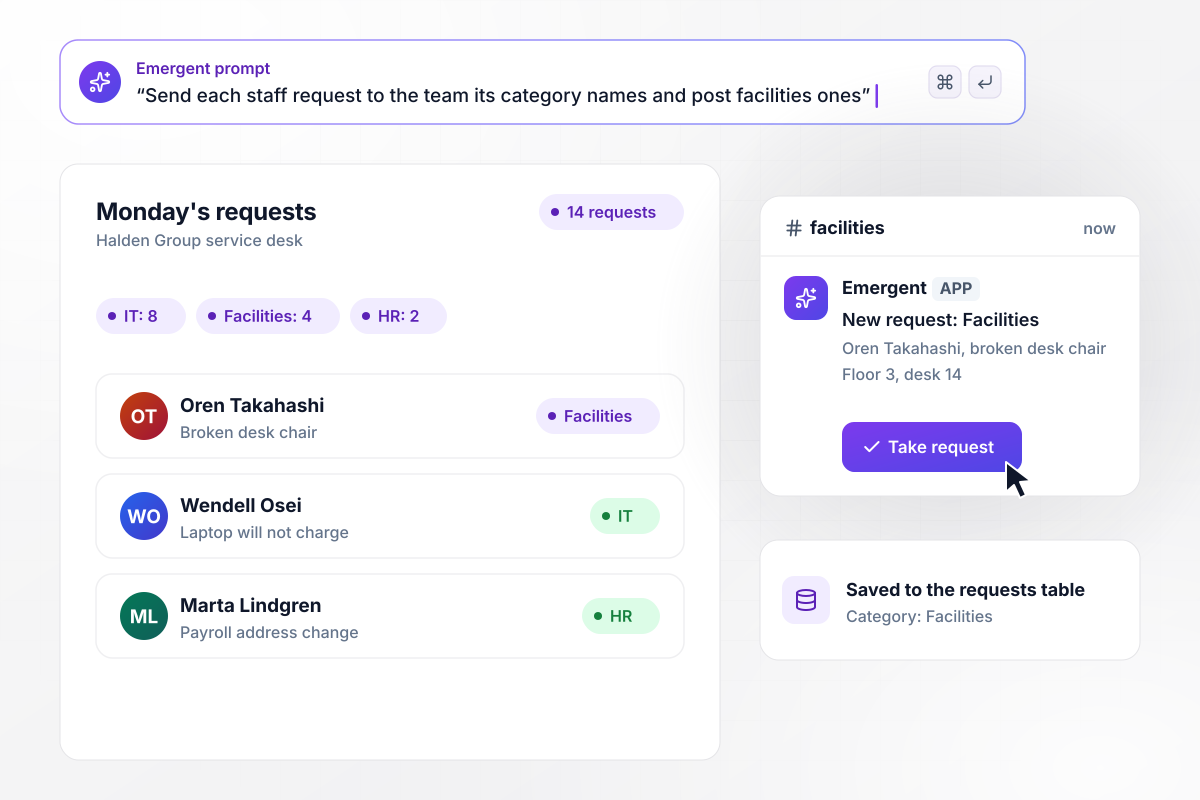
Category decides which team gets each request
Halden Group runs one service request form for its staff, and the category each person picks decides the queue. Oren Takahashi files a broken desk chair under Facilities, and the facilities channel in Slack gets his request with his floor and desk number. Monday's 14 requests split 8 to IT, 4 to facilities, and 2 to HR.






How to Create a Service Request Form
Seven steps to a service request form that gives every request an owner, flags urgent ones, and emails requesters a number to track.
Write down every kind of request people send you and who handles each one. Under each type, note what the person doing the work needs before the first call: the address, the model, a photo. That list becomes your prompt in the next step.
Type a plain-English description of the form: the request types, the questions each one asks, and where each request should go. Emergent builds the form and its database from that prompt. Change anything later with another prompt.
Name a person or a queue for each request type, and add a second rule where location matters, such as one crew per district. A request that matches no rule should land with one named person, never in a shared inbox that nobody watches.
Pick the answers that cannot wait, such as a gas smell or a flooded basement, and choose who gets the alert. Keep that list short: when half of all requests are urgent, the alert stops meaning anything to the person on call.
Decide what the requester receives after submitting: a request number, a copy of the answers, and an email whenever the status changes. A number they can quote on the phone saves a search through the inbox when they call back.
Enter five requests from last month, including one urgent case and one that fits no type. Check that each one lands with its owner, that the alert reaches the person on call, and that the requester email carries the request number.
Publish the form on the free tier, or on a custom domain, which uses credits. Put the link on the website, in email signatures, and on every invoice, where customers will look for it the next time something breaks.
Why Run Service Requests on Emergent?
Requests land in a database you own, and there is no response cap: a storm week that triples the call volume still records every request.

|
Jotform | Adobe Acrobat | Google Forms | |
|---|---|---|---|---|
| How you build | Describe it in plain English | Templates, editor, AI generator | Upload a PDF and place fields, web forms on Pro | Editor, with Gemini drafting on some Workspace plans |
| Where responses live | A database table you own, plus any integration | Jotform account | Adobe cloud storage, downloadable as PDF | Google Sheets |
| Response limits | No response caps | Monthly submission caps by plan; the form stops at the cap | No yearly send cap, usage limits apply | No limit |
| Code ownership | Full code export to GitHub on paid plans | None | None | None |



Pick the Pricing Plan That Works for You
Choose the plan that fits your building ambitions. From weekend projects to enterprise applications, we've got you covered.




Find the right form
for whatever you're collecting

Frequently Asked Questions
Your Questions, Answered
Don't change this element unless you know what you are doing
More things you can build
with Emergent









on Emergent today


